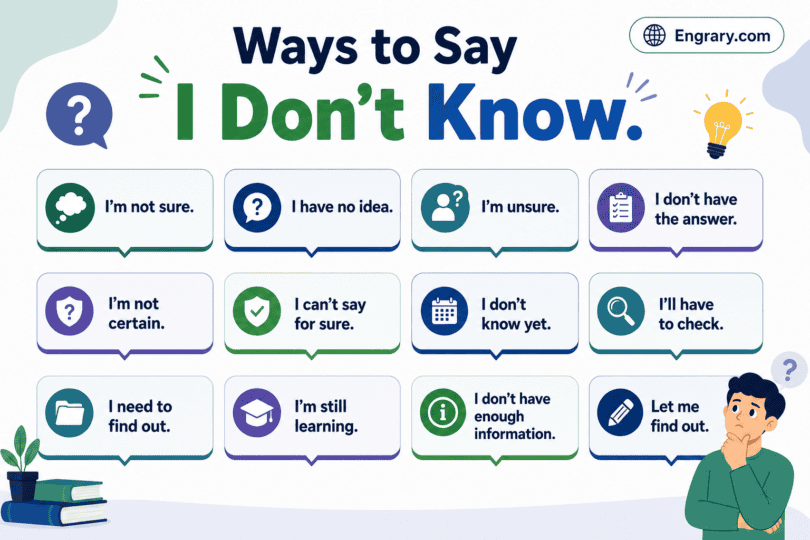
I don’t know is honest and correct, but it can sometimes sound blunt, uncertain, or unhelpful if used alone. In many situations, a softer or more helpful phrase works better because it shows that you are willing to check, learn, or follow up.
Below, you’ll find 100 natural alternatives to I don’t know for work emails, texts, daily conversations, customer service, interviews, school, casual chats, and careful answers. Each phrase includes a short meaning and a simple example.
Best I Don’t Know Phrase by Situation
| Situation | Better Phrase |
|---|---|
| Polite reply | I’m not sure. |
| Professional email | Let me verify that and get back to you. |
| Work meeting | I need to confirm the details first. |
| Customer service | I’ll look into that for you. |
| Interview | I’d need to research that further. |
| School | I’m still learning about that. |
| Casual chat | Not sure yet. |
| Text message | Let me check. |
| Outside expertise | I’m not the best person to answer that. |
| Careful answer | I don’t want to give you incorrect information. |
Is It Okay to Say “I Don’t Know”?
Yes, I don’t know is okay to say because it is honest. Nobody knows everything, and admitting uncertainty is better than giving a wrong answer.
However, in work, school, customer service, or serious conversations, it often sounds better to add a helpful next step. For example, I don’t know, but I’ll find out sounds more useful than only saying I don’t know.
I Don’t Know vs I’m Not Sure
| Phrase | Tone | Best Use |
|---|---|---|
| I don’t know | Direct and honest, but sometimes blunt. | Casual speech or clear honesty. |
| I’m not sure | Softer and less blunt. | Polite conversations, work, and everyday replies. |
| I can’t say for sure | Careful and balanced. | When you are uncertain but want to sound thoughtful. |
| Let me check | Helpful and action-based. | When you can verify the answer. |
What Kind of “I Don’t Know” Do You Mean?
| Meaning | Better Phrase |
|---|---|
| You are unsure | I’m not sure. |
| You need to check | Let me double-check. |
| You lack information | I don’t have that information right now. |
| You need an expert | I’m not the best person to answer that. |
| You will follow up | I’ll find out and let you know. |
| You are still learning | I’m still learning about that. |
Polite Ways to Say I Don’t Know
Use these phrases when you want to sound respectful, honest, and careful.
I’m not sure
A softer and more polite way to say I don’t know.
Example: I’m not sure, but I can check.
I’m not certain
A careful phrase for uncertainty.
Example: I’m not certain about the exact date.
I can’t say for sure
A balanced phrase when you do not want to guess.
Example: I can’t say for sure without checking.
I don’t have the answer right now
A clear phrase for temporary uncertainty.
Example: I don’t have the answer right now.
I’d need to check first
A polite phrase when you need to confirm.
Example: I’d need to check first before giving an answer.
I’m unsure at the moment
A polite and simple phrase.
Example: I’m unsure at the moment.
I don’t know enough to answer that yet
A careful phrase when you need more context.
Example: I don’t know enough to answer that yet.
I wish I had the answer
A kind phrase that shows you want to help.
Example: I wish I had the answer, but I’m not sure.
I need a little more information
A polite phrase when the question needs more detail.
Example: I need a little more information before I can answer.
I’m afraid I don’t know
A polite phrase that sounds gentle and honest.
Example: I’m afraid I don’t know the answer to that.
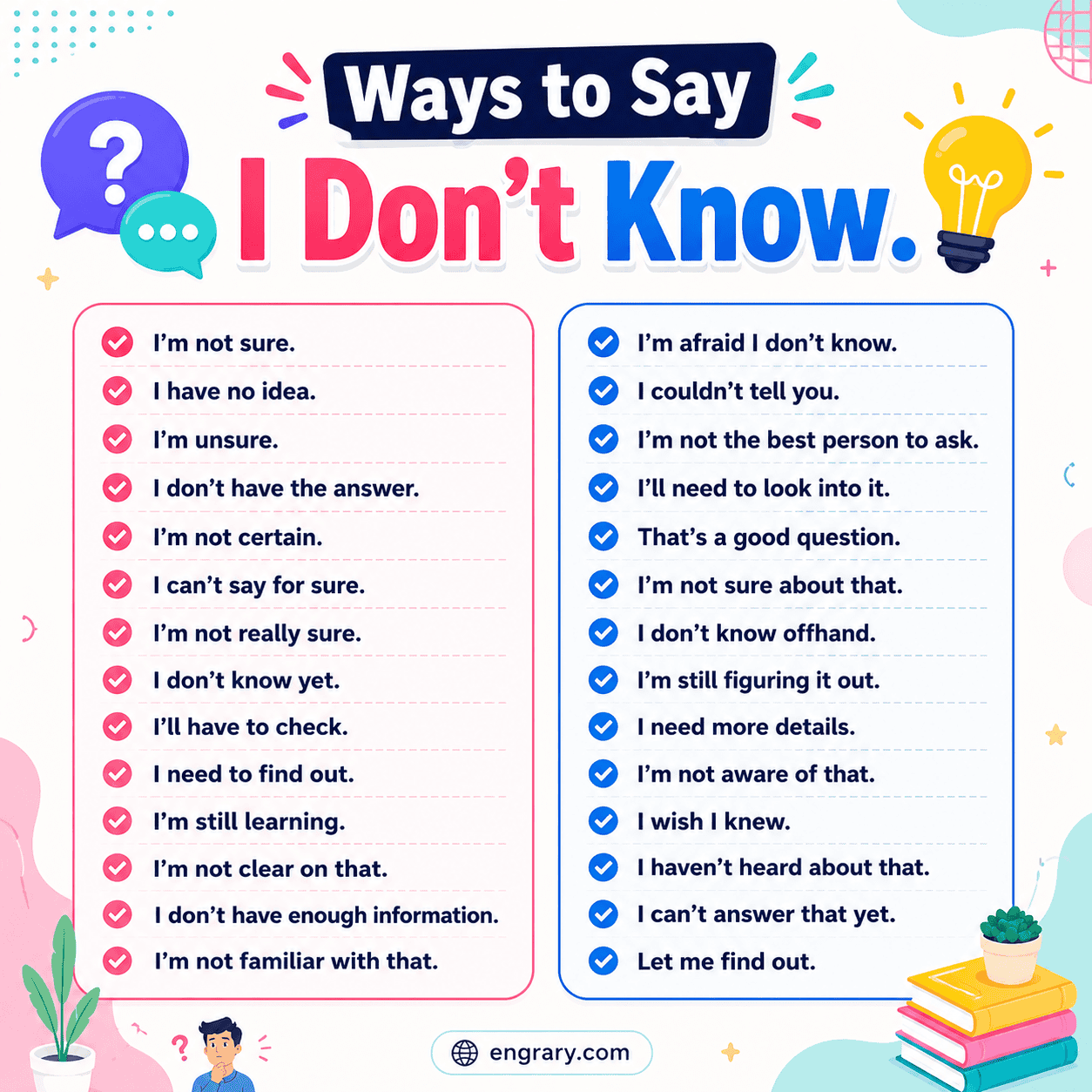
Professional Alternatives for Work and Emails
Use these phrases for emails, meetings, clients, coworkers, managers, and formal messages.
I don’t have that information right now
A professional phrase for missing information.
Example: I don’t have that information right now, but I can check.
Let me verify that and get back to you
A polished phrase for checking facts.
Example: Let me verify that and get back to you.
I need to confirm the details first
A professional phrase for avoiding mistakes.
Example: I need to confirm the details first.
I’ll look into this and follow up
A helpful work-safe phrase.
Example: I’ll look into this and follow up by email.
I don’t want to give you incorrect information
A careful phrase that shows responsibility.
Example: I don’t want to give you incorrect information.
I’ll need to review that before answering
A professional phrase for careful replies.
Example: I’ll need to review that before answering.
I’ll confirm this with the team
A useful workplace phrase.
Example: I’ll confirm this with the team and update you.
I’ll check the details and come back to you
A polished phrase for follow-up.
Example: I’ll check the details and come back to you.
I need to look at the latest information first
A professional phrase for updated details.
Example: I need to look at the latest information first.
I’ll provide a confirmed answer shortly
A confident phrase when you plan to follow up.
Example: I’ll provide a confirmed answer shortly.
Helpful Ways to Say You’ll Find Out
Use these phrases when you want to sound useful instead of uncertain.
Let me check
A simple phrase for verifying something.
Example: Let me check that for you.
Let me double-check
A careful phrase for confirming details.
Example: Let me double-check before I answer.
I’ll find out
A direct phrase that promises action.
Example: I’ll find out and let you know.
I’ll ask someone who knows
A helpful phrase when another person has the answer.
Example: I’ll ask someone who knows more about this.
I’ll get back to you on that
A common follow-up phrase.
Example: I’ll get back to you on that tomorrow.
I’ll look it up
A casual but useful phrase.
Example: I’ll look it up and tell you.
I’ll check the source first
A careful phrase for accuracy.
Example: I’ll check the source first.
Let me find the right answer
A helpful phrase that shows effort.
Example: Let me find the right answer for you.
I’ll check and confirm
A short phrase for follow-up.
Example: I’ll check and confirm before the meeting.
I’ll make sure before I answer
A responsible phrase for accuracy.
Example: I’ll make sure before I answer.
Casual Ways to Say I Don’t Know
Use these phrases for friends, family, chats, and everyday conversations.
Not sure
A short casual phrase.
Example: Not sure, maybe tomorrow.
No idea
A casual phrase for not knowing.
Example: No idea where he went.
I have no clue
A very casual phrase.
Example: I have no clue what happened.
I’m not sure yet
A casual phrase for temporary uncertainty.
Example: I’m not sure yet.
No idea yet
A short phrase for texts or chats.
Example: No idea yet, but I’ll ask.
I couldn’t tell you
A casual phrase when you truly do not know.
Example: I couldn’t tell you.
Your guess is as good as mine
A casual phrase when both people are unsure.
Example: Your guess is as good as mine.
Beats me
A very informal phrase.
Example: Beats me.
Who knows?
A casual phrase when the answer is uncertain.
Example: Who knows? Maybe it will change tomorrow.
I’m clueless on that one
A light casual phrase.
Example: I’m clueless on that one.
Honest Ways to Say You’re Not Sure
Use these phrases when you have a guess but do not want to sound fully certain.
I might be wrong, but…
A careful phrase before giving a guess.
Example: I might be wrong, but I think it starts at noon.
I’m not completely sure
A clear phrase for partial uncertainty.
Example: I’m not completely sure about that.
I could be mistaken
A polite phrase before an uncertain answer.
Example: I could be mistaken, but I think she already left.
That’s my best guess
A natural phrase for an estimated answer.
Example: That’s my best guess.
I don’t know enough to say
A careful phrase when more information is needed.
Example: I don’t know enough to say.
I’m not fully confident about that
A direct phrase for careful uncertainty.
Example: I’m not fully confident about that answer.
I’d rather not guess
A responsible phrase when accuracy matters.
Example: I’d rather not guess.
I need more information first
A clear phrase when context is missing.
Example: I need more information first.
I can only make an estimate
A useful phrase when the answer is approximate.
Example: I can only make an estimate right now.
I’m not ready to say for certain
A careful phrase for important answers.
Example: I’m not ready to say for certain yet.
Customer-Service Friendly Responses
Use these phrases for support chats, client replies, service emails, and customer questions.
I’ll look into that for you
A helpful customer-service phrase.
Example: I’ll look into that for you right away.
Let me check that for you
A polite service phrase.
Example: Let me check that for you.
I’ll confirm this and update you
A professional support phrase.
Example: I’ll confirm this and update you shortly.
I don’t have that information yet
A clear phrase for missing details.
Example: I don’t have that information yet.
Thank you for your patience while I check
A polite phrase for customer support.
Example: Thank you for your patience while I check.
I’m checking this now
A helpful phrase that shows action.
Example: I’m checking this now.
Let me find the correct information
A careful phrase for accuracy.
Example: Let me find the correct information for you.
I’ll make sure you get the right answer
A reassuring support phrase.
Example: I’ll make sure you get the right answer.
I’ll check with the right department
A useful phrase for customer-service teams.
Example: I’ll check with the right department.
I don’t want to mislead you
A careful phrase that builds trust.
Example: I don’t want to mislead you, so let me confirm first.
Interview-Safe Ways to Say I Don’t Know
Use these phrases when you want to sound honest, thoughtful, and capable in interviews.
I don’t know the exact answer, but I would approach it by…
A strong interview phrase that shows problem-solving.
Example: I don’t know the exact answer, but I would approach it by checking the data first.
I’d need to research that further
A professional phrase for learning more.
Example: I’d need to research that further before giving a final answer.
I’m not familiar with that yet, but I’m willing to learn
A confident phrase for a knowledge gap.
Example: I’m not familiar with that yet, but I’m willing to learn.
I would verify the details before answering
A careful phrase for accuracy.
Example: I would verify the details before answering.
That’s something I’d like to learn more about
A positive phrase for curiosity.
Example: That’s something I’d like to learn more about.
I haven’t worked with that directly yet
A clear phrase for limited experience.
Example: I haven’t worked with that directly yet.
I’d ask the right person and confirm the answer
A practical interview phrase.
Example: I’d ask the right person and confirm the answer.
I would not want to guess without checking
A responsible phrase for careful answers.
Example: I would not want to guess without checking.
I’m still building experience in that area
A confident phrase for a developing skill.
Example: I’m still building experience in that area.
I would start by finding the missing information
A problem-solving phrase for interviews.
Example: I would start by finding the missing information.
School and Learning-Friendly Phrases
Use these phrases for students, teachers, classrooms, and learning situations.
I’m still learning about that
A student-friendly phrase.
Example: I’m still learning about that.
I haven’t figured that out yet
A growth-minded phrase for learning.
Example: I haven’t figured that out yet.
Can you explain it another way?
A useful phrase when you need help understanding.
Example: Can you explain it another way?
I need more practice with that
A clear phrase for learning gaps.
Example: I need more practice with that.
I’m not sure, but I’d like to understand
A curious and respectful phrase.
Example: I’m not sure, but I’d like to understand.
I’m still working on it
A simple phrase for progress.
Example: I’m still working on it.
I don’t understand it yet
A clear learning phrase.
Example: I don’t understand it yet.
Can we go over it again?
A helpful classroom phrase.
Example: Can we go over it again?
I’m trying to figure it out
A natural phrase for learning.
Example: I’m trying to figure it out.
I need help understanding this
A clear phrase for asking support.
Example: I need help understanding this part.
Short I Don’t Know Texts and Replies
Use these short phrases for messages, comments, chats, and quick replies.
Not sure.
Use this for a casual short reply.
No idea yet.
Use this when you do not know yet.
Let me check.
Use this when you can verify.
I’ll find out.
Use this when you plan to check.
I’m not certain.
Use this for polite uncertainty.
No clue.
Use this in casual chats.
Checking now.
Use this when you are actively looking.
I’ll ask.
Use this when someone else may know.
Need to verify.
Use this when accuracy matters.
Not sure yet.
Use this when the answer may come later.
Extra Natural Uncertainty Phrases
Use these when you want more natural ways to express uncertainty without sounding careless.
I don’t have enough details yet
A clear phrase when information is missing.
Example: I don’t have enough details yet.
I need to look into it more
A useful phrase for further checking.
Example: I need to look into it more.
I’m not the best person to answer that
A polite phrase when someone else knows better.
Example: I’m not the best person to answer that.
That’s outside my expertise
A professional phrase for knowledge limits.
Example: That’s outside my expertise.
I’d need more context
A useful phrase when the question is unclear.
Example: I’d need more context to answer properly.
I’m still waiting on that information
A clear phrase when the answer depends on someone else.
Example: I’m still waiting on that information.
I don’t have a confirmed answer yet
A careful phrase for unverified details.
Example: I don’t have a confirmed answer yet.
I’m not in a position to answer that yet
A formal phrase for limited knowledge or authority.
Example: I’m not in a position to answer that yet.
I can check and let you know
A helpful phrase with follow-up action.
Example: I can check and let you know.
I’ll need to confirm before saying anything
A careful phrase for serious or important topics.
Example: I’ll need to confirm before saying anything.
Phrases to Use Carefully
Some alternatives can sound careless, rude, too casual, or unprofessional depending on the situation.
| Phrase | Why to Use Carefully | Better Use |
|---|---|---|
| No idea. | It can sound blunt or careless. | Use casually with friends. |
| Beats me. | It sounds very informal and dismissive. | Use only in casual speech. |
| I have no clue. | It can sound unprepared at work. | Use casually, not professionally. |
| How should I know? | It can sound rude or defensive. | Avoid it in polite conversation. |
| Not my problem. | It sounds dismissive and unhelpful. | Use helpful wording like I’ll ask someone who knows. |
What to Say Instead of I Don’t Know in Different Situations
| Situation | Better Phrase |
|---|---|
| Polite reply | I’m not sure. |
| Professional email | Let me verify that and get back to you. |
| Work meeting | I need to confirm the details first. |
| Customer service | I’ll look into that for you. |
| Interview | I’d need to research that further. |
| School | I’m still learning about that. |
| Casual chat | Not sure yet. |
| Text message | Let me check. |
| Outside expertise | I’m not the best person to answer that. |
| Careful answer | I don’t want to give you incorrect information. |
How to Choose the Right Uncertainty Phrase
Choose the phrase based on the setting and the reason you do not know. In casual conversations, short phrases like Not sure, No idea yet, or Let me check sound natural. In professional settings, more helpful wording like Let me verify that and get back to you or I don’t want to give you incorrect information works better.
When facts need checking, use Let me double-check or I’ll find out. If the question is outside your expertise, say I’m not the best person to answer that and direct the person to someone who can help. For interviews or learning situations, choose phrases that show honesty and curiosity, such as I’d need to research that further or I’m still learning about that.
Summary
There are many ways to say I don’t know, and the best phrase depends on the situation. I’m not sure, Let me check, and I’ll find out work well in everyday conversations because they sound natural and helpful.
Professional phrases like Let me verify that and get back to you sound better in work settings. Customer-service and interview-safe phrases show honesty with action, while school-friendly phrases help learners admit uncertainty without feeling embarrassed.
FAQs
Another way to say I don’t know is I’m not sure. You can also say I’m not certain, Let me check, I’ll find out, I can’t say for sure, or I don’t have the answer right now.
Professionally, you can say Let me verify that and get back to you, I need to confirm the details first, I’ll look into this and follow up, or I don’t want to give you incorrect information. These phrases sound helpful and responsible.
A polite way to say I don’t know is I’m not sure. You can also say I’m not certain, I can’t say for sure, I’d need to check first, or I wish I had the answer.
In an interview, you can say I don’t know the exact answer, but I would approach it by… or I’d need to research that further. These phrases show honesty while also showing problem-solving and willingness to learn.
No idea is not always rude, but it can sound too casual or careless in professional settings. It is better for friends, texts, or informal conversations. At work, use I’m not sure or Let me check instead.
You May Also Like