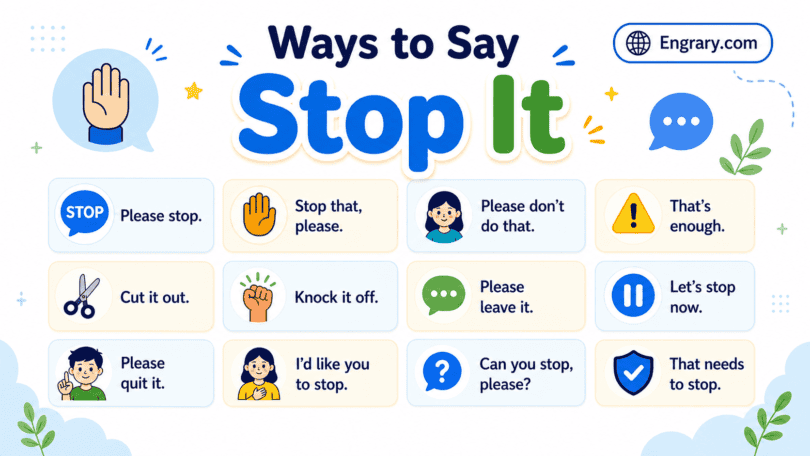
Stop it is a direct phrase used when you want someone to stop an action, behavior, joke, interruption, or uncomfortable situation. It can sound playful, annoyed, rude, serious, or urgent depending on your tone and context.
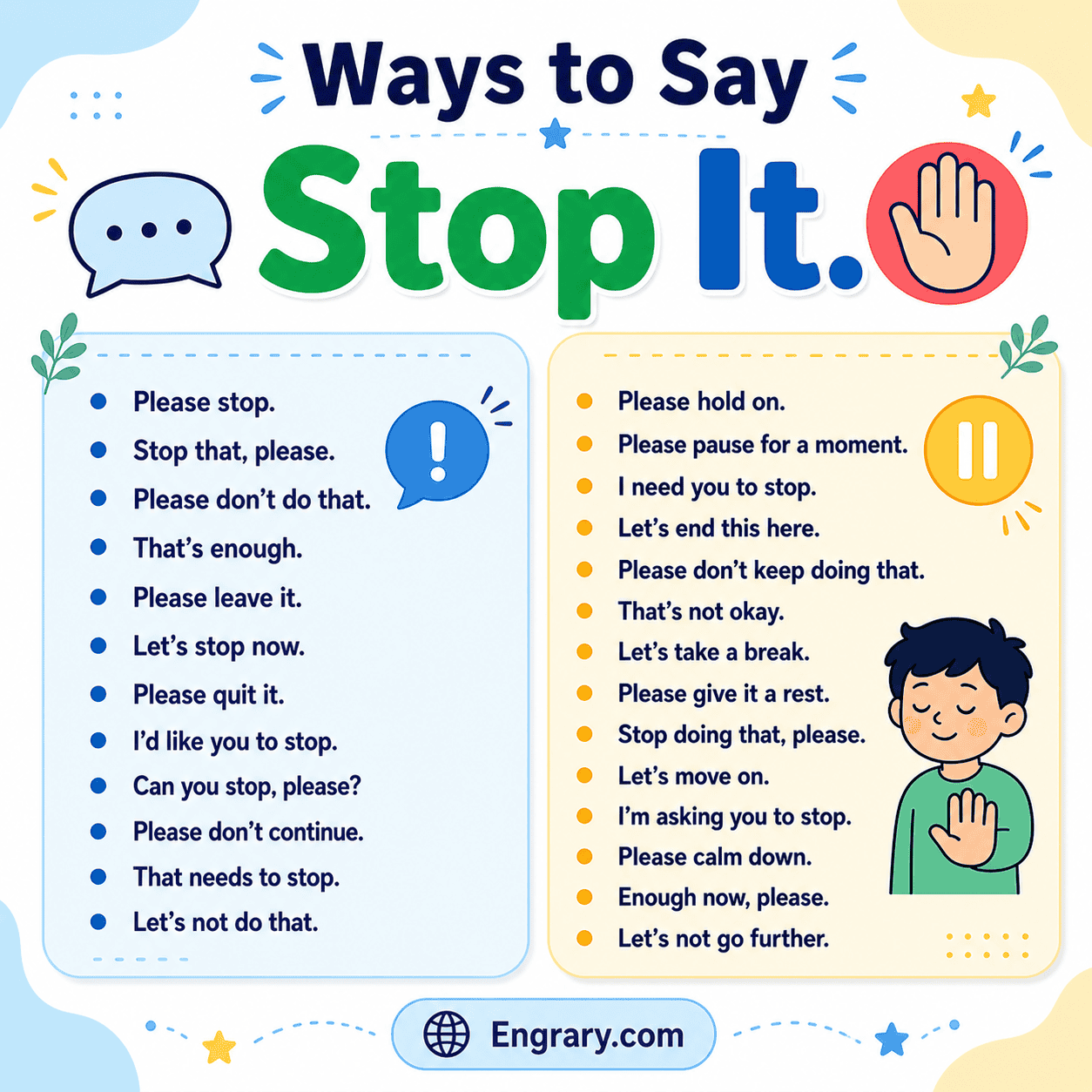
Below, you’ll find 70 natural alternatives to stop it for polite requests, firm boundaries, casual chats, workplace situations, children, classrooms, playful moments, urgent situations, and short replies. Each phrase includes a short use and a simple example.
Best Stop It Phrase by Situation
Use this quick table when you want the right phrase fast.
| Situation | Better Phrase |
|---|---|
| Polite request | Please stop. |
| Clear instruction | Stop doing that. |
| Firm boundary | I need you to stop. |
| Uncomfortable behavior | I’m not comfortable with that. |
| Workplace setting | Let’s pause this discussion. |
| Classroom | Let’s stop that now. |
| Child behavior | Please use kind hands. |
| Casual friend | Cut it out. |
| Playful moment | Okay, okay, stop. |
| Urgent situation | Stop now. |
Stop It vs Stop Doing That
| Phrase | Tone | Best Use |
|---|---|---|
| Stop it | Direct, emotional, sometimes playful or annoyed. | Casual speech or urgent moments. |
| Stop doing that | Clear and specific. | When you want to name the behavior more directly. |
| Please stop | Polite and simple. | Everyday respectful requests. |
| I need you to stop | Firm and clear. | Boundaries or repeated behavior. |
Polite Ways to Say Stop It
Use these phrases when you want to sound respectful but still clear.
Please stop
A simple and polite way to ask someone to stop.
Example: Please stop; that is distracting.
Could you stop, please?
A softer request that sounds polite.
Example: Could you stop, please? I’m trying to focus.
Please don’t do that
A respectful way to ask someone not to continue an action.
Example: Please don’t do that near the table.
Would you mind stopping?
A polite phrase for a gentle request.
Example: Would you mind stopping for a moment?
Can we stop this for now?
A calm way to end an action or discussion.
Example: Can we stop this for now and talk later?
Let’s stop here
A polite phrase for ending a conversation or activity.
Example: Let’s stop here and come back to it tomorrow.
Please leave that alone
A polite phrase when someone is touching or using something.
Example: Please leave that alone.
Could we pause for a moment?
A polite way to slow or stop a situation.
Example: Could we pause for a moment and think this through?
Firm Ways to Tell Someone to Stop
Use these phrases when you need a clear boundary or the behavior continues after a polite request.
I need you to stop
A firm and clear boundary phrase.
Example: I need you to stop doing that.
That needs to stop
A direct phrase for behavior that is not okay.
Example: That needs to stop now.
No more of that
A firm phrase for repeated behavior.
Example: No more of that, please.
That’s enough
A clear phrase for ending behavior immediately.
Example: That’s enough; stop now.
Stop doing that
A direct and specific phrase.
Example: Stop doing that before someone gets hurt.
I’ve asked you to stop
A firm phrase for repeated behavior.
Example: I’ve asked you to stop, and I mean it.
This needs to end now
A strong phrase for a serious situation.
Example: This needs to end now.
I don’t want this to continue
A clear phrase for setting a boundary.
Example: I don’t want this to continue.
Casual Ways to Say Stop It
Use these phrases for friends, casual conversations, teasing, or informal moments.
Cut it out
A casual phrase for telling someone to stop.
Example: Cut it out; I’m serious.
Quit it
A short informal phrase.
Example: Quit it, that’s annoying.
Knock it off
A casual but firmer phrase.
Example: Knock it off before someone gets upset.
Enough already
A casual phrase when something has gone on too long.
Example: Enough already, we get it.
Give it a rest
A casual phrase for stopping a joke, comment, or topic.
Example: Give it a rest for a while.
Leave it alone
A casual phrase for stopping someone from touching or bothering something.
Example: Leave it alone.
Drop it
A casual phrase for stopping a topic or argument.
Example: Drop it; I don’t want to talk about this now.
Let it go
A casual phrase for moving on from something.
Example: Let it go and move on.
Professional Alternatives for Work
Use these phrases for meetings, emails, workplace conversations, clients, coworkers, or formal situations.
Let’s pause this discussion
A professional way to stop or slow a conversation.
Example: Let’s pause this discussion until we have more information.
Let’s stop here for now
A polite phrase for ending a meeting or topic.
Example: Let’s stop here for now and continue tomorrow.
Please refrain from doing that
A formal phrase for asking someone to stop.
Example: Please refrain from doing that during the meeting.
Can we move on?
A polite way to stop a topic.
Example: Can we move on to the next point?
I think we should end this topic here
A professional phrase for closing a discussion.
Example: I think we should end this topic here.
Let’s return to the main point
A professional way to stop an off-topic discussion.
Example: Let’s return to the main point.
This discussion is no longer productive
A firm workplace phrase.
Example: This discussion is no longer productive.
Let’s take a break and revisit this later
A calm phrase for stopping tension at work.
Example: Let’s take a break and revisit this later.
Boundary-Setting Phrases That Sound Clear
Use these phrases when someone is making you uncomfortable or crossing a line.
I’m not comfortable with that
A clear phrase for personal boundaries.
Example: I’m not comfortable with that.
Please give me some space
A direct but respectful boundary phrase.
Example: Please give me some space.
This is not okay
A firm phrase for unacceptable behavior.
Example: This is not okay.
I don’t want this to continue
A clear phrase for ending unwanted behavior.
Example: I don’t want this to continue.
I’ve asked you to stop
A firm phrase for repeated behavior.
Example: I’ve asked you to stop.
Please respect my boundary
A clear and respectful phrase.
Example: Please respect my boundary.
I need you to step back
A direct phrase for space or safety.
Example: I need you to step back.
Do not touch that
A clear boundary phrase for objects or personal belongings.
Example: Do not touch that.
Parent and Teacher-Friendly Stop Phrases
Use these phrases for children, students, classrooms, parenting, and calm correction.
Hands down, please
A calm phrase for stopping touching or grabbing.
Example: Hands down, please.
Let’s stop that now
A clear but gentle phrase for children.
Example: Let’s stop that now and choose something safer.
That behavior needs to stop
A firm but calm phrase.
Example: That behavior needs to stop.
Please use kind hands
A gentle phrase for children who are hitting, pushing, or grabbing.
Example: Please use kind hands.
Let’s make a better choice
A calm phrase that redirects behavior.
Example: Let’s make a better choice.
Pause and listen, please
A classroom-friendly phrase.
Example: Pause and listen, please.
That is not safe
A clear phrase for unsafe behavior.
Example: That is not safe.
Show me calm behavior
A gentle correction phrase.
Example: Show me calm behavior.
Playful Ways to Say Stop It
Use these only in light, friendly situations where everyone understands the joke.
Okay, okay, stop
A playful phrase when someone is making you laugh or teasing.
Example: Okay, okay, stop; I can’t stop laughing.
You’re too much
A light phrase for playful teasing.
Example: You’re too much.
That’s enough from you
A playful phrase for close friends.
Example: That’s enough from you for today.
Stop before I start laughing
A funny phrase for joking situations.
Example: Stop before I start laughing too hard.
You’re killing me
A playful phrase when someone is being very funny.
Example: You’re killing me with these jokes.
Alright, that’s enough comedy
A playful phrase for jokes or teasing.
Example: Alright, that’s enough comedy for one day.
Urgent or Serious Ways to Say Stop
Use these phrases when safety, harm, danger, or serious discomfort is involved.
Stop now
A direct phrase for urgent situations.
Example: Stop now.
Do not continue
A serious phrase for ending an action.
Example: Do not continue.
This is not safe
A clear phrase for safety concerns.
Example: This is not safe.
Back off
A strong phrase for distance or safety.
Example: Back off.
I said stop
A firm phrase when someone ignores your first request.
Example: I said stop.
Get away from that
A direct safety phrase.
Example: Get away from that.
Move back now
A clear urgent instruction.
Example: Move back now.
Stop before someone gets hurt
A serious warning phrase.
Example: Stop before someone gets hurt.
Short Stop It Texts and Replies
Use these short phrases for messages, chats, comments, or quick replies.
Please stop.
Use this for a simple polite message.
Stop doing that.
Use this for a clear instruction.
That’s enough.
Use this when something has gone too far.
No more.
Use this for repeated behavior.
Cut it out.
Use this with friends or casual situations.
Drop it.
Use this to stop a topic.
Not okay.
Use this for boundary-setting.
Stop now.
Use this for urgent situations.
Phrases to Use Carefully
Some alternatives can sound rude, aggressive, childish, or too harsh depending on the situation.
| Phrase | Why to Use Carefully | Better Use |
|---|---|---|
| Shut up. | It usually sounds rude or insulting. | Avoid it unless joking with someone very close. |
| Knock it off. | It can sound annoyed or scolding. | Use with friends, kids, or informal settings. |
| Back off. | It sounds strong and defensive. | Use when you need space or safety. |
| I said stop. | It sounds very firm and serious. | Use when someone ignores a clear boundary. |
| Cut it out. | It can sound playful or irritated. | Use with people who understand your tone. |
What to Say Instead of Stop It in Different Situations
Use this table when you want to choose the best phrase quickly.
| Situation | Better Phrase |
|---|---|
| Polite request | Please stop. |
| Clear instruction | Stop doing that. |
| Firm boundary | I need you to stop. |
| Uncomfortable behavior | I’m not comfortable with that. |
| Workplace setting | Let’s pause this discussion. |
| Classroom | Let’s stop that now. |
| Child behavior | Please use kind hands. |
| Casual friend | Cut it out. |
| Playful moment | Okay, okay, stop. |
| Urgent situation | Stop now. |
How to Choose the Right Stop Phrase
Choose the right phrase based on the relationship, setting, and seriousness of the behavior. For polite requests, Please stop or Could you stop, please? works well. For repeated behavior, firmer phrases like I’ve asked you to stop or That needs to stop make the boundary clearer.
At work, use professional wording like Let’s pause this discussion or Please refrain from doing that. With children, calm and clear phrases like Let’s stop that now or Please use kind hands work better than harsh wording. In urgent situations, direct phrases like Stop now or This is not safe are best because clarity matters most.
Summary
There are many ways to say stop it, and the best phrase depends on tone and context. Polite phrases like Please stop work for respectful requests, while firm phrases like I need you to stop help set boundaries.
Casual phrases, workplace wording, parent-friendly phrases, playful lines, and urgent commands all fit different situations. The key is to choose wording that matches the seriousness of the moment without sounding unnecessarily rude or unclear.
FAQs
Another way to say stop it is please stop. You can also say stop doing that, cut it out, that’s enough, I need you to stop, or let’s stop here, depending on the situation.
Politely, you can say please stop, could you stop, please?, please don’t do that, would you mind stopping?, or can we stop this for now? These phrases sound respectful while still being clear.
Professionally, you can say let’s pause this discussion, please refrain from doing that, can we move on?, or I think we should end this topic here. These phrases are better for meetings, emails, and workplace conversations.
A firm way to tell someone to stop is I need you to stop. You can also say that needs to stop, no more of that, I’ve asked you to stop, or this needs to end now.
Cut it out can sound casual, playful, or annoyed depending on tone. It is usually fine with friends or informal situations, but it may sound rude in professional or serious settings.
You May Also Like