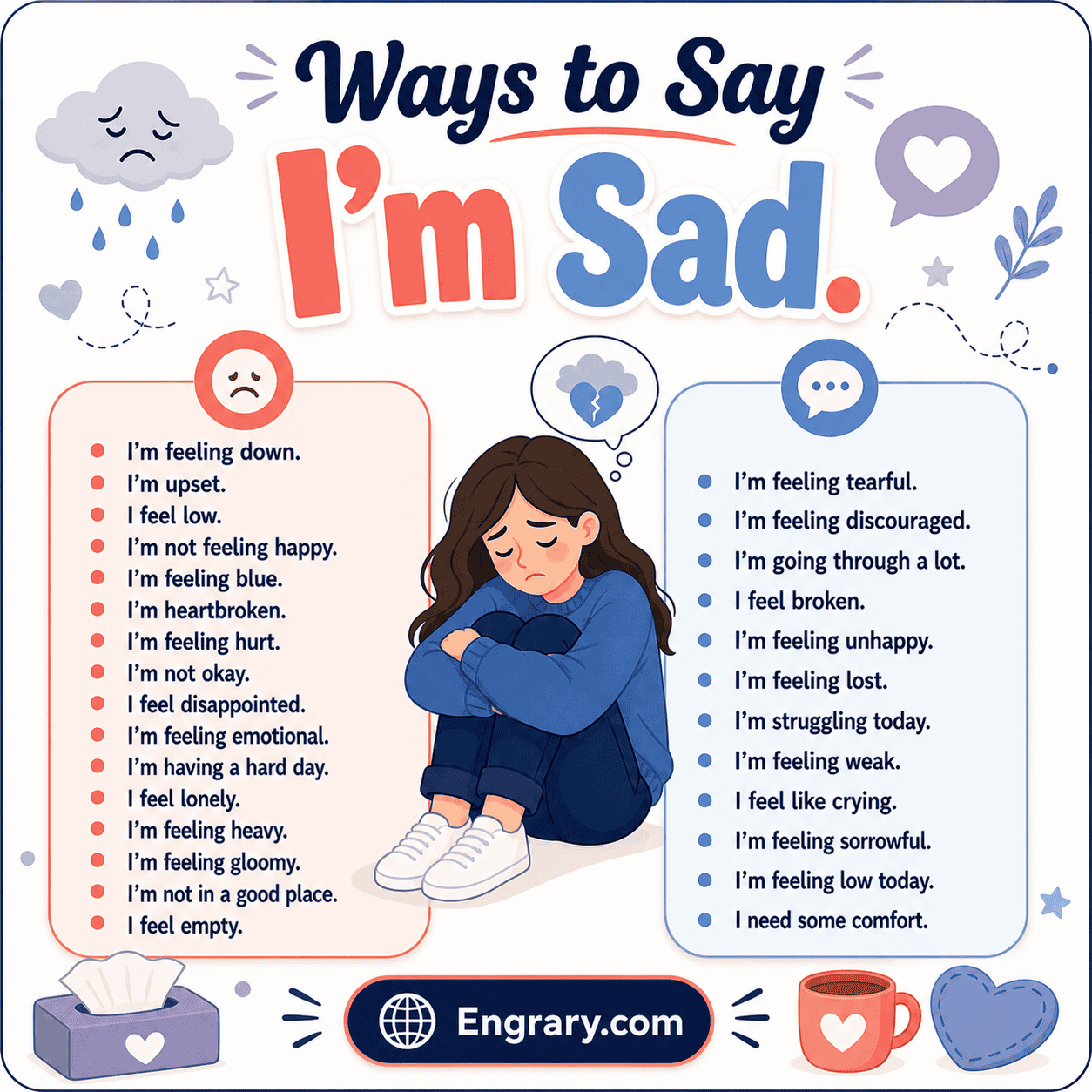
“I’m sad” is simple and clear, but sometimes it does not fully explain what you feel. You might feel disappointed, lonely, heartbroken, emotionally drained, or simply not like yourself.
For example, “I’m feeling down” works for mild sadness, while “I’m devastated” is much stronger. Meanwhile, “I’m disappointed by the outcome” sounds more professional. Therefore, this guide gives you 100 ways to say “I’m sad” without saying “sad,” with examples for low moods, deep emotions, relationships, loneliness, heartbreak, grief, texts, and professional situations.
Best “I’m Sad” Phrases by Situation
| Situation | Best Phrase |
|---|---|
| Mild sadness | I’m feeling down |
| Low mood | I’m not feeling like myself |
| Emotional hurt | I feel hurt |
| Disappointment | I’m disappointed |
| Loneliness | I feel alone |
| Heartbreak | I’m heartbroken |
| Grief | I’m grieving |
| Deep sadness | I’m devastated |
| Emotional tiredness | I’m emotionally drained |
| Professional sadness | I’m disappointed by the outcome |
| Short text | I’m not okay |
| Poetic sadness | My heart feels heavy |
“I’m Sad” vs “I’m Upset” vs “I’m Depressed”
These phrases are related, but they do not always mean the same thing. “Sad” is general, “upset” can include hurt or anger, and “depressed” should be used carefully because it can refer to a mental health condition.
| Phrase | Meaning | Best Use |
|---|---|---|
| I’m sad | General feeling of unhappiness | Everyday sadness |
| I’m upset | Sad, hurt, angry, or emotionally disturbed | Emotional hurt, disappointment, conflict |
| I’m depressed | Deep low mood; can also refer to a mental health condition | Use carefully |
| I’m disappointed | Sad because something did not happen as hoped | Bad results, unmet expectations |
| I’m heartbroken | Very sad because of love, loss, or emotional pain | Breakups, loss, emotional pain |
| I’m grieving | Sad after death, loss, or major life change | Grief, bereavement, deep loss |
| I’m emotionally drained | Sad and mentally tired | Stress, emotional exhaustion |
| I’m not okay | Honest and broad emotional distress | Texts, close conversations |
Is “I’m Sad” Polite and Natural?
Yes, “I’m sad” is natural in English. It is clear, simple, and easy to understand in everyday conversations.
However, it can sound too basic when you want to explain your feelings more clearly. If you feel disappointed, lonely, hurt, or emotionally exhausted, a more specific phrase may help others understand you better. In professional settings, phrases like “I’m disappointed by the outcome” or “This is disappointing news” usually sound more appropriate than “I’m sad.”
Everyday Phrases That Mean You Feel Sad
These phrases work well in normal conversations when you want to express sadness naturally.
I’m feeling down
A natural phrase for mild sadness.
Example: I’m feeling down today.
I’m not okay today
A direct phrase for emotional difficulty.
Example: I’m not okay today, but I’m trying.
I’m upset
A broad phrase for sadness, hurt, or emotional pain.
Example: I’m upset about what happened.
I feel low
A simple phrase for a low mood.
Example: I feel low this morning.
I’m having a hard day
A gentle phrase for a difficult emotional day.
Example: I’m having a hard day.
I’m not feeling like myself
A phrase for feeling emotionally off.
Example: I’m not feeling like myself lately.
I’m feeling a little blue
An idiomatic phrase for feeling sad.
Example: I’m feeling a little blue today.
I’m in a low mood
A clear phrase for sadness or emotional heaviness.
Example: I’m in a low mood right now.
I don’t feel great emotionally
A plain phrase for emotional difficulty.
Example: I don’t feel great emotionally today.
I’m feeling heavy today
A natural phrase for emotional weight.
Example: I’m feeling heavy today.
Mild Sadness Phrases for Low Moods
Use these phrases when you feel a little sad, quiet, or emotionally off, but not deeply distressed.
I’m a little down
A soft phrase for mild sadness.
Example: I’m a little down today.
I’m not in the best mood
A polite phrase for a low mood.
Example: I’m not in the best mood right now.
I’m feeling off
A casual phrase for not feeling emotionally normal.
Example: I’m feeling off today.
I’m feeling low
A simple phrase for mild sadness.
Example: I’m feeling low this week.
I’m a bit upset
A soft phrase for emotional hurt or sadness.
Example: I’m a bit upset about it.
I’m not feeling my usual self
A phrase for feeling emotionally different.
Example: I’m not feeling my usual self.
I’m having one of those days
A casual phrase for a difficult day.
Example: I’m having one of those days.
I feel a little empty
A phrase for quiet sadness.
Example: I feel a little empty today.
I’m feeling quiet today
A gentle phrase when sadness makes you less talkative.
Example: I’m feeling quiet today.
I’m not feeling very cheerful
A polite phrase for low mood.
Example: I’m not feeling very cheerful right now.
Deep Sadness Phrases for Heavy Emotions
These phrases express stronger sadness, emotional pain, or serious hurt.
I’m devastated
A very strong phrase for deep sadness.
Example: I’m devastated by the news.
I’m heartbroken
A phrase for deep emotional pain, love, or loss.
Example: I’m heartbroken over what happened.
I’m deeply upset
A strong phrase for serious sadness.
Example: I’m deeply upset by this.
I feel broken
A very emotional phrase for deep pain.
Example: I feel broken right now.
My heart feels heavy
A gentle but deep phrase for sadness.
Example: My heart feels heavy today.
I’m overwhelmed with sadness
A strong phrase for intense emotion.
Example: I’m overwhelmed with sadness.
I’m struggling emotionally
A clear phrase for serious emotional difficulty.
Example: I’m struggling emotionally right now.
I feel empty inside
A heavy phrase for deep sadness.
Example: I feel empty inside.
I’m barely holding it together
A phrase for feeling close to breaking down.
Example: I’m barely holding it together today.
I’m hurting deeply
A strong phrase for emotional pain.
Example: I’m hurting deeply.
Polite Ways to Say You’re Not Feeling Okay
These phrases help you express sadness without oversharing or sounding too dramatic.
I’m not feeling okay today
A polite and honest phrase.
Example: I’m not feeling okay today.
I’m having a difficult day
A gentle phrase for sadness or emotional stress.
Example: I’m having a difficult day.
I’m going through a lot right now
A phrase for emotional difficulty without giving details.
Example: I’m going through a lot right now.
I’m not in the best place emotionally
A clear phrase for emotional struggle.
Example: I’m not in the best place emotionally.
I’m trying to process some things
A polite phrase when you need time.
Example: I’m trying to process some things.
I’m feeling a bit overwhelmed
A softer phrase for emotional heaviness.
Example: I’m feeling a bit overwhelmed today.
I need a little time
A simple phrase for needing space.
Example: I need a little time to feel better.
I’m not quite myself today
A gentle phrase for low mood.
Example: I’m not quite myself today.
I’m dealing with some heavy feelings
A thoughtful phrase for emotional difficulty.
Example: I’m dealing with some heavy feelings.
I appreciate your patience
A polite phrase when sadness affects your mood or response.
Example: I appreciate your patience while I work through this.
Professional Ways to Express Disappointment or Sadness
These phrases work well in emails, meetings, workplace conversations, and formal situations.
I’m disappointed by the outcome
A professional phrase for sadness about a result.
Example: I’m disappointed by the outcome.
This is disappointing news
A polite phrase for receiving a bad result.
Example: This is disappointing news, but I appreciate the update.
I had hoped for a different result
A professional phrase for disappointment.
Example: I had hoped for a different result.
I’m sorry to see this happen
A respectful phrase for sadness about a situation.
Example: I’m sorry to see this happen.
This has been difficult to process
A formal phrase for emotional difficulty.
Example: This has been difficult to process.
I’m feeling discouraged by the situation
A professional phrase for sadness and discouragement.
Example: I’m feeling discouraged by the situation.
I’m concerned about the impact
A workplace-safe phrase for serious disappointment.
Example: I’m concerned about the impact this may have.
I’m trying to process the situation
A controlled phrase for emotional response.
Example: I’m trying to process the situation.
I appreciate your understanding
A polite phrase when sadness affects communication.
Example: I appreciate your understanding during this time.
This is not the result I hoped for
A professional phrase for disappointment.
Example: This is not the result I hoped for.
Relationship Phrases for Emotional Honesty
These phrases work well with friends, partners, family members, or someone you trust.
I’m having a hard time
A clear phrase for emotional struggle.
Example: I’m having a hard time right now.
I feel hurt
A simple phrase for emotional pain.
Example: I feel hurt by what happened.
I feel alone right now
A phrase for loneliness or emotional distance.
Example: I feel alone right now.
I’m not okay, but I’m trying
A vulnerable phrase for sadness and effort.
Example: I’m not okay, but I’m trying.
I need some comfort today
A direct phrase for asking for support.
Example: I need some comfort today.
I’m feeling emotionally heavy
A phrase for deep emotional weight.
Example: I’m feeling emotionally heavy.
I don’t really know how to explain it
A phrase for sadness that is hard to describe.
Example: I don’t really know how to explain it.
I just feel low
A simple phrase for low mood.
Example: I just feel low today.
I’m trying not to fall apart
A very emotional phrase for deep struggle.
Example: I’m trying not to fall apart.
I could use someone to talk to
A helpful phrase for asking for support.
Example: I could use someone to talk to.
Phrases for Loneliness and Feeling Left Out
Use these phrases when sadness comes from feeling alone, forgotten, disconnected, or excluded.
I feel alone
A direct phrase for loneliness.
Example: I feel alone right now.
I feel left out
A phrase for being excluded.
Example: I feel left out of the group.
I feel forgotten
A phrase for feeling unnoticed.
Example: I feel forgotten lately.
I feel disconnected
A phrase for emotional distance.
Example: I feel disconnected from everyone.
I miss having someone around
A phrase for loneliness.
Example: I miss having someone around.
I feel like no one notices
A phrase for feeling unseen.
Example: I feel like no one notices how I’m doing.
I’m feeling isolated
A phrase for loneliness or separation.
Example: I’m feeling isolated these days.
I feel distant from everyone
A phrase for emotional separation.
Example: I feel distant from everyone.
I wish someone understood
A phrase for loneliness and emotional need.
Example: I wish someone understood.
I feel like I’m carrying this alone
A strong phrase for feeling unsupported.
Example: I feel like I’m carrying this alone.
Phrases for Heartbreak or Missing Someone
These phrases are useful for breakups, distance, emotional pain, or missing someone deeply.
I miss them
A simple phrase for missing someone.
Example: I miss them so much.
I miss you
A direct phrase for longing.
Example: I miss you today.
My heart hurts
A gentle emotional phrase for heartbreak.
Example: My heart hurts when I think about it.
I’m heartbroken
A strong phrase for emotional pain.
Example: I’m heartbroken after the breakup.
I feel lost without them
A phrase for grief, heartbreak, or missing someone.
Example: I feel lost without them.
I’m still hurting
A phrase for ongoing pain.
Example: I’m still hurting from what happened.
I can’t stop thinking about what happened
A phrase for emotional pain after an event.
Example: I can’t stop thinking about what happened.
I’m trying to move on, but it hurts
A phrase for heartbreak or recovery.
Example: I’m trying to move on, but it hurts.
I feel empty without you
A strong phrase for missing someone close.
Example: I feel empty without you.
This really broke my heart
A phrase for deep emotional hurt.
Example: This really broke my heart.
Grief and Loss Phrases That Show Sadness
These phrases are useful for grief, bereavement, death, major loss, or painful anniversaries.
I’m grieving
A clear phrase for sadness after loss.
Example: I’m grieving right now.
I’m mourning the loss
A formal phrase for grief.
Example: I’m mourning the loss of someone I loved.
I miss them deeply
A phrase for grief and longing.
Example: I miss them deeply.
I’m trying to cope with the loss
A phrase for dealing with grief.
Example: I’m trying to cope with the loss.
My heart is heavy
A gentle grief phrase.
Example: My heart is heavy today.
I’m still processing the loss
A phrase for ongoing grief.
Example: I’m still processing the loss.
I feel a deep sense of sorrow
A formal phrase for grief.
Example: I feel a deep sense of sorrow.
I’m carrying a lot of grief
A phrase for emotional heaviness after loss.
Example: I’m carrying a lot of grief.
I’m remembering them today
A phrase for grief or memorial days.
Example: I’m remembering them today.
Some days are harder than others
A gentle phrase for grief over time.
Example: Some days are harder than others.
Short Text Replies for “I’m Sad”
These short phrases work well in texts, chats, DMs, and quick replies.
I’m not okay
A short, honest text.
Example: I’m not okay.
Feeling down
A short phrase for mild sadness.
Example: Feeling down today.
Bad day
A quick phrase for a difficult day.
Example: Bad day.
I’m upset
A short phrase for sadness or hurt.
Example: I’m upset.
I feel low
A short phrase for low mood.
Example: I feel low.
Not myself today
A quick phrase for feeling emotionally off.
Example: Not myself today.
I’m heartbroken
A strong short phrase for emotional pain.
Example: I’m heartbroken.
I’m struggling
A short phrase for emotional difficulty.
Example: I’m struggling right now.
I need a minute
A short phrase for needing time or space.
Example: I need a minute.
I could use a hug
A gentle text for asking for comfort.
Example: I could use a hug.
Poetic or Emotional Ways to Say “I’m Sad”
These phrases are expressive, emotional, and better for creative writing, captions, journaling, or deep personal messages.
My heart feels heavy
A poetic phrase for sadness.
Example: My heart feels heavy today.
I feel like a cloud is over me
A poetic phrase for low mood.
Example: I feel like a cloud is over me.
Everything feels a little darker today
A phrase for emotional heaviness.
Example: Everything feels a little darker today.
I’m carrying a heavy heart
A poetic phrase for sadness or grief.
Example: I’m carrying a heavy heart.
My joy feels far away
A creative phrase for feeling low.
Example: My joy feels far away.
I feel weighed down
A phrase for emotional burden.
Example: I feel weighed down.
The world feels quiet today
A poetic phrase for sadness.
Example: The world feels quiet today.
I’m moving through a heavy day
A gentle phrase for sadness.
Example: I’m moving through a heavy day.
My heart is tired
A poetic phrase for emotional exhaustion.
Example: My heart is tired.
I feel like I’m under a gray sky
A creative phrase for sadness.
Example: I feel like I’m under a gray sky.
“I’m Sad” Phrases You Should Use Carefully
Some sadness phrases can sound too intense, too vague, too clinical, or concerning depending on the situation.
| Phrase | Why to Use Carefully | Better Situation |
|---|---|---|
| I’m depressed | Can refer to a mental health condition | Use carefully |
| I want to disappear | Very serious and may signal distress | Seek support |
| I’m dead inside | Dark and dramatic | Casual joking only, if appropriate |
| I hate my life | Very intense and concerning | Use carefully |
| I’m devastated | Very strong | Serious sadness only |
| I’m miserable | Heavy and intense | Deep sadness |
| I’m blue | Idiomatic and slightly old-fashioned | Casual or literary use |
| I’m fine | Hides sadness and may confuse people | Use only if you need privacy |
| Whatever | Can sound dismissive | Avoid in emotional talks |
| Nobody cares | Very heavy and absolute | Use with caution; ask for support |
Common Mistakes with Sadness Phrases
Many English learners use “sad” for every negative emotion, but sadness can come from many different causes. If you feel hurt, disappointed, lonely, heartbroken, or emotionally drained, a more specific phrase will sound more natural.
Avoid using very strong phrases like “I’m devastated” or “I’m heartbroken” for small disappointments. Also, use “I’m depressed” carefully because it can refer to a mental health condition, not just a temporary sad mood. If sadness feels overwhelming or does not improve, reaching out to someone you trust or a qualified professional can be important.
Real Conversation Examples
Mild sadness
A: Are you okay today?
B: I’m feeling down.
Professional disappointment
A: How do you feel about the result?
B: I’m disappointed by the outcome.
Relationship honesty
A: What’s wrong?
B: I feel hurt by what happened.
Loneliness
A: Why have you been quiet?
B: I feel alone right now.
Grief
A: How are you holding up?
B: Some days are harder than others.
Best Alternatives by Situation
| Situation | Better Phrase |
|---|---|
| Mild sadness | I’m feeling down |
| Low mood | I’m not feeling like myself |
| Emotional hurt | I feel hurt |
| Disappointment | I’m disappointed |
| Loneliness | I feel alone |
| Heartbreak | I’m heartbroken |
| Grief | I’m grieving |
| Deep sadness | I’m devastated |
| Emotional tiredness | I’m emotionally drained |
| Professional sadness | I’m disappointed by the outcome |
| Short text | I’m not okay |
| Poetic sadness | My heart feels heavy |
How to Choose the Right Sadness Phrase
Choose your phrase based on how strong the feeling is and why you feel that way. For mild sadness, “I’m feeling down,” “I’m having a hard day,” or “I’m not feeling like myself” sounds natural.
For emotional hurt, relationship problems, or loneliness, use clearer phrases like “I feel hurt,” “I feel alone right now,” or “I could use someone to talk to.” In professional situations, use controlled wording such as “I’m disappointed by the outcome” or “This is disappointing news.” For grief or deep sadness, phrases like “I’m grieving,” “My heart is heavy,” or “I’m still processing the loss” sound more specific.
Summary
“I’m sad” is natural, but it is not always the most specific phrase. Sadness can mean disappointment, loneliness, heartbreak, grief, emotional exhaustion, or a quiet low mood.
For everyday sadness, say “I’m feeling down” or “I’m not okay today.” In professional situations, use “I’m disappointed by the outcome.” When loneliness is the main feeling, try “I feel alone” or “I feel disconnected.” If you are talking about grief, use “I’m grieving” or “My heart is heavy.”
FAQs
Another way to say “I’m sad” is “I’m feeling down.” You can also say “I’m upset,” “I’m not okay today,” “I feel low,” or “My heart feels heavy.”
You can say “I’m feeling down,” “I’m having a hard day,” “I’m emotionally drained,” “I feel hurt,” or “I’m not feeling like myself.”
A professional way to say “I’m sad” is “I’m disappointed by the outcome.” You can also say “This is disappointing news,” “I had hoped for a different result,” or “I’m trying to process the situation.”
In a text, you can say “I’m not okay,” “Feeling down,” “Bad day,” “I’m upset,” “Not myself today,” or “I could use a hug.”
“Sad” means generally unhappy. “Upset” can include sadness, hurt, anger, or emotional disturbance. “Depressed” can describe a deep low mood, but it can also refer to a mental health condition, so use it carefully.
You May Also Like