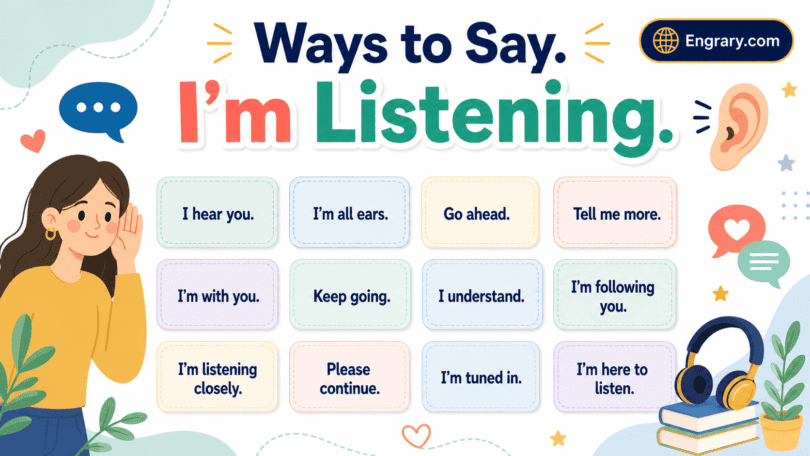
“I’m listening” is a simple phrase, but it can mean more than just hearing someone’s words. Sometimes, it shows that you are paying attention. In emotional moments, it can show care, patience, and support.
For example, “I’m all ears” sounds friendly and casual, while “I’m following your point” sounds more professional. Meanwhile, “I’m here to listen” feels warmer and more supportive. Therefore, this guide gives you 100 natural ways to say “I’m listening” with examples for everyday conversations, work, texts, emotional support, conflict, customer service, and active listening.
Best “I’m Listening” Phrases by Situation
| Situation | Best Phrase |
|---|---|
| General listening | I’m listening |
| Paying attention | I’m paying attention |
| Friendly interest | I’m all ears |
| Showing empathy | I hear you |
| Encouraging someone | Tell me more |
| Emotional support | I’m here to listen |
| Professional setting | I’m following your point |
| Active listening | Let me make sure I understand |
| Conflict or apology | I want to understand your side |
| Customer service | I understand your concern |
| Quick text | I’m here |
| Inviting more detail | What happened next? |
“I’m Listening” vs “I Hear You” vs “I’m All Ears”
These phrases all show attention, but they do not always feel the same. The right phrase depends on whether you want to sound casual, supportive, professional, or deeply engaged.
| Phrase | Meaning | Best Use |
|---|---|---|
| I’m listening | Direct and clear; shows attention | General conversations |
| I hear you | Empathetic and validating | Emotional talks, conflict, support |
| I’m all ears | Friendly, casual, and interested | Casual conversations |
| Go on | Short and encouraging, but can sound abrupt | Casual or neutral chats |
| Tell me more | Warm and curious | Friendly or supportive conversations |
| I’m paying attention | Direct and reassuring | When someone doubts you are listening |
| I’m following | Professional and focused | Meetings, work, explanations |
| Let me make sure I understand | Active-listening phrase | Serious, professional, or emotional talks |
Is “I’m Listening” Polite and Supportive?
Yes, “I’m listening” is polite and natural in many situations. It tells the other person that you are paying attention and are ready to hear what they want to say.
However, serious or emotional conversations often need warmer wording. Phrases like “I’m here to listen,” “Take your time,” or “I want to understand” can make the other person feel safer and more respected. In professional settings, phrases such as “I’m following your point” or “Let me make sure I understand” sound focused and thoughtful.
Everyday Phrases That Show You’re Paying Attention
These phrases work well in normal conversations when you want to show that you are present and following along.
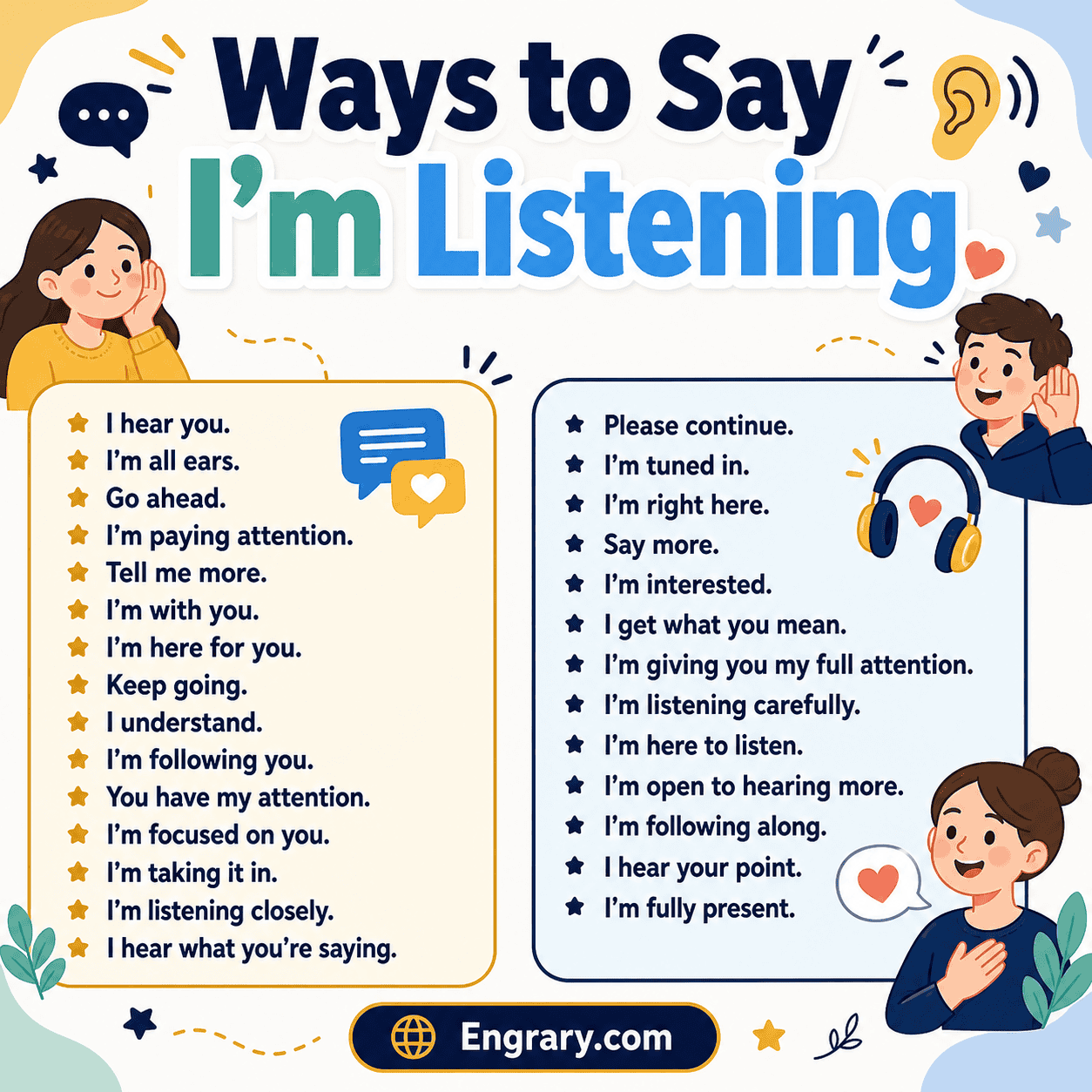
I’m listening
A direct phrase for showing attention.
Example: I’m listening. Go ahead.
I’m paying attention
A clear phrase when someone wants to know you are focused.
Example: I’m paying attention, so please continue.
I hear you
A natural phrase that shows you understand or are trying to understand.
Example: I hear you, and I understand why that matters.
Go on
A short phrase that invites someone to continue.
Example: Go on. What happened next?
Tell me more
A warm phrase that shows interest.
Example: Tell me more about what happened.
I’m all ears
A friendly phrase that means you are ready to listen.
Example: I’m all ears.
I’m following
A phrase that shows you understand the conversation so far.
Example: I’m following. Please continue.
Keep going
A simple phrase that encourages someone to continue speaking.
Example: Keep going. I want to hear the rest.
I’m with you
A natural phrase that means you are following the person’s words.
Example: I’m with you so far.
I’m focused on what you’re saying
A stronger phrase for showing full attention.
Example: I’m focused on what you’re saying.
Warm Responses That Make Someone Feel Heard
Use these phrases when someone needs empathy, patience, or emotional support.
I hear you
A warm phrase for showing empathy.
Example: I hear you, and that sounds difficult.
I understand
A simple phrase that shows you recognize what someone means.
Example: I understand why you feel that way.
That makes sense
A validating phrase for showing someone their feelings or thoughts are reasonable.
Example: That makes sense after what happened.
I can see why you feel that way
A thoughtful phrase for emotional understanding.
Example: I can see why you feel that way.
I’m here with you
A supportive phrase for difficult moments.
Example: I’m here with you.
You have my full attention
A strong phrase for showing focus and respect.
Example: You have my full attention.
I want to understand
A caring phrase that shows real interest.
Example: I want to understand what you’re going through.
I’m listening without judgment
A supportive phrase for safe conversations.
Example: I’m listening without judgment.
Take your time
A patient phrase that gives someone space.
Example: Take your time. I’m here.
I’m here to listen
A warm phrase for emotional support.
Example: I’m here to listen whenever you’re ready.
Professional Listening Phrases for Work
These phrases sound polished and focused in meetings, workplace chats, interviews, and professional conversations.
I’m following your point
A professional phrase for showing that you understand the speaker’s idea.
Example: I’m following your point.
I’m listening carefully
A clear phrase for focused attention.
Example: I’m listening carefully to your concerns.
I understand your concern
A professional phrase for showing empathy and attention.
Example: I understand your concern.
I want to make sure I understand
A thoughtful phrase for checking meaning.
Example: I want to make sure I understand the issue correctly.
Please continue
A polite phrase that invites someone to keep speaking.
Example: Please continue.
I’m taking note of this
A professional phrase that shows you are paying attention.
Example: I’m taking note of this.
I appreciate you explaining that
A respectful phrase for acknowledging someone’s explanation.
Example: I appreciate you explaining that.
Let me reflect what I’m hearing
An active-listening phrase for work discussions.
Example: Let me reflect what I’m hearing.
I’m focused on what you’re saying
A professional phrase for showing attention.
Example: I’m focused on what you’re saying.
I’d like to hear more about that
A polite phrase for asking for more detail.
Example: I’d like to hear more about that.
Active Listening Phrases for Better Conversations
Active listening means you do more than stay quiet. You show that you are understanding, checking meaning, and following the speaker’s thoughts.
Let me make sure I understand
A useful phrase for checking your understanding.
Example: Let me make sure I understand.
What I’m hearing is…
A phrase for summarizing what someone said.
Example: What I’m hearing is that you felt ignored.
It sounds like you’re saying…
A thoughtful phrase for reflecting someone’s point.
Example: It sounds like you’re saying the deadline felt unclear.
Can I repeat that back to make sure I got it?
A careful phrase for confirming understanding.
Example: Can I repeat that back to make sure I got it?
Tell me more about that
A warm phrase that invites more detail.
Example: Tell me more about that.
Can you explain what happened next?
A helpful question for continuing a story.
Example: Can you explain what happened next?
I want to understand your point
A respectful phrase for serious conversations.
Example: I want to understand your point.
Let me check if I understood correctly
A professional phrase for confirming meaning.
Example: Let me check if I understood correctly.
So, what you mean is…
A phrase for restating someone’s idea.
Example: So, what you mean is that the process felt rushed.
That sounds important
A phrase that shows attention and care.
Example: That sounds important.
Quick Text Replies That Show You’re Listening
These short replies work well in texts, chats, comments, and quick online conversations.
I’m listening
A short and clear reply.
Example: I’m listening.
Go on
A quick phrase that invites someone to continue.
Example: Go on.
Tell me
A short reply for inviting more detail.
Example: Tell me.
I hear you
A quick supportive response.
Example: I hear you.
I’m here
A warm short reply.
Example: I’m here.
Keep going
A quick phrase for encouraging someone.
Example: Keep going.
I’m all ears
A friendly text reply.
Example: I’m all ears.
Say more
A short phrase for asking someone to continue.
Example: Say more.
I’m with you
A quick phrase for showing you are following.
Example: I’m with you.
Take your time
A patient reply for emotional or thoughtful messages.
Example: Take your time.
Supportive Phrases for Emotional or Difficult Talks
These phrases help when someone is upset, overwhelmed, hurt, or sharing something personal.
I’m here for you
A caring phrase for emotional support.
Example: I’m here for you.
I’m here to listen
A warm phrase that invites someone to talk.
Example: I’m here to listen whenever you’re ready.
Take your time
A patient phrase for difficult conversations.
Example: Take your time. You don’t have to rush.
You can tell me
A gentle phrase that creates safety.
Example: You can tell me what happened.
I’m listening without judgment
A supportive phrase for sensitive topics.
Example: I’m listening without judgment.
I hear how hard this is
A validating phrase for difficult feelings.
Example: I hear how hard this is for you.
I want to understand
A caring phrase for emotional support.
Example: I want to understand how you feel.
You have my full attention
A strong phrase for showing presence.
Example: You have my full attention.
I’m not here to judge
A gentle phrase for making someone feel safe.
Example: I’m not here to judge.
Say whatever you need to say
A supportive phrase that gives someone space.
Example: Say whatever you need to say.
Calm Listening Phrases for Conflict or Apologies
Use these phrases when someone is upset, explaining their side, or sharing how your words or actions affected them.
I hear you
A calm phrase for acknowledging someone’s feelings.
Example: I hear you.
I’m listening
A direct phrase for showing attention.
Example: I’m listening. Please continue.
I want to understand your side
A respectful phrase for conflict or disagreement.
Example: I want to understand your side.
Tell me what happened
A calm phrase for asking someone to explain.
Example: Tell me what happened.
I’m open to hearing you out
A phrase for showing willingness to listen.
Example: I’m open to hearing you out.
I won’t interrupt
A reassuring phrase for giving someone space.
Example: I won’t interrupt.
I’m trying to understand
A calm phrase for showing effort.
Example: I’m trying to understand.
You’re right to bring this up
A validating phrase for conflict or apology conversations.
Example: You’re right to bring this up.
I appreciate you telling me
A respectful phrase for receiving difficult feedback.
Example: I appreciate you telling me.
Let me hear you fully
A thoughtful phrase for listening without cutting someone off.
Example: Let me hear you fully.
Customer Service Phrases That Show Attention
These phrases work well for customer support, client conversations, service roles, and professional problem-solving.
I understand your concern
A professional phrase for showing attention and empathy.
Example: I understand your concern.
I’m listening and ready to help
A service-friendly phrase for support conversations.
Example: I’m listening and ready to help.
I appreciate you explaining the issue
A polite phrase for customer communication.
Example: I appreciate you explaining the issue.
I’m taking note of this
A professional phrase for showing you are recording details.
Example: I’m taking note of this.
Thank you for sharing that with me
A respectful phrase for receiving information.
Example: Thank you for sharing that with me.
I want to make sure I understand the problem
A careful phrase for customer support.
Example: I want to make sure I understand the problem.
Please continue
A polite phrase for letting someone explain.
Example: Please continue.
I hear what you’re saying
A customer-service phrase for acknowledgment.
Example: I hear what you’re saying.
Let me make sure I have the details right
A careful phrase for confirming information.
Example: Let me make sure I have the details right.
I’m here to help
A supportive phrase for service interactions.
Example: I’m here to help.
Questions That Help Someone Keep Talking
Questions can show that you are listening because they invite the other person to share more clearly.
What happened next?
A simple question that invites more detail.
Example: What happened next?
Can you tell me more?
A warm question for continuing the conversation.
Example: Can you tell me more?
How did that make you feel?
A supportive question for emotional conversations.
Example: How did that make you feel?
What would you like me to understand?
A thoughtful question for deep listening.
Example: What would you like me to understand?
What do you need from me right now?
A helpful question for support.
Example: What do you need from me right now?
Can you explain that a little more?
A polite question for more clarity.
Example: Can you explain that a little more?
What did you mean by that?
A direct question for understanding meaning.
Example: What did you mean by that?
What should I know about this?
A useful question for important details.
Example: What should I know about this?
Is there more you want to share?
A gentle question for continuing.
Example: Is there more you want to share?
Would you like to keep talking?
A respectful question that gives the other person choice.
Example: Would you like to keep talking?
“I’m Listening” Phrases You Should Use Carefully
Some listening phrases can sound impatient, dismissive, or confrontational if used in the wrong tone.
| Phrase | Why to Use Carefully | Better Situation |
|---|---|---|
| Go on | Can sound abrupt | Neutral or casual conversations |
| I’m waiting | Can sound impatient | Avoid in sensitive talks |
| What do you have to say for yourself? | Sounds accusatory | Avoid |
| Speak | Sounds commanding | Avoid |
| I hear you | Can sound dismissive if overused | Use with real follow-up |
| I’m all ears | Too casual for serious moments | Friendly conversations |
| Get to the point | Rude or impatient | Avoid |
| Fine, I’m listening | Sounds annoyed | Avoid |
| Explain yourself | Can sound confrontational | Use “tell me what happened” |
| Make it quick | Dismissive | Avoid |
Common Mistakes with Listening Phrases
Many English learners use short phrases like “go on” or “I’m listening” in every situation. Although these phrases are correct, emotional or serious conversations often need warmer wording.
In sensitive moments, avoid impatient phrases like “get to the point,” “make it quick,” or “I’m waiting.” Instead, use supportive options such as “Take your time,” “I want to understand,” or “I’m listening without judgment.” Also, do not say “I hear you” without showing real understanding through a follow-up question or reflection.
Real Conversation Examples
Everyday conversation
A: Can I tell you something?
B: I’m listening. Go ahead.
Emotional support
A: I don’t know how to explain this.
B: Take your time. I’m here to listen.
Professional meeting
A: I want to explain the issue.
B: I’m following your point. Please continue.
Conflict or apology
A: I felt ignored yesterday.
B: I hear you. I want to understand your side.
Customer service
A: I’ve had the same issue three times.
B: I understand your concern, and I’m taking note of this.
Best “I’m Listening” Alternatives by Situation
| Situation | Better Phrase |
|---|---|
| General listening | I’m listening |
| Paying attention | I’m paying attention |
| Friendly interest | I’m all ears |
| Emotional support | I’m here to listen |
| Showing empathy | I hear you |
| Professional setting | I’m following your point |
| Active listening | Let me make sure I understand |
| Conflict or apology | I want to understand your side |
| Customer service | I understand your concern |
| Quick text | I’m here |
| Inviting more detail | Tell me more |
| Supportive question | What would you like me to understand? |
How to Pick the Right Listening Phrase
Choose your phrase based on the moment. For casual conversations, “I’m listening,” “I’m all ears,” and “Tell me more” sound natural and friendly.
For emotional support, use warmer phrases like “I’m here to listen,” “Take your time,” or “I’m listening without judgment.” In professional settings, choose focused wording such as “I’m following your point,” “Let me make sure I understand,” or “I appreciate you explaining that.”
Summary
“I’m listening” can show attention, empathy, patience, or professional focus. The best phrase depends on whether the person needs a quick reply, emotional support, active listening, or a polished workplace response.
For everyday conversations, use “I’m listening,” “Tell me more,” or “I’m all ears.” In difficult talks, try “I’m here to listen,” “I want to understand,” or “Take your time.” For work and customer service, choose phrases like “I’m following your point,” “I understand your concern,” or “Let me make sure I understand.”
FAQs
Another way to say “I’m listening” is “I’m all ears.” You can also say “I hear you,” “tell me more,” “I’m paying attention,” or “I’m here to listen.”
A professional way to say “I’m listening” is “I’m following your point.” You can also say “I understand your concern,” “I’m taking note of this,” or “Let me make sure I understand.”
A polite way to say “I’m listening” is “You have my full attention.” You can also say “Please continue,” “I want to understand,” or “Take your time.”
“I hear you” means you understand or acknowledge what someone is saying. It often sounds empathetic, but it should be followed by real attention or a helpful response.
You can show real listening by asking follow-up questions, summarizing what you heard, avoiding interruptions, and using phrases like “Let me make sure I understand” or “What I’m hearing is…”
You May Also Like