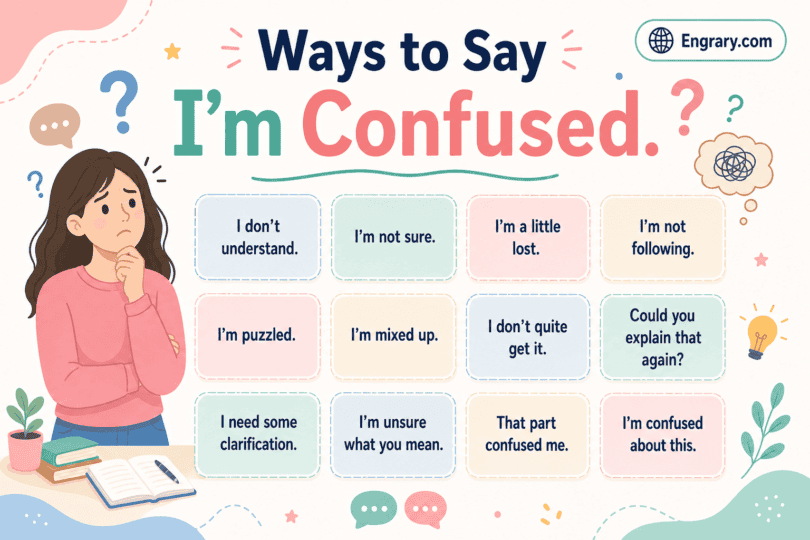
“I’m confused” is natural and easy to understand. However, it is not always the best phrase for every situation. In English, confusion can sound polite, casual, professional, funny, mild, or serious depending on the context.
For example, “I’m a bit confused” sounds polite, while “Could you clarify that?” sounds professional. Meanwhile, “I don’t get it” sounds casual and direct. Therefore, this guide gives you 120 natural ways to say “I’m confused” with examples for daily conversations, texts, work, school, instructions, meetings, and technical situations.
Best Ways to Say “I’m Confused”
| Situation | Best Phrase |
|---|---|
| Simple confusion | I’m confused |
| Polite confusion | I’m a bit confused |
| Professional setting | Could you clarify that? |
| Casual confusion | I don’t get it |
| Strong confusion | I’m completely lost |
| Mild confusion | I’m not sure I follow |
| Classroom confusion | I don’t understand this part |
| Work or meeting confusion | I’m not clear on the next step |
| Instructions or directions | I’m not sure what to do next |
| Asking for help | Could you explain that again? |
Confused vs Puzzled vs Baffled vs Lost
| Phrase | Meaning | Best Use |
|---|---|---|
| Confused | You do not understand clearly | Everyday situations |
| Puzzled | You are thinking but still unsure | Mild confusion |
| Baffled | You are very confused or surprised | Strong confusion |
| Lost | You cannot follow an idea, lesson, or process | Learning, meetings, and directions |
| Stumped | You cannot solve or answer something | Problems, questions, and tasks |
| Unclear | Something is not easy to understand | Polite or professional settings |
Is “I’m Confused” Natural and Polite?
Yes, “I’m confused” is natural in everyday English. You can use it with friends, family, classmates, coworkers, and people you know well.
However, polite or professional situations often need softer wording. Instead of saying “I’m confused” directly, you can say “I’m not sure I understand,” “Could you clarify that?” or “I’d appreciate some clarification.” As a result, your message sounds more respectful and solution-focused.
Everyday Ways to Say “I’m Confused”
These phrases work well in normal conversations. Also, they help you explain that you do not understand something clearly.
I’m confused
A simple and direct phrase for not understanding something.
Example: I’m confused about what happened.
I don’t understand
A clear phrase when something does not make sense to you.
Example: I don’t understand the last part.
I’m not sure I understand
A softer phrase for everyday confusion.
Example: I’m not sure I understand what you mean.
I’m having trouble following
A natural phrase when an explanation feels hard to follow.
Example: I’m having trouble following this story.
I’m not following
A common phrase when you cannot keep up with the explanation.
Example: I’m not following the main point.
This is confusing
A direct phrase for something that is hard to understand.
Example: This is confusing.
I’m unsure about this
A phrase for confusion mixed with doubt.
Example: I’m unsure about this decision.
I don’t know what this means
A simple phrase for unclear information.
Example: I don’t know what this means.
I can’t make sense of this
A natural phrase when something feels unclear or disorganized.
Example: I can’t make sense of this message.
I’m trying to understand
A phrase that shows effort while expressing confusion.
Example: I’m trying to understand the situation.
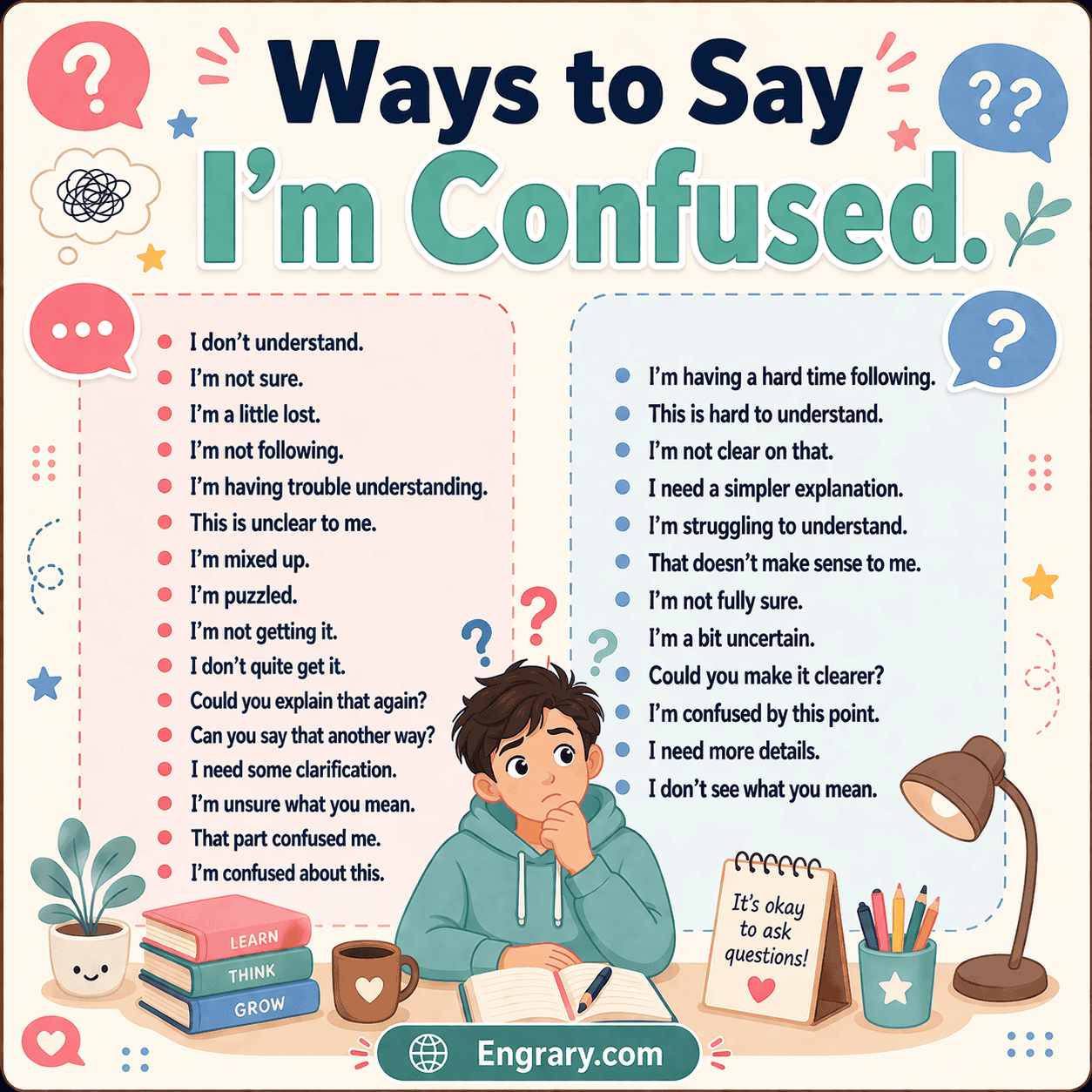
Polite Ways to Say “I’m Confused”
Use these phrases when you want to sound respectful, gentle, or less direct. In addition, they help you ask for help without sounding rude.
I’m a bit confused
A polite phrase for mild confusion.
Example: I’m a bit confused about the instructions.
I’m not sure I follow
A soft phrase when you do not fully understand.
Example: I’m not sure I follow your point.
I may be misunderstanding
A polite phrase that avoids blaming the other person.
Example: I may be misunderstanding the request.
I may need a little clarification
A gentle phrase for asking someone to explain more.
Example: I may need a little clarification on this.
This part is not clear to me
A respectful phrase for pointing out a confusing part.
Example: This part is not clear to me.
Could you explain that again?
A polite question for asking someone to repeat an explanation.
Example: Could you explain that again?
Could you say that another way?
A polite phrase for asking for a simpler explanation.
Example: Could you say that another way?
I want to make sure I understand correctly
A respectful phrase that shows care and attention.
Example: I want to make sure I understand correctly.
Would you mind clarifying that?
A polite question for asking for more explanation.
Example: Would you mind clarifying that?
I think I’m missing something
A gentle phrase for saying you do not fully understand.
Example: I think I’m missing something here.
Professional Ways to Say “I’m Confused”
These phrases work well in emails, meetings, workplace chats, and professional conversations. Therefore, they help you sound clear without seeming careless.
Could you clarify that point?
A professional phrase for asking about a specific point.
Example: Could you clarify that point before we continue?
I’d appreciate some clarification
A polished phrase for emails or formal messages.
Example: I’d appreciate some clarification on the timeline.
I’m not fully following the process
A professional phrase when a process feels unclear.
Example: I’m not fully following the process yet.
Could you walk me through this?
A workplace-friendly phrase for asking for step-by-step help.
Example: Could you walk me through this part?
I may need more context
A professional phrase when you need background information.
Example: I may need more context before responding.
I want to make sure I’m aligned
A polished phrase for confirming shared understanding.
Example: I want to make sure I’m aligned with the plan.
Could you explain the next step?
A clear phrase for workplace or project confusion.
Example: Could you explain the next step?
I’m not clear on the expectations
A professional phrase when responsibilities feel unclear.
Example: I’m not clear on the expectations for this task.
I’d like to confirm my understanding
A professional phrase for checking whether you understood correctly.
Example: I’d like to confirm my understanding before moving forward.
Could you provide an example?
A useful phrase when an example would make something clearer.
Example: Could you provide an example of what you mean?
Casual Ways to Say “I’m Confused”
These phrases sound relaxed and natural. Therefore, they work best with friends, family, classmates, or close coworkers.
I don’t get it
A casual phrase for not understanding something.
Example: I don’t get it.
I’m lost
A casual phrase when you cannot follow the explanation.
Example: I’m lost after that last part.
Wait, what?
A short casual phrase for sudden confusion.
Example: Wait, what?
What do you mean?
A direct casual question for clarification.
Example: What do you mean by that?
That confused me
A simple phrase for something that caused confusion.
Example: That confused me a little.
I’m so confused
A casual phrase for stronger confusion.
Example: I’m so confused right now.
I have no idea what’s going on
A casual phrase for not understanding the situation.
Example: I have no idea what’s going on.
You lost me
A casual phrase when someone’s explanation became hard to follow.
Example: You lost me after the second step.
I’m mixed up
A casual phrase for confusion about details.
Example: I’m mixed up about the dates.
This is throwing me off
A casual phrase when something disrupts your understanding.
Example: This is throwing me off.
Short Confused Texts and Quick Replies
Use these phrases in texts, chats, and quick replies. Moreover, they work well when you need a fast response.
I’m confused.
A simple short text for confusion.
Example: I’m confused.
Huh?
A very short casual reply for confusion.
Example: Huh?
Wait, what?
A quick text when something surprises or confuses you.
Example: Wait, what?
I don’t get it.
A short casual reply when you do not understand.
Example: I don’t get it.
What does that mean?
A quick question for clarification.
Example: What does that mean?
I’m lost.
A short phrase when you cannot follow.
Example: I’m lost.
Can you explain?
A short message for asking for help.
Example: Can you explain?
That makes no sense to me.
A direct phrase when something feels unclear.
Example: That makes no sense to me.
Make it make sense.
A very casual phrase for confusing information.
Example: Make it make sense.
I’m confused rn.
A casual text phrase for “I’m confused right now.”
Example: I’m confused rn.
Strong Confusion Phrases
Use these phrases when the confusion feels intense. However, save the strongest phrases for moments that truly feel difficult to understand.
I’m completely lost
A strong phrase when you cannot follow at all.
Example: I’m completely lost after that explanation.
I’m totally confused
A direct phrase for strong confusion.
Example: I’m totally confused right now.
I’m baffled
A strong phrase for being very confused or surprised.
Example: I’m baffled by this decision.
I’m bewildered
A formal or emotional phrase for deep confusion.
Example: I’m bewildered by what happened.
I can’t make sense of any of this
A strong phrase when nothing seems clear.
Example: I can’t make sense of any of this.
Nothing makes sense right now
A phrase for overwhelming confusion.
Example: Nothing makes sense right now.
I don’t know what’s going on
A natural phrase for confusing situations.
Example: I don’t know what’s going on.
I’m at a loss
A phrase for not knowing what to say or do.
Example: I’m at a loss here.
This is too much to take in
A phrase for confusion mixed with overwhelm.
Example: This is too much to take in.
My brain is not processing this
A casual phrase for strong or funny confusion.
Example: My brain is not processing this.
Mild Confusion Phrases
Use these phrases when you are only slightly confused. As a result, your wording sounds calm and polite.
I’m a little confused
A simple phrase for mild confusion.
Example: I’m a little confused about the schedule.
I’m slightly confused
A polite phrase for light confusion.
Example: I’m slightly confused by the wording.
I’m not quite sure
A gentle phrase for uncertainty.
Example: I’m not quite sure what you mean.
This is a little unclear
A mild phrase for something that needs more explanation.
Example: This is a little unclear to me.
I’m not totally sure I understand
A soft phrase for partial confusion.
Example: I’m not totally sure I understand the last point.
I’m a little unsure
A calm phrase for uncertainty.
Example: I’m a little unsure about the answer.
I might be missing something
A polite phrase for mild confusion.
Example: I might be missing something here.
This part seems unclear
A gentle phrase for pointing out confusion.
Example: This part seems unclear.
I’m still trying to follow
A phrase that shows you are making an effort.
Example: I’m still trying to follow the explanation.
I need a moment to process this
A phrase for mild overwhelm or slow understanding.
Example: I need a moment to process this.
Ways to Ask for Clarification
Sometimes, saying “I’m confused” is not enough. Instead, ask for clarification so the other person knows how to help.
Can you explain that again?
A simple question for another explanation.
Example: Can you explain that again?
Could you explain it another way?
A polite question for a clearer explanation.
Example: Could you explain it another way?
What do you mean by that?
A direct question for meaning.
Example: What do you mean by that?
Could you give me an example?
A helpful question when an example would make things clearer.
Example: Could you give me an example?
Can you break that down?
A casual question for a simpler explanation.
Example: Can you break that down for me?
What am I missing?
A natural question when you think you missed a key point.
Example: What am I missing here?
Can you walk me through it?
A useful question for step-by-step help.
Example: Can you walk me through it?
Could you make that clearer?
A direct but polite request for clarity.
Example: Could you make that clearer?
Can you simplify that?
A practical question for easier wording.
Example: Can you simplify that for me?
Could you go over that again?
A polite question for repeating an explanation.
Example: Could you go over that again?
Confused in Class or Learning Situations
These phrases work well for students, lessons, teachers, tutors, and study situations. In addition, they help you ask for help without sounding rude.
I don’t understand this part
A clear phrase for classroom confusion.
Example: I don’t understand this part of the lesson.
I’m stuck on this question
A phrase for not knowing how to answer.
Example: I’m stuck on this question.
Could you explain this again?
A polite classroom phrase for another explanation.
Example: Could you explain this again?
This lesson is confusing
A direct phrase when a lesson feels hard to understand.
Example: This lesson is confusing.
I’m having trouble following the lesson
A phrase for difficulty keeping up.
Example: I’m having trouble following the lesson.
I don’t get this concept
A casual phrase for not understanding an idea.
Example: I don’t get this concept.
Could you show another example?
A useful question when you need more practice.
Example: Could you show another example?
I’m confused about the formula
A specific phrase for academic confusion.
Example: I’m confused about the formula.
I need help with this part
A simple phrase for asking for help.
Example: I need help with this part.
I’m not sure how to solve this
A phrase for problem-solving confusion.
Example: I’m not sure how to solve this.
Confused at Work or in Meetings
These phrases help you sound professional during meetings, project discussions, and workplace conversations. Meanwhile, they keep the focus on clarity rather than blame.
I’m not following the last point
A professional phrase for meeting confusion.
Example: I’m not following the last point.
Could you repeat the action item?
A clear phrase for confirming a task.
Example: Could you repeat the action item?
I’m not clear on the deadline
A workplace phrase for deadline confusion.
Example: I’m not clear on the deadline.
Could you clarify the priority?
A professional phrase for understanding what matters most.
Example: Could you clarify the priority?
I’m unsure what you need from me
A clear phrase for task-related confusion.
Example: I’m unsure what you need from me.
Can we go over the next step?
A workplace phrase for process confusion.
Example: Can we go over the next step?
I want to make sure I understand the request
A professional phrase for confirming details.
Example: I want to make sure I understand the request.
I’m not clear on who owns this task
A phrase for ownership or responsibility confusion.
Example: I’m not clear on who owns this task.
Could you explain the goal again?
A workplace phrase for clarifying purpose.
Example: Could you explain the goal again?
I may need more detail on this
A professional phrase for requesting more information.
Example: I may need more detail on this before moving forward.
Confused by Instructions or Directions
Use these phrases when steps, directions, or instructions do not feel clear. Therefore, they work well for tasks, forms, travel, and processes.
The instructions are unclear
A direct phrase for confusing instructions.
Example: The instructions are unclear.
I’m not sure what to do next
A phrase for step-by-step confusion.
Example: I’m not sure what to do next.
I’m stuck on step two
A specific phrase for process confusion.
Example: I’m stuck on step two.
I can’t figure out where to start
A phrase for confusion at the beginning of a task.
Example: I can’t figure out where to start.
The directions are confusing
A phrase for unclear directions.
Example: The directions are confusing.
I’m not sure which option to choose
A phrase for choice-related confusion.
Example: I’m not sure which option to choose.
I don’t know where this leads
A phrase for direction or process confusion.
Example: I don’t know where this leads.
Can you guide me through this?
A polite question for help with steps.
Example: Can you guide me through this?
I’m not sure I’m doing this right
A phrase for uncertainty while doing a task.
Example: I’m not sure I’m doing this right.
I need clearer instructions
A direct phrase for asking for better guidance.
Example: I need clearer instructions.
Technical or Digital Confusion Phrases
These phrases work well when apps, websites, devices, settings, or software feel confusing. Also, they help you ask for technical support clearly.
I can’t figure out how this works
A natural phrase for technical confusion.
Example: I can’t figure out how this works.
I’m confused by this setting
A phrase for confusion about an app or tool setting.
Example: I’m confused by this setting.
I don’t know which button to click
A phrase for interface confusion.
Example: I don’t know which button to click.
The interface is confusing
A phrase for confusing design or layout.
Example: The interface is confusing.
I’m stuck on this screen
A phrase for being unable to move forward digitally.
Example: I’m stuck on this screen.
I can’t find the right option
A phrase for not seeing the correct choice.
Example: I can’t find the right option.
I’m not sure what this error means
A phrase for technical error confusion.
Example: I’m not sure what this error means.
This feature is confusing
A direct phrase for unclear digital features.
Example: This feature is confusing.
I need help navigating this
A phrase for needing help using a system or app.
Example: I need help navigating this.
I don’t understand the setup process
A phrase for onboarding or installation confusion.
Example: I don’t understand the setup process.
Idioms for Confusion
Idioms can make your English sound more expressive. However, use them carefully because some are casual or figurative.
I’m at a loss
This means you do not know what to say or do.
Example: I’m at a loss for words.
I’m in the dark
This means you do not have enough information.
Example: I’m in the dark about the decision.
It’s all Greek to me
This means something is very hard to understand.
Example: This report is all Greek to me.
I’m at sea
This means you feel very confused.
Example: I’m at sea with these instructions.
I can’t wrap my head around it
This means you cannot fully understand something.
Example: I can’t wrap my head around it.
I’m going in circles
This means you keep thinking but make no progress.
Example: I’m going in circles trying to solve this.
I’m drawing a blank
This means you cannot remember or think of the answer.
Example: I’m drawing a blank.
I’m scratching my head
This means you feel puzzled.
Example: I’m scratching my head over this.
I’m lost in the weeds
This means too many details have made things confusing.
Example: I’m lost in the weeds here.
I can’t see the forest for the trees
This means you focus on details and miss the bigger picture.
Example: I can’t see the forest for the trees.
Phrases to Use Carefully
Some confusion phrases can sound rude, sarcastic, too casual, or too dramatic depending on the situation. Therefore, use the phrases below carefully.
| Phrase | Why to Use Carefully | Better Situation |
|---|---|---|
| This makes no sense | Can sound blunt or rude | Use casually or soften it |
| What are you talking about? | Can sound confrontational | Use with close people only |
| I don’t get it | Too casual for formal settings | Friends, texts, or casual learning |
| Make it make sense | Very informal or sarcastic | Social media or close friends |
| I’m clueless | Can sound self-deprecating | Casual conversations |
| I’m dumbfounded | Strong and dramatic | Surprising or serious confusion |
| I’m lost | Can sound unprepared at work | Learning or casual situations |
Common Mistakes When Saying “I’m Confused”
Many English learners use “I’m confused” for every situation. While the phrase is correct, it can sound repetitive or too direct in professional settings.
In formal situations, avoid blunt phrases like “This makes no sense” or “What are you talking about?” Instead, use softer wording such as “I’m not sure I understand” or “Could you clarify that?”
Also, try to explain which part confuses you. For example, “I’m confused about the deadline” sounds more helpful than only saying “I’m confused.”
Natural Conversation Examples
Casual conversation
A: We changed the plan again.
B: Wait, what? I’m lost.
Professional conversation
A: We’ll move this task after the second review.
B: Could you clarify the next step?
Classroom conversation
A: Now use this formula to solve the problem.
B: I’m confused about the formula.
Text message
A: Meet me where we met before, but not the usual place.
B: I’m confused. What does that mean?
Technical support
A: Click the advanced setup option.
B: I’m not sure which button to click.
What to Say Instead of “I’m Confused” in Different Situations
| Situation | Better Phrase |
|---|---|
| Professional email | Could you clarify that point? |
| Polite conversation | I’m not sure I understand |
| Casual chat | I don’t get it |
| Text message | Wait, what? |
| Classroom | I don’t understand this part |
| Meeting | I’m not following the last point |
| Instructions | I’m not sure what to do next |
| Technical issue | I’m stuck on this screen |
| Strong confusion | I’m completely lost |
| Asking for help | Could you explain that another way? |
How to Choose the Right Confusion Phrase
Choose your phrase based on the situation, your relationship with the listener, and how confused you feel. If the situation is professional, use polite phrases like “Could you clarify that?” or “I’d appreciate some clarification.”
With friends or in texts, casual phrases like “I don’t get it,” “Wait, what?” or “I’m lost” sound more natural. However, when you need help, asking a clear question like “Could you explain that again?” often works better than only saying “I’m confused.”
Summary
There are many ways to say “I’m confused,” and the best phrase depends on your tone, situation, and level of confusion. For everyday use, “I don’t understand,” “I’m not following,” and “This is confusing” are simple and clear.
However, polite or professional situations often need softer phrases like “I’m not sure I understand,” “Could you clarify that?” or “I’d appreciate some clarification.” If you need help, use clarification questions such as “Could you explain it another way?” or “Can you walk me through it?”
FAQs
Another way to say “I’m confused” is “I’m not sure I understand.” You can also say “I’m puzzled,” “I’m lost,” “I’m not following,” or “I can’t make sense of this.”
A polite way to say “I’m confused” is “I’m a bit confused.” You can also say “I’m not sure I understand,” “I may need a little clarification,” or “Could you explain that again?”
A professional way to say “I’m confused” is “Could you clarify that point?” Other professional options include “I’d appreciate some clarification,” “I’m not fully following the process,” and “I may need more context.”
“Confused” means you do not understand something clearly. “Puzzled” usually means you are thinking about something but still feel unsure.
You can ask, “Could you clarify that?” “Could you explain it another way?” or “Would you mind explaining that again?” These questions sound polite and helpful.
You May Also Like