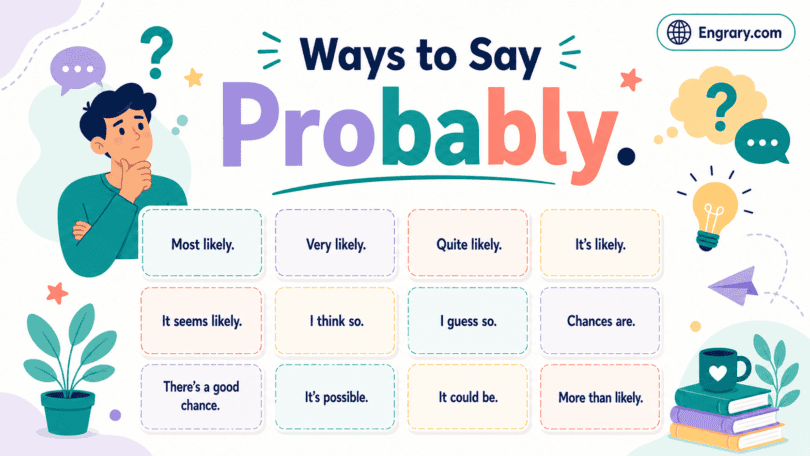
“Probably” means something is likely, but not fully certain. It helps you express a careful guess, a future prediction, a polite opinion, or an evidence-based assumption without sounding too sure.
The best alternative depends on confidence level, tone, setting, and purpose. Some phrases sound casual, some work better in professional emails, and others fit reports, academic writing, predictions, or quick text replies. Below are 150 natural ways to say “probably” with meanings and examples.
Best Probably Phrase by Situation
| Situation | Better Phrase |
|---|---|
| Simple likelihood | Most likely. |
| Polite reply | It seems likely. |
| Work email | Based on what we know. |
| Report writing | It is probable that. |
| Casual text | I think so. |
| Future prediction | Chances are. |
| Evidence-based guess | As far as I can tell. |
| Strong probability | Almost certainly. |
| Weak probability | Possibly. |
| Professional forecast | The most likely outcome is. |
Probably vs Maybe vs Likely vs Presumably
| Phrase | Confidence Level | Best Use |
|---|---|---|
| Probably | Medium-high confidence. | When something is likely but not certain. |
| Maybe | Low to medium confidence. | When something is possible but uncertain. |
| Likely | Medium-high confidence. | Polite, professional, or neutral likelihood. |
| Presumably | Assumption based on evidence. | When something seems true based on available information. |
Is “Probably” Polite and Professional?
“Probably” is natural and polite in many everyday situations. It works well in casual conversations, simple replies, and general predictions.
In professional emails, reports, or formal writing, more precise phrases like it is likely that, based on what we know, the most likely outcome is, or it is probable that may sound clearer and more polished.
Simple Alternatives to Probably
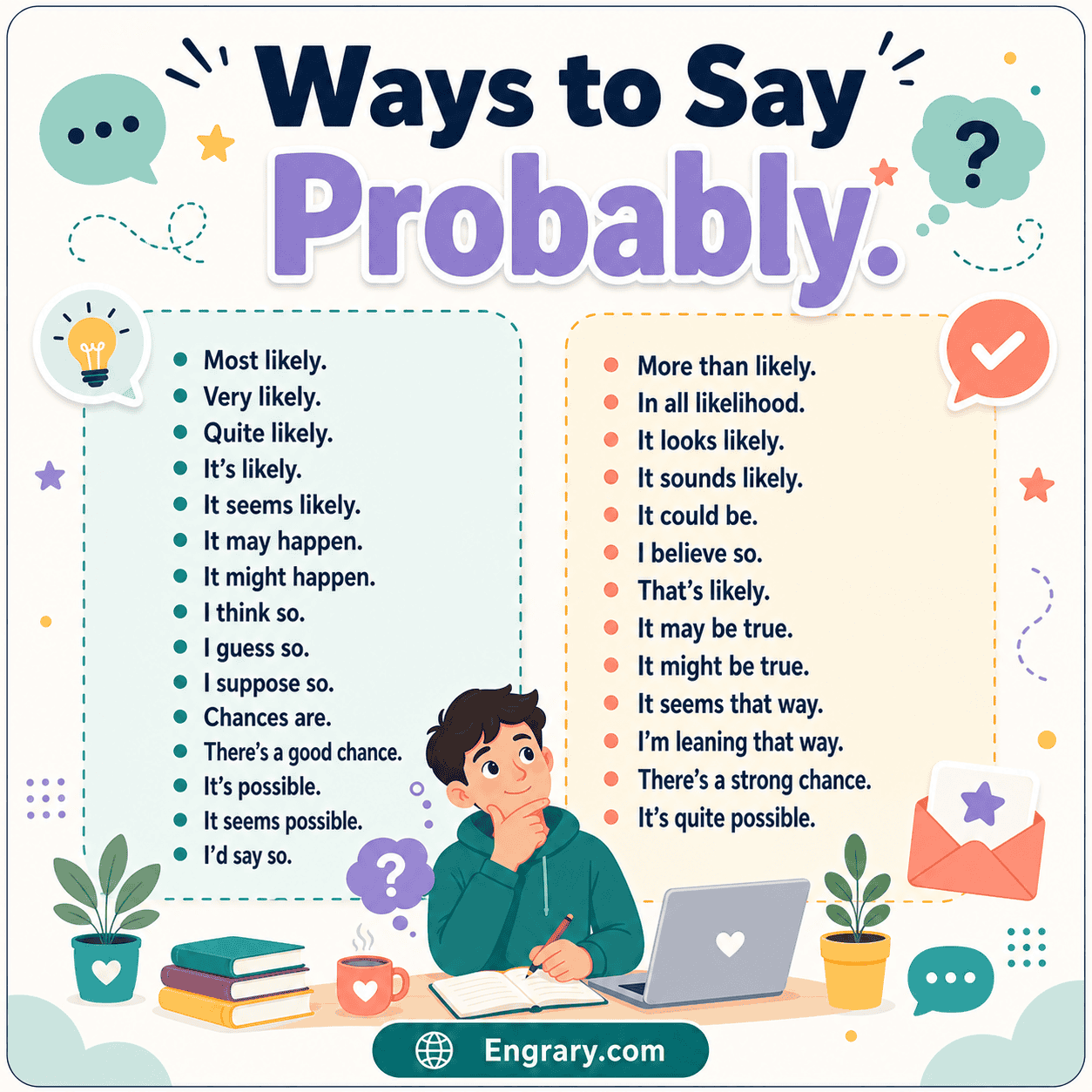
Use these phrases for everyday likelihood.
Likely
A simple word for something that will probably happen.
Example: It is likely to rain later.
Most likely
A natural phrase for something with a strong chance.
Example: Most likely, she will join us.
Probably so
A simple spoken phrase for agreeing with likelihood.
Example: Probably so.
There’s a good chance
A natural phrase for something likely but not certain.
Example: There’s a good chance we’ll finish today.
It seems likely
A careful phrase when something appears probable.
Example: It seems likely that they will agree.
It’s likely
A short and clear phrase for probability.
Example: It’s likely.
I think so
A simple phrase for a likely answer.
Example: I think so.
Chances are
A natural phrase for likely outcomes.
Example: Chances are, he already knows.
It should be likely
A simple phrase for something expected to be true.
Example: It should be likely if the plan stays the same.
That’s likely
A short phrase for agreeing that something may happen.
Example: That’s likely.
Polite Ways to Say Probably
Use these phrases when you want to sound careful and respectful.
It seems likely
A polite phrase for careful probability.
Example: It seems likely.
I think that’s likely
A respectful phrase for giving a cautious answer.
Example: I think that’s likely.
There’s a good chance
A polite phrase when something may happen.
Example: There’s a good chance that will work.
As far as I can tell
A careful phrase based on what you know.
Example: As far as I can tell, everything is ready.
It appears likely
A polished phrase for probability.
Example: It appears likely that the plan will change.
I would say so
A polite spoken phrase for likely agreement.
Example: I would say so.
That seems probable
A careful phrase for saying something is likely.
Example: That seems probable.
It looks likely
A natural phrase when signs point to something happening.
Example: It looks likely.
I believe that’s likely
A polite phrase for sharing a careful opinion.
Example: I believe that’s likely.
It may be likely
A cautious phrase for careful probability.
Example: It may be likely if the numbers stay the same.
Professional Phrases for Work and Emails
Use these phrases for coworkers, clients, reports, meetings, forecasts, and careful updates.
Based on what we know
A professional phrase for an evidence-based answer.
Example: Based on what we know, the launch will likely stay on schedule.
It is likely that
A polished phrase for professional writing.
Example: It is likely that we will need more time.
The most likely outcome is
A professional phrase for forecasts or predictions.
Example: The most likely outcome is a short delay.
At this stage, it seems likely
A careful phrase for updates when things may change.
Example: At this stage, it seems likely that the deadline will move.
I would expect that
A professional phrase for a reasoned prediction.
Example: I would expect that the report will be ready tomorrow.
Current signs suggest
A polished phrase based on available evidence.
Example: Current signs suggest the issue is improving.
The data suggests
A professional phrase when evidence supports a likely result.
Example: The data suggests a positive trend.
It is reasonable to expect
A formal phrase for a likely result.
Example: It is reasonable to expect a small increase.
Our current expectation is
A professional phrase for a likely business outcome.
Example: Our current expectation is that the update will ship next week.
From a practical standpoint, it seems likely
A careful phrase for professional judgment.
Example: From a practical standpoint, it seems likely that we’ll need extra support.
Casual Ways to Say Probably
Use these phrases for friends, family, classmates, and everyday chats.
I think so
A casual phrase for a likely answer.
Example: I think so.
Most likely
A relaxed phrase for something likely.
Example: Most likely.
I’d say so
A casual phrase for saying something is probably true.
Example: I’d say so.
Probably, yeah
A casual spoken phrase for likely agreement.
Example: Probably, yeah.
Chances are
A casual phrase for a likely result.
Example: Chances are, they forgot.
Could be
A casual phrase for something possible or likely.
Example: Could be.
I guess so
A relaxed phrase for uncertain agreement.
Example: I guess so.
Looks like it
A casual phrase when something seems likely.
Example: Looks like it.
Seems like it
A relaxed phrase when signs point to yes.
Example: Seems like it.
I’d bet so
A casual phrase for strong likelihood.
Example: I’d bet so.
Short Text Replies and Quick Uncertainty Phrases
Use these short phrases for messages, chats, comments, and quick replies.
Probably.
Use this for a simple likely answer.
Most likely.
Use this when something has a strong chance.
I think so.
Use this for a short polite reply.
Could be.
Use this when something may be true.
I’d say so.
Use this for a casual likely answer.
Looks likely.
Use this when signs point to yes.
Probably not.
Use this when something is unlikely.
Maybe.
Use this when your confidence is lower.
Likely.
Use this for a short confident reply.
Seems likely.
Use this for a careful quick answer.
Prediction and Future-Likelihood Phrases
Use this section when talking about what may happen next.
It will likely happen
A clear phrase for a future prediction.
Example: It will likely happen next week.
Chances are, it will happen
A natural phrase for a likely future event.
Example: Chances are, it will happen soon.
It’s probably going to happen
A common spoken phrase for a likely future event.
Example: It’s probably going to happen.
There’s a good chance it will happen
A clear phrase for likely future possibility.
Example: There’s a good chance it will happen.
I expect it will happen
A confident phrase for a prediction.
Example: I expect it will happen by Friday.
It should happen soon
A natural phrase for a likely expected result.
Example: It should happen soon.
It is expected to happen
A more formal phrase for a predicted event.
Example: It is expected to happen next month.
It may well happen
A polished phrase for something quite possible.
Example: It may well happen.
It is likely to happen
A clear phrase for future likelihood.
Example: It is likely to happen this year.
The odds suggest it will happen
A stronger phrase for probability based on likelihood.
Example: The odds suggest it will happen.
Evidence-Based Assumption Phrases
Use this section when your answer is based on clues, facts, or available information.
Presumably
A word for an assumption based on available information.
Example: Presumably, they already left.
I’d assume so
A natural phrase for an evidence-based guess.
Example: I’d assume so.
Based on what we know
A careful phrase for a reasoned assumption.
Example: Based on what we know, the plan is still active.
As far as I can tell
A cautious phrase based on current information.
Example: As far as I can tell, nothing has changed.
From what I’ve seen
A natural phrase based on observation.
Example: From what I’ve seen, it should work.
From the available information
A formal phrase for a careful assumption.
Example: From the available information, the results look positive.
It appears that
A polished phrase for something that seems true.
Example: It appears that the issue is fixed.
It seems reasonable to assume
A careful phrase based on logic or evidence.
Example: It seems reasonable to assume they agree.
All signs point to
A natural phrase when evidence suggests one result.
Example: All signs point to a delay.
The situation suggests
A professional phrase for an evidence-based assumption.
Example: The situation suggests that more time is needed.
Formal Writing Alternatives to Probably
Use these phrases for essays, reports, academic writing, and polished communication.
It is probable that
A formal phrase for saying something is likely.
Example: It is probable that demand will increase.
In all likelihood
A polished phrase for strong probability.
Example: In all likelihood, the project will continue.
In all probability
A formal phrase for something likely.
Example: In all probability, the decision will change.
It is reasonable to assume that
A formal phrase for an evidence-based conclusion.
Example: It is reasonable to assume that the trend will continue.
The evidence suggests that
A formal phrase when evidence supports a likely conclusion.
Example: The evidence suggests that the method is effective.
It is likely that
A clear formal phrase for probability.
Example: It is likely that costs will rise.
The results suggest
A formal phrase based on findings.
Example: The results suggest a connection.
The available evidence indicates
A formal phrase based on current information.
Example: The available evidence indicates a likely increase.
There is a high probability that
A formal phrase for strong likelihood.
Example: There is a high probability that demand will grow.
It may reasonably be expected that
A formal phrase for a careful prediction.
Example: It may reasonably be expected that prices will rise.
Stronger Ways to Say Probably
Use these phrases when something is very likely.
Almost certainly
A stronger phrase for high probability.
Example: It will almost certainly change.
More than likely
A common phrase for something very likely.
Example: More than likely, they will approve it.
Very likely
A clear phrase for strong probability.
Example: It is very likely.
Highly likely
A polished phrase for strong likelihood.
Example: It is highly likely that sales will grow.
There’s a strong chance
A natural phrase for high probability.
Example: There’s a strong chance we’ll win.
It’s almost certain
A strong phrase for near certainty.
Example: It’s almost certain.
It’s very probable
A clear phrase for high probability.
Example: It’s very probable.
The chances are high
A natural phrase for strong probability.
Example: The chances are high.
It is more likely than not
A precise phrase for something more likely than unlikely.
Example: It is more likely than not that we’ll need revisions.
The odds are in favor of it
A natural phrase for strong likelihood.
Example: The odds are in favor of it.
Weaker Ways to Say Probably
Use these phrases when you want to sound less certain.
Maybe
A common word for lower certainty.
Example: Maybe.
Possibly
A polite word for something that may happen.
Example: Possibly.
It could happen
A natural phrase for possibility.
Example: It could happen.
There’s a chance
A careful phrase for possible but uncertain outcomes.
Example: There’s a chance.
It might be the case
A cautious phrase for weak possibility.
Example: It might be the case.
It’s possible
A simple phrase for low-to-medium certainty.
Example: It’s possible.
There’s some chance
A careful phrase for limited possibility.
Example: There’s some chance.
It may happen
A simple phrase for uncertain possibility.
Example: It may happen.
It could be true
A careful phrase for uncertain truth.
Example: It could be true.
There’s a possibility
A polished phrase for weaker likelihood.
Example: There’s a possibility.
Business and Report Phrases
Use these phrases for business updates, forecasts, project notes, and reports.
The forecast suggests
A professional phrase for likely business results.
Example: The forecast suggests a small increase.
The expected outcome is
A business phrase for a likely result.
Example: The expected outcome is a delay.
The current outlook suggests
A polished phrase for a forecast.
Example: The current outlook suggests steady growth.
The projected result is
A formal business phrase for expected outcomes.
Example: The projected result is positive.
Initial indicators suggest
A careful phrase for early signs.
Example: Initial indicators suggest strong demand.
The trend points to
A professional phrase based on a pattern.
Example: The trend points to higher engagement.
We expect that
A clear business phrase for likely outcomes.
Example: We expect that the update will improve results.
The likely scenario is
A business phrase for the most probable situation.
Example: The likely scenario is a phased rollout.
The numbers suggest
A practical phrase based on data.
Example: The numbers suggest a better quarter.
The current estimate is
A business phrase for a likely but changeable figure.
Example: The current estimate is around two weeks.
Academic Alternatives to Probably
Use these phrases for essays, research writing, analysis, and formal explanations.
It can be inferred that
An academic phrase for a conclusion based on evidence.
Example: It can be inferred that the policy had an effect.
This suggests that
A clear academic phrase for likely meaning.
Example: This suggests that the results are connected.
It is plausible that
A formal phrase for a reasonable possibility.
Example: It is plausible that the change affected behavior.
The findings indicate
A research-friendly phrase for evidence-based likelihood.
Example: The findings indicate a likely relationship.
One possible explanation is
A careful phrase for academic reasoning.
Example: One possible explanation is increased exposure.
It is reasonable to conclude that
A formal phrase for a supported conclusion.
Example: It is reasonable to conclude that the method worked.
The pattern suggests
A polished phrase for evidence-based interpretation.
Example: The pattern suggests a shift in behavior.
This may indicate
A cautious phrase for academic possibility.
Example: This may indicate a broader trend.
The evidence points toward
A formal phrase for likely direction.
Example: The evidence points toward a positive effect.
It is likely, based on the evidence, that
A precise academic phrase for probability.
Example: It is likely, based on the evidence, that the outcome will improve.
Phrases for Plans and Decisions
Use these phrases when “probably” refers to choices, schedules, or plans.
Most likely, yes
A simple phrase for likely agreement.
Example: Most likely, yes.
I’ll probably go with that
A natural phrase for a likely decision.
Example: I’ll probably go with that option.
That will likely be my choice
A polite phrase for a probable decision.
Example: That will likely be my choice.
I’m leaning toward that
A natural phrase when one option seems more likely.
Example: I’m leaning toward that.
That seems like the best option
A clear phrase for a likely choice.
Example: That seems like the best option.
I expect I’ll choose that
A careful phrase for a likely decision.
Example: I expect I’ll choose that.
That’s probably what I’ll do
A natural spoken phrase for a likely plan.
Example: That’s probably what I’ll do.
I’ll most likely decide soon
A phrase for a likely action in the near future.
Example: I’ll most likely decide soon.
That plan seems likely
A careful phrase for a likely plan.
Example: That plan seems likely.
It looks like we’ll go with that
A natural phrase for a likely group decision.
Example: It looks like we’ll go with that.
Scheduling and Time-Related Probability Phrases
Use these phrases when talking about time, plans, arrivals, meetings, or deadlines.
I’ll likely be there
A clear phrase for a probable arrival.
Example: I’ll likely be there by 6.
I should be able to make it
A polite phrase for likely attendance.
Example: I should be able to make it.
It will most likely be tomorrow
A phrase for likely timing.
Example: It will most likely be tomorrow.
The meeting will likely move
A professional phrase for schedule changes.
Example: The meeting will likely move to Friday.
We’ll probably need more time
A natural phrase for a likely delay.
Example: We’ll probably need more time.
It should be ready soon
A phrase for expected completion.
Example: It should be ready soon.
I expect it by then
A confident phrase for likely timing.
Example: I expect it by then.
There’s a chance it may take longer
A cautious phrase for possible delay.
Example: There’s a chance it may take longer.
It looks like it’ll happen later
A casual phrase for likely delay.
Example: It looks like it’ll happen later.
The timeline suggests
A professional phrase for schedule likelihood.
Example: The timeline suggests delivery next week.
High-Confidence Forecast Phrases
Use these phrases when the probability is stronger than “probably” but not always fully certain.
It is highly probable
A formal phrase for strong likelihood.
Example: It is highly probable that demand will rise.
It is very likely
A clear phrase for high probability.
Example: It is very likely to work.
The result is likely to be
A professional forecast phrase.
Example: The result is likely to be positive.
All evidence suggests
A strong evidence-based phrase.
Example: All evidence suggests the plan will succeed.
The most probable result is
A formal phrase for the strongest expected outcome.
Example: The most probable result is a delay.
The likelihood is high
A precise phrase for strong probability.
Example: The likelihood is high.
It would be surprising if not
A natural phrase for strong expectation.
Example: It would be surprising if they didn’t approve it.
Everything points to
A strong phrase based on many signs.
Example: Everything points to a successful launch.
The chances are very good
A natural phrase for high probability.
Example: The chances are very good.
It is expected that
A formal phrase for a likely outcome.
Example: It is expected that sales will improve.
Low-Confidence Guessing Phrases
Use these phrases when you are less sure than “probably.”
I’m not sure, but maybe
A careful phrase for weak confidence.
Example: I’m not sure, but maybe it will work.
It might happen
A simple phrase for uncertain possibility.
Example: It might happen.
I wouldn’t rule it out
A careful phrase for possible outcomes.
Example: I wouldn’t rule it out.
It could go either way
A phrase when the result is uncertain.
Example: It could go either way.
There’s a small chance
A phrase for lower probability.
Example: There’s a small chance.
It’s hard to say
A phrase for unclear outcomes.
Example: It’s hard to say.
I can’t say for sure
A careful phrase for uncertainty.
Example: I can’t say for sure.
It’s not impossible
A cautious phrase for weak possibility.
Example: It’s not impossible.
Maybe, but I’m not certain
A polite phrase for low confidence.
Example: Maybe, but I’m not certain.
I’m only guessing
A direct phrase for a weak guess.
Example: I’m only guessing.
Phrases to Use Carefully
Some alternatives can sound old-fashioned, too vague, too certain, or too formal depending on the situation.
| Phrase | Why to Use Carefully | Better Use |
|—|—|
| Perchance. | It sounds old-fashioned and literary. | Avoid it in modern daily conversation. |
| Mayhap. | This is outdated and rarely used now. | Use maybe or possibly instead. |
| Obviously. | The word can sound too certain or dismissive. | Use likely or it seems likely instead. |
| Supposedly. | It can suggest doubt about whether something is true. | Use when you want to question the information. |
| Surely. | This can sound like expectation, not neutral probability. | Use carefully in formal or persuasive writing. |
What to Say Instead of Probably in Different Situations
| Situation | Better Phrase |
|---|---|
| Simple likelihood | Most likely. |
| Polite reply | It seems likely. |
| Work email | Based on what we know. |
| Report writing | It is probable that. |
| Casual text | I think so. |
| Future prediction | Chances are. |
| Evidence-based guess | As far as I can tell. |
| Strong probability | Almost certainly. |
| Weak probability | Possibly. |
| Professional forecast | The most likely outcome is. |
How to Choose the Right Probability Phrase
Choose the phrase based on confidence level, tone, and setting. If something is likely but not certain, most likely, it seems likely, or there’s a good chance works well. For professional updates, choose clearer phrases like based on what we know, it is likely that, or the most likely outcome is.
In casual texts, I think so, probably, yeah, or I’d say so sound natural. Evidence-based phrases like as far as I can tell, based on what we know, or from what I’ve seen work well when your guess comes from facts or clues. For stronger certainty, choose almost certainly or highly likely. When your confidence is lower, use maybe, possibly, or it could happen.
Summary
There are many ways to say “probably,” and the best phrase depends on how likely something is and where you are saying it. Most likely, it seems likely, and there’s a good chance work well in many everyday situations.
Professional, casual, formal, prediction-based, evidence-based, stronger, and weaker phrases all fit different needs. The best phrase should match your confidence level, setting, and reason for speaking.
FAQs
Another way to say “probably” is most likely. You can also say likely, there’s a good chance, it seems likely, chances are, or in all likelihood.
Professionally, you can say it is likely that, based on what we know, the most likely outcome is, current signs suggest, or it is reasonable to expect.
A polite way to say “probably” is it seems likely. Other polite options include I think that’s likely, there’s a good chance, as far as I can tell, and it appears likely.
A casual way to say “probably” is I think so. You can also say most likely, I’d say so, probably, yeah, chances are, or looks like it.
“Probably” shows a higher level of confidence than “maybe.” Use probably when something is likely, and use maybe when something is only possible or uncertain.
You May Also Like