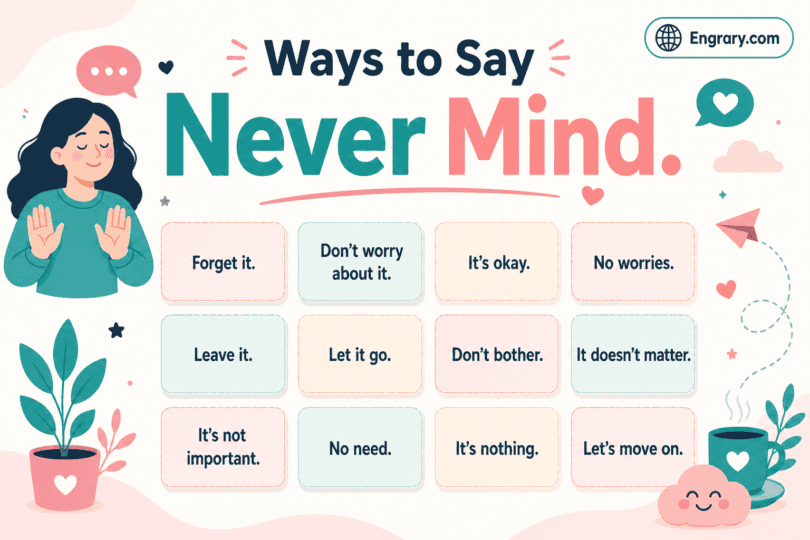
“Never mind” is used when you want someone to ignore something, stop worrying, disregard a message, cancel a request, or move on from a small issue. It is common in casual English, but it can sound abrupt if the tone is sharp.
The best alternative depends on whether you want to correct a message, reassure someone, stop an action, cancel help, or say an issue is already resolved. Below are 88 natural ways to say “never mind” for work, texts, polite conversations, emails, and daily English.
Best Never Mind Phrase by Situation
| Situation | Better Phrase |
|---|---|
| Simple reply | Don’t worry about it. |
| Polite reassurance | It’s okay now. |
| Work email | Please disregard my previous message. |
| Issue resolved | This has been resolved. |
| Wrong text | Sorry, ignore my last message. |
| No help needed | I’ve got it now. |
| Casual chat | All good. |
| Small mistake | No harm done. |
| Ending topic | Let’s move on. |
| Formal update | No further action is needed. |
Never Mind vs Don’t Worry vs Forget It
| Phrase | Tone | Best Use |
|---|---|---|
| Never mind | Casual and flexible, but sometimes abrupt. | When you want someone to ignore, stop, or forget something. |
| Don’t worry about it | Reassuring and polite. | When you want someone not to feel concerned or guilty. |
| Forget it | Casual, but can sound annoyed. | Use carefully when ending a topic or canceling a request. |
| Please disregard that | Professional and clear. | Emails, corrections, formal updates, and wrong messages. |
Is “Never Mind” Polite or Rude?
“Never mind” is not always rude. It is common in casual English when you want someone to ignore a question, stop helping, forget a small issue, or move on.
Tone matters, though. If said sharply, “never mind” can sound annoyed, dismissive, or passive-aggressive. In professional or polite situations, phrases like please disregard that, no further action is needed, it’s okay now, or don’t worry about it usually sound better.
Simple Alternatives to Never Mind
Use these phrases for everyday situations.
Don’t worry about it
A simple phrase for telling someone not to worry.
Example: Don’t worry about it.
It’s okay
A gentle phrase for saying the issue is not a problem.
Example: It’s okay.
No worries
A friendly phrase for casual reassurance.
Example: No worries.
Ignore that
A direct phrase for asking someone to disregard something.
Example: Ignore that.
It doesn’t matter
A phrase for saying something is not important now.
Example: It doesn’t matter.
That’s okay
A soft phrase for moving past a small issue.
Example: That’s okay.
It’s fine
A simple phrase for reassurance or dismissal.
Example: It’s fine.
All good
A casual phrase for saying there is no problem.
Example: All good.
No problem
A simple phrase for saying everything is fine.
Example: No problem.
That’s not important now
A clear phrase for moving away from a less important point.
Example: That’s not important now.
Polite Ways to Say Never Mind
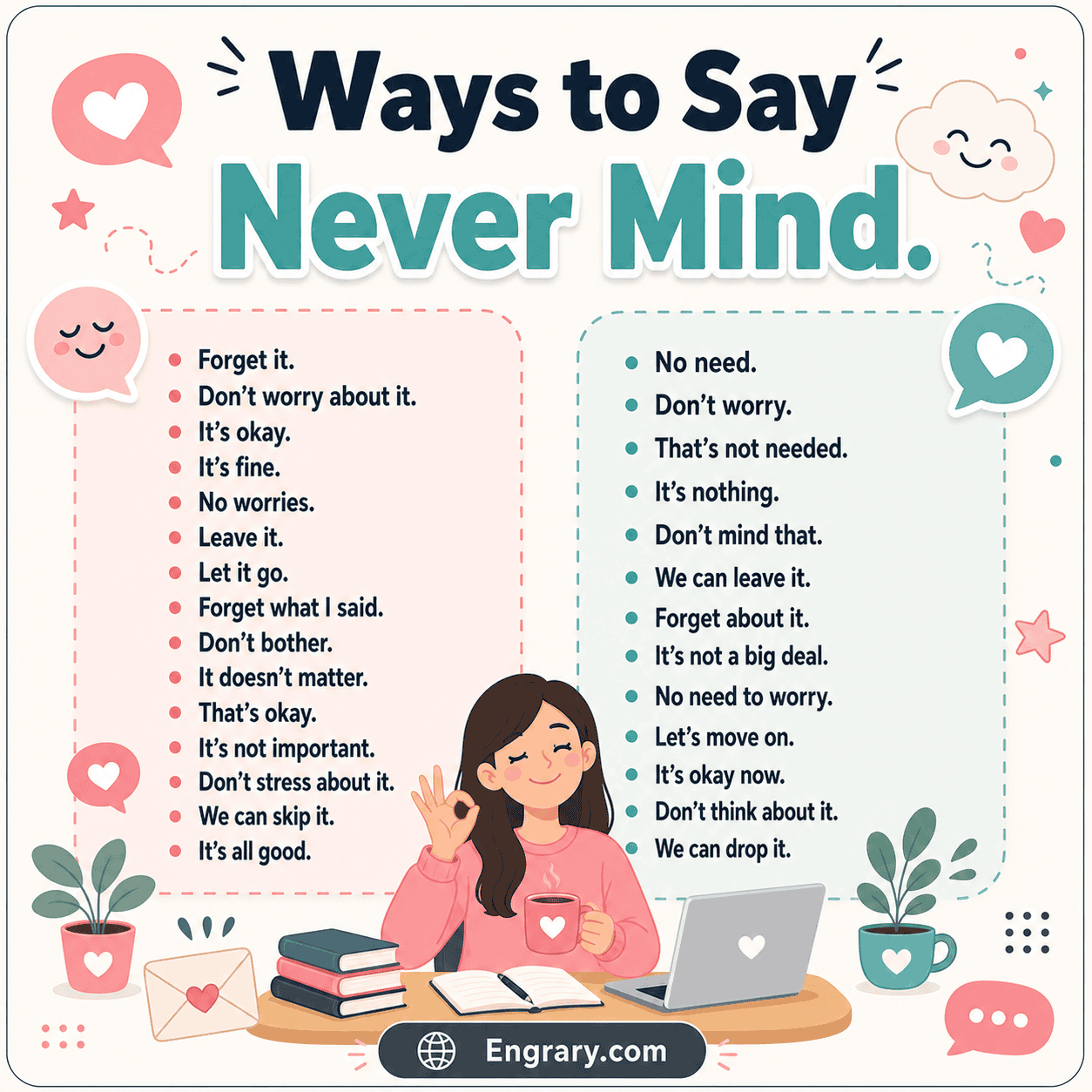
Use these phrases when you want to sound respectful and gentle.
Please don’t worry about it
A polite phrase for reassurance.
Example: Please don’t worry about it.
That’s okay now
A soft phrase for saying the issue is no longer important.
Example: That’s okay now.
No need to worry
A polite way to calm someone.
Example: No need to worry.
Please disregard that
A respectful phrase for asking someone to ignore something.
Example: Please disregard that.
It’s not a problem anymore
A polite phrase when the issue has been fixed or handled.
Example: It’s not a problem anymore.
There’s no need to trouble yourself
A polite phrase for saying someone does not need to help.
Example: There’s no need to trouble yourself.
It’s already taken care of
A polite phrase when the matter is handled.
Example: It’s already taken care of.
No need to continue with that
A respectful phrase for stopping an action.
Example: No need to continue with that.
Please don’t spend more time on it
A polite phrase for stopping someone from continuing.
Example: Please don’t spend more time on it.
You don’t need to worry about it anymore
A gentle phrase for saying the issue is handled.
Example: You don’t need to worry about it anymore.
Professional Phrases for Work and Emails
Use these phrases for coworkers, managers, clients, teams, formal messages, and email corrections.
Please disregard my previous message
A professional phrase for correcting or canceling an earlier message.
Example: Please disregard my previous message.
No further action is needed
A formal phrase for saying nothing else must be done.
Example: No further action is needed.
This has been resolved
A clear professional phrase when the issue is fixed.
Example: This has been resolved.
The issue is now resolved
A polished phrase for workplace updates.
Example: The issue is now resolved.
Apologies, I’ve already found the information
A professional phrase when help is no longer needed.
Example: Apologies, I’ve already found the information.
Please disregard the earlier request
A clear phrase for canceling a previous request.
Example: Please disregard the earlier request.
No action is required at this time
A formal phrase for saying nothing needs to be done now.
Example: No action is required at this time.
I’ve handled this on my end
A professional phrase when you have already solved something.
Example: I’ve handled this on my end.
Please ignore the earlier note
A clear phrase for correcting a previous message.
Example: Please ignore the earlier note.
This is no longer required
A formal phrase when a request or task is no longer needed.
Example: This is no longer required.
Casual Ways to Say Never Mind
Use these phrases for friends, family, classmates, and relaxed chats.
Forget it
A casual phrase for dropping a topic, but it can sound annoyed.
Example: Forget it.
All good
A relaxed phrase for saying there is no issue.
Example: All good.
Never mind, I got it
A casual phrase when help is no longer needed.
Example: Never mind, I got it.
Don’t worry
A simple casual phrase for reassurance.
Example: Don’t worry.
It’s fine
A casual phrase for saying something is okay.
Example: It’s fine.
No big deal
A casual phrase for a small issue.
Example: No big deal.
Leave it
A casual phrase for stopping an action or topic.
Example: Leave it.
Don’t bother
A casual phrase for stopping someone from helping, but it can sound rude.
Example: Don’t bother.
It’s cool
A relaxed phrase for saying there is no problem.
Example: It’s cool.
We’re good
A casual phrase for saying the issue is settled.
Example: We’re good.
Short Text Replies and Quick Chat Phrases
Use these short phrases for quick messages, chats, comments, and short replies.
All good.
Use this for a casual no-problem reply.
Ignore that.
Use this after sending something by mistake.
No worries.
Use this to reassure someone.
Got it now.
Use this when help is no longer needed.
Forget it.
Use this casually, but be careful with tone.
Never mind.
Use this when you want to drop the request or topic.
It’s fine.
Use this to say the issue is okay.
No need.
Use this when someone does not need to continue.
I’m good now.
Use this when you no longer need help.
Sorted.
Use this when the issue is fixed.
Ways to Say Ignore My Last Message
Use this section after a wrong message, typo, early message, or quick correction.
Sorry, ignore my last message
A clear phrase for correcting a text or email.
Example: Sorry, ignore my last message.
Please disregard my previous message
A professional phrase for email correction.
Example: Please disregard my previous message.
Ignore that last part
A simple phrase for correcting part of a message.
Example: Ignore that last part.
That message was meant for someone else
A clear phrase for a wrong recipient.
Example: That message was meant for someone else.
I sent that too soon
A natural phrase after sending a message before checking.
Example: I sent that too soon.
Sorry, that was a mistake
A polite phrase for correcting yourself.
Example: Sorry, that was a mistake.
Please ignore the previous note
A professional phrase for written communication.
Example: Please ignore the previous note.
That earlier message is no longer relevant
A polished phrase for updated information.
Example: That earlier message is no longer relevant.
Sorry, I meant to send something else
A natural phrase after sending the wrong message.
Example: Sorry, I meant to send something else.
Please disregard the last line
A professional phrase for correcting part of a message.
Example: Please disregard the last line.
Ways to Say Help Is No Longer Needed
Use this section when someone was about to help, but you solved the issue.
I figured it out
A natural phrase when you solved the problem yourself.
Example: I figured it out.
I’ve got it now
A casual phrase when you no longer need help.
Example: I’ve got it now.
Thanks, but I handled it
A polite phrase for saying help is no longer needed.
Example: Thanks, but I handled it.
No need anymore
A short phrase for stopping help.
Example: No need anymore.
I found what I needed
A clear phrase when you were looking for information.
Example: I found what I needed.
I already sorted it out
A natural phrase when the matter is handled.
Example: I already sorted it out.
Thanks, I’m all set
A polite phrase for saying you are okay now.
Example: Thanks, I’m all set.
I managed to fix it
A clear phrase when you solved a problem.
Example: I managed to fix it.
I got it working now
A natural phrase when a technical or practical issue is fixed.
Example: I got it working now.
Thanks, I don’t need help anymore
A clear phrase for canceling help politely.
Example: Thanks, I don’t need help anymore.
Ways to Reassure Someone
Use this section when you do not want the other person to feel worried, guilty, or stressed.
It’s okay
A gentle phrase for reassurance.
Example: It’s okay.
No problem at all
A warm phrase for saying there is no issue.
Example: No problem at all.
Don’t worry about it
A common phrase for reassurance.
Example: Don’t worry about it.
It’s really fine
A clear phrase for calming someone.
Example: It’s really fine.
No need to stress about it
A kind phrase for reducing worry.
Example: No need to stress about it.
Everything is fine now
A reassuring phrase when the issue is handled.
Example: Everything is fine now.
There’s nothing to worry about
A polite phrase for calming someone.
Example: There’s nothing to worry about.
It’s already okay
A soft phrase for saying things are fine now.
Example: It’s already okay.
You’re all good
A friendly phrase for reassuring someone.
Example: You’re all good.
It didn’t cause any problem
A clear phrase for reducing guilt or worry.
Example: It didn’t cause any problem.
Ways to Move On from a Small Mistake
Use this section when the issue is minor and you want to continue.
Let’s move on
A clear phrase for continuing after a small issue.
Example: Let’s move on.
It’s not a big deal
A reassuring phrase for a minor mistake.
Example: It’s not a big deal.
We can leave it there
A calm phrase for ending the topic.
Example: We can leave it there.
No harm done
A friendly phrase when nothing serious happened.
Example: No harm done.
Let’s not worry about it
A gentle phrase for moving forward.
Example: Let’s not worry about it.
We can move past it
A calm phrase for continuing after a small problem.
Example: We can move past it.
It’s already forgotten
A reassuring phrase for a small mistake.
Example: It’s already forgotten.
Let’s carry on
A simple phrase for continuing.
Example: Let’s carry on.
We’re past that now
A phrase for saying the issue is finished.
Example: We’re past that now.
Let’s continue from here
A calm phrase for moving forward.
Example: Let’s continue from here.
Formal Ways to Say Never Mind
Use these phrases for official emails, reports, client updates, and formal communication.
Please disregard the previous communication
A formal phrase for correcting an earlier message.
Example: Please disregard the previous communication.
This matter has been addressed
A formal phrase when something has been handled.
Example: This matter has been addressed.
No additional action is necessary
A formal phrase for saying nothing more is needed.
Example: No additional action is necessary.
The previous request may be disregarded
A formal phrase for canceling an earlier request.
Example: The previous request may be disregarded.
The matter is no longer outstanding
A formal phrase when an issue is no longer pending.
Example: The matter is no longer outstanding.
This request is no longer applicable
A formal phrase when a request no longer applies.
Example: This request is no longer applicable.
Please consider the earlier note withdrawn
A formal phrase for retracting a message.
Example: Please consider the earlier note withdrawn.
The concern has since been resolved
A formal phrase for updated issue resolution.
Example: The concern has since been resolved.
Phrases to Use Carefully
Some phrases can sound rude, annoyed, dismissive, or passive-aggressive depending on tone and situation.
| Phrase | Why to Use Carefully | Better Use |
|---|---|---|
| Forget it. | It can sound annoyed or dismissive. | Use only casually, or replace it with Don’t worry about it. |
| Drop it. | It can sound harsh or impatient. | Use only when you need to clearly end a topic. |
| Don’t bother. | It can sound rude or ungrateful. | Use No need anymore or I’ve got it now instead. |
| Whatever. | It can sound dismissive or passive-aggressive. | Avoid it in polite conversations. |
| It doesn’t matter. | It may sound upset if said sharply. | Use gently, or choose It’s okay now. |
What to Say Instead of Never Mind in Different Situations
| Situation | Better Phrase |
|---|---|
| Simple reply | Don’t worry about it. |
| Polite reassurance | It’s okay now. |
| Work email | Please disregard my previous message. |
| Issue resolved | This has been resolved. |
| Wrong text | Sorry, ignore my last message. |
| No help needed | I’ve got it now. |
| Casual chat | All good. |
| Small mistake | No harm done. |
| Ending topic | Let’s move on. |
| Formal update | No further action is needed. |
How to Choose the Right Never Mind Alternative
Choose the phrase based on whether you want to correct a message, cancel a request, reassure someone, stop an action, or move on from a small issue. For polite reassurance, use don’t worry about it, it’s okay, or no need to worry. In work emails, choose please disregard my previous message, no further action is needed, or this has been resolved.
Casual texts sound natural with all good, ignore that, or got it now. If help is no longer needed, use I figured it out, I’ve got it now, or thanks, I’m all set. To move on from a mistake, phrases like no harm done or let’s move on are clearer and softer than forget it.
Summary
There are many ways to say “never mind,” and the best phrase depends on whether you mean ignore that, don’t worry, help is no longer needed, the issue is resolved, or let’s move on. Don’t worry about it, it’s okay, and please disregard that work well in different situations.
Professional, polite, casual, text-ready, correction-based, and reassurance-based phrases all fit different needs. The best phrase should match your tone, setting, and purpose.
FAQs
Another way to say “never mind” is don’t worry about it. You can also say it’s okay, no worries, ignore that, please disregard that, or it doesn’t matter, depending on the situation.
Professionally, you can say please disregard my previous message, no further action is needed, this has been resolved, the issue is now resolved, or please disregard the earlier request.
A polite way to say “never mind” is please don’t worry about it. Other polite options include that’s okay now, no need to worry, please disregard that, and it’s not a problem anymore.
In an email, you can say please disregard my previous message, please ignore the earlier note, no action is required at this time, this has been resolved, or this is no longer required.
“Never mind” is not always rude, but it can sound abrupt or annoyed if the tone is sharp. In polite or professional settings, use softer phrases like don’t worry about it, please disregard that, or no further action is needed.
You May Also Like