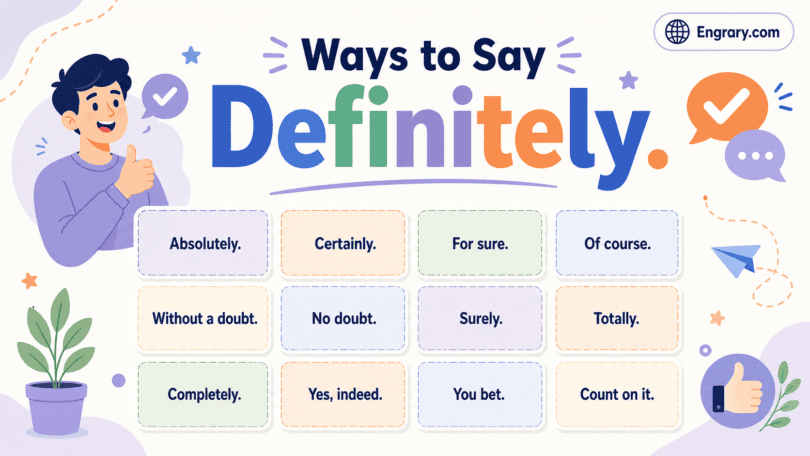
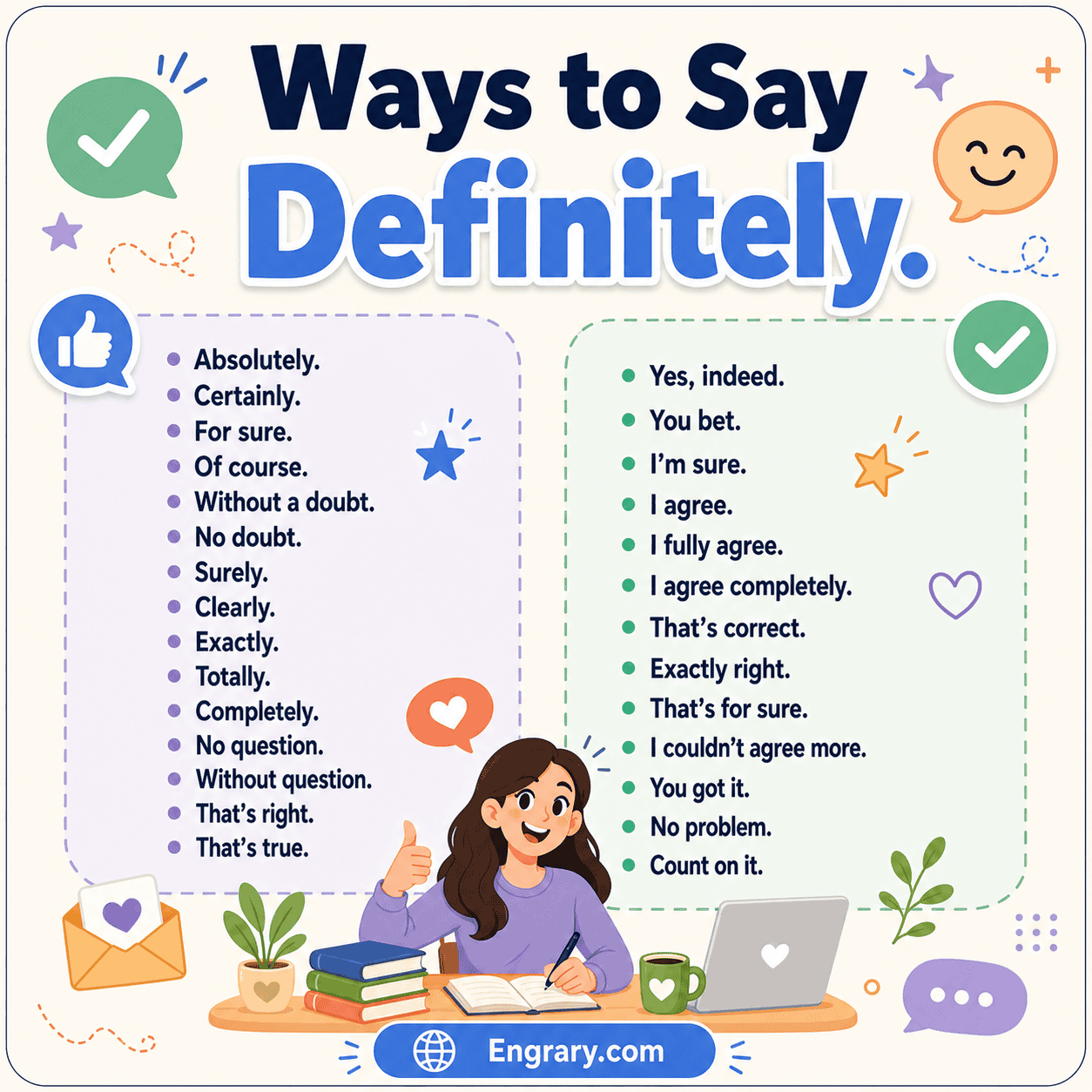
“Definitely” is used to show a confident yes, strong agreement, complete certainty, confirmation, approval, or commitment. It sounds clear and natural, but the best alternative depends on tone, situation, and whether you want to sound professional, polite, casual, or strongly confident.
Below, you’ll find 100 natural ways to say “definitely” for work emails, text messages, polite conversations, client replies, strong agreement, certainty, promises, approvals, and daily English replies. Each phrase includes a short meaning and a simple example.
Best Definitely Phrase by Situation
| Situation | Better Phrase |
|---|---|
| Simple yes | Certainly. |
| Polite reply | Of course. |
| Work email | Confirmed. |
| Client confirmation | I can confirm that. |
| Casual text | For sure. |
| Strong agreement | I completely agree. |
| Complete certainty | Without a doubt. |
| Promise | You can count on it. |
| Approval | That’s perfectly fine. |
| Enthusiastic reply | Absolutely. |
Definitely vs Absolutely vs Certainly vs Surely
| Phrase | Tone | Best Use |
|---|---|---|
| Definitely | Confident, clear, and direct. | Saying yes, confirming something, or showing certainty. |
| Absolutely | Strong, enthusiastic, and emphatic. | Strong agreement, excited yes, permission, or certainty. |
| Certainly | Polite and professional. | Work emails, client replies, formal yes, and respectful confirmation. |
| Surely | Formal, literary, or expectation-based. | When something seems highly likely or expected, not usually as a casual yes. |
Is “Definitely” Polite and Professional?
“Definitely” is polite, clear, and natural in many situations. It works well in daily conversations, friendly messages, and confident replies.
In formal work emails or client messages, more polished phrases like certainly, confirmed, I can confirm that, or that works for me may sound more professional. For casual texts, phrases like for sure, yep, definitely, and sure thing sound more relaxed.
Simple Alternatives to Definitely
Use these phrases for everyday yes, agreement, or confirmation.
Certainly
A polite and clear alternative to “definitely.”
Example: Certainly.
Absolutely
A strong and confident way to say yes.
Example: Absolutely.
Of course
A warm and natural phrase for agreement or permission.
Example: Of course.
For sure
A casual phrase for confident agreement.
Example: For sure.
Without a doubt
A strong phrase for complete certainty.
Example: Without a doubt.
No question
A confident phrase when there is no doubt.
Example: No question.
Surely
A formal word for something likely or expected.
Example: Surely, that is the right choice.
Undoubtedly
A polished word for strong certainty.
Example: Undoubtedly, this is important.
Clearly
A useful word when something is obvious.
Example: Clearly, this matters.
No doubt
A natural phrase for certainty or agreement.
Example: No doubt.
Polite Ways to Say Definitely
Use these phrases when you want to sound respectful and natural.
Certainly
A polite way to say yes or confirm something.
Example: Certainly, I can help.
Of course
A warm phrase for friendly agreement.
Example: Of course, that’s fine.
Yes, certainly
A clear and respectful confirmation.
Example: Yes, certainly.
I’d be happy to
A polite phrase for accepting a request.
Example: I’d be happy to help.
That sounds good
A friendly phrase for agreeing with a plan.
Example: That sounds good to me.
Yes, of course
A polite phrase for helpful confirmation.
Example: Yes, of course.
That would be fine
A respectful phrase for approval.
Example: That would be fine.
I agree with you
A clear and polite agreement phrase.
Example: I agree with you.
You’re right
A simple phrase for agreeing with someone.
Example: You’re right.
That works well
A polite phrase for agreeing with a choice or plan.
Example: That works well.
Professional Phrases for Work and Emails
Use these phrases for coworkers, clients, managers, approvals, meetings, and email replies.
Confirmed
A concise professional confirmation.
Example: Confirmed.
I can confirm that
A clear phrase for professional certainty.
Example: I can confirm that.
That is correct
A polished phrase for confirming accuracy.
Example: That is correct.
Certainly
A professional way to say yes.
Example: Certainly, I can send that over.
That works for me
A work-friendly phrase for agreement.
Example: That works for me.
Yes, that’s correct
A clear confirmation in work messages.
Example: Yes, that’s correct.
I agree with that approach
A professional phrase for agreement.
Example: I agree with that approach.
I’m aligned with that
A workplace phrase for shared agreement.
Example: I’m aligned with that plan.
I can support that
A professional phrase for approval or agreement.
Example: I can support that.
I’ll proceed with that
A work-safe phrase for confirming action.
Example: I’ll proceed with that.
Casual Ways to Say Definitely
Use these phrases for friends, family, classmates, and everyday chats.
For sure
A casual way to say definitely.
Example: For sure.
Yep, definitely
A relaxed and confident yes.
Example: Yep, definitely.
Sure thing
A friendly casual confirmation.
Example: Sure thing.
No doubt
A casual phrase for certainty.
Example: No doubt.
Totally
A relaxed phrase for agreement.
Example: Totally.
Yep
A short casual yes.
Example: Yep.
You bet
A casual phrase for confident agreement.
Example: You bet.
Of course
A natural casual agreement phrase.
Example: Of course.
Absolutely
A strong casual or friendly yes.
Example: Absolutely.
Sounds good
A relaxed phrase for agreeing with a plan.
Example: Sounds good.
Short Text Replies and Quick Confirmations
Use these short phrases for messages, chats, comments, and quick replies.
Definitely.
Use this for a direct confident yes.
For sure.
Use this for a casual confirmation.
Confirmed.
Use this for a clear short reply.
Sure thing.
Use this for a friendly yes.
No doubt.
Use this for certainty.
Yep.
Use this for a casual quick reply.
Of course.
Use this for a polite quick answer.
Absolutely.
Use this for a stronger confirmation.
Sounds good.
Use this for agreeing with a plan.
Done.
Use this when you are confirming an action.
Strong Agreement Phrases
Use these phrases when you strongly agree with someone’s point, idea, or opinion.
I completely agree
A strong phrase for full agreement.
Example: I completely agree.
You’re exactly right
A confident phrase for agreeing with someone’s point.
Example: You’re exactly right.
I couldn’t agree more
A natural phrase for very strong agreement.
Example: I couldn’t agree more.
That’s completely true
A phrase for agreeing with a statement.
Example: That’s completely true.
No question about it
A confident phrase for strong agreement.
Example: No question about it.
That’s exactly how I see it
A natural phrase for shared opinion.
Example: That’s exactly how I see it.
I’m with you on that
A friendly phrase for agreement.
Example: I’m with you on that.
That makes complete sense
A phrase for agreeing with an idea or explanation.
Example: That makes complete sense.
I agree fully
A clear phrase for complete agreement.
Example: I agree fully.
That’s a fair point
A polite phrase for agreeing with someone’s view.
Example: That’s a fair point.
Certainty and Emphasis Phrases
Use these phrases when “definitely” means without doubt, clearly, or certainly true.
Without a doubt
A strong phrase for complete certainty.
Example: Without a doubt.
Undoubtedly
A polished word for strong certainty.
Example: Undoubtedly, this is the best option.
No question
A confident phrase for certainty.
Example: No question.
I’m certain
A clear phrase for strong confidence.
Example: I’m certain this is correct.
There’s no doubt about it
A strong phrase for complete certainty.
Example: There’s no doubt about it.
Clearly
A useful word when something is obvious.
Example: Clearly, this is necessary.
Without question
A formal phrase for certainty.
Example: Without question, this matters.
Unquestionably
A formal word for strong certainty.
Example: Unquestionably, it was a success.
Positively
A formal or emphatic word for certainty.
Example: Positively.
Beyond doubt
A strong phrase for certainty.
Example: That is beyond doubt.
Promise and Commitment Phrases
Use these phrases when “definitely” means you will do something or someone can rely on you.
You can count on it
A confident phrase for a promise.
Example: You can count on it.
I’ll make sure of it
A strong phrase for taking responsibility.
Example: I’ll make sure of it.
I’ll definitely do that
A clear phrase for commitment.
Example: I’ll definitely do that.
Consider it done
A confident phrase for accepting a task.
Example: Consider it done.
I’ll take care of it
A practical phrase for promising action.
Example: I’ll take care of it.
I’ll make it happen
A confident phrase for commitment.
Example: I’ll make it happen.
You have my word
A serious phrase for a promise.
Example: You have my word.
I won’t forget
A clear phrase for commitment.
Example: I won’t forget.
I’ll handle it
A direct phrase for taking responsibility.
Example: I’ll handle it.
You can rely on me
A strong phrase for trust and commitment.
Example: You can rely on me.
Permission and Approval Phrases
Use these phrases when someone asks if they may do something or when you want to approve something.
Of course
A warm phrase for giving permission.
Example: Of course, you can join.
By all means
A polite phrase for permission.
Example: By all means.
Go right ahead
A friendly phrase for approval.
Example: Go right ahead.
That’s perfectly fine
A polite phrase for approval.
Example: That’s perfectly fine.
Feel free
A simple phrase that gives permission.
Example: Feel free to ask.
Please do
A warm phrase for permission.
Example: Please do.
That’s okay with me
A clear phrase for approval.
Example: That’s okay with me.
I have no objection
A formal phrase for approval.
Example: I have no objection.
That works for me
A practical phrase for approval or agreement.
Example: That works for me.
You’re welcome to
A friendly phrase for giving permission.
Example: You’re welcome to stay.
Enthusiastic Ways to Say Definitely
Use these phrases when you want to sound excited, positive, or fully interested.
Absolutely
A strong and enthusiastic yes.
Example: Absolutely.
Count me in
A lively phrase for accepting a plan.
Example: Count me in.
I’m all in
A strong phrase for full commitment.
Example: I’m all in.
I’d love to
A warm phrase for accepting an invitation.
Example: I’d love to.
That sounds perfect
A positive phrase for strong approval.
Example: That sounds perfect.
I’m excited about that
A phrase for enthusiastic agreement.
Example: I’m excited about that.
That would be great
A warm phrase for accepting something.
Example: That would be great.
I’m in
A short excited yes.
Example: I’m in.
Let’s do it
A confident phrase for agreeing to a plan.
Example: Let’s do it.
I’m totally on board
A lively phrase for full agreement.
Example: I’m totally on board.
Formal Ways to Say Definitely
Use these phrases for formal writing, official messages, reports, and polished communication.
Certainly
A polished formal confirmation.
Example: Certainly.
Undoubtedly
A formal word for strong certainty.
Example: Undoubtedly, this decision is important.
Without question
A formal phrase for strong confidence.
Example: Without question, this is necessary.
Unquestionably
A formal word for complete certainty.
Example: Unquestionably, the results are strong.
I can confirm this
A formal phrase for verification.
Example: I can confirm this.
This is confirmed
A formal confirmation phrase.
Example: This is confirmed.
It is certain
A formal phrase for certainty.
Example: It is certain.
There is no doubt
A formal phrase for confidence.
Example: There is no doubt.
This is accurate
A polished phrase for confirming correctness.
Example: This is accurate.
I can verify that
A formal phrase for confirming truth or accuracy.
Example: I can verify that.
Phrases to Use Carefully
Some alternatives can sound too casual, too stiff, too strong, or inappropriate depending on the situation.
| Phrase | Why to Use Carefully | Better Use |
|---|---|---|
| Totally. | It may sound too casual for formal emails. | Use in texts or friendly conversations. |
| Yep. | It is very casual. | Use with friends or familiar coworkers. |
| Surely. | It can sound formal, old-fashioned, or like an assumption. | Use for expectation, not as a casual yes. |
| Categorically. | It can sound overly formal or intense. | Use only in serious formal statements. |
| Obviously. | It can sound rude or dismissive. | Use carefully, or replace it with Definitely. |
What to Say Instead of Definitely in Different Situations
| Situation | Better Phrase |
|---|---|
| Simple yes | Certainly. |
| Polite reply | Of course. |
| Work email | Confirmed. |
| Client confirmation | I can confirm that. |
| Casual text | For sure. |
| Strong agreement | I completely agree. |
| Complete certainty | Without a doubt. |
| Promise | You can count on it. |
| Approval | That’s perfectly fine. |
| Enthusiastic reply | Absolutely. |
How to Choose the Right Definitely Alternative
Choose the phrase based on whether you need a confident yes, professional confirmation, strong agreement, complete certainty, promise, permission, or enthusiastic reply. For polite replies, use certainly, of course, or yes, certainly. In casual texts, phrases like for sure, sure thing, and yep, definitely sound natural.
Work emails and client replies sound more polished with confirmed, I can confirm that, or that works for me. Strong agreement phrases like I completely agree and you’re exactly right work better for opinions or ideas. For promises, use you can count on it, I’ll make sure of it, or consider it done.
Summary
There are many ways to say “definitely,” and the best phrase depends on whether you mean yes, certainty, agreement, confirmation, approval, or commitment. Certainly, absolutely, of course, and for sure work well in different situations.
Professional, casual, polite, enthusiastic, certainty-focused, promise-based, and approval phrases all fit different needs. The best phrase should match your tone, relationship, and reason for replying.
FAQs
Another way to say “definitely” is certainly. You can also say absolutely, of course, for sure, without a doubt, no question, or undoubtedly, depending on the situation.
Professionally, you can say confirmed, I can confirm that, that is correct, certainly, that works for me, or I’m aligned with that. These phrases sound polished in emails, meetings, and client replies.
A polite way to say “definitely” is certainly. Other polite options include of course, yes, certainly, I’d be happy to, that sounds good, and that would be fine.
A casual way to say “definitely” is for sure. You can also say yep, definitely, sure thing, no doubt, totally, or sounds good in relaxed conversations.
“Definitely” is clear, confident, and direct. “Absolutely” often sounds stronger, more enthusiastic, or more emphatic. Both can mean yes or certainty, but absolutely usually adds more emotional emphasis.
You May Also Like