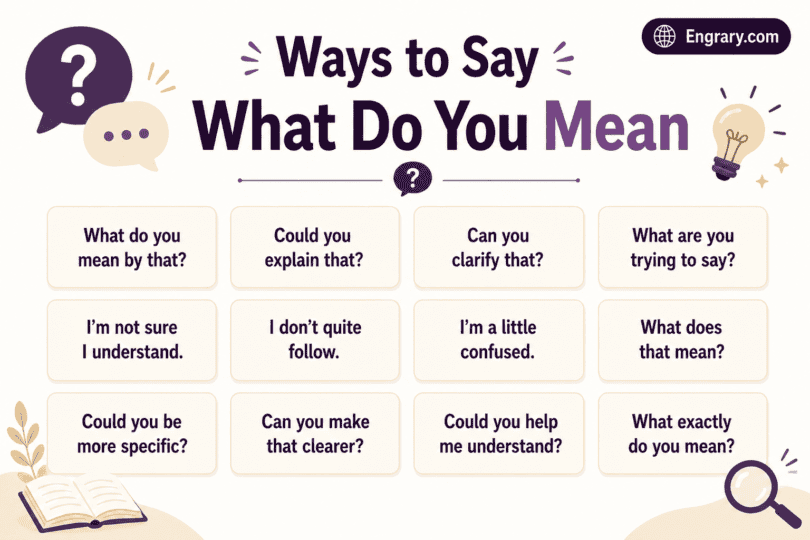
“What do you mean?” is used to ask for clarification, understand someone’s point, or check the meaning of something. It is a useful question, but it can sound direct or challenging if the tone is too sharp.
The best alternative depends on the setting, purpose, and relationship. Some phrases sound polite, some work better in professional emails, and others feel natural in casual chats, texts, classrooms, or sensitive conversations. Below are 82 natural ways to say “what do you mean” with meanings and examples.
Best What Do You Mean Phrase by Situation
| Situation | Better Phrase |
|---|---|
| Simple clarification | Could you explain that? |
| Polite reply | Could you clarify that? |
| Work meeting | Could you elaborate on that? |
| Could you provide more context? | |
| Casual chat | What do you mean by that? |
| Text message | Can you explain? |
| Student question | Could you explain that another way? |
| Need an example | Could you give me an example? |
| Before disagreeing | Let me make sure I understand first. |
| Sensitive conversation | Can you help me understand what you mean? |
What Do You Mean vs Could You Clarify vs Could You Repeat That?
| Phrase | Tone | Best Use |
|---|---|---|
| What do you mean? | Direct, neutral, or challenging depending on tone. | Casual clarification or direct questions. |
| Could you clarify that? | Polite and respectful. | Work, emails, meetings, and careful conversations. |
| Could you repeat that? | Repetition-focused. | When you did not hear the words clearly. |
| Could you explain that? | Meaning-focused. | When you heard the words but do not understand the idea. |
Is “What Do You Mean?” Polite or Rude?
“What do you mean?” is not automatically rude. It can be a normal question when you want to understand something better.
However, tone matters. If said sharply, it may sound defensive or challenging. In polite, professional, or sensitive situations, softer phrases like Could you clarify that?, Could you explain what you mean?, or Can you help me understand? often sound better.
Simple Alternatives to What Do You Mean
Use these phrases for everyday clarification.
Could you clarify that?
A polite phrase for asking someone to make their meaning clearer.
Example: Could you clarify that?
What do you mean by that?
A natural phrase for asking about someone’s exact meaning.
Example: What do you mean by that?
Could you explain that?
A simple phrase when you do not understand the idea.
Example: Could you explain that?
What does that mean?
A direct phrase for asking the meaning of a word, phrase, or idea.
Example: What does that mean?
I’m not sure I understand
A softer phrase that shows you need more explanation.
Example: I’m not sure I understand.
Can you explain what you mean?
A clear phrase for asking someone to explain their point.
Example: Can you explain what you mean?
Could you say that another way?
A helpful phrase when the wording is confusing.
Example: Could you say that another way?
I didn’t quite follow
A polite phrase when you lost the meaning.
Example: I didn’t quite follow that part.
Can you make that clearer?
A direct but useful phrase for unclear meaning.
Example: Can you make that clearer?
What are you referring to?
A helpful phrase when you need to know the exact thing being discussed.
Example: What are you referring to?
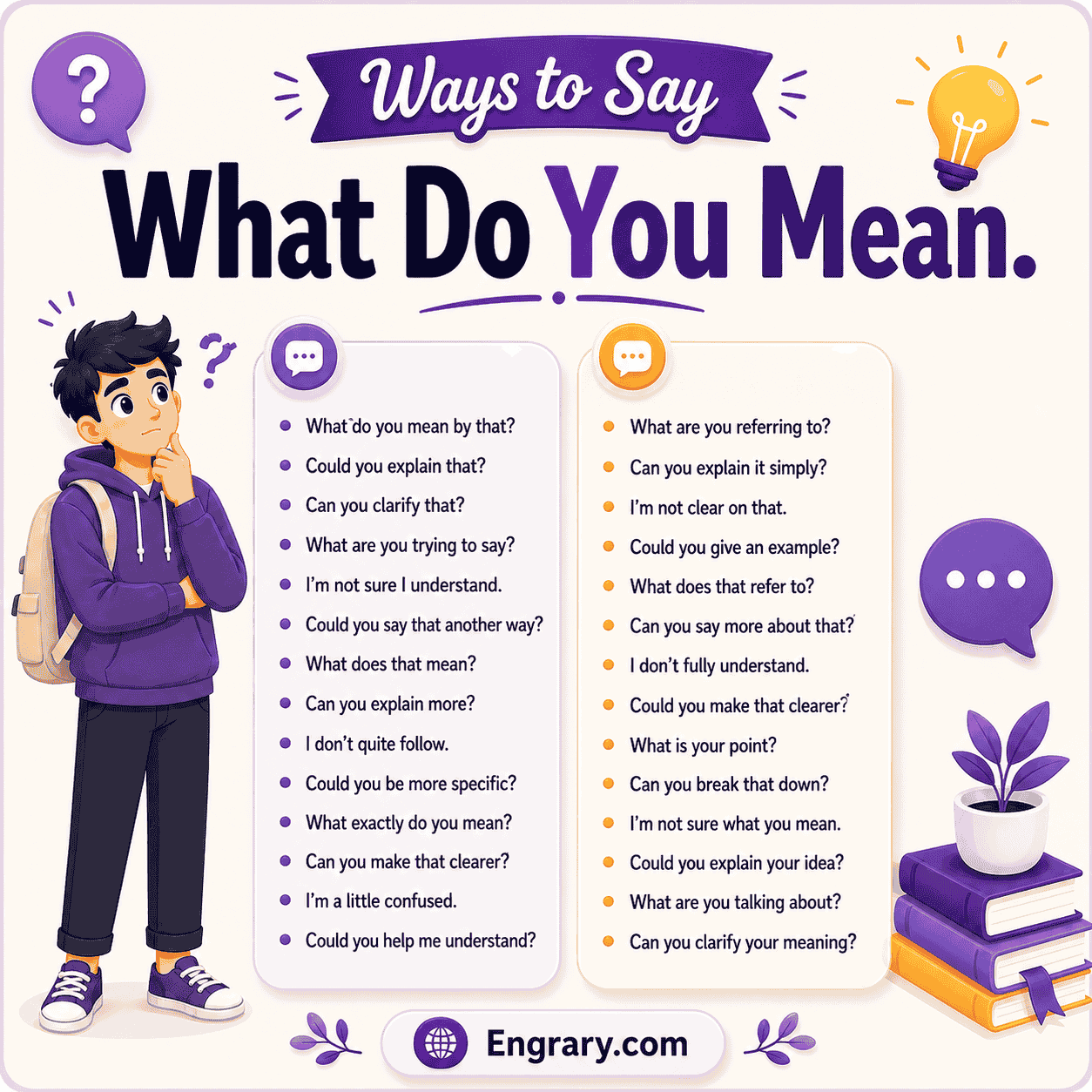
Polite Ways to Ask What Someone Means
Use these phrases when you want to sound respectful and gentle.
Could you explain what you mean?
A polite phrase for asking for clarification.
Example: Could you explain what you mean?
Could you say that another way?
A respectful phrase when you need simpler wording.
Example: Could you say that another way?
Can you help me understand?
A gentle phrase that avoids sounding critical.
Example: Can you help me understand your point?
Would you mind clarifying that?
A polite phrase for formal or careful conversations.
Example: Would you mind clarifying that?
I want to make sure I understand
A respectful phrase that shows careful listening.
Example: I want to make sure I understand.
Could you explain that a little more?
A soft phrase for asking for more explanation.
Example: Could you explain that a little more?
May I ask what you mean by that?
A polite phrase for sensitive or formal moments.
Example: May I ask what you mean by that?
Could you rephrase that?
A useful phrase when the wording is unclear.
Example: Could you rephrase that?
Would you explain that in more detail?
A polite phrase for asking for a fuller explanation.
Example: Would you explain that in more detail?
Could you help me see what you mean?
A gentle phrase for understanding someone’s idea.
Example: Could you help me see what you mean?
Professional Phrases for Work and Emails
Use these phrases for meetings, emails, clients, coworkers, managers, and workplace communication.
Could you elaborate on that?
A professional phrase for asking for more detail.
Example: Could you elaborate on that?
Could you clarify your point?
A work-safe phrase for understanding someone’s idea.
Example: Could you clarify your point?
I’d like to understand this better
A professional phrase that sounds thoughtful.
Example: I’d like to understand this better.
Could you provide more context?
A useful email phrase when information is incomplete.
Example: Could you provide more context?
Can you be more specific?
A clear phrase when the statement is too general.
Example: Can you be more specific?
Could you expand on that?
A professional phrase for asking for more explanation.
Example: Could you expand on that?
Could you walk me through that?
A helpful phrase for complex points or processes.
Example: Could you walk me through that?
I want to make sure I’m interpreting this correctly
A polished phrase for careful workplace communication.
Example: I want to make sure I’m interpreting this correctly.
Could you clarify the main point?
A professional phrase for focusing on the key idea.
Example: Could you clarify the main point?
Could you share a bit more background?
A polite phrase for asking for context.
Example: Could you share a bit more background?
Casual Ways to Say What Do You Mean
Use these phrases for friends, family, chats, and daily conversations.
What do you mean by that?
A common casual phrase for asking about meaning.
Example: What do you mean by that?
I’m confused
A direct casual phrase when something is unclear.
Example: I’m confused. Can you explain?
What are you saying?
A casual phrase for asking someone to clarify.
Example: What are you saying exactly?
Wait, what do you mean?
A casual phrase when something surprises or confuses you.
Example: Wait, what do you mean?
Can you explain?
A short and natural phrase.
Example: Can you explain?
Say that again?
A casual phrase when you need someone to repeat or explain.
Example: Say that again?
What’s that mean?
A casual version of what does that mean?
Example: What’s that mean?
I don’t get it
A casual phrase when you do not understand.
Example: I don’t get it.
Wait, explain that
A direct casual phrase for asking for clarification.
Example: Wait, explain that.
What do you mean exactly?
A casual phrase for asking for a clearer meaning.
Example: What do you mean exactly?
Short Text Replies and Quick Clarification Phrases
Use these short phrases for messages, comments, chats, and quick replies.
Meaning?
Use this for a very short text reply.
Explain?
Use this when you want a quick explanation.
What do you mean?
Use this for direct clarification.
Can you explain?
Use this when you need more meaning.
Say that again?
Use this when you need repetition or clarification.
More context?
Use this when the message feels incomplete.
How so?
Use this when you want the reason or meaning.
What part?
Use this when you need the person to be more specific.
Example?
Use this when an example would help.
Clarify?
Use this as a quick message asking for clearer meaning.
Ways to Ask for More Detail
Use these phrases when the idea is unclear, too general, or missing important information.
Could you give me an example?
A helpful phrase when an example would make the meaning clearer.
Example: Could you give me an example?
Can you explain that further?
A clear phrase for more detail.
Example: Can you explain that further?
Could you walk me through that?
A useful phrase for processes, plans, or complex ideas.
Example: Could you walk me through that?
What exactly do you mean?
A direct phrase for asking for precise meaning.
Example: What exactly do you mean?
Can you add more detail?
A simple phrase when the explanation is too short.
Example: Can you add more detail?
Could you be more specific?
A polite phrase for clearer details.
Example: Could you be more specific?
What do you mean by that part?
A focused phrase for one unclear section.
Example: What do you mean by that part?
Can you give me more context?
A useful phrase when background information is missing.
Example: Can you give me more context?
Could you explain the reason behind that?
A helpful phrase when you need the logic or cause.
Example: Could you explain the reason behind that?
Can you break that down for me?
A natural phrase for asking for a simpler explanation.
Example: Can you break that down for me?
Ways to Clarify Before Disagreeing
Use these phrases when you want to question something without sounding rude or argumentative.
Let me make sure I understand first
A careful phrase before responding or disagreeing.
Example: Let me make sure I understand first.
Are you saying that…?
A phrase for checking someone’s meaning before replying.
Example: Are you saying that we should wait?
Do you mean that…?
A phrase for confirming an interpretation.
Example: Do you mean that the deadline changed?
I want to clarify your point before I respond
A professional phrase for careful disagreement.
Example: I want to clarify your point before I respond.
Can we define that more clearly?
A useful phrase when a term or idea is unclear.
Example: Can we define that more clearly?
Before I respond, can I check what you mean?
A polite phrase for avoiding misunderstanding.
Example: Before I respond, can I check what you mean?
I may be misunderstanding, but do you mean…?
A soft phrase before asking or disagreeing.
Example: I may be misunderstanding, but do you mean the first option?
Let’s clarify that before moving on
A calm phrase for group discussions.
Example: Let’s clarify that before moving on.
Can I check my understanding first?
A polite phrase before giving a response.
Example: Can I check my understanding first?
Are we talking about the same thing?
A useful phrase when the conversation may be unclear.
Example: Are we talking about the same thing?
Student and Learning-Friendly Phrases
Use these phrases for classrooms, study, ESL learning, lessons, and explanations.
Could you explain that another way?
A helpful phrase when a student needs simpler wording.
Example: Could you explain that another way?
Can you give an example?
A useful phrase for learning through examples.
Example: Can you give an example?
I didn’t quite follow
A polite phrase when the idea was hard to understand.
Example: I didn’t quite follow the last part.
Can we go over that again?
A classroom-friendly phrase for review.
Example: Can we go over that again?
What does this part mean?
A focused phrase for one unclear part.
Example: What does this part mean?
Could you explain it more simply?
A helpful phrase for easier wording.
Example: Could you explain it more simply?
I’m not sure I understand the example
A clear phrase for learning situations.
Example: I’m not sure I understand the example.
Can you show me how it works?
A useful phrase for practical learning.
Example: Can you show me how it works?
Could you explain the idea step by step?
A helpful phrase for difficult lessons.
Example: Could you explain the idea step by step?
Can we look at another example?
A useful phrase when one example is not enough.
Example: Can we look at another example?
Sensitive and Respectful Clarification Phrases
Use these phrases when tone matters, such as emotional talks, serious topics, feedback, or possible misunderstandings.
Can you help me understand what you mean?
A respectful phrase that sounds calm and open.
Example: Can you help me understand what you mean?
I want to understand you correctly
A careful phrase for sensitive conversations.
Example: I want to understand you correctly.
Could you explain that in a different way?
A gentle phrase when the wording feels unclear.
Example: Could you explain that in a different way?
I may be misunderstanding you
A soft phrase that avoids blame.
Example: I may be misunderstanding you.
Could we slow down and clarify that?
A respectful phrase for emotional or complex conversations.
Example: Could we slow down and clarify that?
I want to make sure I don’t misread your meaning
A careful phrase for serious conversations.
Example: I want to make sure I don’t misread your meaning.
Can we unpack that a little?
A gentle phrase for exploring meaning.
Example: Can we unpack that a little?
I’d like to understand your perspective better
A respectful phrase for deeper understanding.
Example: I’d like to understand your perspective better.
Can you tell me more about what you meant?
A calm phrase for sensitive clarification.
Example: Can you tell me more about what you meant?
I want to hear what you mean, not assume
A thoughtful phrase for avoiding misunderstanding.
Example: I want to hear what you mean, not assume.
Phrases to Use Carefully
Some phrases can sound rude, defensive, accusatory, or confrontational depending on tone.
| Phrase | Why to Use Carefully | Better Use |
|---|---|---|
| What’s that supposed to mean? | It can sound angry or accusatory. | Use only when you are directly challenging someone. |
| What are you trying to say? | It can sound suspicious or defensive. | Use carefully in sensitive conversations. |
| What’s your point? | It can sound impatient or dismissive. | Use only in direct discussions. |
| I don’t get it. | It can sound blunt in formal settings. | Use casually or replace with I’m not sure I understand. |
| Explain yourself. | It sounds demanding or confrontational. | Use softer phrases like Could you explain what you mean?. |
What to Say Instead of What Do You Mean in Different Situations
| Situation | Better Phrase |
|---|---|
| Simple clarification | Could you explain that? |
| Polite reply | Could you clarify that? |
| Work meeting | Could you elaborate on that? |
| Could you provide more context? | |
| Casual chat | What do you mean by that? |
| Text message | Can you explain? |
| Student question | Could you explain that another way? |
| Need an example | Could you give me an example? |
| Before disagreeing | Let me make sure I understand first. |
| Sensitive conversation | Can you help me understand what you mean? |
How to Choose the Right Clarification Phrase
Choose your phrase based on what you need. If you did not understand the meaning, use Could you explain that?, Could you clarify that?, or Can you help me understand?. If you did not hear the words clearly, use Could you repeat that? or Say that again?
For professional conversations, choose polished phrases like Could you elaborate on that?, Could you provide more context?, or I want to make sure I’m interpreting this correctly. For sensitive conversations, softer wording like I may be misunderstanding you or I want to understand you correctly can prevent the question from sounding rude.
Summary
There are many ways to say “what do you mean,” and the best phrase depends on whether you need clarification, repetition, examples, more detail, or a softer tone. Could you clarify that?, Could you explain that?, and I’m not sure I understand work well in polite conversations.
Professional, casual, student-friendly, text-ready, and sensitive phrases all fit different situations. The best phrase should help you understand clearly without sounding rude, defensive, or confrontational.
FAQs
Another way to say “what do you mean” is could you clarify that? You can also say could you explain that?, what do you mean by that?, I’m not sure I understand, or can you explain what you mean?
Politely, you can say could you clarify that?, could you explain what you mean?, would you mind clarifying that?, can you help me understand?, or I want to make sure I understand.
Professionally, you can say could you elaborate on that?, could you clarify your point?, could you provide more context?, can you be more specific?, or I want to make sure I’m interpreting this correctly.
“What do you mean?” is not always rude, but it can sound rude if your tone is sharp or defensive. In polite or professional situations, softer phrases like Could you clarify that? or Can you help me understand? often sound better.
To clarify means to explain the meaning more clearly. To repeat means to say the same words again. Use Could you clarify that? when you do not understand the idea, and use Could you repeat that? when you did not hear the words clearly.
You May Also Like