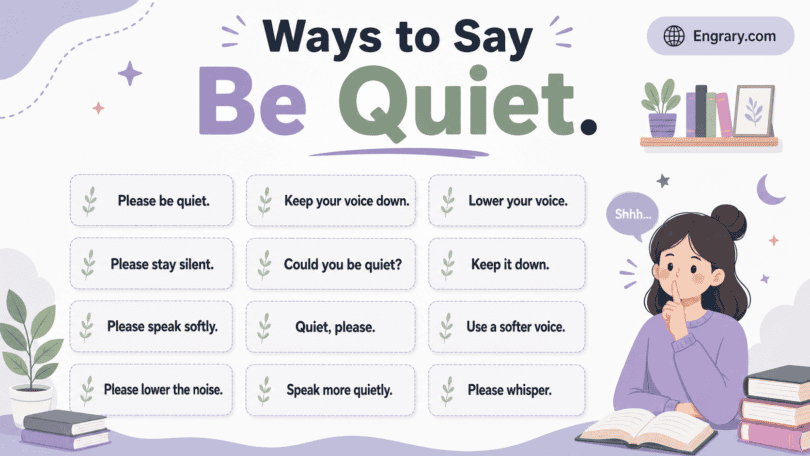
“Be quiet” is clear, but it can sound too direct or rude in some situations. Often, a softer phrase works better, especially when you speak to adults, coworkers, students, children, or people in public places.
For example, “Could you please lower your voice?” sounds polite, while “Keep it down” sounds casual. Meanwhile, “Let’s use indoor voices” sounds gentle and child-friendly. Therefore, this guide gives you 80 natural ways to say “be quiet” with examples for polite requests, classrooms, workplaces, public places, texts, and casual conversations.
Best Ways to Say “Be Quiet” by Situation
| Situation | Best Phrase |
|---|---|
| Polite request | Could you please lower your voice? |
| Professional setting | Could we keep the volume down? |
| Classroom | Quiet voices, please |
| Children | Let’s use indoor voices |
| Public place | Please keep it down |
| Firm request | I need quiet right now |
| Casual setting | Keep it down |
| Reason-based request | I’m trying to concentrate |
| Text reminder | Quiet hours, please |
| Playful phrase | Shh |
Be Quiet vs Keep Quiet vs Quiet Down vs Lower Your Voice
| Phrase | Meaning | Best Use |
|---|---|---|
| Be quiet | A direct request for silence | General situations, but it can sound blunt |
| Keep quiet | Stay quiet or avoid speaking | Instructions or serious situations |
| Quiet down | Become less noisy | Groups, children, and casual settings |
| Lower your voice | Speak more softly | Polite requests and public places |
| Keep it down | Reduce the noise level | Casual or shared spaces |
| Hush | A soft command for quiet | Children or gentle moments |
| Silence, please | A formal request for silence | Events, classrooms, and announcements |
Is “Be Quiet” Rude or Polite?
“Be quiet” is not always rude, but it can sound blunt. Tone, relationship, and setting matter a lot. When you say it sharply, it may sound impatient or disrespectful.
In polite situations, use softer phrases like “Could you please lower your voice?” or “Would you mind keeping it down?” When you need to be firm, you can still sound respectful by saying “I need quiet right now” or “Please lower your voice.”
Polite Ways to Say “Be Quiet”
Use these phrases when you want to ask for quiet respectfully and avoid sounding too direct.
Could you please lower your voice?
A polite phrase for asking someone to speak more softly.
Example: Could you please lower your voice? I’m trying to focus.
Would you mind keeping it down?
A respectful question for reducing noise.
Example: Would you mind keeping it down for a few minutes?
Could we keep the noise down?
A polite group-friendly phrase.
Example: Could we keep the noise down in here?
Please speak a little more softly
A gentle phrase for asking someone to lower their voice.
Example: Please speak a little more softly.
Could you keep your voice down?
A polite and direct phrase for quiet.
Example: Could you keep your voice down during the meeting?
I’d appreciate a little quiet
A soft phrase for requesting silence.
Example: I’d appreciate a little quiet while I finish this.
Could we lower the volume, please?
A polite phrase for noise, music, or voices.
Example: Could we lower the volume, please?
Would it be possible to keep things quieter?
A very polite phrase for sensitive situations.
Example: Would it be possible to keep things quieter tonight?
Please be mindful of the noise
A respectful phrase that reminds someone to notice their volume.
Example: Please be mindful of the noise in the hallway.
I’m sorry, but could you keep it down?
A polite phrase that softens the request.
Example: I’m sorry, but could you keep it down a little?
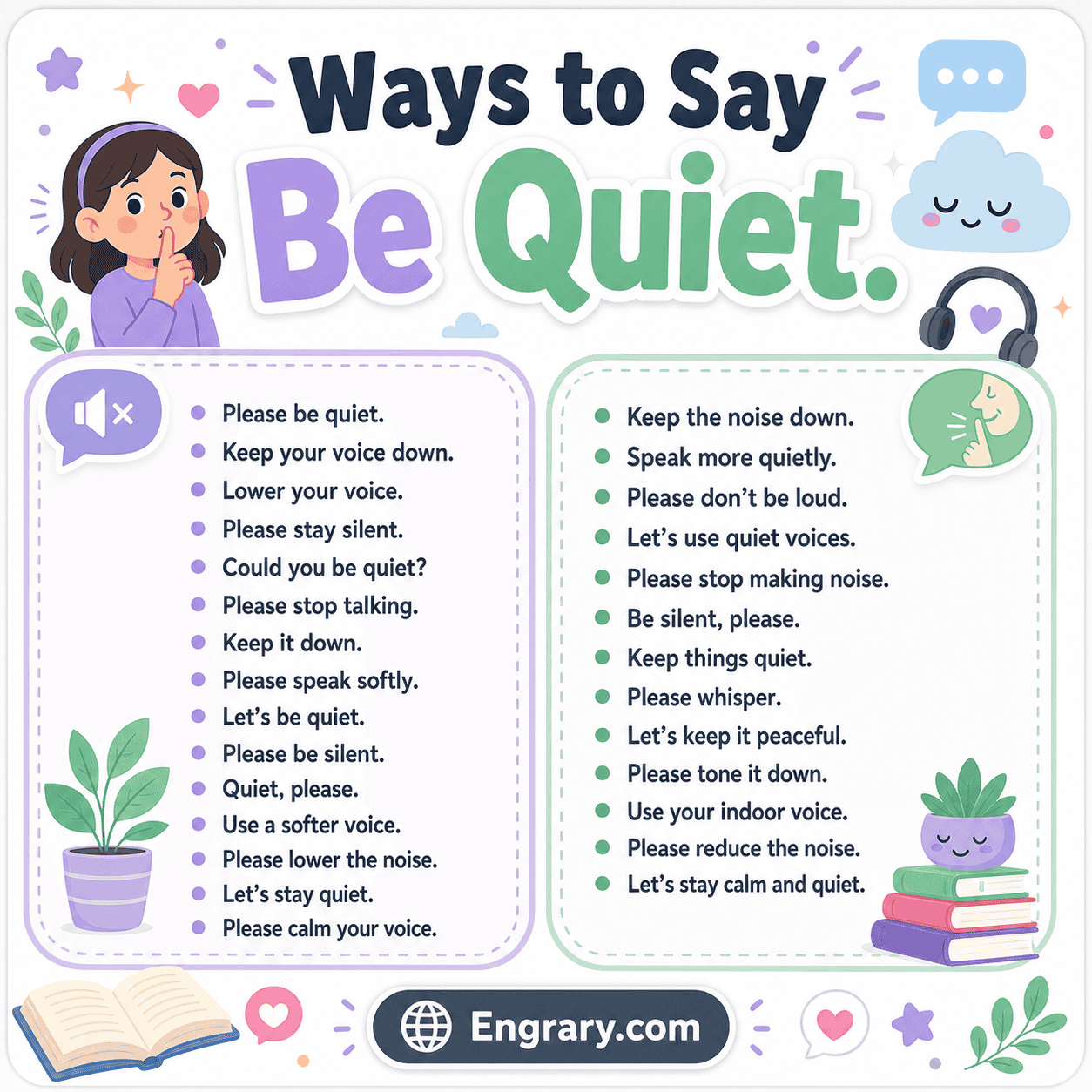
Professional Ways to Ask Someone to Keep the Noise Down
These phrases work well in offices, meetings, coworking spaces, and other professional settings.
Could we keep the volume down?
A professional phrase for reducing noise.
Example: Could we keep the volume down during the call?
Let’s keep the discussion focused
A professional phrase for limiting side talk.
Example: Let’s keep the discussion focused for now.
I’m having trouble concentrating
A reason-based phrase that sounds respectful.
Example: I’m having trouble concentrating with the noise.
Could we continue this quietly?
A polite phrase for keeping a conversation low.
Example: Could we continue this quietly in the back?
Let’s keep the noise level low
A calm workplace phrase.
Example: Let’s keep the noise level low while others are working.
Can we keep this area quiet?
A professional phrase for shared spaces.
Example: Can we keep this area quiet for the next hour?
Could we take this conversation elsewhere?
A polite phrase for moving a noisy conversation.
Example: Could we take this conversation elsewhere?
Let’s avoid side conversations
A useful phrase for meetings or presentations.
Example: Let’s avoid side conversations during the presentation.
Please hold comments until the end
A formal phrase for keeping order.
Example: Please hold comments until the end of the session.
Let’s keep the room quiet for now
A professional phrase for temporary silence.
Example: Let’s keep the room quiet for now.
Gentle Ways to Ask for Quiet
These phrases sound soft and calm. Therefore, they work well with children, family, or sensitive situations.
Let’s use quiet voices
A gentle phrase for lowering noise.
Example: Let’s use quiet voices inside.
Let’s keep things calm
A soft phrase for reducing noise and energy.
Example: Let’s keep things calm for a while.
Soft voices, please
A gentle phrase for children or groups.
Example: Soft voices, please.
Let’s whisper for a bit
A friendly phrase for quiet speaking.
Example: Let’s whisper for a bit while the baby sleeps.
Can we have a quiet moment?
A gentle request for silence.
Example: Can we have a quiet moment?
Let’s bring the volume down
A calm phrase for reducing loudness.
Example: Let’s bring the volume down a little.
Let’s settle down
A gentle phrase for calming a noisy group.
Example: Let’s settle down before we start.
Please use a calm voice
A soft phrase for someone speaking loudly.
Example: Please use a calm voice.
Let’s keep it peaceful
A gentle phrase for keeping the mood quiet.
Example: Let’s keep it peaceful in here.
A little quieter, please
A short gentle phrase for reducing noise.
Example: A little quieter, please.
Firm but Respectful Ways to Say “Be Quiet”
Use these phrases when you need to be clear without sounding rude or impatient.
I need quiet right now
A firm but respectful phrase for needing silence.
Example: I need quiet right now so I can finish this.
Please stop talking for a moment
A direct phrase for temporary silence.
Example: Please stop talking for a moment.
Please lower your voice
A firm but polite phrase.
Example: Please lower your voice in the hallway.
Let’s pause the conversation
A respectful phrase for stopping a discussion briefly.
Example: Let’s pause the conversation until the meeting ends.
Please keep the noise down
A clear phrase for reducing noise.
Example: Please keep the noise down.
I need everyone to listen
A firm phrase for groups or classrooms.
Example: I need everyone to listen now.
Let’s stop the side conversations
A firm group phrase for meetings or lessons.
Example: Let’s stop the side conversations.
Please give me a quiet moment
A respectful phrase for asking for silence.
Example: Please give me a quiet moment to think.
This needs to be quieter
A direct phrase for lowering noise.
Example: This needs to be quieter.
Let’s bring the volume down now
A firm but controlled phrase.
Example: Let’s bring the volume down now.
Casual Ways to Say “Be Quiet”
These phrases sound more relaxed. As a result, they work best with friends, family, or familiar people.
Keep it down
A casual phrase for lowering noise.
Example: Keep it down; I’m on a call.
Lower your voice
A simple casual phrase.
Example: Lower your voice a little.
Quiet down
A casual phrase for becoming less noisy.
Example: Quiet down for a second.
Tone it down
A casual phrase for reducing loudness or energy.
Example: Tone it down a bit.
Not so loud
A simple casual phrase for loud voices.
Example: Not so loud; people are sleeping.
Can you keep it down?
A casual question for lowering noise.
Example: Can you keep it down for a minute?
Easy on the volume
A casual phrase for noise or music.
Example: Easy on the volume, please.
Bring it down a bit
A relaxed phrase for lowering noise.
Example: Bring it down a bit.
Let’s keep it low
A casual phrase for keeping voices quiet.
Example: Let’s keep it low in here.
Can we lower the noise?
A casual but polite phrase.
Example: Can we lower the noise a little?
Classroom and Teacher Phrases for Quiet
These phrases work well for teachers, tutors, classrooms, and group learning. They also help create order without sounding harsh.
Quiet voices, please
A simple classroom phrase for lower volume.
Example: Quiet voices, please.
Voices off, please
A classroom phrase for silence.
Example: Voices off, please.
Eyes forward and voices off
A teacher phrase for attention and silence.
Example: Eyes forward and voices off.
Please listen quietly
A respectful classroom phrase.
Example: Please listen quietly while I explain.
It’s quiet time now
A clear phrase for changing to a quiet activity.
Example: It’s quiet time now.
Let’s give everyone a chance to hear
A considerate phrase for group quiet.
Example: Let’s give everyone a chance to hear.
Please wait your turn to speak
A classroom phrase for turn-taking.
Example: Please wait your turn to speak.
Hands up before speaking
A classroom rule phrase.
Example: Hands up before speaking.
Let’s listen first
A gentle phrase for classroom attention.
Example: Let’s listen first, then ask questions.
I need the room quiet
A firm teacher phrase.
Example: I need the room quiet before we begin.
Parent-Friendly Ways to Ask Children to Be Quiet
These phrases work well with children because they sound gentle, clear, and easy to understand.
Let’s use indoor voices
A child-friendly phrase for speaking softly.
Example: Let’s use indoor voices in the house.
Use your inside voice
A common phrase for children.
Example: Use your inside voice, please.
Let’s lower our voices
A gentle phrase for reducing volume together.
Example: Let’s lower our voices now.
Quiet time, please
A simple phrase for children.
Example: Quiet time, please.
Can we use soft voices?
A gentle question for children.
Example: Can we use soft voices while Grandma rests?
Let’s be quiet for a minute
A short child-friendly phrase.
Example: Let’s be quiet for a minute.
The baby is sleeping
A reason-based phrase children can understand.
Example: The baby is sleeping, so let’s be quiet.
We need quiet right now
A clear phrase for children.
Example: We need quiet right now.
Let’s take a quiet break
A gentle phrase for calming down.
Example: Let’s take a quiet break.
Whisper voice, please
A child-friendly phrase for quiet talking.
Example: Whisper voice, please.
Public Place Phrases for Asking Someone to Be Quiet
Use these phrases in libraries, hospitals, waiting rooms, shared spaces, public transport, or quiet areas.
This is a quiet area
A clear phrase for public spaces.
Example: This is a quiet area.
Could you keep it down, please?
A polite public-space request.
Example: Could you keep it down, please?
People are trying to concentrate
A reason-based phrase for shared spaces.
Example: People are trying to concentrate.
We need to keep the noise low here
A polite phrase for public quiet areas.
Example: We need to keep the noise low here.
Could you speak more quietly?
A respectful phrase for public places.
Example: Could you speak more quietly?
Please respect the quiet space
A polite phrase for libraries or study areas.
Example: Please respect the quiet space.
Let’s keep this area peaceful
A gentle phrase for shared spaces.
Example: Let’s keep this area peaceful.
Could you take the call outside?
A polite phrase for phone calls.
Example: Could you take the call outside?
Others are trying to rest
A reason-based phrase for hospitals, hotels, or homes.
Example: Others are trying to rest.
Please lower the volume
A direct but polite public-space phrase.
Example: Please lower the volume.
Reason-Based Ways to Ask Someone to Be Quiet
These phrases explain why you need quiet. As a result, they often sound more polite than a direct command.
I’m trying to concentrate
A useful phrase when noise affects your focus.
Example: I’m trying to concentrate.
I’m on a call
A simple reason for needing quiet.
Example: I’m on a call, so please keep it down.
The baby is sleeping
A clear reason for asking for quiet.
Example: The baby is sleeping.
People are trying to work
A reason-based phrase for offices or shared spaces.
Example: People are trying to work.
Someone is resting
A caring reason for quiet.
Example: Someone is resting in the next room.
I need a quiet moment
A personal reason for asking for silence.
Example: I need a quiet moment, please.
We’re in a quiet area
A clear phrase for public or shared spaces.
Example: We’re in a quiet area.
I can’t hear the speaker
A reason-based phrase for events or meetings.
Example: I can’t hear the speaker.
This space needs to stay quiet
A firm phrase for quiet areas.
Example: This space needs to stay quiet.
I’m trying to focus
A simple phrase for study or work.
Example: I’m trying to focus right now.
Short Texts and Quick Reminders for Quiet
These short phrases work well for messages, signs, group chats, or quick reminders.
Please keep it down
A short polite reminder.
Example: Please keep it down.
Quiet hours, please
A short reminder for shared living spaces.
Example: Quiet hours, please.
Lower the volume, please
A short phrase for music, TV, or voices.
Example: Lower the volume, please.
Can we keep it quiet?
A short message for group settings.
Example: Can we keep it quiet tonight?
Meeting in progress
A short notice for quiet during a meeting.
Example: Meeting in progress.
Baby sleeping
A short reminder for quiet near a child.
Example: Baby sleeping.
Please take the call outside
A short phrase for phone calls.
Example: Please take the call outside.
Keep voices low
A short reminder for quiet spaces.
Example: Keep voices low.
Quiet zone
A short sign-style phrase.
Example: Quiet zone.
Please keep this area quiet
A clear written reminder.
Example: Please keep this area quiet.
Slang and Playful Ways to Ask for Quiet
These phrases can sound playful with close friends, but many sound rude with strangers. Therefore, use them carefully.
Shh
A short sound for asking for quiet.
Example: Shh, the movie is starting.
Shush
A casual or playful phrase for quiet.
Example: Shush, I’m trying to hear this.
Hush
A softer phrase that often sounds gentle or old-fashioned.
Example: Hush, it’s okay.
Zip it
A very informal phrase that can sound rude.
Example: Zip it, I’m joking.
Button it
An informal phrase that can sound harsh or old-fashioned.
Example: Button it, we’re trying to listen.
Can it
A blunt informal phrase for stopping noise or talk.
Example: Can it for a second.
Pipe down
A casual phrase for becoming quieter.
Example: Pipe down, please.
Put a lid on it
A playful but sometimes rude phrase.
Example: Put a lid on it for a minute.
Simmer down
A casual phrase for calming down.
Example: Simmer down, everyone.
Silence, please
A formal or dramatic phrase for asking for quiet.
Example: Silence, please; the event is starting.
Phrases to Use Carefully
Some quiet phrases can sound rude, impatient, or harsh depending on the situation. Therefore, use the phrases below carefully.
| Phrase | Why to Use Carefully | Better Situation |
|---|---|---|
| Shut up | Very rude and aggressive | Avoid in polite situations |
| Shut your mouth | Extremely rude | Avoid |
| Zip it | Informal and often rude | Close friends only, if playful |
| Button it | Harsh or old-fashioned | Close friends only, if joking |
| Can it | Abrupt and dismissive | Very casual situations only |
| Pipe down | Casual and sometimes rude | Friends or informal groups |
| Silence! | Commanding and harsh outside authority | Formal authority only |
| Hush now | Can sound patronizing with adults | Children or gentle moments |
| Be quiet already | Sounds impatient | Avoid in respectful settings |
| Stop talking | Very direct and can sound harsh | Firm situations only |
Common Mistakes When Asking Someone to Be Quiet
Many English learners use “be quiet” in every situation. Although the phrase is clear, it can sound blunt when you say it to an adult, coworker, stranger, or guest.
In polite situations, use a request instead of a command. For example, “Could you please lower your voice?” sounds more respectful than “Be quiet.” Also, explaining the reason can make your request feel less rude.
Avoid harsh phrases like “shut up,” “shut your mouth,” or “be quiet already” in respectful settings. These phrases can sound angry, even when you only want less noise.
Natural Conversation Examples
Polite conversation
A: Sorry, are we being too loud?
B: A little. Could you please lower your voice?
Workplace conversation
A: Is the noise bothering you?
B: Yes, I’m having trouble concentrating.
Classroom conversation
A: Why did the teacher stop talking?
B: She said, “Quiet voices, please.”
Parent and child
A: Why do I have to be quiet?
B: The baby is sleeping, so let’s use indoor voices.
Public place
A: Are we too loud?
B: This is a quiet area, so please keep it down.
What to Say Instead of “Be Quiet” in Different Situations
| Situation | Better Phrase |
|---|---|
| Polite conversation | Could you please lower your voice? |
| Office or meeting | Could we keep the volume down? |
| Classroom | Quiet voices, please |
| Talking to children | Let’s use indoor voices |
| Library | Please respect the quiet space |
| Someone on a call | Could you take the call outside? |
| Casual chat | Keep it down |
| Group setting | Let’s bring the volume down |
| Need focus | I’m trying to concentrate |
| Text reminder | Quiet hours, please |
How to Choose the Right Quiet Phrase
Choose your phrase based on who you are speaking to, where you are, and how firm you need to be. When you speak to a stranger, coworker, or guest, use polite phrases like “Could you please lower your voice?” or “Would you mind keeping it down?”
With children, gentle phrases like “Let’s use indoor voices” or “Quiet voices, please” sound better. However, if the situation needs a firm response, use clear but respectful wording like “I need quiet right now” or “Please lower your voice.”
Summary
There are many ways to say “be quiet,” and the best phrase depends on your tone, setting, and relationship with the person. In polite situations, “Could you please lower your voice?” and “Would you mind keeping it down?” work well.
However, classrooms, homes, workplaces, and public places often need different wording. Gentle phrases like “Let’s use indoor voices,” firm phrases like “I need quiet right now,” and reason-based requests like “I’m trying to concentrate” can help you ask for quiet without sounding rude.
FAQs
Another way to say “be quiet” is “please keep it down.” You can also say “lower your voice,” “quiet down,” “speak softly,” or “could you please lower your voice?”
A polite way to say “be quiet” is “Could you please lower your voice?” You can also say “Would you mind keeping it down?” or “Could we keep the noise down?”
You can say “Could you please lower your voice?” or “Please speak a little more softly.” If you want to give a reason, say “I’m trying to concentrate.”
Yes, “shut up” usually sounds rude and aggressive. It is better to say “please be quiet,” “could you keep it down?” or “please lower your voice.”
Teachers can say “Quiet voices, please,” “Voices off, please,” “Let’s settle down,” or “Please listen quietly.” These phrases sound clearer and more classroom-friendly.
You May Also Like