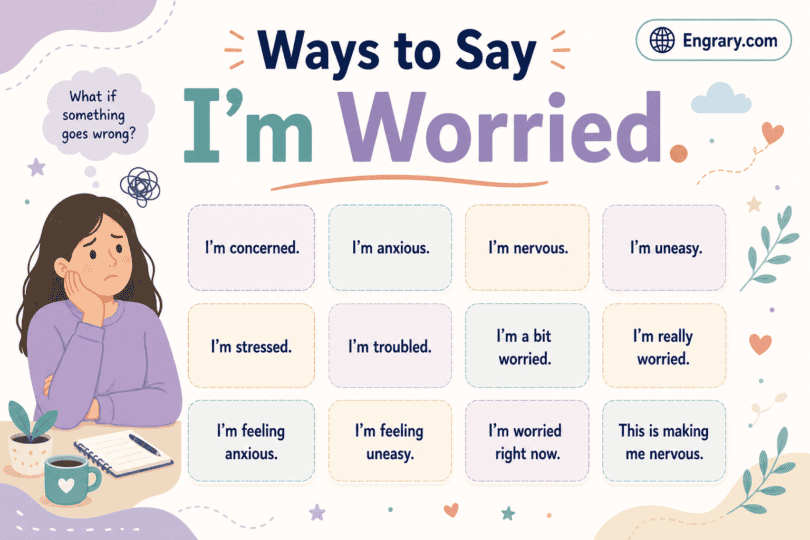
“I’m worried” is natural and easy to understand. However, it does not fit every situation. In English, worry can sound mild, serious, polite, professional, emotional, or supportive depending on the context.
For example, “I’m a bit concerned” sounds polite, while “I have some concerns” sounds professional. Meanwhile, “I’m really worried about you” sounds caring and personal. Therefore, this guide gives you 120 natural ways to say “I’m worried” with examples for daily conversations, texts, work, health, safety, relationships, and emotional situations.
Best Ways to Say “I’m Worried”
| Situation | Best Phrase |
|---|---|
| Simple worry | I’m worried |
| Polite concern | I’m a bit concerned |
| Professional setting | I have some concerns |
| Strong worry | I’m really worried |
| Mild worry | I’m slightly uneasy |
| Text message | Are you okay? |
| Worried about someone | I’m worried about you |
| Health or safety concern | Please let me know you’re safe |
| Future outcome | I’m concerned about the outcome |
| Emotional worry | It’s been on my mind |
Worried vs Concerned vs Anxious vs Uneasy
| Phrase | Meaning | Best Use |
|---|---|---|
| Worried | General concern that something bad may happen | Everyday situations |
| Concerned | Polite, serious, or professional worry | Work, family, and formal situations |
| Anxious | Worry mixed with nervousness | Personal feelings or uncertainty |
| Uneasy | Mild discomfort or suspicion | Early worry, doubt, or discomfort |
| Troubled | Deep emotional concern | Serious or personal situations |
| Stressed | Worry mixed with pressure | Work, deadlines, and responsibilities |
Is “I’m Worried” Natural and Polite?
Yes, “I’m worried” sounds natural in everyday English. You can use it with friends, family, classmates, coworkers, and people you know well.
However, polite or professional situations often need softer wording. Instead of saying “I’m worried” directly, you can say “I’m a bit concerned,” “I have some concerns,” “This may need attention,” or “I’d like to understand this better.” As a result, your message sounds calmer and more respectful.
Everyday Ways to Say “I’m Worried”
These phrases work well in normal conversations. Also, they help you express concern clearly without sounding too formal.
I’m worried
A simple and direct phrase for concern.
Example: I’m worried about the test results.
I’m concerned
A calm phrase that sounds slightly more serious.
Example: I’m concerned about what happened.
I’m anxious about it
A phrase for worry mixed with nervousness.
Example: I’m anxious about the interview.
I’m uneasy
A phrase for mild discomfort or doubt.
Example: I’m uneasy about this decision.
This worries me
A direct phrase for something that causes concern.
Example: This worries me a little.
I’m not sure about this
A gentle phrase for doubt or worry.
Example: I’m not sure about this plan.
I have a bad feeling about this
A natural phrase when something feels wrong.
Example: I have a bad feeling about this.
Something feels off
A casual phrase for discomfort or suspicion.
Example: Something feels off about the situation.
I can’t stop thinking about it
A phrase for worry that stays on your mind.
Example: I can’t stop thinking about it.
It’s been bothering me
A natural phrase for ongoing worry.
Example: It’s been bothering me since yesterday.
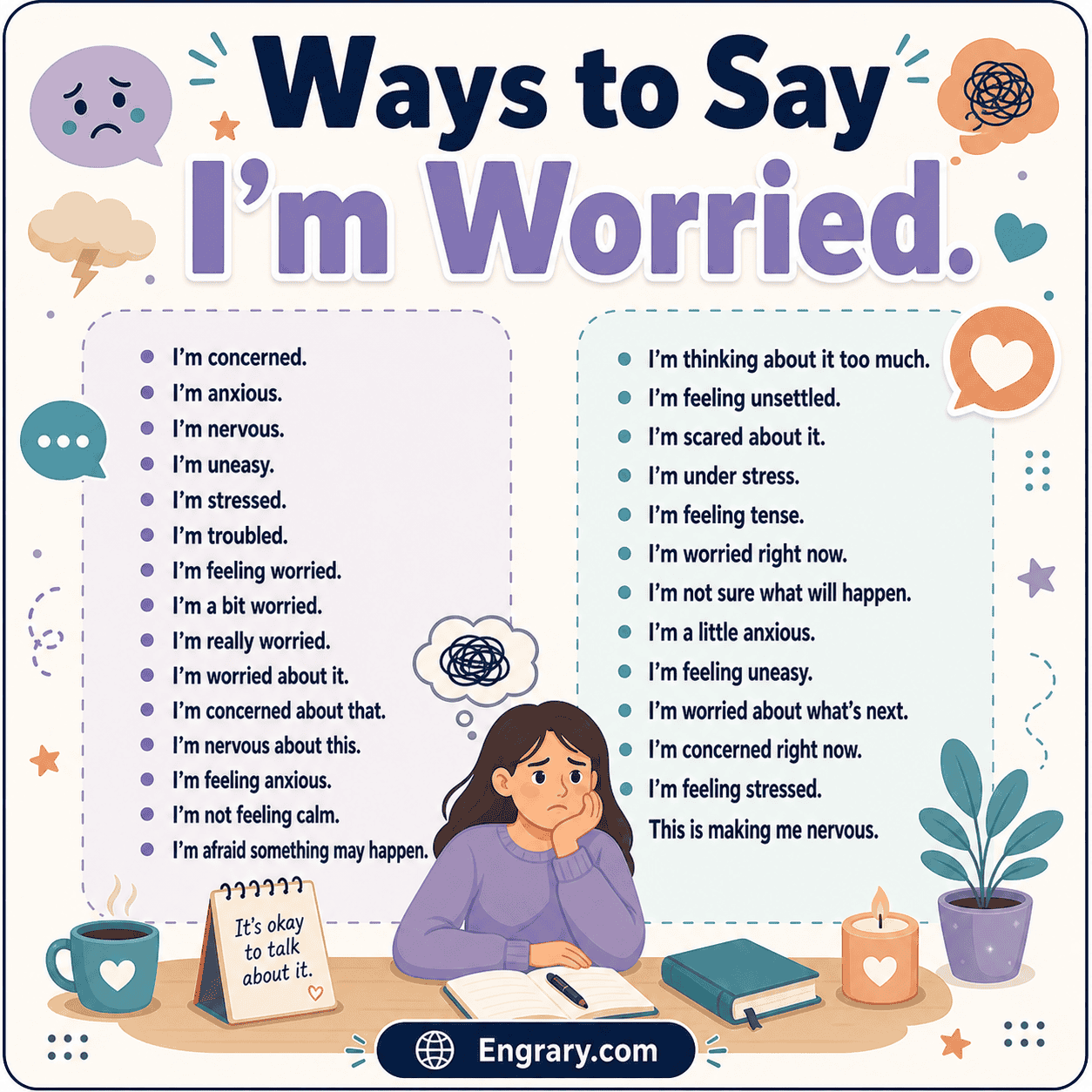
Polite Ways to Say “I’m Worried”
Use these phrases when you want to sound gentle, respectful, or less direct. In addition, they help you raise concerns without sounding harsh.
I’m a bit concerned
A polite phrase for mild worry.
Example: I’m a bit concerned about the delay.
I have a small concern
A soft phrase for raising an issue.
Example: I have a small concern about the plan.
I’m slightly uneasy about this
A polite phrase for mild discomfort.
Example: I’m slightly uneasy about this change.
I’m not completely comfortable with this
A careful phrase for polite disagreement or concern.
Example: I’m not completely comfortable with this approach.
This gives me some concern
A formal-sounding phrase for expressing worry.
Example: This gives me some concern.
I’d like to understand this better
A gentle phrase for concern without sounding critical.
Example: I’d like to understand this better before we continue.
I may be overthinking it, but I’m concerned
A soft phrase for sharing worry carefully.
Example: I may be overthinking it, but I’m concerned.
I hope this does not become an issue
A polite phrase for possible future problems.
Example: I hope this does not become an issue later.
I’d feel better if we checked
A gentle phrase for suggesting caution.
Example: I’d feel better if we checked one more time.
This is something we should review
A polite phrase for asking others to look at a concern.
Example: This is something we should review before deciding.
Professional Ways to Express Concern
These phrases work well in emails, meetings, reports, and workplace conversations. Therefore, they are useful when you need to sound calm and professional.
I have some concerns
A professional phrase for raising an issue.
Example: I have some concerns about the timeline.
I’m concerned about the timeline
A clear workplace phrase for schedule-related worry.
Example: I’m concerned about the timeline for this project.
This may need attention
A professional phrase for something that needs review.
Example: This may need attention before launch.
I’d like to raise a concern
A formal phrase for meetings or emails.
Example: I’d like to raise a concern about the budget.
I have reservations about this
A professional phrase for hesitation or doubt.
Example: I have reservations about this decision.
This could become a problem
A clear phrase for a possible issue.
Example: This could become a problem if we wait too long.
We should keep an eye on this
A professional phrase for monitoring a concern.
Example: We should keep an eye on this over the next week.
I’m concerned about the final result
A professional phrase for worry about results.
Example: I’m concerned about the final result of the review.
This needs careful consideration
A formal phrase for serious thought.
Example: This needs careful consideration before we move forward.
I think we should proceed carefully
A professional phrase for caution.
Example: I think we should proceed carefully with this decision.
Casual Ways to Say “I’m Worried”
These phrases sound more relaxed. Therefore, they work best with friends, family, or close contacts.
I’m kind of worried
A casual phrase for mild concern.
Example: I’m kind of worried about tomorrow.
I’m getting worried
A natural phrase when worry is increasing.
Example: I’m getting worried because she hasn’t replied.
I’m freaking out a little
A casual phrase for emotional worry.
Example: I’m freaking out a little about the exam.
This is stressing me out
A casual phrase for worry mixed with pressure.
Example: This is stressing me out.
I’m nervous about it
A natural phrase for worry before something happens.
Example: I’m nervous about the meeting.
I don’t feel good about this
A casual phrase for doubt or discomfort.
Example: I don’t feel good about this.
This has me worried
A conversational phrase for concern.
Example: This has me worried now.
I’m scared this might go wrong
A casual phrase for fear about an outcome.
Example: I’m scared this might go wrong.
I keep thinking about it
A simple phrase for repeated worry.
Example: I keep thinking about it.
I’m not feeling great about this
A casual phrase for concern or doubt.
Example: I’m not feeling great about this plan.
Short Worried Texts and Quick Messages
Use these phrases in texts, chats, and quick replies. Moreover, they work well when you need a fast check-in.
Are you okay?
A short message for checking on someone.
Example: Are you okay?
Everything okay?
A casual check-in message.
Example: Everything okay?
You okay?
A short and casual way to ask if someone is fine.
Example: You okay?
I’m worried.
A direct short text.
Example: I’m worried.
Please reply.
A short message when you need reassurance.
Example: Please reply when you can.
Text me when you can.
A gentle message when you are waiting for a response.
Example: Text me when you can.
Let me know you’re safe.
A short safety-related message.
Example: Let me know you’re safe.
I hope you’re alright.
A caring message for someone you are worried about.
Example: I hope you’re alright.
That worries me.
A direct response to something concerning.
Example: That worries me.
I’m starting to worry.
A short phrase when concern is growing.
Example: I’m starting to worry.
Strong Worry Phrases
Use these phrases when the worry feels serious, urgent, or intense. However, save the strongest phrases for situations that truly need them.
I’m really worried
A strong but natural phrase for serious concern.
Example: I’m really worried about him.
I’m deeply concerned
A serious phrase for strong concern.
Example: I’m deeply concerned about the situation.
I’m extremely worried
A direct phrase for very strong worry.
Example: I’m extremely worried about what happened.
I’m scared something is wrong
A strong phrase for fear that something bad happened.
Example: I’m scared something is wrong.
I can’t stop worrying
A phrase for worry that feels hard to control.
Example: I can’t stop worrying about the results.
This is really troubling me
A serious phrase for emotional concern.
Example: This is really troubling me.
I’m losing sleep over this
A phrase for worry that affects your peace of mind.
Example: I’m losing sleep over this decision.
I’m afraid this could get worse
A phrase for fear about a problem growing.
Example: I’m afraid this could get worse.
This feels serious
A direct phrase for a situation that seems important or risky.
Example: This feels serious.
I’m worried sick
A strong informal phrase for intense worry.
Example: I’m worried sick about her.
Mild Worry Phrases
Use these phrases when the concern is small, early, or not too serious. As a result, your message sounds calm instead of dramatic.
I’m a little worried
A simple phrase for mild concern.
Example: I’m a little worried about the weather.
I’m slightly concerned
A polite phrase for light concern.
Example: I’m slightly concerned about the timing.
I feel a little uneasy
A phrase for mild discomfort.
Example: I feel a little uneasy about this.
I’m not too sure about this
A gentle phrase for doubt.
Example: I’m not too sure about this idea.
This might be a concern
A mild phrase for a possible issue.
Example: This might be a concern later.
I have a slight concern
A polite phrase for a small issue.
Example: I have a slight concern about the details.
I’m a little unsure
A soft phrase for uncertainty.
Example: I’m a little unsure about the next step.
This makes me hesitate
A phrase for cautious concern.
Example: This makes me hesitate.
I’m not fully convinced
A mild phrase for doubt.
Example: I’m not fully convinced this will work.
I’d rather be careful
A gentle phrase for caution.
Example: I’d rather be careful with this.
Emotional Ways to Say “I’m Worried”
These phrases sound more personal and emotional. Also, they work well when worry feels hard to ignore.
It’s been on my mind
A natural phrase for ongoing worry.
Example: It’s been on my mind all day.
I feel unsettled
A phrase for emotional discomfort.
Example: I feel unsettled about what happened.
This is really bothering me
A direct phrase for emotional worry.
Example: This is really bothering me.
My mind keeps going back to it
A phrase for repeated thoughts about a concern.
Example: My mind keeps going back to it.
It’s weighing on me
A phrase for worry that feels emotionally heavy.
Example: It’s weighing on me.
I feel nervous about what might happen
A phrase for worry about the future.
Example: I feel nervous about what might happen.
I can’t shake this feeling
A phrase for worry that does not go away.
Example: I can’t shake this feeling.
I feel tense about it
A phrase for emotional or physical tension.
Example: I feel tense about it.
This has been hard to ignore
A phrase for worry that keeps returning.
Example: This has been hard to ignore.
I feel emotionally drained by this
A phrase for worry that feels tiring.
Example: I feel emotionally drained by this.
Ways to Say You’re Worried About Someone
Use these phrases when you care about someone and want to check on them. In addition, they sound supportive rather than demanding.
I’m worried about you
A direct caring phrase.
Example: I’m worried about you.
I hope you’re okay
A gentle phrase for checking on someone.
Example: I hope you’re okay.
I’ve been concerned about you
A caring phrase for ongoing worry.
Example: I’ve been concerned about you lately.
I just wanted to check in
A soft phrase for reaching out.
Example: I just wanted to check in and see how you are.
You had me worried
A phrase used after someone caused concern.
Example: You had me worried when you didn’t answer.
I was worried something happened
A phrase for concern after silence or delay.
Example: I was worried something happened.
I’ve been thinking about you
A caring phrase that shows concern.
Example: I’ve been thinking about you.
I’m here if you need anything
A supportive phrase for someone who may be struggling.
Example: I’m here if you need anything.
Please let me know how you’re doing
A caring phrase for asking for an update.
Example: Please let me know how you’re doing.
I hope everything is all right
A gentle phrase for concern.
Example: I hope everything is all right.
Health and Safety Worry Phrases
These phrases work well when you worry about someone’s health, safety, or well-being. Therefore, they are useful in caring messages.
I’m worried about your health
A direct phrase for health-related concern.
Example: I’m worried about your health.
I hope you’re feeling okay
A gentle phrase for someone who may be unwell.
Example: I hope you’re feeling okay.
I’m concerned about your safety
A serious phrase for safety-related worry.
Example: I’m concerned about your safety.
Please let me know you’re safe
A caring phrase when someone may be in danger.
Example: Please let me know you’re safe.
I hope nothing serious happened
A phrase for possible accidents or problems.
Example: I hope nothing serious happened.
I’m worried something may be wrong
A phrase for possible trouble or illness.
Example: I’m worried something may be wrong.
I just want to make sure you’re okay
A gentle phrase for checking on someone.
Example: I just want to make sure you’re okay.
Let me know when you arrive
A practical phrase for safety and travel.
Example: Let me know when you arrive.
Please take care of yourself
A caring phrase for someone’s well-being.
Example: Please take care of yourself.
I’m worried about how you’re doing
A thoughtful phrase for emotional or physical health.
Example: I’m worried about how you’re doing.
Future and Outcome-Based Worry Phrases
Use these phrases when you worry about results, decisions, consequences, or what may happen next. Meanwhile, choose softer wording if the situation is uncertain but not serious.
I’m worried about what might happen
A natural phrase for future worry.
Example: I’m worried about what might happen next.
I’m concerned about the outcome
A phrase for worry about results.
Example: I’m concerned about the outcome.
I’m not sure how this will turn out
A phrase for uncertainty about the future.
Example: I’m not sure how this will turn out.
There’s a chance this could go wrong
A direct phrase for possible problems.
Example: There’s a chance this could go wrong if we rush.
I’m worried this may not work
A phrase for concern about a plan.
Example: I’m worried this may not work.
I’m unsure about the result
A calm phrase for uncertain outcomes.
Example: I’m unsure about the result.
I’m hoping this turns out well
A softer phrase for future worry.
Example: I’m hoping this turns out well.
I’m worried about the consequences
A phrase for concern about what may follow.
Example: I’m worried about the consequences.
This might create problems
A phrase for possible future trouble.
Example: This might create problems later.
The next step worries me
A phrase for concern about what comes next.
Example: The next step worries me.
Relationship and Family Worry Phrases
These phrases work well for personal, family, or relationship concerns. Since these situations can feel sensitive, choose wording that sounds caring rather than blaming.
I’m worried about us
A direct phrase for relationship concern.
Example: I’m worried about us.
I’m scared we’re drifting apart
A phrase for emotional distance in a relationship.
Example: I’m scared we’re drifting apart.
I’m worried about your feelings
A caring phrase for emotional concern.
Example: I’m worried about your feelings.
I don’t want this to come between us
A phrase for protecting a relationship.
Example: I don’t want this to come between us.
I’m worried about our conversation
A phrase for concern after a discussion.
Example: I’m worried about our conversation last night.
What happened has been on my mind
A phrase for lingering concern after an event.
Example: What happened has been on my mind.
I’m afraid I upset you
A caring phrase when you think someone may be hurt.
Example: I’m afraid I upset you.
I hope we’re okay
A gentle phrase for relationship reassurance.
Example: I hope we’re okay.
Something feels different
A phrase for noticing emotional distance.
Example: Something feels different between us.
I’ve been thinking about what you said
A thoughtful phrase for ongoing concern.
Example: I’ve been thinking about what you said.
Phrases to Use Carefully
Some worry phrases can sound too dramatic, emotional, or informal depending on the situation. Therefore, use the phrases below only when the tone fits.
| Phrase | Why to Use Carefully | Better Situation |
|---|---|---|
| I’m freaking out | Very casual and emotional | Friends or texts |
| I’m panicking | Strong and serious | Real panic or urgent situations |
| I’m scared to death | Very dramatic | Emotional or informal situations |
| I’m losing it | Informal and intense | Close friends only |
| This is killing me | Dramatic and emotionally heavy | Casual or emotional speech |
| I’m paranoid | Can sound negative or dismissive | Use only if accurate |
| I’m terrified | Very strong fear | Serious fear or danger |
Common Mistakes When Saying “I’m Worried”
Many English learners use “I’m worried” for every type of concern. While the phrase is correct, it can sound repetitive or too direct in polite situations.
In professional settings, “I have some concerns” or “I’m concerned about the timeline” often sounds better. With friends, phrases like “I’m getting worried” or “This is stressing me out” feel more natural.
Also, avoid using very strong phrases too often. Phrases like “I’m panicking,” “I’m terrified,” or “I’m scared to death” should stay in serious or emotional situations.
Natural Conversation Examples
Casual conversation
A: She still hasn’t replied.
B: I’m starting to worry.
Professional conversation
A: Do you think the deadline is realistic?
B: I have some concerns about the timeline.
Text message
A: I’ll call you later.
B: Okay, please let me know you’re safe.
Worried about someone
A: Why did you call twice?
B: I was worried something happened.
Relationship conversation
A: You seem quiet today.
B: I’m worried about our conversation yesterday.
What to Say Instead of “I’m Worried” in Different Situations
| Situation | Better Phrase |
|---|---|
| Professional email | I have some concerns |
| Mild worry | I’m a little concerned |
| Serious concern | I’m deeply concerned |
| Text message | Are you okay? |
| Worried about someone | I hope everything is okay |
| Health or safety | Please let me know you’re safe |
| Future result | I’m concerned about the outcome |
| Relationship worry | Something feels off |
| Emotional worry | It’s been on my mind |
| Polite concern | I’d like to understand this better |
How to Choose the Right Worry Phrase
Choose your phrase based on the level of worry, the situation, and the person you are speaking to. If the worry is small, mild phrases like “I’m a little concerned” or “I feel a little uneasy” work well.
Professional situations usually need calmer wording, such as “I have some concerns” or “This may need attention.” Meanwhile, close friends or family may understand more emotional phrases like “I’m really worried about you” or “I can’t stop thinking about it.”
Summary
There are many ways to say “I’m worried,” and the best phrase depends on your tone, situation, and level of concern. For everyday use, “I’m worried,” “I’m concerned,” and “This worries me” are simple and clear.
However, polite or professional situations often need softer phrases like “I’m a bit concerned,” “I have some concerns,” or “This may need attention.” If you are worried about someone, caring phrases like “I hope you’re okay,” “I just wanted to check in,” and “Please let me know you’re safe” sound more supportive.
FAQs
Another way to say “I’m worried” is “I’m concerned.” You can also say “I’m anxious about it,” “This worries me,” “I’m uneasy,” or “It’s been on my mind.”
A polite way to say “I’m worried” is “I’m a bit concerned.” You can also say “I have a small concern,” “I’d like to understand this better,” or “I’d feel better if we checked.”
A professional way to express concern is “I have some concerns.” Other professional options include “I’m concerned about the timeline,” “This may need attention,” and “I’d like to raise a concern.”
“Worried” means you are concerned that something bad may happen. “Anxious” usually means worried and nervous at the same time, often with a stronger emotional feeling.
You can say “I’m worried about you,” “I hope you’re okay,” “I just wanted to check in,” or “Please let me know you’re safe.” These phrases sound caring and supportive.
You May Also Like