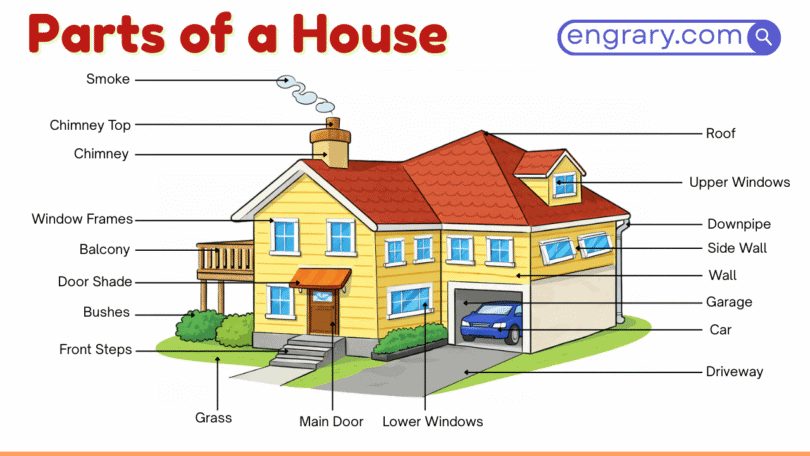
House parts are the physical sections that form a home’s outer structure, inner spaces, support system, and utility layout. Together, these parts connect in a clear structural order that supports shelter, access, protection, ventilation, and daily use. The foundation supports the base, while the walls and roof form the main enclosure. At the same time, the doors and windows provide access, light, and airflow, and the interior sections shape the living space.
In addition, a labeled diagram shows how these named parts align across the base, outer shell, upper covering, entry points, and inner layout of the house. As the foundation supports the load, the walls carry the vertical structure and the roof protects the top enclosure. Meanwhile, the doors, windows, stairs, and utility sections support movement, visibility, and practical use across standard house designs.
Exterior Structure Parts
The exterior structure forms the main outer body of the house. Together, these parts support the building, enclose the living space, and protect the interior from outside conditions.
Foundation
The foundation is the base structure of the house. It supports the full load of the building and keeps the structure stable on the ground.
Wall
The wall is the vertical side structure of the house. It supports the upper sections and encloses the interior space.
Siding
The siding is the outer covering fixed over the exterior wall surface. It protects the wall and forms the visible outer finish of the house.
Roof
The roof is the upper covering of the house. It protects the interior from sun, rain, and other outside conditions.
Rafter
The rafter is the sloped framing part that supports the roof. It helps carry roof load downward into the wall structure.
Eave
The eave is the lower edge of the roof that extends beyond the wall. It helps direct rainwater away from the outer wall.
Fascia
The fascia is the vertical board fixed along the roof edge. It supports the gutter and forms the outer finishing edge below the roofline.
Soffit
The soffit is the underside section below the eave. It covers the roof overhang and often supports ventilation along the roof edge.
Ceiling
The ceiling is the overhead inner surface below the roof or floor above. It forms the upper interior boundary of a room.
Floor
The floor is the lower walking surface inside the house. It supports movement, furniture, and daily use.
Beam
The beam is the horizontal support part that helps carry structural load. It strengthens the house by supporting weight across spans.
Joist
The joist is the horizontal framing part that supports floors or ceilings. It helps carry weight across the house structure.
Column
The column is the vertical support part that carries weight downward. It helps transfer load from upper sections to the foundation.
Stud
The stud is the vertical framing part inside a wall. It helps form the wall structure and supports the sections attached to it.
Sheathing
The sheathing is the covering layer fixed over wall or roof framing. It forms a supportive surface beneath the outer finish.
Gutter
The gutter is the narrow channel fixed along the roof edge. It collects and directs rainwater away from the house.
Downspout
The downspout is the vertical pipe connected to the gutter. It carries rainwater downward and directs it away from the house base.
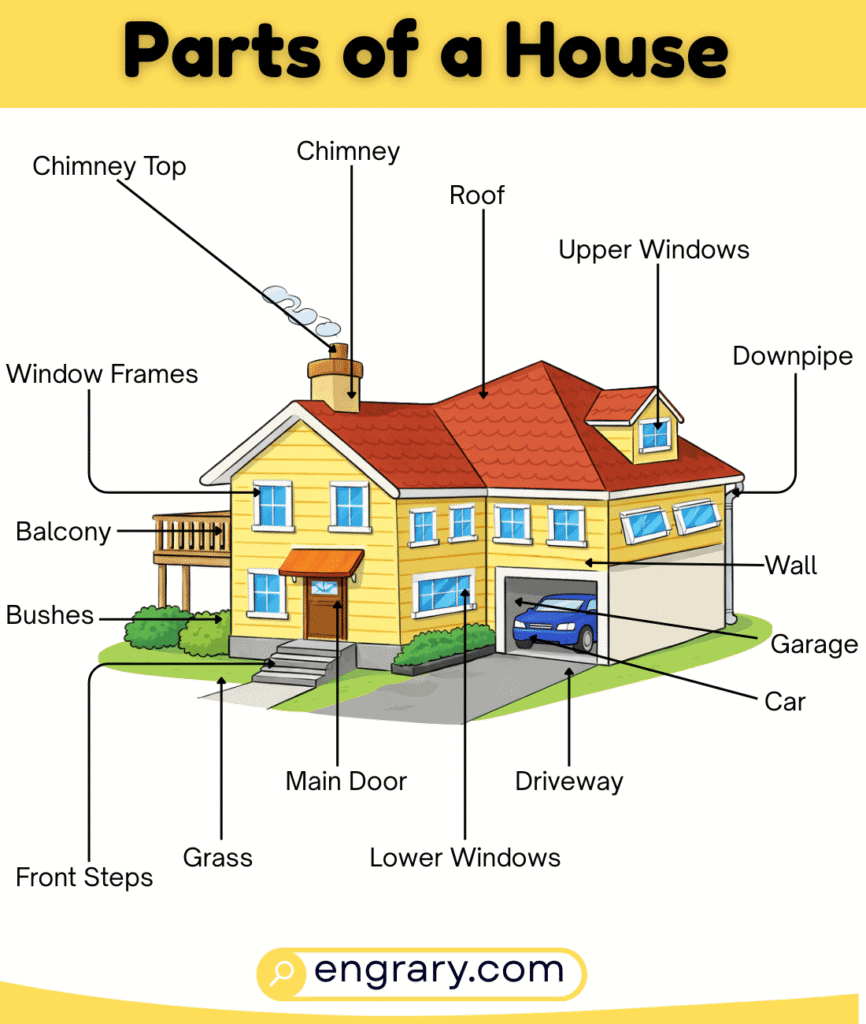
Entry And Opening Parts
These parts support entry, exit, light, airflow, and visibility. Together, they connect the inside of the house with the outside environment.
Door
The door is the movable entry panel used to enter or leave the house. It opens and closes within the frame.
Door Frame
The door frame is the outer support structure that surrounds the door. It holds the door in place and supports alignment.
Window
The window is the fitted opening with glass or another clear material. It provides light, airflow, and visibility.
Window Frame
The window frame is the supporting border around the window. It holds the window structure in position.
Header
The header is the horizontal support part above a door or window opening. It carries the load above the opening and transfers that weight to the side framing.
Sill
The sill is the lower horizontal part at the base of a window or doorway. It forms the bottom edge support of the opening.
Threshold
The threshold is the lower strip at the base of the doorway. It forms the bottom transition point between spaces.
Porch
The porch is the covered or open entry area attached to the front or side of the house. It creates an entrance space before the main door.
Step
The step is the raised surface used to move up or down at an entrance. It helps people reach the doorway safely.
Interior Room And Access Parts
These parts shape the inside layout of the house and support movement between spaces. Together, they define room structure, circulation, and practical indoor use.
Room
The room is an enclosed interior space inside the house. It provides a defined area for living, sleeping, cooking, or other daily use.
Hallway
The hallway is the passage that connects rooms and sections inside the house. It supports movement from one space to another.
Staircase
The staircase is the stepped structure that connects lower and upper floors. It allows vertical movement between levels.
Railing
The railing is the protective side support fixed along stairs, balconies, or open edges. It helps provide balance and safety during movement.
Balcony
The balcony is the raised outer platform attached to an upper floor. It extends outward from the house and creates an open standing space.
Attic
The attic is the upper space below the roof. It is often used for storage or as an additional enclosed area.
Basement
The basement is the lower level below the main ground floor. It forms an underground or partially underground section of the house.
Closet
The closet is the small enclosed storage space built into a room or wall area. It is used to store clothes, tools, or household items.
Utility And Support Parts
These parts support water flow, air movement, power access, and everyday function. Together, they help the house operate as a practical living structure.
Pipe
The pipe is the hollow line that carries water, gas, or waste through the house. It supports utility flow between different sections.
Drain
The drain is the outlet path that carries used water away from sinks, floors, or other fixtures. It supports water removal.
Vent
The vent is the opening that allows air to move in or out of the house. It supports airflow, cooling, or air release.
Chimney
The chimney is the vertical passage that carries smoke or gases upward and out of the house. It supports safe venting from fireplaces or heating systems.
Switch
The switch is the control used to turn electrical circuits on or off. It helps manage lights or connected electrical parts.
Socket
The socket is the fixed power outlet that receives an electrical plug. It provides connection for powered devices.
Fuse Box
The fuse box is the electrical control box that holds circuit protection parts. It helps manage and protect the house electrical system.
Water Tank
The water tank is the storage container that holds water for household use where fitted. It supports water supply within the house.
Parts Of House Names Key Takeaways
Parts of house names are grouped into exterior, entry, interior, and utility sections. Together, these groups form the main working structure of a standard house. The exterior parts create the base and outer enclosure, while the entry parts provide access, light, and airflow. At the same time, the interior parts shape room layout and movement, and the utility parts support water, air, and power flow. In addition, these sections work together to make the house stable, usable, and protected for daily living.
FAQs
The main parts of a house include the foundation, walls, roof, doors, windows, floors, stairs, and utility systems. Together, these parts support structure, access, and daily use.
The foundation supports the whole building. It carries the load of the house and keeps the structure stable on the ground.
The opening parts of a house include doors, windows, frames, sills, and thresholds. These parts support entry, light, airflow, and visibility.
The gutter carries rainwater away from the roof edge. It helps direct water away from the outer walls and base area.
Common inside parts of a house include rooms, hallways, stairs, closets, ceilings, floors, and utility lines. These parts support indoor living and movement.
You May Also Like