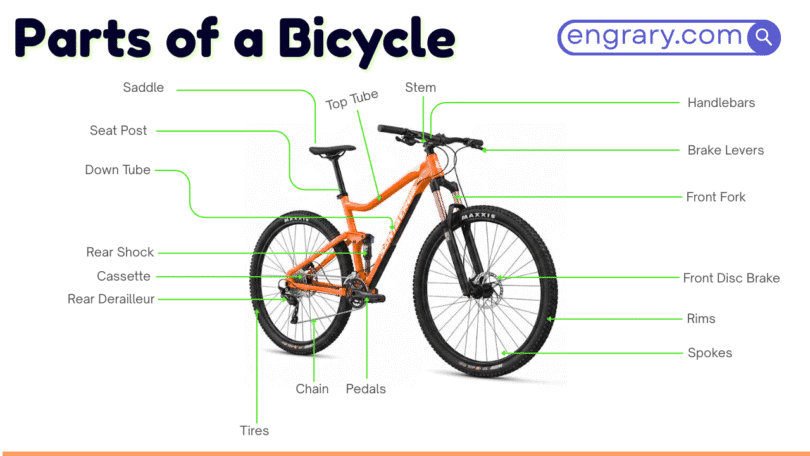
Bicycle parts are the physical structures that allow a bicycle to move, turn, and stop. Each section connects within a fixed mechanical order that supports balance, rotation, and directional control. The frame forms the base structure, wheels create rolling motion, the drivetrain transfers pedal force to the rear wheel, and brakes regulate speed.
A labeled diagram clarifies how these named parts align and interact within the full structure. Power moves from the pedals through the crank and chain system to rotate the rear wheel, while the steering assembly maintains controlled direction and stability across standard bicycle designs.
Frame Parts Of A Bicycle
The frame forms the main load-bearing structure. It connects the front assembly, drivetrain, and rear wheel into one rigid system.
Frame
The frame is the main structural body of the bicycle. It connects the front assembly, drivetrain, rear wheel, and seating area into one rigid unit that maintains alignment under load. Competitor anatomy guides consistently treat the frame as its own named part, not only as a section heading.
Top Tube
Extending horizontally between the head tube and seat tube, the top tube maintains upper frame rigidity and defines rider reach length.
Down Tube
Running diagonally from the head tube to the bottom bracket shell, the down tube carries forward stress and strengthens the front triangle.
Seat Tube
Rising vertically from the bottom bracket area, the seat tube holds the seatpost and determines saddle height adjustment range.
Chainstay
Positioned along the lower rear triangle, chainstays connect the bottom bracket to the rear dropouts and transmit pedaling force to the rear wheel.
Seatstay
Angling upward from the rear dropouts toward the seat tube, seatstays reinforce the rear triangle and provide mounting support for the rear brake.
Head Tube
Located at the front of the frame, the head tube houses the headset bearings and enables smooth fork rotation.
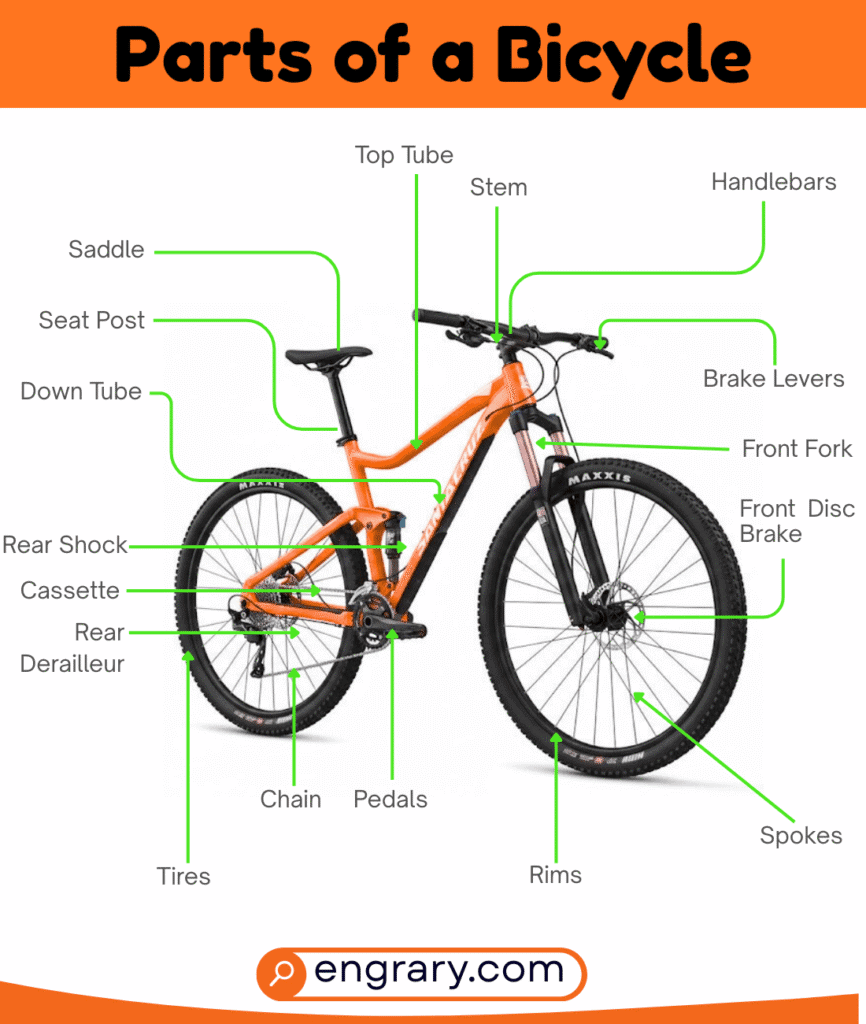
Steering And Control Parts
This group directs movement and manages rider input from the hands.
Handlebar
Mounted at the front, the handlebar provides grip positioning and determines steering leverage.
Stem
Clamped between the handlebar and fork steerer tube, the stem fixes handlebar position and influences reach and steering alignment.
Fork
Extending downward from the head tube, the fork supports the front wheel axle and absorbs directional force during motion.
Headset
Installed inside the head tube, the headset contains bearings that allow controlled rotation of the fork within the frame.
Grips
Fitted over the handlebar ends, grips increase traction and improve hand stability.
Brake Levers
Positioned near the grips, brake levers activate braking force through cables or hydraulic systems.
Gear Shifters
Mounted beside the brake levers, gear shifters control front and rear derailleurs to change gears.
Shall I continue with the next section covering Wheel Parts Of A Bicycle and Drivetrain Parts Of A Bicycle?
Wheel Parts Of A Bicycle
Wheels convert rotational force into forward motion. Each wheel is built from a tensioned circular structure that rotates around a central axle.
Wheel
The complete rotating assembly that includes rim, hub, spokes, tire, tube, and valve, allowing the bicycle to roll smoothly over surfaces.
Rim
Forming the outer circular ring, the rim supports the tire and provides the braking surface on rim-brake systems.
Spokes
Radiating between hub and rim, spokes maintain wheel tension balance and distribute load evenly across the structure.
Hub
Located at the center of the wheel, the hub houses internal bearings and rotates around the axle.
Tire
Mounted over the rim, the tire provides traction and surface contact with the ground.
Inner Tube
Placed inside the tire, the inner tube holds compressed air to maintain shape and absorb surface irregularities.
Valve
The valve controls inflation and air retention inside the inner tube. The two most common bicycle valve types are Schrader and Presta, with Schrader being wider and more common on many general-use bikes, while Presta is narrower and commonly used on many road-style setups. Competitor bicycle anatomy pages regularly include this distinction.
Drivetrain Parts Of A Bicycle
The drivetrain transfers leg power from the pedals to the rear wheel, creating propulsion through rotational movement.
Pedal
Positioned at the outer ends of the crank arms, the pedals receive foot pressure during rotation.
Crank Arm
Connecting each pedal to the crankset, the crank arm converts downward force into circular motion.
Crankset
Mounted at the bottom bracket, the crankset includes the crank arms and chainrings that drive the chain. In some usage, this part is also called the chainset, so mentioning both terms improves terminology coverage without changing the meaning.
Chainring
Attached to the crankset, the chainring engages the chain and initiates power transfer.
Bottom Bracket
Installed inside the frame shell, the bottom bracket contains bearings that allow the crankset to rotate smoothly.
Chain
Looped around chainrings and rear sprockets, the chain transmits mechanical energy to the rear wheel.
Cassette
Mounted on the rear hub, the cassette is the grouped set of rear sprockets that provides different gear ratios. It may also be referred to as a cogset in some terminology, though cassette is the more common label in standard bicycle anatomy guides.
Freewheel
Integrated into some rear hubs, the freewheel allows the wheel to rotate without forcing the pedals to turn.
Rear Derailleur
Suspended below the cassette, the rear derailleur shifts the chain across the rear sprockets and maintains chain tension. It also contains small guide pulleys that help direct the chain during gear changes.
Jockey Wheel
The jockey wheel is the small pulley inside the rear derailleur that guides the chain across the rear cogs during shifting. It helps keep chain movement controlled and supports smoother gear changes. This is a useful long-tail part name that some competitor anatomy pages include directly.
Front Derailleur
Positioned near the chainrings, the front derailleur moves the chain between front gears.
Brake System Parts
The brake system regulates motion by creating controlled friction against the rotating wheel. It connects hand input to stopping force through mechanical or hydraulic transmission.
Brakes
Brakes are the stopping system that reduces wheel speed through friction. The two main bicycle brake types are rim brakes and disc brakes, and adding this parent entry improves alignment with how major bicycle anatomy pages present braking systems.
Front Brake
Mounted on the fork, the front brake applies friction to the rim or rotor to slow the front wheel.
Rear Brake
Positioned near the seatstays, the rear brake controls deceleration of the back wheel and stabilizes stopping balance.
Brake Cables
Running between brake levers and brake mechanisms, brake cables transmit pulling force in mechanical brake systems.
Seating And Support Parts
This section maintains rider position and supports body weight during motion.
Saddle
Installed at the top of the seatpost, the saddle supports seated body weight and influences riding posture.
Seatpost
Inserted into the seat tube, the seatpost holds the saddle and allows vertical height adjustment.
Seat Clamp
Fitted around the top of the seat tube, the seat clamp secures the seatpost at a fixed height.
Kickstand
Attached near the lower rear frame area, the kickstand supports the bicycle in an upright stationary position.
Reflector
Mounted on wheels or frame sections, the reflector increases visibility by reflecting external light.
Chain Guard
Covering part of the drivetrain, the chain guard prevents clothing from contacting the moving chain.
FAQs
The main parts of a bicycle are the frame, wheels, drivetrain, brakes, steering section, and seating parts. These groups together form the complete structural system of a standard bicycle.
A bicycle contains over 25 standard parts, including frame tubes, wheel components, drivetrain elements, brake parts, and seating supports, depending on model design and gear configuration.
The drivetrain connects the pedals to the rear wheel. It includes the crankset, chainring, chain, cassette or freewheel, and rear derailleur to transfer rotational force.
The fork holds the front wheel, while the rear triangle of the frame holds the rear wheel. Both connect at the dropouts for stable axle positioning.
Bicycle brakes include brake levers, brake cables or hydraulic lines, and front and rear brake mechanisms that apply friction to slow wheel rotation.
Parts Of Bicycle Names Key Takeaways
The parts of bicycle names are organized into frame, steering, wheel, drivetrain, brake, and seating groups. The frame forms the structural base, steering directs movement, wheels enable rolling, the drivetrain converts pedal force into rear wheel rotation, and brakes control deceleration. Power flows from pedals through crank arms, chainrings, chain, and cassette to drive motion. We see variation in brake types and gear counts, yet these core structural groups remain mechanically consistent across standard bicycles.
You May Also Like