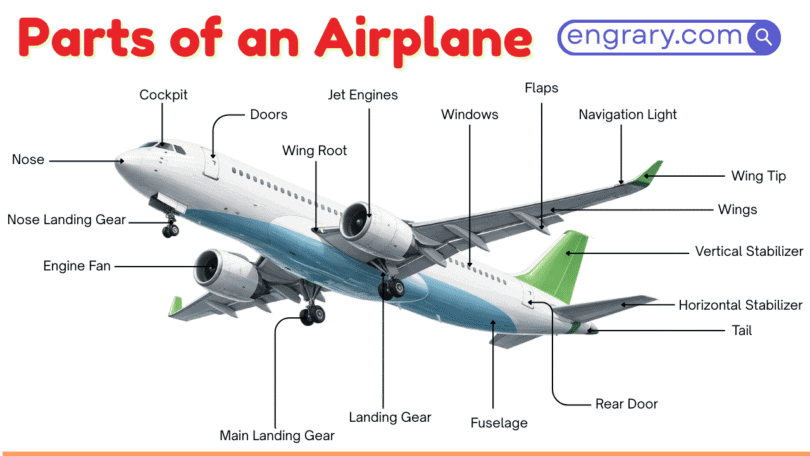
When you look at a labeled diagram of an airplane, the structure becomes clearer than it first appears. Instead of seeing only wings and engines, you begin to notice the fuselage, tail section, landing gear, and control surfaces working together as one coordinated system. Words like ailerons, rudder, flaps, and stabilizer often sound technical, yet placing them correctly helps you describe how an aircraft lifts, turns, and lands with precision.
In this article, we break down the parts of an airplane into major structural groups such as the fuselage, wings, tail, engines, and landing gear. We focus on the standard fixed-wing aircraft layout while noting that design details may vary slightly across models. Just below, the labeled diagram gathers these parts into one organized view, helping you connect each name to its structural role in flight.
Main Parts Of An Airplane
An airplane is built from several large structural groups that work together during takeoff, flight, and landing. Each group contains smaller parts that perform specific tasks.
Fuselage
Forming the central body, the fuselage connects all major parts of the airplane. It houses the cockpit, cabin, cargo space, and internal systems such as wiring and fuel lines. Its structure provides strength and aerodynamic shape during flight.
Wings
Extending from the fuselage, the wings generate lift. Their airfoil design creates pressure differences as air flows over them, allowing the airplane to rise into the air. Internal support beams and fuel tanks are also housed within the wing structure.
Tail Section
Located at the rear, the tail section maintains stability and balance. It includes the vertical and horizontal stabilizers along with control surfaces that guide directional movement and keep the aircraft aligned during flight.
Engines
Mounted on the wings or fuselage depending on aircraft design, engines produce thrust. They convert fuel into forward motion to move the airplane through the air.
Landing Gear
Supporting the airplane on the ground, the landing gear absorbs impact during landing. It also allows taxiing and controlled ground movement before takeoff and after landing.
Cockpit
Positioned at the front of the fuselage, the cockpit contains flight controls, navigation instruments, and communication systems. Pilots manage aircraft operation from this enclosed control area.
Fuel System
Integrated within the wings and fuselage, the fuel system stores and delivers fuel to the engines. It includes tanks, pumps, and fuel lines that maintain steady engine operation.
Avionics System
Comprising electronic equipment, the avionics system includes navigation displays, communication radios, radar, and flight monitoring instruments. These components assist in guidance and aircraft management.
Control Surfaces
Attached to the wings and tail, control surfaces adjust airflow to guide roll, pitch, and yaw. They respond to pilot input to maintain controlled flight.
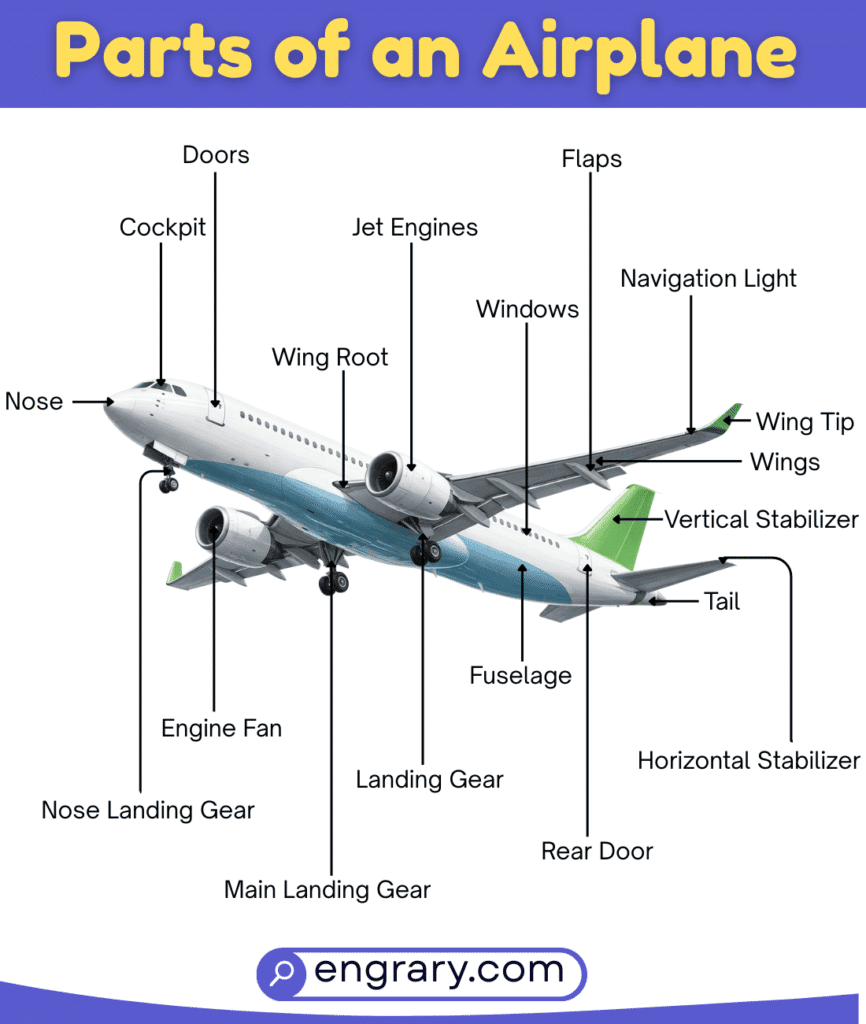
Fuselage Parts
The fuselage forms the central body of the airplane and connects all major structural groups. It houses the crew, passengers, and essential systems while maintaining overall structural strength during flight.
Cockpit
Located at the front section of the fuselage, the cockpit contains flight controls and instruments. Pilots operate navigation, communication, and control systems from this area. Its design allows clear forward visibility and access to essential controls.
Cabin
Positioned within the main body, the cabin provides space for passengers and crew. It contains seating, storage compartments, and safety equipment. The cabin structure is pressurized in many aircraft to maintain safe air pressure at high altitude.
Nose
Forming the front-most section, the nose shapes airflow during flight. It improves aerodynamic performance and often houses radar or navigation equipment. Its streamlined design reduces air resistance.
Windows
Installed along the fuselage, windows allow visibility and natural light. In passenger aircraft, they provide outside viewing while maintaining structural integrity.
Doors
Placed along the fuselage body, doors allow entry and exit for passengers and crew. They are reinforced to maintain cabin pressure and safety during flight.
Wing Parts
The wings generate lift and support controlled flight. Their structure allows airflow to create upward force, while built-in components adjust direction and stability.
Wings
Extending from the fuselage, the wings create lift as air flows over and under their surface. Their curved shape, known as an airfoil, increases pressure differences that raise the aircraft during flight.
Leading Edge
Forming the front boundary of the wing, the leading edge is the first surface that meets oncoming air during flight. Its curved design helps smooth airflow over the wing, which in turn supports lift generation and stable performance at different speeds.
Trailing Edge
Completing the rear boundary of the wing, the trailing edge is where airflow leaves the wing surface. Many movable parts such as flaps and ailerons attach along this edge, allowing changes in lift and control during takeoff, turning, and landing.
Flaps
Mounted along the rear edge of the wings, flaps increase lift at lower speeds. They extend during takeoff and landing to allow controlled ascent and descent.
Ailerons
Positioned near the outer trailing edges, ailerons control rolling motion. When one moves upward and the other downward, the airplane tilts from side to side.
Slats
Mounted along the leading edge, slats extend forward to increase lift at lower speeds. When deployed during takeoff or landing, they allow smoother airflow over the wing, reducing stall risk and improving control.
Spoilers
Positioned on the upper wing surface, spoilers reduce lift by disturbing airflow. During landing, they assist braking by transferring weight onto the landing gear, and in flight they help control descent and roll balance.
Winglets
Located at the tips of the wings, winglets reduce air turbulence. They improve fuel efficiency by minimizing drag caused by air vortices.
Fuel Tanks
Integrated within the wing structure, fuel tanks store aviation fuel. Their placement supports weight balance and efficient fuel distribution during flight.
Tail Parts
The tail section stabilizes the airplane and controls directional movement. These parts maintain balance and ensure steady flight.
Vertical Stabilizer
Rising upward from the tail, the vertical stabilizer maintains side-to-side stability. It prevents unwanted yawing motion and keeps the aircraft aligned during flight.
Horizontal Stabilizer
Extending horizontally at the tail, the horizontal stabilizer controls pitch balance. It helps maintain steady nose position during climbing and descending.
Rudder
Attached to the vertical stabilizer, the rudder controls left and right turning motion. When it moves, it directs airflow to adjust yaw.
Elevators
Mounted on the horizontal stabilizer, elevators control upward and downward movement of the nose. They allow the aircraft to climb or descend smoothly.
Engine And Propulsion Parts
Propulsion parts generate the thrust needed to move the airplane forward. These systems convert fuel energy into motion and allow controlled acceleration during takeoff and flight.
Jet Engine
Mounted under or along the wings in many aircraft, the jet engine produces thrust by compressing air, mixing it with fuel, and igniting it. The expanding gases exit at high speed, pushing the airplane forward.
Propeller
Used in certain aircraft types, the propeller rotates rapidly to pull or push air backward. This backward airflow creates forward motion through thrust.
Nacelle
Surrounding the engine, the nacelle provides structural support and streamlines airflow. It also protects internal engine components from environmental exposure.
Exhaust
Located at the rear of the engine system, the exhaust directs high-speed gases outward. This outward force contributes to forward thrust.
Landing Gear Parts
Landing gear supports the airplane during takeoff, landing, and ground movement. These parts absorb impact and allow controlled taxiing on runways.
Landing Gear Doors
Covering the landing gear when retracted, landing gear doors maintain aerodynamic smoothness during flight. They open when the gear deploys and close again once the wheels are fully stored inside the aircraft body.
Main Landing Gear
Positioned beneath the main body structure, the main landing gear carries most of the aircraft’s weight during landing. It includes shock absorbers that reduce impact force.
Nose Landing Gear
Located at the front underside, the nose landing gear supports balance and steering on the ground. It helps guide direction while taxiing.
Wheels
Attached to the landing gear assemblies, wheels allow smooth movement along the runway. They are built to handle high speeds and heavy loads.
Brakes
Installed within the wheel system, brakes slow the airplane after landing. They provide controlled deceleration during runway operations.
Control Surfaces Of The Airplane
Control surfaces adjust airflow around the airplane and allow precise movement in the air. These parts respond to pilot input and maintain balance during flight.
Ailerons
Mounted on the outer trailing edges of the wings, ailerons control rolling motion. When one surface rises and the other lowers, the airplane tilts to one side.
Elevators
Attached to the horizontal stabilizer, elevators control upward and downward nose movement. Their motion adjusts climb and descent.
Rudder
Connected to the vertical stabilizer, the rudder controls left and right turning motion. It manages yaw and supports directional stability.
Flaps
Located on the inner trailing edges of the wings, flaps increase lift at lower speeds. They extend during takeoff and landing to support controlled flight.
FAQs About Parts Of An Airplane
The main parts of an airplane include the fuselage, wings, tail section, engines, landing gear, and control surfaces. In the parts of an airplane structure, these groups work together to support flight and stability.
The wings create lift. In the parts of an airplane system, their airfoil shape allows air pressure differences that raise the aircraft during flight.
Ailerons, elevators, and the rudder control direction. In the parts of an airplane network, these control surfaces adjust roll, pitch, and yaw.
The landing gear helps the airplane land safely. In the parts of an airplane design, it absorbs impact and supports movement on the runway.
Jet engines or propellers provide thrust. In the parts of an airplane system, propulsion parts convert fuel energy into forward motion.
Parts Of An Airplane Key Takeaways
The parts of an airplane function as an integrated flight system. The fuselage forms the central body, the wings generate lift, and the tail maintains stability and directional control. Engines provide thrust for forward motion, while landing gear supports ground operations. Control surfaces adjust roll, pitch, and yaw to guide movement through the air. As thrust pushes the aircraft forward, airflow over the wings produces lift, and stabilizers maintain balance. Although airplane size and design vary, the core structural groups remain consistent.
You May Also Like