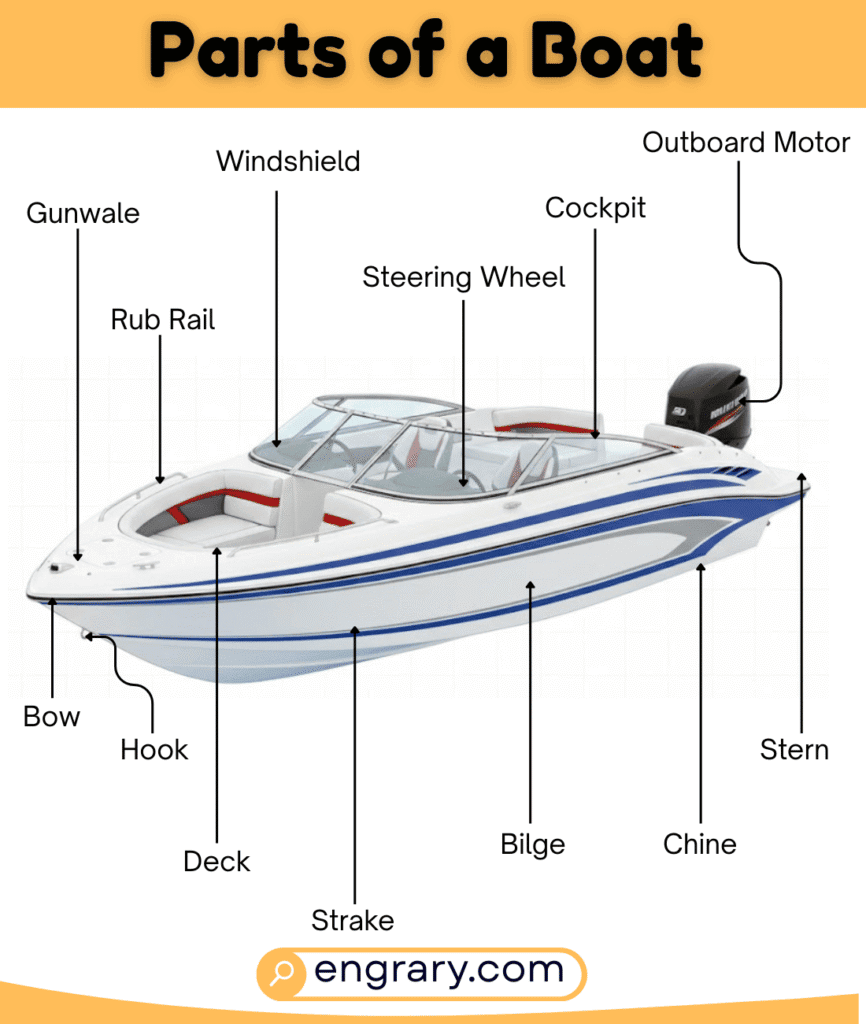
Boat parts are the physical sections that allow a boat to float, move, steer, and remain stable on water. Together, these sections connect in a fixed structural order that supports balance, directional control, propulsion, and handling. For example, the hull forms the main body, while the deck creates the upper surface. At the same time, the steering section controls direction, and the propulsion system drives movement through the water.
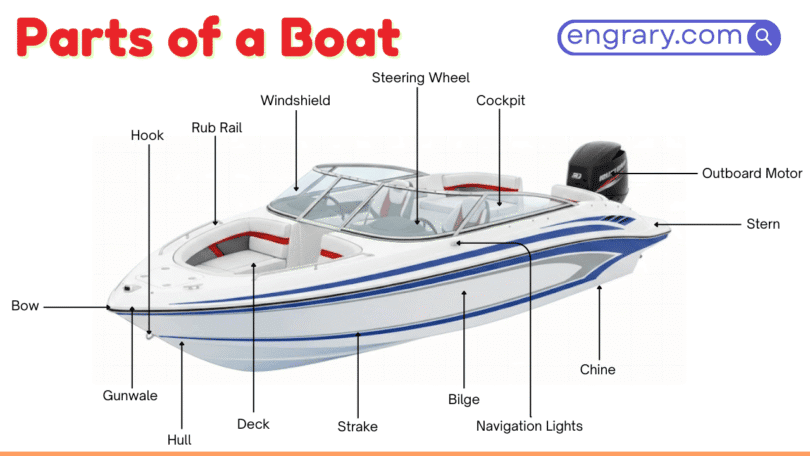
In addition, a labeled diagram shows how these named parts align across the front, middle, lower body, and rear sections of the boat. As power moves through the engine or propeller system, the boat gains forward motion. Meanwhile, the rudder and related steering parts guide direction and help maintain controlled movement across standard boat designs.
Hull And Main Body Parts
The hull and main body form the core structure of a boat. Together, these parts create buoyancy, while also supporting weight and shaping movement through water.
Hull
The hull is the main body of the boat. It provides flotation, supports the structure, and shapes how the boat moves through water.
Bow
The bow is the front end of the boat. It meets the water first and helps direct forward movement.
Forward
Forward means toward the bow, or front, of the boat. It is a standard direction term.
Stern
The stern is the rear end of the boat. It commonly supports steering and propulsion-related parts.
Aft
Aft means toward the stern, or rear, of the boat. It is a fixed direction term.
Port Side
The port side is the left side of the boat when facing the bow. It is used for clear orientation.
Starboard Side
The starboard side is the right side of the boat when facing the bow. It pairs with port side to identify both sides.
Deck
The deck is the upper surface of the boat. It provides the main standing or working area.
Gunwale
The gunwale is the top outer edge of the boat’s side. It forms the upper boundary of the hull.
Keel
The keel is the central lower line along the bottom of the hull. It improves balance and helps the boat track straight.
Beam
The beam is the widest width of the boat. It also relates to side-to-side stability.
Draft
The draft is the distance between the waterline and the lowest part of the boat. It shows how deep the boat sits in water.
Transom
The transom is the rear surface at the stern. It supports the back end of the hull and often connects to the motor area.
Steering And Control Parts
This group controls direction and manages how the boat responds during movement. Together, these parts help guide turning, steering input, and speed control.
Rudder
The rudder is the movable flat steering surface near the rear of the boat. It changes water flow direction to turn the boat left or right.
Tiller
The tiller is a handle connected directly to the rudder on many smaller boats. It allows manual steering by moving the rudder side to side.
Steering Wheel
The steering wheel is the circular control used on many motorboats. It turns the steering system, which then redirects the rudder or outdrive mechanism.
Helm
The helm is the main steering control position of the boat. It is the area where steering and key directional controls are operated.
Throttle
The throttle controls engine power and speed. It increases or reduces propulsion force to adjust how fast the boat moves.
Console
The console is the control housing that holds steering and instrument parts. It often contains the wheel, gauges, switches, and throttle controls.
Propulsion Parts
The propulsion section creates the force that moves the boat through water. Together, these parts generate, transfer, and control forward or reverse motion, while also working in a connected mechanical flow.
Engine
The engine is the main power source of the boat. It produces the mechanical force needed to drive the propulsion system.
Motor
The motor is the powered unit that drives movement on many boats, especially smaller motorboats and outboard-powered designs. In common use, it often refers to the external powered unit attached at the stern.
Propeller
The propeller is the rotating blade assembly that pushes water backward to move the boat forward. It converts engine or motor power into thrust.
Shaft
The shaft is the rotating rod that transfers power from the engine to the propeller on shaft-driven boats.
Outboard Motor
The outboard motor is a self-contained external propulsion unit mounted on the stern. It combines the engine, propeller drive, and steering function in one assembly.
Inboard Engine
The inboard engine is installed inside the boat hull. It powers the propulsion system from within the main body structure.
Fuel Tank
The fuel tank stores the fuel supply used by the engine or motor. It supports continued propulsion during operation.
Anchoring And Mooring Parts
These parts hold the boat in place when it stops, docks, or stays secured near shore. Together, they help keep the boat fixed, tied, or protected during stationary use.
Anchor
The anchor is the weighted holding device that secures the boat in one position after it drops into the water.
Anchor Line
The anchor line is the rope or line that connects the anchor to the boat. It lets users lower, hold, and retrieve the anchor.
Cleat
The cleat is a fixed fastening fitting that secures ropes on the boat. It commonly sits along the upper side edge or deck area and helps hold anchor lines and mooring lines in place.
Mooring Line
The mooring line is the rope that ties the boat to a dock, buoy, or fixed point.
Bow Eye
The bow eye is the reinforced metal loop near the bow that supports tying down, towing, or securing the boat.
Fender
The fender is the protective cushion that sits between the boat and a dock or another boat. It reduces contact impact while the boat remains moored.
Safety And Utility Parts
These parts support onboard function, visibility, access, and general handling during use. Together, they help manage water control, improve access, and support basic onboard use.
Bilge
The bilge is the lowest inner area of the boat hull where water can collect. It forms the bottom interior space beneath the main deck level.
Bilge Pump
The bilge pump removes collected water from the bilge. It helps keep excess water from remaining inside the lower hull.
Drain Plug
The drain plug seals the drain opening near the lower rear part of the hull. It allows water to be released when the boat is out of the water.
Navigation Lights
Navigation lights are the signal lights used to show the boat’s position and direction in low light or dark conditions.
Ladder
The ladder provides a step structure for getting into or out of the boat, especially from the water.
Windshield
The windshield is the clear front screen that helps block wind and water spray in the control area.
Seat
The seat provides a sitting position for passengers or the operator. It supports body weight during travel and while stationary.
Storage Compartment
The storage compartment is the enclosed space used to hold gear, tools, ropes, or safety items on the boat.
Key Takeaways
Parts of boat names are grouped into hull, steering, propulsion, anchoring, and utility sections. Together, these groups form the main working structure of a standard boat. The hull provides flotation, while steering parts control direction. At the same time, propulsion parts create thrust, and anchoring parts keep the boat secured in place. In addition, utility parts support onboard handling, drainage, visibility, and access. As these sections work in sequence, power moves through the propeller system while the hull stays afloat and the steering section maintains controlled movement on water.
FAQs
The main parts of a boat include the hull, bow, stern, deck, keel, rudder, engine, propeller, and anchor. These parts support flotation, movement, steering, and control.
The front part of a boat is called the bow. It is the forward end that meets the water first during movement.
The bottom structural part is the hull, and the central lower line is the keel. These parts support flotation, shape, and stability in the water.
The rudder helps the boat turn by redirecting water flow at the rear. On some boats, steering also works through an outboard motor or steering-linked drive unit.
The two sides of a boat are called port side and starboard side. Port is the left side, and starboard is the right side when facing the bow.
You May Also Like