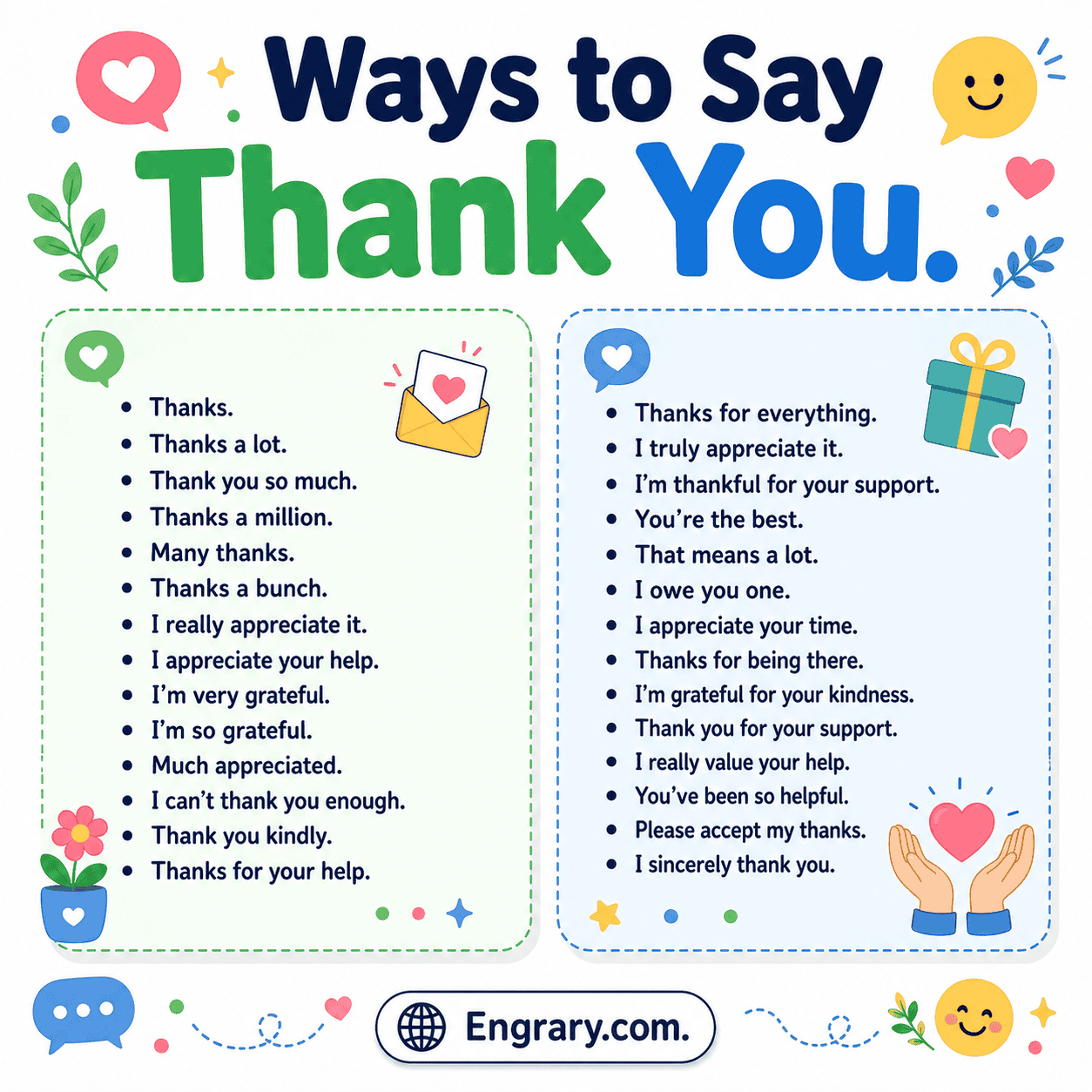
Saying thank you is one of the easiest ways to show appreciation in English. The right phrase can sound casual, warm, formal, professional, or deeply sincere depending on the situation.
This guide shares different ways to say thank you in English, along with simple meanings and examples. You will also see which phrases work best in casual conversations, friendly situations, workplace communication, and emails or writing.
Common Ways to Say Thank You
These are some of the most common and useful alternatives to thank you. They work well in many everyday situations.
- Thank you: the standard phrase and the safest choice in almost every situation.
Example: Thank you for your help. - Thanks: a shorter and more casual version of thank you.
Example: Thanks for coming. - Thank you so much: a stronger version that shows extra appreciation.
Example: Thank you so much for helping me. - Many thanks: polite and slightly more formal than thanks.
Example: Many thanks for your support. - Thanks a lot: common in everyday speech and writing.
Example: Thanks a lot for the ride. - I appreciate it: natural and sincere, especially when someone helps you.
Example: I appreciate it. - Much appreciated: short, polite, and often used in messages or work communication.
Example: Much appreciated. - Thanks a bunch: casual and friendly.
Example: Thanks a bunch. - Thanks very much: polite and clear in many situations.
Example: Thanks very much for your time. - I’m grateful: stronger and more personal than a simple thank you.
Example: I’m grateful for your support.
Formal Ways to Say Thank You
These phrases work best when you want to sound respectful, polished, or formal.
- Thank you: still one of the best formal choices because it is simple and widely appropriate.
Example: Thank you for your assistance. - Thank you very much: more formal and more emphatic than plain thank you.
Example: Thank you very much for your consideration. - I sincerely appreciate it: polished and respectful.
Example: I sincerely appreciate it. - I am very grateful: formal and strong without sounding too dramatic.
Example: I am very grateful for your help. - Many thanks: polite and appropriate in formal writing.
Example: Many thanks for your reply. - I truly appreciate your help: respectful and warm.
Example: I truly appreciate your help. - My sincere thanks: formal and polished.
Example: My sincere thanks for your support. - I am deeply thankful: stronger and more heartfelt.
Example: I am deeply thankful for your kindness. - I sincerely thank you: clear, respectful, and professional.
Example: I sincerely thank you for your support. - I’m truly grateful: formal but still natural.
Example: I’m truly grateful for your assistance.
Casual Ways to Say Thank You
These phrases sound relaxed and natural in daily conversation.
- Thanks: the most common casual version.
Example: Thanks. - Thanks a lot: casual and easy to use.
Example: Thanks a lot. - Thanks a bunch: friendly and informal.
Example: Thanks a bunch. - I appreciate it: casual but still sincere.
Example: I appreciate it. - Much appreciated: short and natural in messages or everyday talk.
Example: Much appreciated. - You’re the best: casual and expressive.
Example: You’re the best. - Cheers: casual and common in some English-speaking regions.
Example: Cheers for that. - Thanks so much: natural and slightly warmer than plain thanks.
Example: Thanks so much. - I owe you one: very casual, used when someone does you a favor.
Example: I owe you one. - Can’t thank you enough: stronger, but still common in informal speech.
Example: Can’t thank you enough for this.
Friendly Ways to Say Thank You
These phrases sound warmer and more personal than plain casual thanks.
- Thanks so much: warm and natural.
Example: Thanks so much for being here. - I really appreciate it: sincere and friendly.
Example: I really appreciate it. - You’re amazing: warm and expressive, best with people you know well.
Example: You’re amazing. Thank you. - I can’t thank you enough: strong but common when someone has really helped you.
Example: I can’t thank you enough. - Thanks for being there: personal and supportive.
Example: Thanks for being there for me. - I’m so grateful: warm and heartfelt.
Example: I’m so grateful for your help. - That means a lot: good when you want to show emotional appreciation.
Example: That means a lot to me. - You’re so kind: friendly and appreciative.
Example: You’re so kind. - I really appreciate your help: clear and sincere.
Example: I really appreciate your help. - Thanks, I truly mean it: personal and genuine.
Example: Thanks, I truly mean it.
Professional Ways to Say Thank You at Work
These phrases work especially well with coworkers, managers, clients, interviewers, or professional contacts.
- Thank you for your time: one of the strongest workplace-safe choices.
Example: Thank you for your time today. - I appreciate your support: professional and warm.
Example: I appreciate your support on this project. - Thank you for your help: clear and useful in almost any work situation.
Example: Thank you for your help. - I truly appreciate your assistance: polished and professional.
Example: I truly appreciate your assistance. - Thank you for your guidance: ideal for mentors, teachers, or managers.
Example: Thank you for your guidance. - Many thanks for your help: polite and suitable in business writing.
Example: Many thanks for your help. - I appreciate your time and effort: useful when someone has put in real work.
Example: I appreciate your time and effort. - Thank you for your consideration: especially good in interviews or formal requests.
Example: Thank you for your consideration. - I am grateful for your support: respectful and professional.
Example: I am grateful for your support. - Thank you for your prompt response: ideal in email and client communication.
Example: Thank you for your prompt response.
Ways to Say Thank You in Emails or Writing
Spoken gratitude and written gratitude do not always use the same wording naturally. In writing, especially professional writing, fuller and clearer phrases often work better.
- Thank you for reaching out: useful when replying to someone who contacted you first.
Example: Thank you for reaching out. - Thank you for your time: polished and common in email.
Example: Thank you for your time. - I appreciate your help: clear and professional in writing.
Example: I appreciate your help. - Many thanks: concise but respectful.
Example: Many thanks. - Thank you for your consideration: ideal for requests, interviews, and formal notes.
Example: Thank you for your consideration. - I sincerely appreciate your support: stronger and more polished.
Example: I sincerely appreciate your support. - Thank you for your prompt reply: useful in ongoing email conversations.
Example: Thank you for your prompt reply. - I truly appreciate your assistance: professional and sincere.
Example: I truly appreciate your assistance. - Thank you for your understanding: helpful when discussing delays, changes, or inconvenience.
Example: Thank you for your understanding. - My sincere thanks: formal and polished in writing.
Example: My sincere thanks for your help.
Stronger Ways to Say Thank You
Sometimes plain thank you is not enough. These phrases work better when you want to show deeper appreciation.
- I can’t thank you enough: strong and heartfelt, but still common.
Example: I can’t thank you enough for this. - I’m deeply grateful: strong and sincere.
Example: I’m deeply grateful for your support. - I truly appreciate it: warmer and stronger than a quick casual thanks.
Example: I truly appreciate it. - I’m so thankful: emotional but natural.
Example: I’m so thankful for your help. - This means so much to me: best when the help or kindness feels significant.
Example: This means so much to me. - I’m incredibly grateful: strong but still natural.
Example: I’m incredibly grateful. - I really can’t express my thanks enough: very strong gratitude.
Example: I really can’t express my thanks enough. - I’m beyond thankful: emotional and strong, best for personal situations.
Example: I’m beyond thankful. - I sincerely appreciate everything: respectful and heartfelt.
Example: I sincerely appreciate everything. - You have my heartfelt thanks: formal and strong.
Example: You have my heartfelt thanks.
How to Choose the Right Thank You Phrase
Choose the phrase based on the situation, the person, and how strong your gratitude really is. For small everyday kindnesses, simple phrases like thanks, thank you, or I appreciate it usually work best. In work or formal writing, fuller phrases like Thank you for your time or I truly appreciate your assistance sound more polished. When the help is bigger or more personal, stronger options like I can’t thank you enough or I’m deeply grateful fit better. It also helps to think about whether you are speaking, texting, or writing an email, because the same phrase does not always sound equally natural in every format.
What to Say Instead of Thank You in Different Situations
Sometimes the best phrase depends on what you are thanking someone for.
- I appreciate it: best for quick everyday thanks.
- Thank you for your time: best for professional and interview situations.
- Much appreciated: best for short, natural appreciation in messages or work chat.
- I’m grateful for your help: best for meaningful support.
- Thanks for your support: best when someone stood by you or helped consistently.
- I owe you one: best for casual favors.
- That means a lot: best for emotional or personal appreciation.
- Thank you for understanding: best when someone has been patient or flexible.
- I truly appreciate your assistance: best for formal or workplace gratitude.
- My sincere thanks: best for more formal written appreciation.
Summary
There are many ways to say thank you in English. Some sound casual, some formal, some professional, and some much more heartfelt.
The best phrase depends on the situation, your relationship with the other person, and how strong your gratitude is. Once you understand the tone behind each option, it becomes much easier to choose the right one naturally.
FAQs
Another way to say thank you is thanks, I appreciate it, or many thanks. The best choice depends on whether you want to sound casual, polite, or more formal.
Formal alternatives include Thank you very much, I sincerely appreciate it, and My sincere thanks. These work best in respectful or professional situations.
Friendly ways to say thank you include Thanks so much, That means a lot, and I really appreciate your help. These sound warmer and more personal than plain thanks.
In an email, you can say Thank you for your time, Many thanks, or I truly appreciate your assistance. These usually sound more polished than casual speech-based wording.
Stronger ways to say thank you include I can’t thank you enough, I’m deeply grateful, and This means so much to me. These are best when you want to express deeper appreciation.
You May Also Like