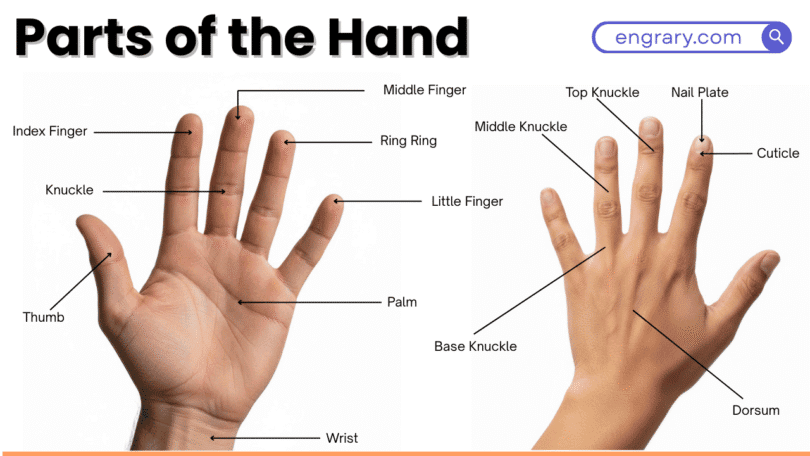
When you look at a labeled diagram of the hand, the structure becomes easier to understand. Instead of seeing only fingers and a palm, you begin to notice the thumb, knuckles, nails, and joints working together. Words like tendons, ligaments, and nerves often appear in daily talk, yet placing them correctly sharpens how you describe grip, movement, and control.
In this article, we break down the parts of the hand into visible sections and deeper internal structures so the full system feels connected. We focus on the common human hand while noting that size and proportion may vary slightly. Just below, the labeled diagram gathers these parts in one clear view, helping you match each name to its correct place.
Main Parts Of The Hand
The hand includes visible structures and deeper elements that support movement, grip, and coordination. These parts work together during writing, lifting, holding, and fine motor tasks.
Palm
Forming the inner surface, the palm provides contact during grasping. Its firm yet flexible tissue supports pressure when holding objects. Skin lines across it improve friction and control.
Back Of The Hand
Covering the outer surface, the back of the hand protects underlying bones and tendons. It allows visible movement of joints and supports extension of the fingers.
Fingers
The fingers enable bending and straightening through coordinated joint motion. Each finger contains multiple small bones that increase flexibility. Their movement supports precision tasks such as typing and gripping.
Thumb
The thumb allows opposition, which means it can move across the palm to touch other fingers. This movement strengthens grip and supports fine control. Its structure makes detailed hand motion possible.
Fingernails
Positioned at the tips of the fingers, fingernails protect sensitive tissue beneath them. They also improve precision by providing resistance during small movements.
Knuckles
Forming the visible joints where fingers bend, knuckles allow controlled motion. They connect finger bones and support strength during gripping.
Bones
Within the structure, bones form the framework that supports all movement. They give the hand shape and stability while allowing flexibility through joints.
Muscles
Muscles generate the force needed for motion. When they contract, fingers and the thumb move in controlled patterns.
Tendons
Connecting muscles to bones, tendons transfer force to create movement. They allow smooth bending and straightening.
Ligaments
Ligaments connect bone to bone and stabilize joints. They maintain alignment during motion.
Nerves
Nerves carry signals between the hand and brain. They control movement and allow the sense of touch.
Joints
Joints connect bones and allow bending, straightening, and rotation. Their coordinated motion supports both strength and precision.
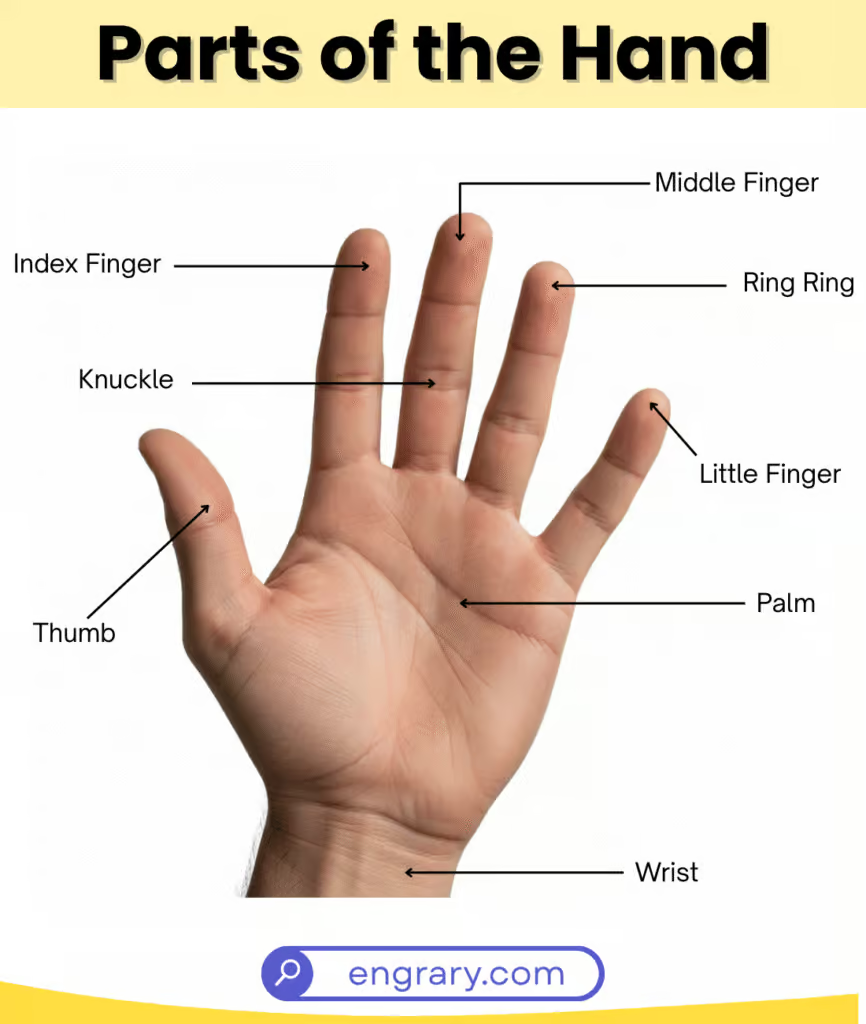
External Parts Of The Hand
The external parts of the hand are visible and directly involved in touch and grip. These structures allow contact, movement, and surface control during daily tasks.
Palm
Forming the inner surface of the hand, the palm provides grip and pressure support. Thick skin and underlying tissue absorb force during lifting and holding. Natural skin lines improve friction and control.
Back Of The Hand
Covering the outer surface, the back of the hand protects underlying bones and tendons. Its thinner skin allows veins and joint movement to remain visible during motion.
Fingers
The fingers allow bending and straightening through joint movement. Each finger contains small bones that increase flexibility and reach. Their coordinated action supports writing, typing, and holding objects.
Fingertips
At the end of each finger, the fingertips contain dense sensory receptors. These receptors detect pressure, texture, and temperature. Their sensitivity allows precise handling of small objects.
Thumb
Unlike the other fingers, the thumb moves across the palm to meet them. This motion strengthens grip and enables precise control. Its range of movement makes detailed hand tasks possible.
Fingernails
Located at the tips of the fingers, fingernails protect the soft tissue beneath. They also provide resistance during small movements, improving fine control.
Knuckles
Forming the visible bending points of the fingers, knuckles allow controlled motion. They connect finger bones and support strength during gripping.
Internal Parts Of The Hand
Beneath the surface, the hand contains structures that create movement, strength, and sensation. These internal parts work together so the fingers and thumb can bend, extend, and grip with control.
Bones Of The Hand
Forming the internal framework, the bones give the hand its shape and stability. They are arranged in three main groups: carpals in the wrist region, metacarpals in the middle portion, and phalanges in the fingers. This arrangement allows both firmness and flexibility.
Muscles Of The Hand
Muscles generate the force needed for movement. Some muscles lie within the hand itself, while others extend from the forearm. When they contract, they produce bending and straightening of the fingers and thumb.
Tendons
Within the internal structure, tendons connect muscles to bones and transfer force to create movement. They slide smoothly during bending and straightening, allowing controlled motion of the fingers and thumb. Two main types coordinate this action:
- Flexor Tendons:
Running along the palm side, flexor tendons allow the fingers and thumb to bend. When muscles contract, they pull the bones inward to form grip. - Extensor Tendons:
Positioned along the back of the hand, extensor tendons straighten the fingers and thumb. They work opposite the flexor tendons to maintain balance and controlled release.
Ligaments
Ligaments connect bone to bone and stabilize joints. They maintain alignment during gripping and lifting, preventing excessive motion.
Nerves
Nerves carry signals between the hand and the brain. They control movement and allow the sense of touch, pressure, and temperature.
Carpals
Forming the base framework near the wrist, the carpals are eight small bones arranged in two rows. They create flexibility and allow controlled wrist movement. Their compact structure supports rotation and bending without losing stability.
Metacarpals
Extending from the carpals toward the fingers, the metacarpals form the central structure of the hand. They provide length and support to the palm. Their alignment helps distribute pressure during gripping.
Phalanges
Shaping the fingers and thumb, the phalanges are the small bones that allow bending and extension. Each finger contains three phalanges, while the thumb contains two. Their segmented design increases precision and flexibility.
Joints Of The Hand
Movement in the hand depends on a network of joints that connect bones and allow controlled motion. These joints enable bending, straightening, and small rotational movements that support grip and precision.
Wrist Joint
Connecting the hand to the forearm, the wrist joint allows up and down as well as side to side movement. This flexibility supports lifting, turning, and positioning the hand during tasks.
Metacarpophalangeal Joints
Located where the fingers meet the hand, these joints allow bending and straightening. They also support slight spreading and closing of the fingers.
Interphalangeal Joints
Found between the finger bones, these joints allow bending at each segment. Their movement increases flexibility and control during gripping.
Carpometacarpal Joint
This joint connects the thumb to the wrist region. It allows the thumb to move across the palm, which strengthens grip and precision.
FAQs
The main parts of the hand include the palm, fingers, thumb, knuckles, bones, muscles, tendons, ligaments, nerves, and joints. In the parts of the hand structure, these elements work together for grip and movement.
There are 27 bones in one hand. In the parts of the hand framework, these bones are grouped as carpals, metacarpals, and phalanges to support flexibility and strength.
The thumb allows strong gripping through opposition. In the parts of the hand system, this movement lets the thumb touch the fingers, improving control and precision.
Tendons connect muscles to bones. In the parts of the hand structure, tendons transfer force from muscles so the fingers and thumb can move smoothly.
Interphalangeal and metacarpophalangeal joints help fingers bend. In the parts of the hand network, these joints allow controlled motion during writing and grasping.
Parts Of The Hand Key Takeaways
The parts of the hand function as a coordinated system of structure and motion. External parts such as the palm, fingers, and thumb manage contact and grip, while internal parts such as bones, muscles, and tendons create strength and movement. Joints allow bending and rotation, and nerves provide sensation and control. As muscles contract and tendons pull on bones, joints move to produce precise actions. Although size and shape may vary slightly, the core hand structure remains consistent.
You May Also Like