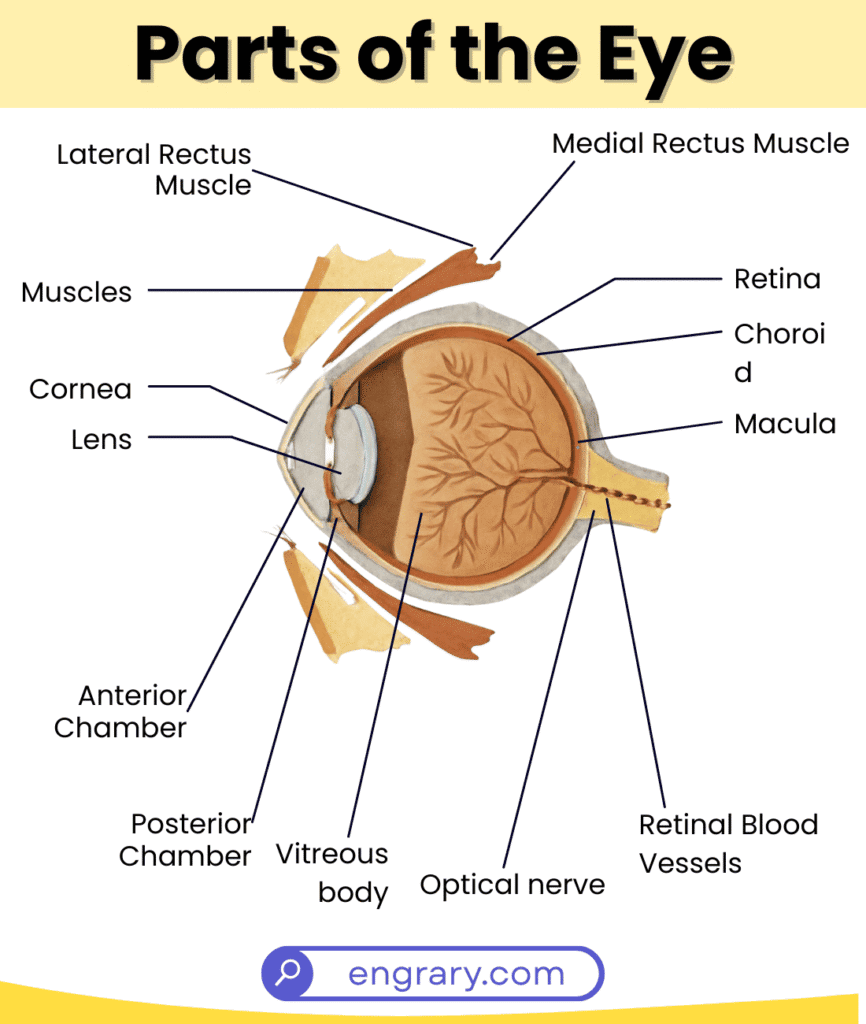
A labeled diagram of the eye presents all major structures in one connected view. Instead of learning separate names, you see how each part relates to the others inside a compact system. From the clear outer layer to the light sensitive inner surface, the structure becomes easier to follow when every part is labeled in order.
The diagram typically highlights the cornea, iris, pupil, lens, retina, optic nerve, and surrounding layers. Because these parts work together during vision, seeing them arranged in one frame helps build a clear mental map of the eye.
Main Parts Of The Eye
The eye works as a compact visual system in which each structure supports the next. Light enters, bends, adjusts, and finally turns into signals that the brain can read. The main parts below form that chain, and each one plays a direct role in clear vision.
Cornea
At the very front, the cornea acts as the first focusing surface. This clear, curved layer bends incoming light so it can move deeper into the eye. Because it must stay transparent, it has no blood vessels and receives moisture from tears and internal fluids.
Sclera
Surrounding the eye, the sclera forms the tough white outer coat. It protects delicate inner structures and helps maintain shape. Eye muscles attach to it, which allows smooth and controlled movement.
Iris
Just behind the cornea, the iris gives the eye its color. It adjusts the size of the pupil to regulate light entry. In bright conditions it tightens, and in dim light it relaxes, balancing brightness.
Pupil
At the center of the iris, the pupil forms a dark circular opening. Light passes through this opening toward the lens. Its size changes automatically, which supports clear vision in different lighting conditions.
Lens
Behind the pupil, the lens fine tunes focus. It changes shape to adjust vision for near and distant objects. Because of this flexibility, images remain sharp at varying distances.
Retina
At the inner back surface, the retina contains light sensitive cells that detect light. These cells convert light into electrical signals. As a result, visual information can travel toward the brain.
Optic Nerve
Extending from the retina, the optic nerve carries visual signals to the brain. It forms the communication link between the eye and the visual center. Without this pathway, sight would not occur.
Vitreous Body
Filling the central cavity, the vitreous body is a clear gel that supports internal structure. It maintains the round shape of the eye and allows light to pass through to the retina without distortion.
External Parts Of The Eye
The outer structures of the eye protect delicate internal tissues and support comfort during vision. These parts guard against dust, bright light, and dryness while helping maintain a clear surface.
Eyelid
Covering the front surface, the eyelid protects the eye from debris and excessive light. It blinks regularly, spreading tears across the cornea to keep it moist. Through this movement, it reduces irritation and maintains a smooth surface.
Eyelashes
Along the edge of the eyelid, eyelashes form a protective barrier. When touched, they trigger a quick blink reflex. This response shields the eye from small particles and sudden contact.
Eyebrow
Above the eye, the eyebrow directs sweat and moisture away from the surface. It also contributes to facial expression. Through subtle movement, it supports communication and visual focus.
Internal Parts Of The Eye
The inner structures of the eye process light and convert it into signals for vision. These parts work together in a precise sequence so that images can form clearly.
Cornea
At the front of the eye, the cornea forms a clear, curved surface that begins focusing incoming light. As light passes through it, rays bend toward the center. Because it must stay transparent, it contains no blood vessels and depends on surrounding fluids for nourishment.
Sclera
Surrounding the eye, the sclera provides a firm white outer layer. It protects delicate inner tissues and maintains shape. Muscles attach to it, which allows smooth and controlled movement.
Iris
Just behind the cornea, the iris gives the eye its color. It regulates the size of the pupil, adjusting light entry. In bright conditions it tightens, and in dim conditions it relaxes.
Pupil
At the center of the iris, the pupil forms a dark opening. Light travels through it toward deeper structures. Its size changes automatically in response to brightness.
Lens
Behind the pupil, the lens fine tunes focus. It changes shape to adjust vision for near and distant objects. This flexibility supports sharp images at different distances.
Retina
At the inner back surface, the retina contains light sensitive cells. These cells convert light into electrical signals. As a result, visual information begins its path to the brain.
Optic Nerve
Extending from the retina, the optic nerve carries signals to the brain. It forms the communication pathway that allows sight to occur.
Vitreous Body
Filling the central cavity, the vitreous body is a clear gel that supports internal structure. It maintains the round shape of the eye and allows light to pass through to the retina without distortion.
Light Path Through The Eye
Vision depends on a clear sequence that begins the moment light reaches the eye. Each structure adjusts, focuses, or converts light before passing it forward, and the order of this pathway shapes how clearly we see.
Light first enters through the cornea, where it bends toward the center. It then moves through the pupil, whose size is controlled by the iris to regulate brightness. After that, the lens refines the focus so light reaches the retina in sharp detail. At the retina, light becomes electrical signals, which travel through the optic nerve to the brain. This connected chain allows images to form as sight.
FAQs
The main parts of the eye include the cornea, sclera, iris, pupil, lens, retina, optic nerve, and vitreous body. In the parts of the eye structure, these components work together to focus light and create visual signals.
The iris controls light entry by adjusting the size of the pupil. In the parts of the eye system, this change helps maintain clear vision in both bright and dim conditions.
Vision begins in the retina. In the parts of the eye sequence, light reaches the retina, where specialized cells convert it into electrical signals that travel to the brain.
The eyelids and eyelashes protect the front surface of the eye. In the parts of the eye grouping, blinking spreads tears that keep the cornea moist and reduce irritation.
The optic nerve connects the eye to the brain. In the parts of the eye network, it carries visual signals from the retina to areas responsible for interpreting sight.
Key Takeaway On Parts Of The Eye
The parts of the eye work together as one visual system. The outer layer protects and shapes the eye, the focusing structures bend and adjust light, the retina converts light into signals, and the optic nerve carries those signals to the brain. As light moves inward through the cornea and lens, electrical signals move outward through the nerve to create sight. Although eye color and size vary among individuals, the core structures remain consistent across the human eye.
You May Also Like