
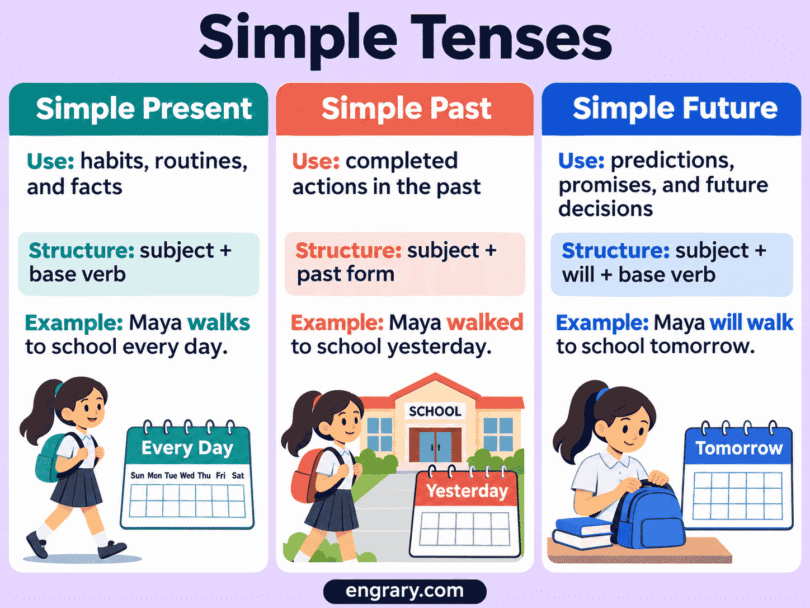
The simple tenses describe actions, events, and states in the present, past, or future without emphasizing their progress or earlier completion. For example, Sara walks to school every day, Sara walked to school yesterday, and Sara will walk to school tomorrow place the same activity in three different time frames.
This guide explains the simple present, simple past, and simple future separately. It covers their structures, main uses, spelling and pronunciation rules, negative sentences, questions, short answers, time expressions, comparisons, and common mistakes.
Simple Tenses and Their Main Uses
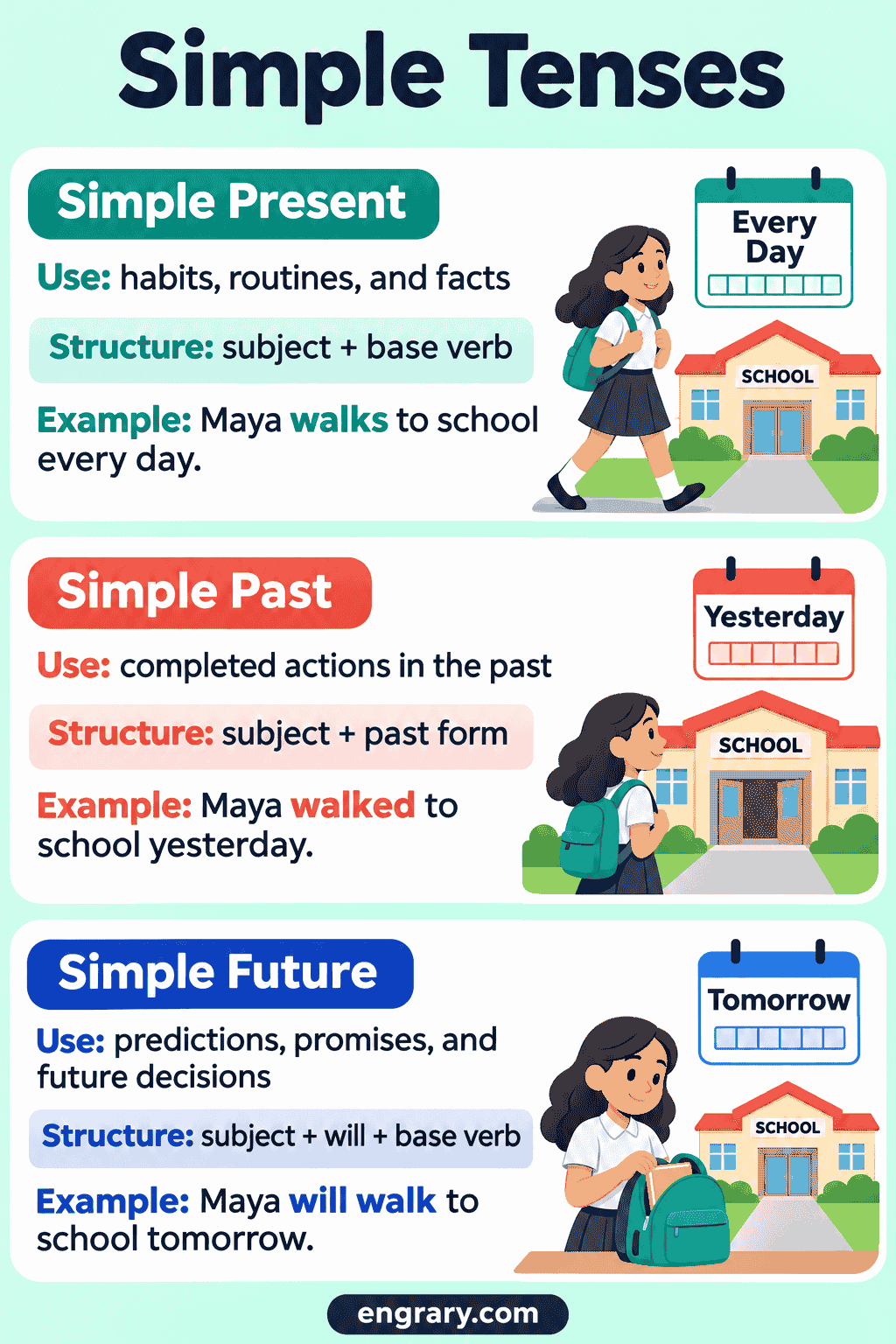
The word simple refers to grammatical aspect. It does not mean that an action is short, easy, or completed quickly. Instead, a simple form presents an action or state as a whole without focusing on its internal progress.
| No. | Tense | Example | Main meaning |
|---|---|---|---|
| 1 | Simple present | Sara walks to school every day. | A regular present habit |
| 2 | Simple past | Sara walked to school yesterday. | A completed past action |
| 3 | Simple future | Sara will walk to school tomorrow. | An expected future action |
English changes the main verb directly for present and past forms. For example, walk becomes walks with a third-person singular subject and walked in the past. Meanwhile, the form commonly called the simple future uses will + base verb.
The base verb is the basic form, such as write. The past form may be regular, as in worked, or irregular, as in wrote.
Simple Present Tense
The simple present describes habits, repeated events, facts, general truths, long-term situations, and states. It also appears in schedules, procedural descriptions, story summaries, and live commentary.
Simple Present Structure
The verb be follows its own pattern and does not use do or does in negatives and questions.
| Sentence type | Most verbs | Verb be |
|---|---|---|
| Affirmative | I/you/we/they work; he/she/it works | I am; he/she/it is; you/we/they are |
| Negative | Subject + do/does not + base verb | Subject + am/is/are + not |
| Yes/no question | Do/Does + subject + base verb? | Am/Is/Are + subject? |
Third-Person Singular Forms
With he, she, it, or a singular noun, most simple-present verbs take an ending.
| Base verb | Rule | Third-person form |
|---|---|---|
| work | Add -s | works |
| wash | Add -es after -sh | washes |
| watch | Add -es after -ch | watches |
| fix | Add -es after -x | fixes |
| go | Add -es | goes |
| study | Change consonant + y to -ies | studies |
| play | Keep the vowel + y, then add -s | plays |
| have | Irregular form | has |
| do | Irregular spelling | does |
Simple Present Uses and Examples
Habits and repeated actions
- I drink tea every morning.
- Aisha walks to work on weekdays.
- We visit our grandparents twice a month.
Facts and general truths
- Water boils at 100°C at standard atmospheric pressure.
- The Earth moves around the Sun.
- Plants need light and water.
Long-term situations and states
- My brother works at a bank.
- Sara knows the answer.
- This bag belongs to me.
- They own a small shop near the market.
Schedules and procedural descriptions
- The train leaves at seven tomorrow morning.
- First, you add the flour and then you mix the ingredients.
Sentence 15 uses the simple present because it describes a procedure with an expressed subject. By contrast, “Add the flour” is an imperative, not a simple-present sentence.
Simple Present Negative Sentences
After don’t or doesn’t, use the base verb. The third-person ending appears on does, not on the main verb.
- I don’t watch television before work.
- She doesn’t drive to the office.
- We aren’t ready to leave.
- The library isn’t open on Sundays.
Simple Present Questions and Short Answers
- Do you work on Saturdays? — Yes, I do. / No, I don’t.
- Does Hamza speak Arabic? — Yes, he does. / No, he doesn’t.
- Who lives next door?
In sentence 22, who is the subject, so the question does not need do or does.
Negative Questions in the Simple Present
Negative questions often express surprise, expectation, or a request for confirmation.
- Doesn’t she work here?
- Don’t they know the address?
- Isn’t the shop open today?
Emphatic Do and Does
Although affirmative sentences normally omit do and does, speakers can add them for emphasis or correction.
- I do understand your concern.
- She does work on Fridays.
- He says he dislikes tea, but he does drink coffee.
Pronunciation of Third-Person Endings
The spelling is usually -s or -es, but the pronunciation depends on the final sound of the base verb.
| Ending sound | Common environment | Examples |
|---|---|---|
| /s/ | After a voiceless sound | works, stops, laughs |
| /z/ | After a vowel or voiced sound | plays, runs, reads |
| /ɪz/ | After a sibilant sound | watches, washes, fixes |
Stative Verbs in the Simple Present
Stative verbs describe conditions, possession, opinions, emotions, and mental states. Therefore, they commonly take the simple present even when the state exists now.
- I understand the problem.
- She prefers tea.
- We need more time.
- This key belongs to Amina.
Common stative verbs include know, believe, understand, need, prefer, own, belong, and love. Their usual stative meanings generally do not take continuous forms.
Simple Past Tense
The simple past describes completed actions, finished situations, past states, sequences of events, and former habits. A time expression often identifies the finished period, although context can supply it instead.
Simple Past Structure
| Sentence type | Most verbs | Verb be |
|---|---|---|
| Affirmative | Subject + past form | Subject + was/were |
| Negative | Subject + did not + base verb | Subject + was/were + not |
| Yes/no question | Did + subject + base verb? | Was/Were + subject? |
Use was with I, he, she, it, and singular nouns. Use were with you, we, they, and plural nouns.
Regular Past Forms
| Base verb | Rule | Past form |
|---|---|---|
| work | Add -ed | worked |
| live | Add -d after final e | lived |
| study | Change consonant + y to -ied | studied |
| play | Keep vowel + y, then add -ed | played |
| stop | Double the final consonant | stopped |
| prefer | Double the stressed final consonant | preferred |
Common Irregular Past Forms
Irregular verbs do not form the past with the usual -ed ending.
| Base verb | Past form | Base verb | Past form |
|---|---|---|---|
| go | went | see | saw |
| buy | bought | write | wrote |
| take | took | have | had |
| make | made | come | came |
| eat | ate | give | gave |
| find | found | speak | spoke |
Simple Past Uses and Examples
Completed past actions
- We visited Lahore last year.
- Sara finished the report yesterday.
- My brother bought a new bicycle on Monday.
- The train arrived ten minutes late.
Sequences of events
- She opened the door, entered the room, and sat down.
- I turned off the computer and left the office.
Past habits and repeated actions
- We played cricket after school every Friday.
- I walked to college every day that summer.
Past states and finished situations
- They were neighbors for ten years.
- The classroom was quiet during the test.
- Aisha had long hair when she was a child.
Simple Past Negative Sentences
After didn’t, use the base verb because did already carries the past meaning.
- I didn’t see the message last night.
- He didn’t bring his notebook to class.
- We weren’t tired after the short journey.
- The office wasn’t busy yesterday morning.
Simple Past Questions and Short Answers
- Did you finish the assignment? — Yes, I did. / No, I didn’t.
- Was Sara at the meeting? — Yes, she was. / No, she wasn’t.
- Where did they buy the furniture?
- Who opened the window?
Sentence 41 is a subject question. Since who performed the action, the ordinary affirmative form does not require did.
Negative Questions in the Simple Past
- Didn’t you receive my email?
- Wasn’t he at work yesterday?
- Weren’t the children ready on time?
Emphatic Did
An affirmative simple-past sentence can use did + base verb for emphasis or correction.
- I did call you yesterday.
- She did finish the work on time.
- They did attend the meeting, although they arrived late.
Pronunciation of Regular Past Endings
The spelling -ed has three common pronunciations.
| Ending sound | Common environment | Examples |
|---|---|---|
| /t/ | After a voiceless sound except /t/ | worked, washed, laughed |
| /d/ | After a vowel or voiced sound except /d/ | played, cleaned, lived |
| /ɪd/ | After /t/ or /d/ | wanted, needed, started |
Used To and Would for Past Habits
Use used to + base verb for former habits and states that are no longer true.
- I used to walk to school.
- She used to live near the river.
- They didn’t use to own a car.
Habitual would can describe repeated past actions when the past context is clear:
- During summer holidays, we would swim in the river every morning.
However, habitual would does not normally describe past states. Therefore, She used to live near the river is natural, while She would live near the river does not express the same former-state meaning without a special context.
Simple Future Tense
The form commonly called the simple future uses will + base verb. It expresses predictions, immediate decisions, offers, willingness, promises, and future expectations.
Simple Future Structure
| Sentence type | Structure | Example |
|---|---|---|
| Affirmative | Subject + will + base verb | She will call later. |
| Negative | Subject + will not + base verb | She will not call later. |
| Yes/no question | Will + subject + base verb? | Will she call later? |
Will remains unchanged with every subject. Its common contractions are ’ll and won’t.
Simple Future Uses and Examples
Predictions and expectations
- I think the weather will improve tomorrow.
- Technology will change the way people learn.
- The journey will take about three hours.
- I am sure you will recognize the building.
Immediate decisions
- The phone is ringing, so I will answer it.
- We are out of milk; I will buy some.
- The room feels warm. I will open the window.
Offers, promises, and willingness
- This bag looks heavy. I will carry it for you.
- I will help you prepare for the interview.
- We will return the books tomorrow.
- I will keep your information private.
Future expectations and facts
- The new bridge will reduce travel time.
- The shop will close earlier during the holiday.
Simple Future Negative Sentences
- Sara won’t attend the workshop on Friday.
- The library will not open during the public holiday.
- This short delay won’t affect the final result.
- The children will not stay awake until midnight.
Simple Future Questions and Short Answers
- Will you join us for dinner? — Yes, I will. / No, I won’t.
- Who will lead the discussion tomorrow?
Questions with will do not require do or does. In affirmative short answers, keep the full modal: Yes, I will, rather than Yes, I’ll.
Negative Questions in the Simple Future
- Won’t you join us for dinner?
- Won’t the shop open tomorrow?
- Why won’t the printer work?
Shall in Modern English
Will works with every subject. Shall appears mainly in formal language and in questions that make offers or suggestions.
- Shall I carry that box?
- Shall we begin the meeting?
Will Beyond Ordinary Future Meaning
Because will is a modal verb, it can express meanings other than straightforward future time.
| Meaning | Example |
|---|---|
| Willingness | I will help you. |
| Request | Will you close the door? |
| Typical behavior | He will leave his cup on the desk. |
| Confident present deduction | That will be Sara at the door. |
Context reveals whether will refers primarily to future time or another modal meaning.
Differences Between the Simple Tenses
Using the same subject and verb makes the time relationship easier to see.
| Simple present | Simple past | Simple future |
|---|---|---|
| She writes every morning. | She wrote yesterday morning. | She will write tomorrow morning. |
| They play on Fridays. | They played last Friday. | They will play next Friday. |
| I work from home on Mondays. | I worked from home last Monday. | I will work from home next Monday. |
| He is busy today. | He was busy yesterday. | He will be busy tomorrow. |
| We have a meeting today. | We had a meeting yesterday. | We will have a meeting tomorrow. |
The simple present often describes repetition or a current state. In contrast, the simple past places an event or state in a finished period. The simple future presents an expected event, decision, prediction, promise, or willingness.
Common Forms of Be, Have, and Do
The verbs be, have, and do occur frequently, so their changing forms deserve special attention.
| Verb | Simple present | Simple past | Simple future |
|---|---|---|---|
| be | am/is/are | was/were | will be |
| have | have/has | had | will have |
| do | do/does | did | will do |
Compare these high-frequency patterns:
- There is a problem now.
- There was a problem yesterday.
- There will be a problem if we ignore the warning.
Simple Present and Present Continuous
The simple present commonly describes habits, long-term situations, and states. Meanwhile, the present continuous commonly describes activity underway now or a temporary situation.
| Simple present | Present continuous | Difference |
|---|---|---|
| I read every evening. | I am reading now. | Habit versus current activity |
| She works in Lahore. | She is working from home this week. | Long-term versus temporary situation |
| They live near the school. | They are living with relatives this month. | Established versus temporary living situation |
| I understand the problem. | Continuous form is normally unsuitable. | Stative meaning |
The present continuous can also describe an arranged future event, while the simple present often describes a schedule:
| Simple present for a schedule | Present continuous for an arrangement |
|---|---|
| The train leaves at six. | We are leaving at six. |
| The conference starts on Monday. | I am meeting the organizer on Monday. |
Simple Past and Present Perfect
The simple past describes an event within a finished past time. The present perfect connects a past event to the present and normally avoids finished time expressions such as yesterday or last year.
| Simple past | Present perfect | Difference |
|---|---|---|
| I visited Karachi last year. | I have visited Karachi several times. | Definite finished time versus experience |
| She finished the report yesterday. | She has finished the report, so it is ready now. | Finished event versus present result |
| We lived there from 2018 to 2020. | We have lived here since 2020. | Finished period versus a situation continuing to the present |
Will and Going To
Both constructions can refer to future time, but they often emphasize different reasons for the prediction or plan.
| Will | Going to | Typical distinction |
|---|---|---|
| The phone is ringing. I will answer it. | I am going to call Sara tonight. | Immediate decision versus earlier intention |
| I think it will rain tomorrow. | Look at those clouds. It is going to rain. | Opinion-based prediction versus present evidence |
| I will help you with the bags. | We are going to help our neighbors move on Saturday. | Spontaneous offer versus existing plan |
These distinctions describe common tendencies rather than absolute rules. In some contexts, both constructions work, although the speaker’s emphasis changes.
Subject Questions in the Simple Tenses
An ordinary affirmative subject question does not use do, does, or did. However, an object question usually needs the appropriate auxiliary.
| Subject question | Object question |
|---|---|
| Who works here? | Who do you work with? |
| Who opened the door? | What did she open? |
| Who will lead the meeting? | Which meeting will she lead? |
In Who opened the door?, who performed the action. In What did she open?, she performed the action, while what represents the object.
Question Tags with Simple Tenses
Question tags use the auxiliary that matches the tense of the main statement.
| Statement | Question tag |
|---|---|
| She works here, | doesn’t she? |
| They don’t live nearby, | do they? |
| He called yesterday, | didn’t he? |
| The children weren’t tired, | were they? |
| You’ll come tomorrow, | won’t you? |
Positive statements generally take negative tags, while negative statements take positive tags.
Common Time Expressions
Time expressions often support the intended meaning, but they do not determine the tense by themselves.
| Simple present | Simple past | Simple future |
|---|---|---|
| always, usually, often, sometimes, every day | yesterday, ago, last week, in 2025 | tomorrow, soon, later, next week |
Frequency adverbs usually appear before the main verb but after be.
- She usually walks to work.
- They often visit us during the holidays.
- He is always helpful.
- We didn’t often travel during winter.
Future Time and Condition Clauses
In an ordinary future time clause after when, before, after, until, once, or as soon as, use a present form. A future condition after if usually follows the same pattern.
| Clause type | Example |
|---|---|
| When-clause | I’ll call you when I arrive. |
| After-clause | We’ll leave after Sara finishes work. |
| Until-clause | They’ll wait until the shop opens. |
| As-soon-as clause | I’ll message you as soon as I know. |
| If-clause | If it rains, we will stay home. |
Nevertheless, will is correct in direct and embedded questions about future time.
| Function | Example |
|---|---|
| Future time clause | I’ll call when she arrives. |
| Direct question | When will she arrive? |
| Embedded question | I don’t know when she will arrive. |
Special Uses of Simple Tense Forms
Verb forms can express meanings beyond their most basic time references.
| Form | Special use | Example |
|---|---|---|
| Simple present | Scheduled future | The course starts Monday. |
| Simple present | Historical or narrative present | In the final scene, the hero returns home. |
| Simple present | Live commentary | Khan passes the ball and Ali scores. |
| Simple past | Polite distancing | I wanted to ask about the fee. |
| Simple past | Unreal present condition | If I had more time, I would travel. |
| Will | Willingness | I will help you. |
| Will | Confident present deduction | That will be Sara at the door. |
The sentence I wanted to ask about the fee can politely soften a present request. Likewise, If I had more time uses a past form for an unreal present situation rather than a completed past event.
Tense Changes in One Paragraph
Tense consistency does not mean that every verb in a paragraph must use the same tense. Instead, the tense should match each action’s time and meaning.
I learned yesterday that the museum opens at nine, so we will leave home at eight. My sister usually drives, but tomorrow I will take the car because she worked late last night.
Here, learned and worked describe completed past events. Opens describes a schedule, while drives describes a habit. Finally, will leave and will take refer to future actions.
Common Mistakes with Simple Tenses
Check the auxiliary first, then inspect the form of the main verb.
| Incorrect | Correct | Explanation |
|---|---|---|
| She work here. | She works here. | Add -s with a third-person singular subject. |
| He doesn’t works on Friday. | He doesn’t work on Friday. | Use the base verb after doesn’t. |
| Does she knows the answer? | Does she know the answer? | Does carries the third-person marking. |
| I am knowing the answer. | I know the answer. | The usual meaning of know is stative. |
| She study every evening. | She studies every evening. | Change consonant + y to -ies. |
| They didn’t went home. | They didn’t go home. | Use the base verb after didn’t. |
| Did you saw him? | Did you see him? | Did already carries the past meaning. |
| We was tired. | We were tired. | Use were with we. |
| He stoped the car. | He stopped the car. | Double the final consonant before -ed. |
| I have seen her yesterday. | I saw her yesterday. | Use simple past with the finished time yesterday. |
| She will goes tomorrow. | She will go tomorrow. | Use the base verb after will. |
| Do you will come with us? | Will you come with us? | Do not use do with will. |
| I will call when I will arrive. | I’ll call when I arrive. | Use a present form in an ordinary future time clause. |
FAQs
The three commonly taught simple tenses are the simple present, simple past, and simple future. They locate actions and states in present, past, or future time without emphasizing progress or earlier completion.
Simple refers to grammatical aspect. A simple form presents an event or state as a whole. It does not necessarily describe a short, easy, repeated, or one-time action.
Use do and does to form most simple-present negatives and questions. Use did for most simple-past negatives and questions. After these auxiliaries, use the base verb. Do not use them with ordinary forms of be or with modal will.
The simple past describes an event within a finished past time, such as yesterday or last year. The present perfect connects a past event to the present and normally does not appear with a finished past-time expression.
Yes. The simple present commonly describes schedules and timetables, as in “The train leaves at seven tomorrow.” It also appears in future time and condition clauses, as in “I’ll call when I arrive.”
You May Also Like

Leave a Comment