
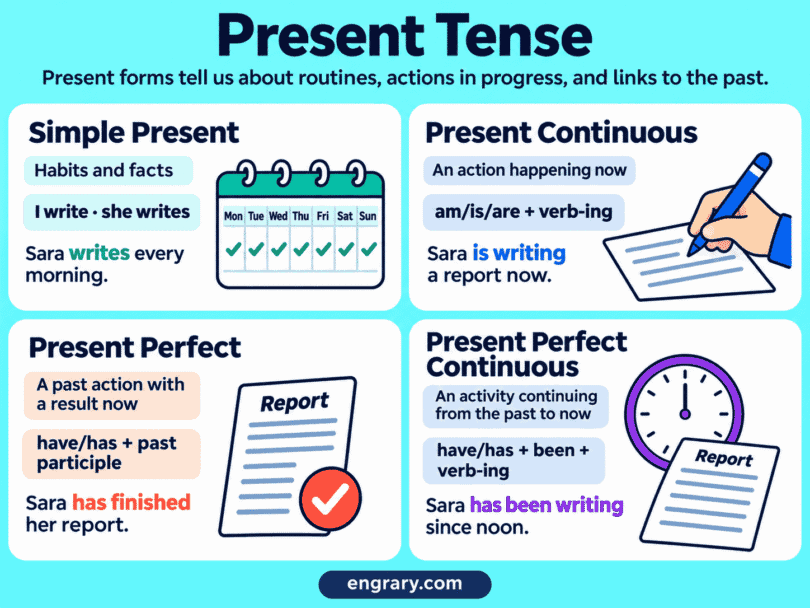
The present tense in English has four forms. We use them to describe habits, facts, activities in progress, and events that connect to the present. For example, Sara paints every Sunday tells us about her routine. The sentence still makes sense on Monday, even if Sara is at school.
Now imagine that Sara is painting her kitchen. She has painted two walls tells us how much she has finished. She has been painting since breakfast tells us how long she has spent on the job. To choose the right form, consider what you want someone to know about the activity.
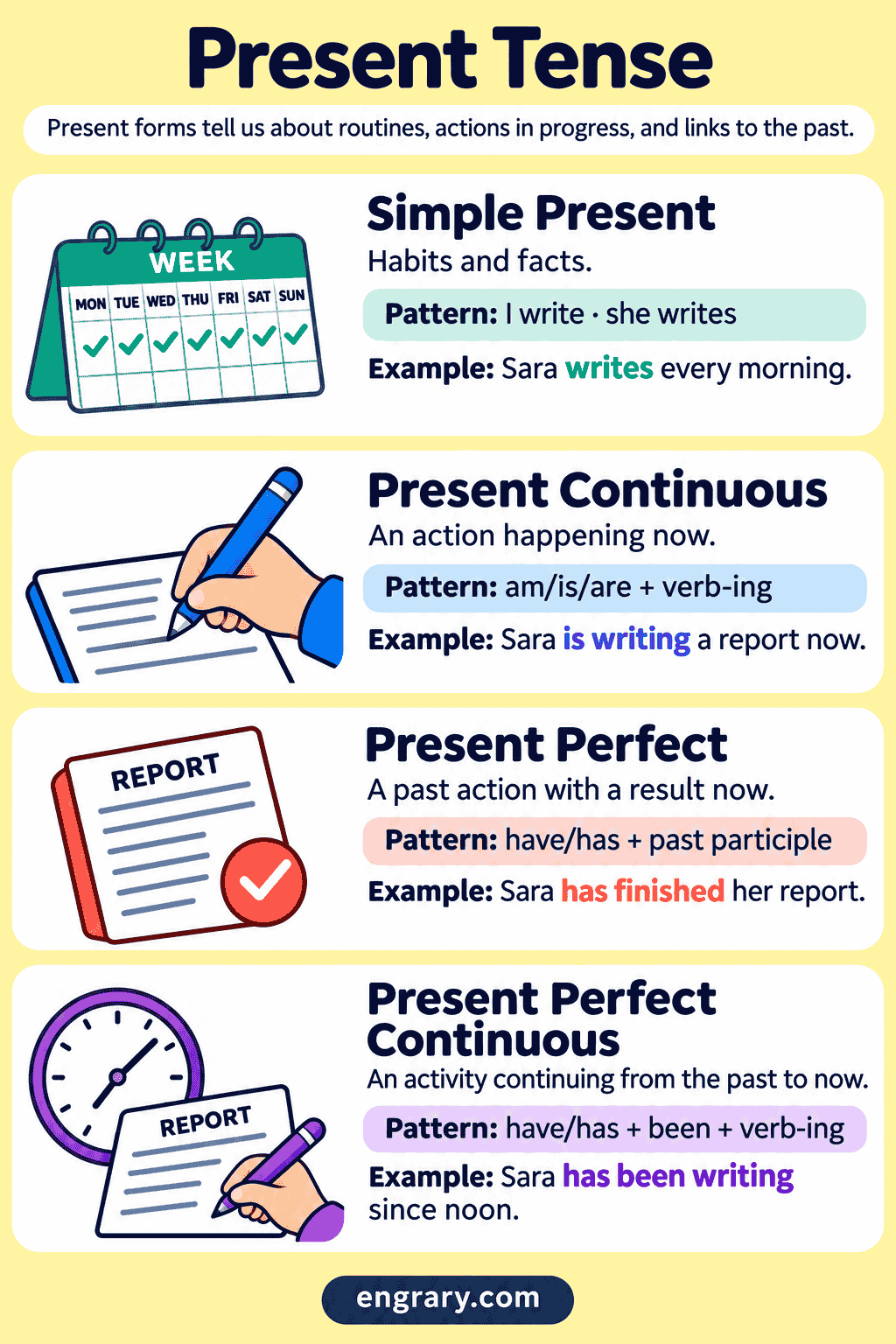
The Four Forms of the Present Tense
Follow the verb paint down the table. The subject and activity stay the same, so you can see how the verb form changes the meaning.
| Present tense form | Verb pattern | Example | Meaning |
|---|---|---|---|
| Simple present | Base verb, usually with -s or -es for he, she, or it | Sara paints every Sunday. | Painting is her routine. |
| Present continuous | am/is/are + -ing form | Sara is painting the kitchen this week. | Her project is in progress. |
| Present perfect | have/has + past participle | Sara has painted two walls so far. | Two walls are complete. |
| Present perfect continuous | have/has been + -ing form | Sara has been painting since breakfast. | The speaker emphasizes how long the activity has lasted. |
Simple Present Tense
Use the simple present for habits, general facts, states, and scheduled events. For example, Maya works at the library every Saturday describes her routine. In contrast, Maya knows the librarian describes a state. Both sentences use the simple present, although only one describes a repeated action.
Simple Present Structure
Use the base form with I, you, we, and they. With he, she, or it, most verbs take -s or -es. For questions and negatives, use do or does with the base verb.
| Sentence type | Plural subject | Singular subject |
|---|---|---|
| Statement | They work on Saturdays. | Maya works on Saturdays. |
| Negative | They don’t work on Sundays. | Maya doesn’t work on Sundays. |
| Question | Do they work here? | Does Maya work here? |
Notice where the -s goes. In Maya works, the main verb carries the ending. In Does Maya work?, does already marks the singular subject, so work stays in its base form.
Some spellings also change: watch → watches, study → studies, and play → plays. The verb be has its own pattern: I am ready, she is ready, and they are ready. To ask a question with be, move it before the subject: Is she ready?
Simple Present Uses and Examples
| Use | Example | What it expresses |
|---|---|---|
| Habit | I walk to school on weekdays. | Part of my routine |
| General fact | The Earth orbits the Sun. | A fact about the world |
| Preference | My sister prefers tea to coffee. | How she feels |
| State | Ali owns a bicycle. | Something that belongs to him |
| Timetable | The train leaves at eight tomorrow. | A scheduled departure |
Present Continuous Tense
Use the present continuous, also called the present progressive, for an action happening now or a temporary situation around now. For example, I’m reading a novel this week is still true while I’m having lunch. The book is a current activity even when I put it down.
Present Continuous Structure
Choose am, is, or are to match the subject, then add the -ing form: I am reading, Maya is reading, and the children are reading.
| Sentence type | Example |
|---|---|
| Statement | Maya is shelving books. |
| Negative | Maya isn’t shelving books today. |
| Yes-or-no question | Is Maya shelving books? |
| Information question | What is Maya doing? |
Most verbs simply take -ing, as in read → reading. Some drop a final silent e, as in write → writing. Others double the final consonant, as in sit → sitting.
Present Continuous Uses and Examples
| Use | Example | What it expresses |
|---|---|---|
| Action happening now | Listen! Someone is knocking at the door. | An action we can hear |
| Temporary situation | I am staying with my aunt this week. | A short-term arrangement |
| Gradual change | The days are getting shorter. | A change in progress |
| Future arrangement | We are meeting our teacher tomorrow. | A meeting we have arranged |
Verbs such as know, own, and understand usually take a simple form when they describe states. Other verbs can describe either a state or an activity, depending on their meaning.
| Example | Meaning of think |
|---|---|
| I think your answer is right. | I hold an opinion. |
| I am thinking about your answer. | I am considering it now. |
Present Perfect Tense
Use the present perfect, also called the present perfect simple, to connect an earlier event or state to now. For example, I’ve lost my keys explains why I can’t open the door. The loss happened earlier, but its result matters now.
Present Perfect Structure
Use have or has + the past participle. Choose has with he, she, or it and have with I, you, we, or they.
| Sentence type | Example |
|---|---|
| Statement | Sara has written three emails today. |
| Negative | Sara hasn’t written the last email yet. |
| Yes-or-no question | Has Sara written to the manager? |
| Information question | How many emails has Sara written today? |
With a regular verb, the simple past and past participle look alike: I painted the wall yesterday and I have painted the wall. An irregular verb makes the difference easier to see.
| Base verb | Simple past | Past participle | Present perfect example |
|---|---|---|---|
| write | wrote | written | I have written the address down. |
| see | saw | seen | We have seen this film twice. |
| take | took | taken | He has taken the keys. |
| eat | ate | eaten | The children have eaten lunch. |
Present Perfect Uses and Examples
| Use | Example | What it expresses |
|---|---|---|
| Present result | I have finished my homework. | The work is complete now. |
| Life experience | We have visited Lahore twice. | Two visits before now |
| Progress so far | I have read three chapters so far. | The number of chapters I have finished |
| Continuing state | She has owned this shop since 2020. | She became the owner in 2020 and still owns it. |
If you name a finished past time, use the simple past for the event. Compare I’ve sent the invitation with I sent the invitation yesterday. The first gives an update. The second tells the listener when it happened.
Present Perfect Continuous Tense
Use the present perfect continuous, also called the present perfect progressive, to emphasize an activity over time. The activity may still be happening, or it may have stopped recently and left a visible effect.
Present Perfect Continuous Structure
Use have or has + been + the -ing form. Choose have or has to match the subject. Keep been and the -ing form the same: I have been waiting, she has been waiting, and they have been waiting.
| Sentence type | Example |
|---|---|
| Statement | Sara has been painting since breakfast. |
| Negative | Sara hasn’t been painting for very long. |
| Yes-or-no question | Has Sara been painting all morning? |
| Information question | How long has Sara been painting? |
Present Perfect Continuous Uses and Examples
| Use | Example | What it expresses |
|---|---|---|
| Continuing activity | We have been waiting for the bus for twenty minutes. | We are still at the bus stop. |
| Repeated activity | Maya has been practicing the piano every evening this month. | She has practiced on several evenings. |
| Recent activity with a present effect | My sleeves are wet because I have been washing the car. | The activity explains my wet sleeves, even if I have finished. |
Common Contractions in the Present Tense
In everyday English, she’s can mean either she is or she has. The words that follow help you recognize which one the speaker means. The same pattern applies to he’s and it’s.
| Contracted sentence | Full form | Present tense form |
|---|---|---|
| She’s painting the kitchen. | She is painting the kitchen. | Present continuous |
| She’s painted two walls. | She has painted two walls. | Present perfect |
| She’s been painting since breakfast. | She has been painting since breakfast. | Present perfect continuous |
Other contractions are easier to recognize. I’m means I am, we’re means we are, and they’ve means they have. In negative sentences, does not becomes doesn’t, is not becomes isn’t, and has not becomes hasn’t.
Differences Between the Present Tense Forms
Sometimes two forms both fit a situation. To choose between them, decide which detail matters to your listener.
| First sentence | Second sentence | Difference in meaning |
|---|---|---|
| I work from home on Fridays. | I am working from home this week. | The first gives my regular schedule. The second describes this week’s arrangement. |
| She is writing the report. | She has written the report. | The first places us in the middle of the task. The second reports its completion. |
| I have read three chapters. | I have been reading for an hour. | The first gives a count. The second gives a duration and leaves the number of chapters open. |
| We have lived here for ten years. | We have been living here for ten years. | Both can describe the same ten years. The simple form presents residence as a fact, while the continuous form emphasizes the ongoing situation. |
Time Expressions with the Present Tense
Time expressions give clues about the speaker’s meaning. For example, every Saturday suggests a routine, while so far often introduces a report of progress.
| Time expression | What it adds | Example |
|---|---|---|
| Usually | Frequency | Maya usually works on Saturdays. |
| Right now | The current moment | She is helping a reader right now. |
| Already | Completion by now, sometimes earlier than expected | She has already finished the report. |
| Yet | An expected event in a question or negative | Has the parcel arrived yet? |
| So far | Progress up to now | We have packed six boxes so far. |
| Since | A starting point | I have known her since May. |
| For | A length of time | We have been talking for an hour. |
Since can introduce an event as well as a date. In I’ve lived here since I moved to Lahore, moved names the past event that started the period. Meanwhile, have lived describes the situation that continues today.
Both perfect forms can go with for. For example, I have known Ali for six years describes a continuing state. I have been studying with Ali for six weeks describes an activity. In each sentence, for tells us how long.
Common Present Tense Mistakes
| Common mistake | Correct sentence | Rule |
|---|---|---|
| She walk to school every day. | She walks to school every day. | Add -s after she in an affirmative simple present sentence. |
| Does he works here? | Does he work here? | Use the base verb after does. |
| They waiting outside. | They are waiting outside. | The present continuous needs am, is, or are. |
| I am knowing the answer. | I know the answer. | Know describes a state here. |
| She has wrote a letter. | She has written a letter. | The present perfect needs a past participle. |
| I have seen him yesterday. | I saw him yesterday. | Yesterday places this event at a finished past time. |
| We have waiting for an hour. | We have been waiting for an hour. | Use been before the -ing form. |
| I have lived here since five years. | I have lived here for five years. | Five years is a duration. |
FAQs About the Present Tense
The simple present is one of the four present forms. She reads every evening uses the simple present. She is reading now uses the present continuous.
Yes. If you say I’m learning to drive, you describe a current activity that extends beyond one lesson. The sentence still makes sense when you’re having dinner between lessons.
Yes. The simple present often describes a schedule, as in The exam starts at nine tomorrow. The present continuous can describe a personal arrangement, as in I’m meeting my teacher after the exam.
Yes. I’ve booked the tickets reports a finished action with a result that matters now. To say exactly when it happened, use the simple past: I booked the tickets last night.
It can, but the surrounding words matter. I’ve been working since eight, and I still have two pages to finish suggests the work continues. In I’m taking a break because I’ve been working all morning, the speaker has paused.
You May Also Like



Leave a Comment