
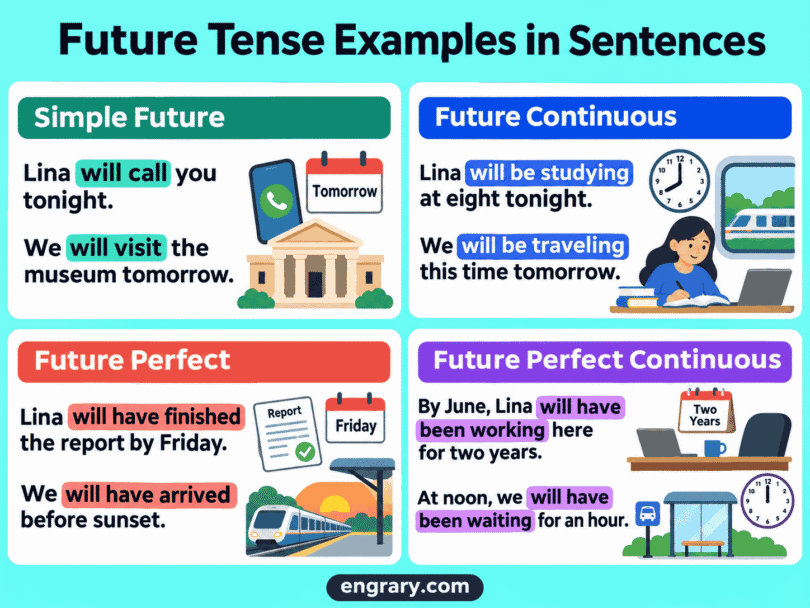
Future tense examples in sentences show how English describes actions, plans, predictions, and situations that come after the present. For example, “I will call you tonight” presents a future action, while “I will be working at eight” shows an activity that will be underway at a particular future time.
This guide contains 150 numbered examples across the simple future, future continuous, future perfect, and future perfect continuous. It also explains sentence structures, negatives, questions, short answers, time expressions, and other common ways to discuss the future.
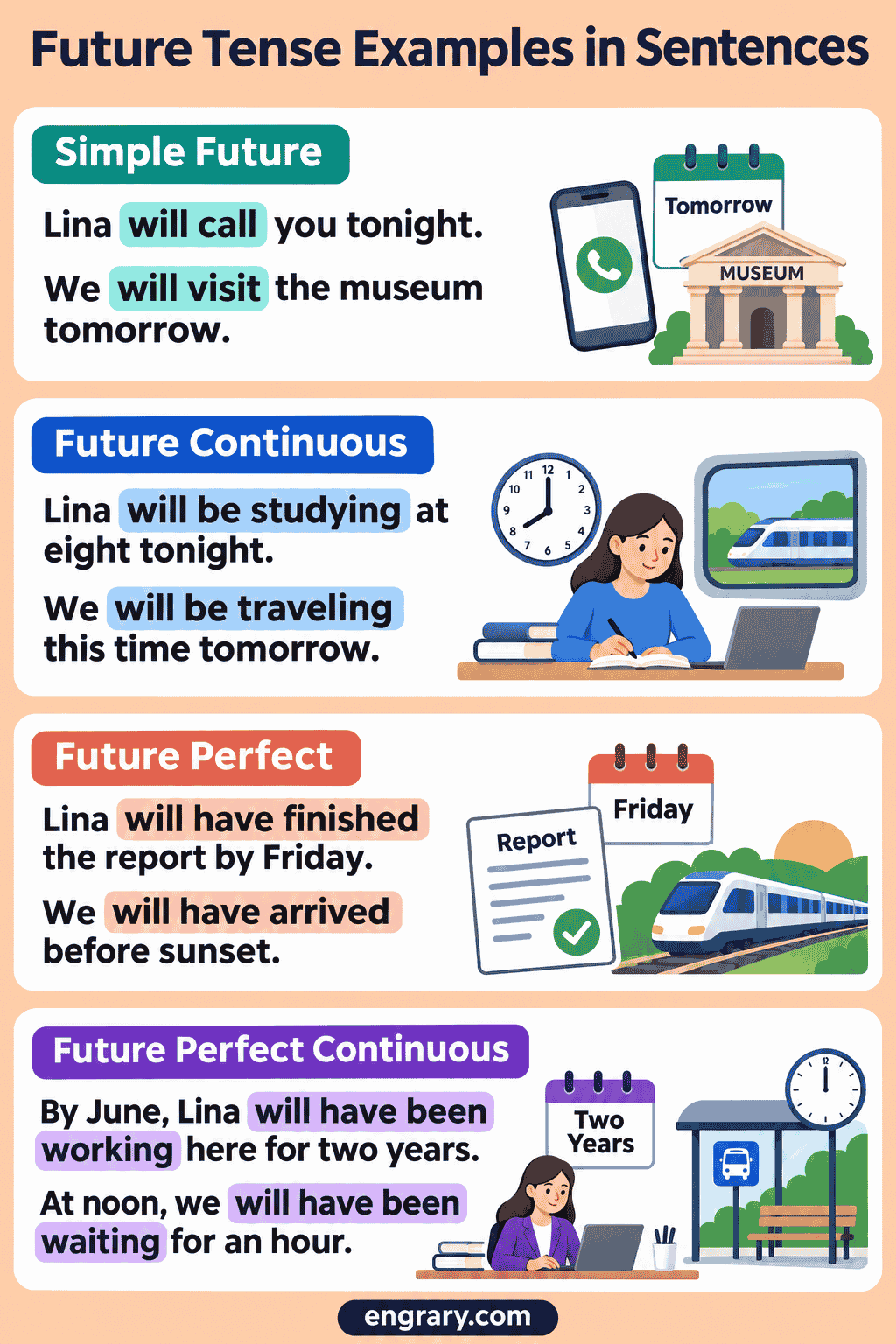
Everyday Future Tense Examples Across the Four Forms
The following sentences describe one study session from four different viewpoints.
| No. | Future form | Example | Main meaning |
|---|---|---|---|
| 1 | Simple future | I will study tonight. | A future action |
| 2 | Future continuous | I will be studying at eight tonight. | Activity underway at a future time |
| 3 | Future perfect | I will have finished the chapter by nine. | Completion before a future point |
| 4 | Future perfect continuous | By nine, I will have been studying for two hours. | Duration leading up to a future point |
English expresses future time through several constructions rather than a special ending on the main verb. Nevertheless, grammar courses commonly call the patterns above the four future tense forms.
The base verb is the basic form, such as write. Its past participle is written, and its -ing form is writing. Therefore, the four patterns include will write, will be writing, will have written, and will have been writing.
Simple Future Tense Examples in Sentences
The simple future uses will + base verb. It commonly expresses predictions, decisions made while speaking, offers, promises, and future expectations. Moreover, will stays the same with every subject.
| Sentence type | Structure | Example |
|---|---|---|
| Affirmative | Subject + will + base verb | She will call later. |
| Negative | Subject + will not + base verb | She will not call later. |
| Yes/no question | Will + subject + base verb? | Will she call later? |
| Information question | Question word + will + subject + base verb? | When will she call? |
Affirmative Sentences
- I think the weather will improve tomorrow.
- Sara will begin her new job next Monday.
- Our teacher will explain the results after lunch.
- The train will arrive at platform three shortly.
- Technology will change the way people learn.
- The phone is ringing, so I will answer it.
- We are out of bread; I will buy some on my way home.
- This box looks heavy. I will carry it for you.
- I will help you prepare for the interview.
- We will return the borrowed books tomorrow.
- Aisha will send you the address this evening.
- My brother will repair the loose shelf this weekend.
- The children will enjoy the science exhibition.
- I am sure you will recognize the building.
- Our team will discuss the proposal on Tuesday.
- Bilal will meet us outside the station.
- The new bridge will reduce travel time.
- I will keep your documents safe.
- The shop will close earlier during the holiday.
- We will celebrate your achievement together.
The sentences above cover several meanings. For example, sentence 10 expresses an immediate decision, sentence 12 makes an offer, and sentence 22 gives a promise.
Negative Sentences
Use will not or its contraction won’t before the base verb.
- I won’t forget your appointment tomorrow.
- She will not attend the workshop on Friday.
- The library won’t open during the public holiday.
- We will not share your personal information.
- Hamza won’t need the car this evening.
- The children will not stay awake until midnight.
- This small delay won’t affect the final result.
- My parents will not move until next year.
- The package won’t arrive before Monday.
Questions and Short Answers
Questions with will do not require do or does.
- Will you join us for dinner? — Yes, I will. / No, I won’t.
- Will Sara bring her camera tomorrow? — Yes, she will. / No, she won’t.
- Will the shop accept a card payment? — Yes, it will. / No, it won’t.
- Will they finish the repairs this week? — Yes, they will. / No, they won’t.
- When will the next class begin?
- Where will your family stay during the trip?
- How will we reach the village before dark?
- Why will the office close early tomorrow?
- Who will lead the discussion this afternoon?
In sentence 42, who acts as the subject, so it comes directly before will lead.
Future Continuous Tense Examples in Sentences
The future continuous, also called the future progressive, uses will be + verb-ing. It places an activity in progress at a future time. In addition, it can describe temporary situations, expected activities, and polite enquiries about plans.
| Sentence type | Structure | Example |
|---|---|---|
| Affirmative | Subject + will be + verb-ing | She will be working at noon. |
| Negative | Subject + will not be + verb-ing | She will not be working at noon. |
| Yes/no question | Will + subject + be + verb-ing? | Will she be working at noon? |
| Information question | Question word + will + subject + be + verb-ing? | Where will she be working? |
Affirmative Sentences
- At eight tonight, I will be revising for my exam.
- This time tomorrow, we will be flying to Karachi.
- Sara will be meeting the new clients at ten.
- The children will be sleeping when we return.
- My father will be driving home during the evening rush.
- At noon, the chef will be preparing lunch for the guests.
- While you are cooking, I will be setting the table.
- The students will be taking their final test next Monday morning.
- Aisha will be staying with her aunt for two weeks.
- I will be using my brother’s laptop until mine is repaired.
- The engineers will be working on the bridge throughout the night.
- Our neighbors will be traveling around northern Pakistan next month.
- The manager will be interviewing candidates all afternoon.
- At sunset, the farmers will be returning from the fields.
- We will be waiting near the main entrance when you arrive.
- At this hour next Saturday, they will be celebrating their graduation.
- The baby will be sleeping during the early part of the journey.
- Tomorrow evening, I will be discussing the budget with my team.
Clear future reference points make this form easier to understand. For instance, sentence 43 identifies eight o’clock as a point during the study session.
Negative Sentences
- I won’t be working late tomorrow.
- She will not be using the conference room at noon.
- We won’t be traveling during the school holidays.
- The children will not be playing outside after dark.
- Bilal won’t be waiting at the old bus stop.
- The technicians will not be testing the system during office hours.
- You won’t be carrying all those bags by yourself.
- My parents will not be staying at a hotel this time.
- The team won’t be practicing on the main field tomorrow.
Questions and Short Answers
- Will you be using the car this evening? — Yes, I will. / No, I won’t.
- Will Sara be waiting at the station? — Yes, she will. / No, she won’t.
- Will they be staying for dinner? — Yes, they will. / No, they won’t.
- Will the children be sleeping when we arrive? — Yes, they will. / No, they won’t.
- What will you be doing at ten tomorrow morning?
- Where will the guests be sitting during the ceremony?
- How long will your cousins be staying with you?
- Why will the technicians be working overnight?
- Who will be managing the office while Nadia is away?
Stative verbs such as know, believe, own, and understand do not normally appear in continuous forms. Therefore, say “I will know the result tomorrow,” rather than “I will be knowing the result tomorrow.”
Future Perfect Tense Examples in Sentences
The future perfect uses will have + past participle. It looks back from a future reference point and shows that an action will be complete before that point. It can also describe a state that continues up to a future time.
| Sentence type | Structure | Example |
|---|---|---|
| Affirmative | Subject + will have + past participle | She will have finished by noon. |
| Negative | Subject + will not have + past participle | She will not have finished by noon. |
| Yes/no question | Will + subject + have + past participle? | Will she have finished by noon? |
| Information question | Question word + will + subject + have + past participle? | When will she have finished? |
Affirmative Sentences
- By Friday, I will have completed the report.
- She will have saved enough money by the end of the year.
- The builders will have repaired the road by next month.
- By noon, Amir will have written three pages.
- Our class will have read six chapters by Monday.
- The guests will have arrived before dinner begins.
- We will have left before the traffic becomes heavy.
- By the time you call, he will have gone to bed.
- The students will have submitted their projects before the deadline.
- By next summer, my sister will have graduated from university.
- The company will have opened two new branches by December.
- By the end of the course, you will have learned several useful techniques.
- They will have visited five cities before their holiday ends.
- By next year, we will have lived in this neighborhood for a decade.
- In June, I will have known Sara for ten years.
- By next month, he will have been the team leader for a full year.
- The rain will have stopped before the match starts.
- By midnight, the rescue team will have reached the village.
Sentence 94 is future perfect rather than future perfect continuous. Although it contains will have been, no -ing verb follows been.
Negative Sentences
A negative future perfect sentence often shows that an action will remain incomplete at the stated future point.
- I won’t have finished the book by tonight.
- She will not have completed the training before Monday.
- The workers won’t have repaired the roof by sunset.
- We will not have reached the hotel before dark.
- Hamza won’t have saved enough money by June.
- The children will not have returned from school by two.
- You won’t have received the certificate before the final review.
- The shop will not have reopened by the start of the festival.
- Our team won’t have solved every problem by the end of today.
Questions and Short Answers
- Will you have submitted the form by Monday? — Yes, I will. / No, I won’t.
- Will Sara have finished the report before lunch? — Yes, she will. / No, she won’t.
- Will they have reached the airport by six? — Yes, they will. / No, they won’t.
- Will the rain have stopped before the game begins? — Yes, it will. / No, it won’t.
- How many chapters will you have read by Friday?
- Where will the family have moved by the end of the year?
- Why will the shop have closed before we arrive?
- What will the team have achieved by the end of the project?
- Who will have completed the training before the new term begins?
Future Perfect Continuous Tense Examples in Sentences
The future perfect continuous, also called the future perfect progressive, uses will have been + verb-ing. It emphasizes the duration of an activity leading up to a future reference point.
| Sentence type | Structure | Example |
|---|---|---|
| Affirmative | Subject + will have been + verb-ing | She will have been working for six hours. |
| Negative | Subject + will not have been + verb-ing | She will not have been working for six hours. |
| Yes/no question | Will + subject + have been + verb-ing? | Will she have been working for six hours? |
| Information question | Question word + will + subject + have been + verb-ing? | How long will she have been working? |
Affirmative Sentences
- By noon, I will have been studying for four hours.
- Next July, she will have been teaching at the school for ten years.
- When the bus arrives, we will have been waiting for an hour.
- By six, Bilal will have been driving for five hours.
- At the end of this week, they will have been renovating the house for a month.
- By December, my brother will have been learning Chinese for two years.
- When the guests arrive, Sara will have been cooking all afternoon.
- By sunset, the farmers will have been working in the fields for ten hours.
- Next month, we will have been living in Lahore for three years.
- By the end of the match, the players will have been running for nearly two hours.
- When the doors open, people will have been standing in line since dawn.
- By Tuesday, the technicians will have been testing the software for a week.
- At noon, the children will have been practicing their performance for three hours.
- By the time the doctor arrives, the nurse will have been monitoring the patient for an hour.
- Next spring, Aisha will have been managing the shop for five years.
- By midnight, the volunteers will have been distributing food for six hours.
- He will need a break because he will have been repairing the machine all morning.
- Their clothes will be dusty because they will have been cleaning the storeroom.
The activity may begin before now or later. The important relationship is its duration before the future reference point. Furthermore, this form does not show by itself whether the activity will continue afterward.
Negative Sentences
- By May, I won’t have been living here for a full year.
- She will not have been working long enough to qualify for the benefit.
- They won’t have been traveling for six hours when they reach Multan.
- We will not have been waiting very long when the office opens.
- The students won’t have been studying for a full month before the test.
- Hamza will not have been driving long enough to feel tired.
- The team won’t have been practicing together for more than a week.
- By June, my cousin will not have been running the business for a complete year.
- The machine won’t have been operating long enough to overheat.
Questions and Short Answers
- Will you have been working for six hours by noon? — Yes, I will. / No, I won’t.
- Will Sara have been teaching here for ten years next June? — Yes, she will. / No, she won’t.
- Will they have been traveling all night when they arrive? — Yes, they will. / No, they won’t.
- Will the workers have been repairing the bridge for a month by Friday? — Yes, they will. / No, they won’t.
- How long will you have been learning English by the end of this course?
- Where will the team have been practicing before the tournament begins?
- Why will she have been waiting for so long?
- What will the scientists have been studying for five years by then?
- Who will have been managing the office for the longest time by December?
Duration alone does not require a continuous form. Stative verbs usually take the future perfect, as in “By June, I will have known her for ten years,” rather than “will have been knowing.”
Differences Between Future Tense Forms in Sentences
Small changes in a future verb phrase can change the viewpoint from a general action to progress, completion, or duration. The following tables reuse the same ideas to make those differences clear.
Simple Future and Future Continuous
| Simple future | Future continuous | Main difference |
|---|---|---|
| I will write the report tomorrow. | I will be writing the report at ten tomorrow. | The first presents a future action; the second places it in progress at ten. |
| She will talk to the manager. | She will be talking to the manager when you arrive. | The first announces an action; the second shows it underway at a reference point. |
| We will travel next week. | This time next week, we will be traveling through the mountains. | The continuous form focuses on activity during a specific future period. |
Future Continuous and Future Perfect
| Future continuous | Future perfect | Main difference |
|---|---|---|
| At noon, I will be reading the report. | By noon, I will have read the report. | Activity in progress at noon versus completion by noon |
| At six, they will be repairing the road. | By six, they will have repaired the road. | Work underway at six versus a finished result |
| When you call, she will be writing the email. | Before you call, she will have written the email. | Ongoing activity versus earlier completion |
Future Perfect and Future Perfect Continuous
| Future perfect | Future perfect continuous | Main difference |
|---|---|---|
| By noon, she will have packed ten boxes. | By noon, she will have been packing for three hours. | Completed quantity versus duration |
| By June, he will have been a teacher for ten years. | By June, he will have been teaching for ten years. | A continuing state versus an activity |
| The team will have completed five tests by Friday. | The team will have been testing the system for a week by Friday. | Achieved result versus time spent on the activity |
The words will have been do not automatically create a continuous form. A future perfect continuous phrase also needs an -ing verb, such as working or studying.
Other Ways to Express Future Time
English also uses be going to, the present continuous, and the present simple for future meaning. These constructions remain outside the numbered collection so the article contains exactly 150 main examples.
Will and Be Going To
| Form | Typical use | Example |
|---|---|---|
| Will | Decision made while speaking | The phone is ringing. I will answer it. |
| Be going to | Earlier intention | I am going to apply for the course. |
| Will | Prediction based mainly on opinion | I think it will rain tomorrow. |
| Be going to | Prediction based on present evidence | Look at those clouds. It is going to rain. |
| Will | Spontaneous offer | I will carry that box for you. |
| Be going to | Existing plan | We are going to paint the kitchen this weekend. |
These distinctions describe common tendencies rather than absolute rules. Sometimes both forms work, although the speaker may emphasize a different reason for choosing each one.
Present Continuous for Future Arrangements
The present continuous commonly describes an arrangement that has already been organized. A future time expression or the surrounding context supplies the future meaning.
- I am meeting my dentist at three tomorrow.
- We are having dinner with our cousins on Saturday.
- Sara is flying to Islamabad next week.
- They are starting the training course on Monday.
Present Simple for Schedules
The present simple commonly describes timetables, programs, and official schedules.
- The train leaves at 7:30 tomorrow morning.
- The semester begins next Monday.
- The film starts at nine tonight.
- Our flight lands shortly after midnight.
Future Time Clauses in Sentences
An ordinary future time clause after when, before, after, until, once, or as soon as usually takes a present form. Similarly, a future condition after if usually takes a present form.
| Clause type | Example | Explanation |
|---|---|---|
| When-clause | I’ll call you when I arrive. | The main clause carries will; the time clause uses present simple. |
| Before-clause | Please check the address before you leave. | Present simple follows before. |
| After-clause | We’ll eat after Sara comes home. | Present simple establishes the later event. |
| Until-clause | He’ll wait until the office opens. | Present simple follows until. |
| As-soon-as clause | She’ll message us as soon as she lands. | Present simple follows as soon as. |
| If-clause | We’ll go outside if the weather improves. | Present simple states the possible future condition. |
However, will can appear in direct and embedded questions about future time.
| Function | Example |
|---|---|
| Future time clause | I’ll call when she arrives. |
| Direct question | When will she arrive? |
| Embedded question | I don’t know when she will arrive. |
Will can also appear after if when it expresses willingness. For example, “If you will wait here, the manager will see you shortly” politely asks the listener to wait. Therefore, the rule is more precise than “never use will after when or if.”
Common Future Time Expressions
Future time expressions help establish a reference point or period. However, meaning and context determine the verb form.
| Time expression | Common purpose | Example |
|---|---|---|
| Tomorrow, next week, soon | General future reference | We will leave tomorrow. |
| At eight tonight | Activity at a future point | I will be studying at eight tonight. |
| This time tomorrow | Activity underway | We will be flying this time tomorrow. |
| By Friday, by then | Completion deadline | I will have finished by Friday. |
| By the time | Completion before another event | She will have left by the time we arrive. |
| For | Length of time | He will have been working for six hours. |
| Since | Starting point | By June, she will have lived here since 2020. |
By and Until
By sets the latest time for completion. In contrast, until describes continuation up to a time.
| Expression | Meaning | Example |
|---|---|---|
| By Friday | No later than Friday | I will have finished the report by Friday. |
| Until Friday | Continuing up to Friday | I will be working on the report until Friday. |
Future Tense Examples in a Short Paragraph
Next Monday, our class will begin a community project. At ten, we will be meeting local volunteers in the school hall. By lunchtime, we will have divided everyone into working groups. When the afternoon session starts, the organizers will have been preparing activities for several hours.
Here, will begin presents a future event. Meanwhile, will be meeting places an activity in progress at ten. Will have divided shows completion by lunchtime, while will have been preparing emphasizes duration before the afternoon session.
Common Mistakes in Future Tense Sentences
When checking a future sentence, identify the helping verbs first. Then check whether the correct verb form follows them.
| Incorrect | Correct | Explanation |
|---|---|---|
| She will goes tomorrow. | She will go tomorrow. | Use the base verb after will. |
| Do you will come with us? | Will you come with us? | Questions with will do not use do. |
| He will working at noon. | He will be working at noon. | Future continuous requires will be. |
| They will be travel next week. | They will be traveling next week. | Use the -ing form after will be. |
| She will have wrote it by Friday. | She will have written it by Friday. | Use the past participle after will have. |
| We will have finish by noon. | We will have finished by noon. | Future perfect requires a past participle. |
| He will have working for six hours. | He will have been working for six hours. | Future perfect continuous requires been. |
| I will be knowing the answer tomorrow. | I will know the answer tomorrow. | Know is normally stative. |
| I’ll call you when I will arrive. | I’ll call you when I arrive. | Use a present form in an ordinary future time clause. |
| I’ll finish the report until Friday. | I’ll finish the report by Friday. | By sets a completion deadline. |
Choosing will instead of going to, or the reverse, does not always create a grammatical error. Often, the choice changes the emphasis between a spontaneous decision, an existing intention, and the evidence available to the speaker.
FAQs
The four forms commonly taught in English grammar are the simple future, future continuous, future perfect, and future perfect continuous. They describe future actions from the viewpoints of action, progress, completion, and duration.
Place not after will. Use will not or won’t followed by the rest of the verb phrase: won’t go, won’t be working, won’t have finished, and won’t have been waiting.
Use will commonly for immediate decisions, offers, promises, and predictions based on opinion. Use going to commonly for earlier intentions and predictions supported by present evidence. Nevertheless, the two constructions can overlap in some contexts.
Use the future perfect continuous when you want to emphasize how long an activity will have continued before a future point. For example, “By noon, we will have been waiting for two hours” focuses on the duration of the wait.
Yes. The present continuous commonly describes arrangements, as in “We are meeting tomorrow.” The present simple commonly describes schedules and timetables, as in “The train leaves at seven.”
You May Also Like

Leave a Comment