
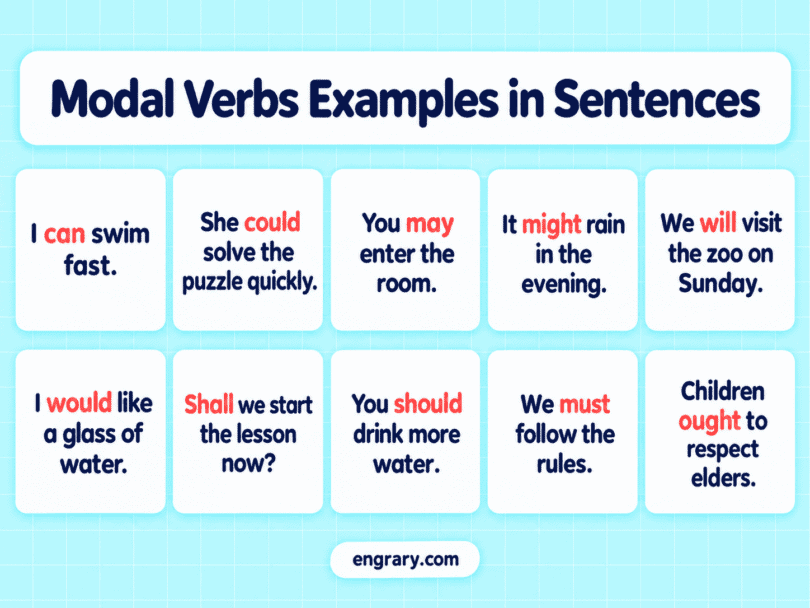
Modal verbs help speakers express ability, possibility, permission, necessity, advice, prediction, willingness, and other meanings. Because they work with a main verb, they allow one basic action to express different levels of certainty, intention, or obligation.
This article provides exactly 100 modal verbs examples in sentences using can, could, may, might, must, shall, should, will, and would. You will also see modal questions, negative forms, modal perfect sentences, correct verb patterns, and common mistakes.
What Is a Modal Verb in a Sentence?
A modal verb is an auxiliary verb that works with a main verb to express a particular meaning such as ability, permission, possibility, necessity, advice, or prediction.
For example:
She can swim.
It might rain.
You must leave.
We should wait.
They will arrive soon.
The usual structure is:
modal verb + base form of the main verb
For example:
can swim
might come
should rest
will leave
Common Modal Verb Sentences
The nine core modal verbs appear frequently in everyday English. Each one can express one or more related meanings depending on the sentence.
| Modal Verb | Example Sentence |
|---|---|
| can | She can drive. |
| could | He could help us. |
| may | It may rain. |
| might | They might come later. |
| must | We must leave. |
| shall | Shall we begin? |
| should | You should rest. |
| will | She will call tomorrow. |
| would | I would help you. |
The following sections show these modal verbs in a wider range of natural sentences.
100 Modal Verbs Examples in Sentences
The examples below contain exactly 100 complete sentences. Each group shows how one core modal verb works in different contexts.
Sentences With Can
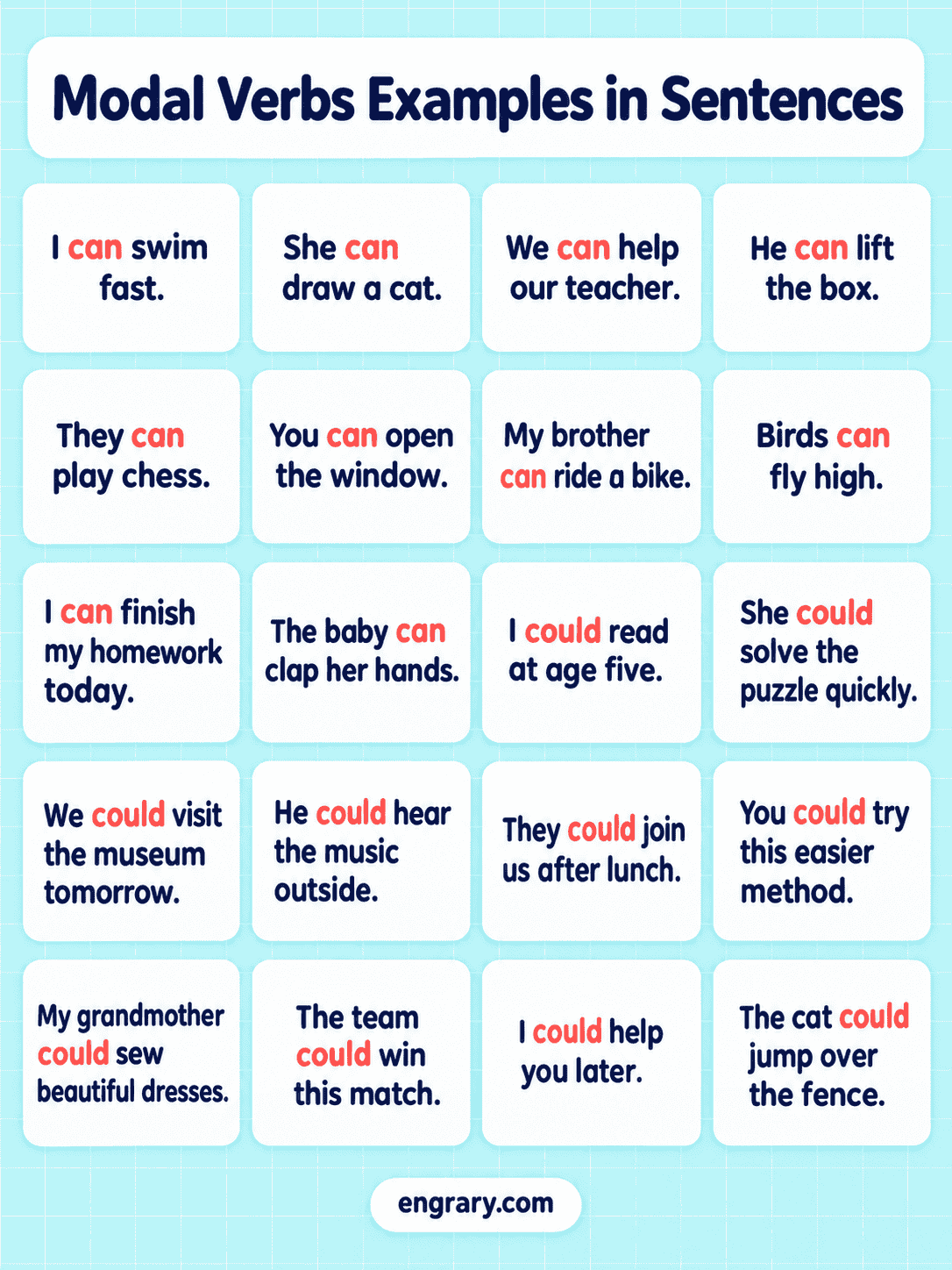
Can commonly expresses ability, permission, requests, and possibility.
- She can swim very well.
- I can help you with your homework.
- He can speak three languages.
- We can meet after lunch.
- You can borrow my book.
- They can finish the work today.
- Mia can play the piano.
- Can you open the window?
- Can I use your phone?
- This road can become dangerous in winter.
- Everyone can learn from mistakes.
- The machine can produce hundreds of copies.
Sentences With Could
Could can express past ability, possibility, polite requests, suggestions, or hypothetical situations.
- He could read when he was four.
- She could swim before she started school.
- We could try another route.
- They could arrive late.
- Could you close the door?
- Could I borrow your pen?
- You could ask your teacher for help.
- The plan could work with a few changes.
- I could stay longer if necessary.
- She could be at home already.
Sentences With May
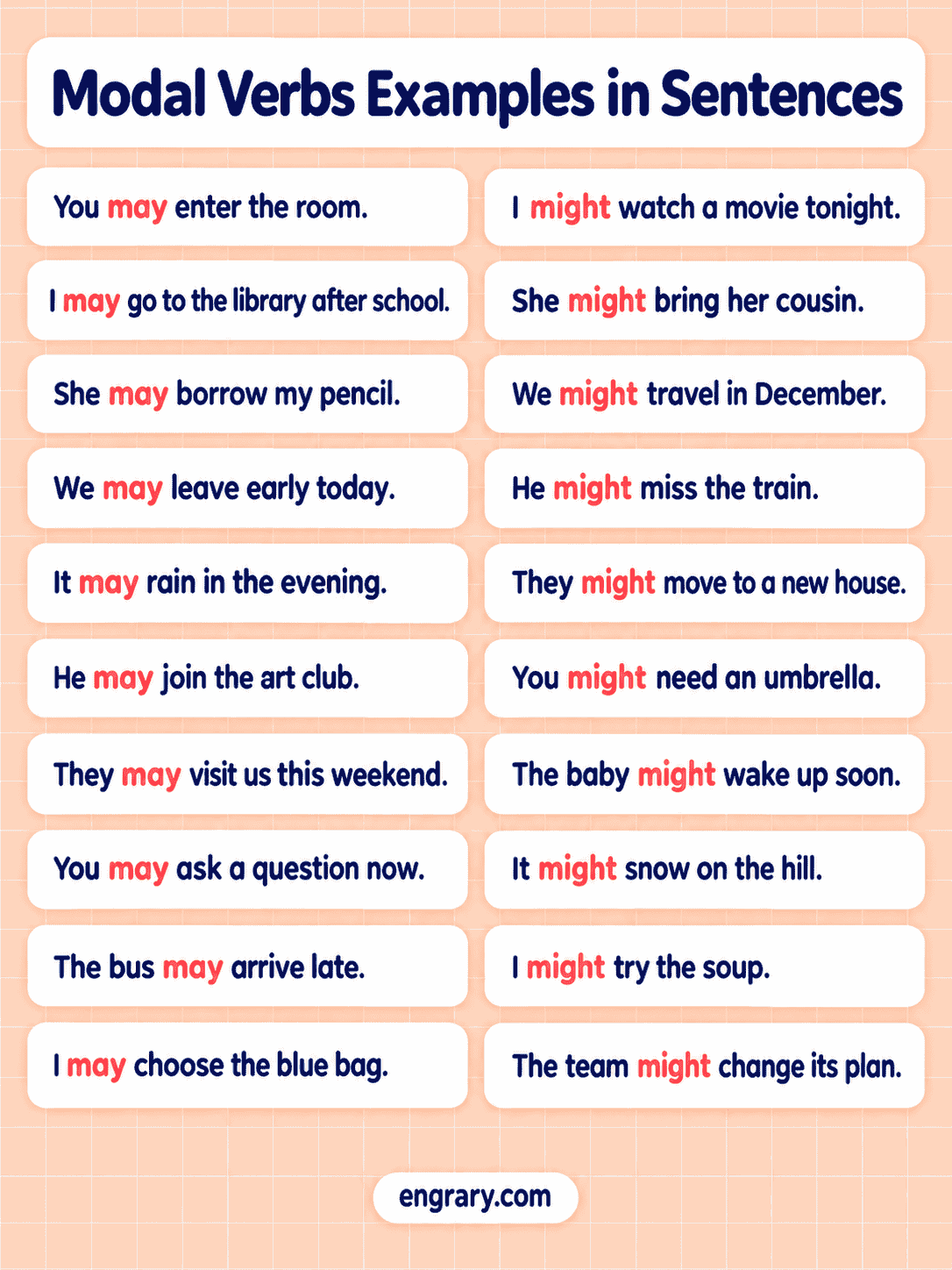
May commonly expresses possibility or relatively formal permission.
- It may rain this evening.
- She may arrive late.
- They may need more time.
- You may leave after the meeting.
- May I come in?
- May I ask a question?
- The new method may improve the results.
- He may know the answer.
Sentences With Might
Might usually expresses possibility or uncertainty.
- She might come to the party.
- It might snow tonight.
- They might need our help.
- We might stay another day.
- He might know where the keys are.
- The train might arrive late.
- I might call you this evening.
- This idea might solve the problem.
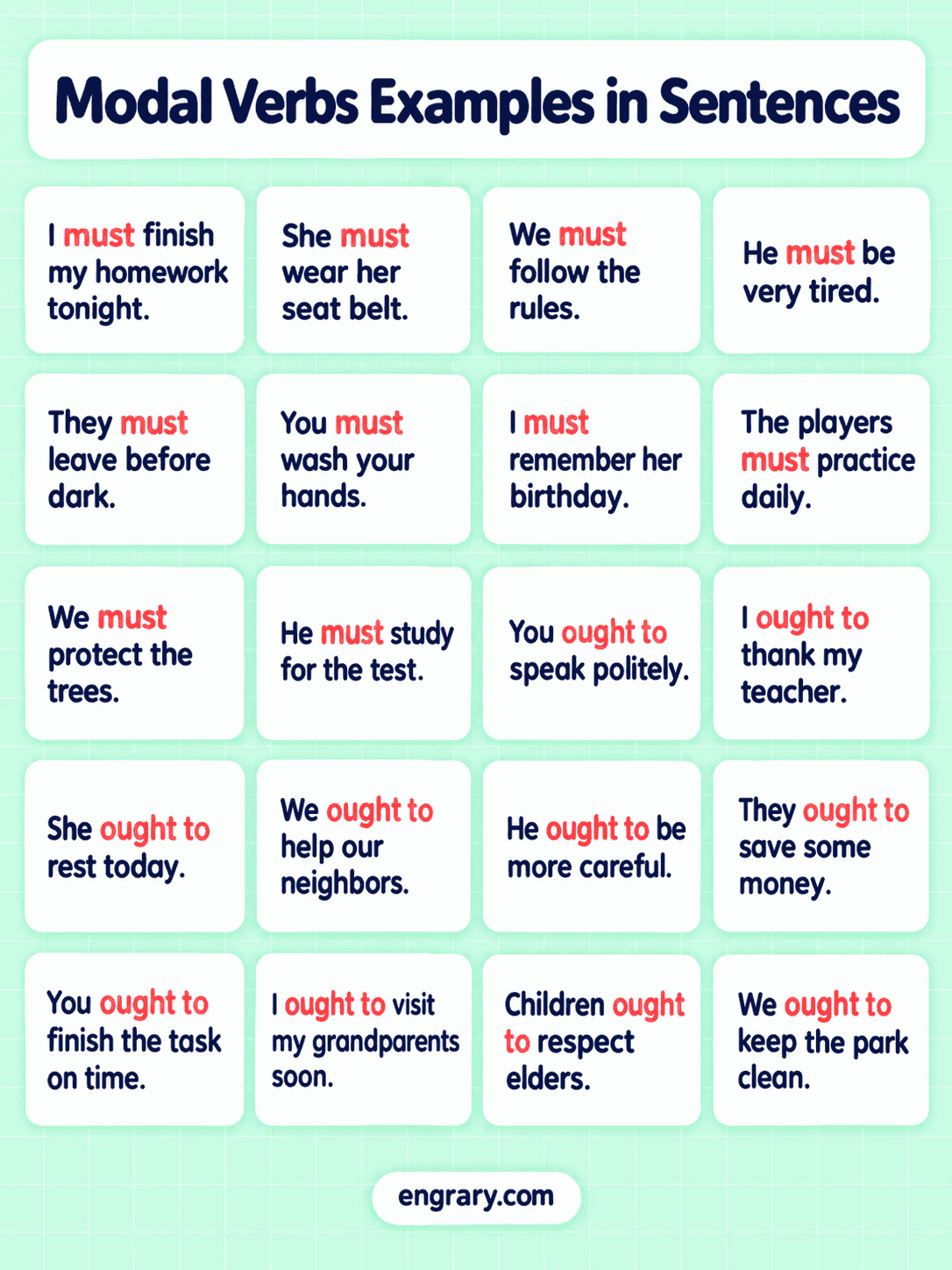
Sentences With Must
Must can express strong necessity, obligation, rules, or strong deduction.
- You must wear a seat belt.
- We must finish the project today.
- Students must follow the school rules.
- You must keep this door closed.
- I must remember to call her.
- Visitors must show their identification.
- She must be tired after the journey.
- He must know the answer.
- They must have enough food for everyone.
- We must leave before sunset.
- You must take this matter seriously.
- Everyone must complete the form.
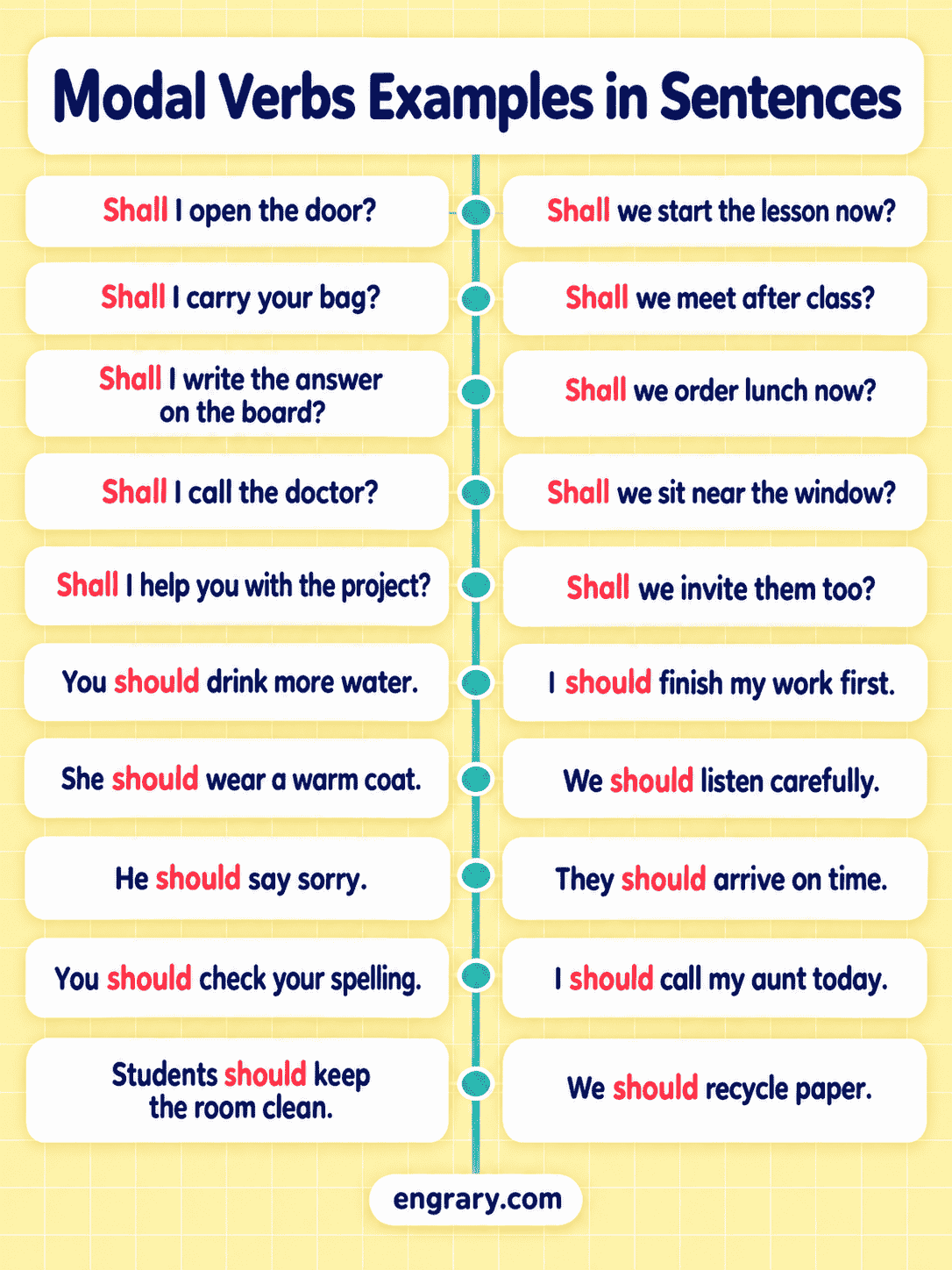
Sentences With Shall
Shall commonly appears in offers and suggestions and can also express formal future meaning.
- Shall we begin the meeting?
- Shall I open the window?
- Shall we order dinner now?
- Shall I carry your bag?
- We shall continue after the break.
- I shall return tomorrow.
Sentences With Should
Should commonly expresses advice, recommendations, expectations, or weaker obligation.
- You should rest after the journey.
- She should call her teacher.
- We should leave before it gets dark.
- They should check the details carefully.
- He should apologize for his mistake.
- You should drink more water.
- Students should arrive on time.
- She should be home by now.
- The bus should arrive soon.
- We should consider another option.
- You should keep a copy of the document.
- He should speak to the manager.
Sentences With Will
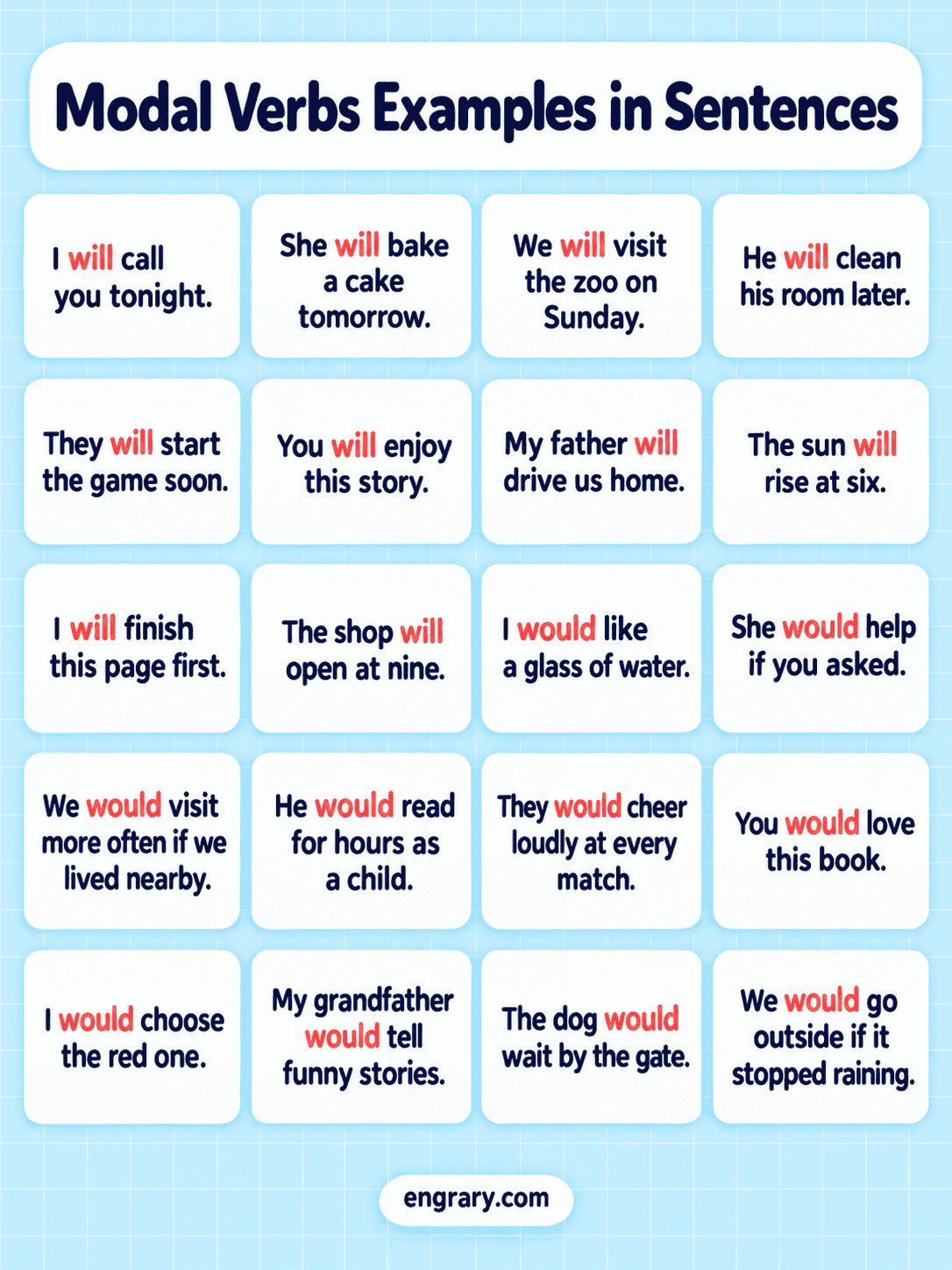
Will can express future actions, predictions, willingness, promises, and requests.
- They will arrive tomorrow.
- I will call you tonight.
- She will help us with the project.
- We will meet outside the station.
- The meeting will begin at nine.
- It will rain later.
- He will understand when you explain it.
- I will remember your advice.
- They will finish the work by Friday.
- The store will open at eight.
- Will you close the door?
- Will you join us for dinner?
- I will never forget your kindness.
- She will probably choose the blue dress.
- We will need more chairs.
- The new system will save time.
Sentences With Would
Would can express hypothetical situations, polite requests, preferences, future in the past, or repeated past habits.
- I would help if I had more time.
- She would choose the smaller room.
- We would stay longer if we could.
- Would you like some tea?
- Would you open the window?
- I would prefer a quiet table.
- He said he would call later.
- She knew they would arrive soon.
- We would visit our grandparents every summer.
- My father would read to us every evening.
- I would never ignore such an important warning.
- They would buy the house if it were cheaper.
- She would travel more if she had time.
- He would make a good teacher.
- I would rather stay at home tonight.
- We would appreciate your help.
Modal Verb and Main Verb Examples
A modal verb works with a main verb, which normally remains in its base form. The following examples make the two roles easy to identify.
| Sentence | Modal Verb | Main Verb |
|---|---|---|
| She can swim. | can | swim |
| He could help. | could | help |
| It may rain. | may | rain |
| They might come. | might | come |
| We must leave. | must | leave |
| We shall continue. | shall | continue |
| You should rest. | should | rest |
| They will arrive. | will | arrive |
| I would help. | would | help |
The modal adds meaning such as ability, possibility, necessity, advice, or prediction, while the main verb expresses the central action or state.
Modal Verbs in Questions
Core modal verbs can form questions directly by appearing before the subject. Therefore, they do not normally need do, does, or did.
Examples:
Can you swim?
Could you help me?
May I come in?
Might they arrive late?
Shall we begin?
Should we wait?
Will she come?
Would you like some coffee?
A common structure is:
modal + subject + base verb
For example:
Can + she + drive?
Should + we + leave?
Modal Verbs in Negative Sentences
Modal verbs form negatives by placing not after the modal.
Examples:
She cannot swim.
They could not attend the meeting.
He may not come today.
We might not stay overnight.
You must not enter this room.
She should not worry.
They will not wait much longer.
I would not agree to those terms.
Common contracted forms include:
can’t
couldn’t
mustn’t
shouldn’t
won’t
wouldn’t
Modal Perfect Sentences
Modal verbs can refer to past situations by combining with have + past participle.
The structure is:
modal + have + V3
Examples:
She might have forgotten the appointment.
He must have left already.
They could have won the match.
You should have called me.
We would have stayed longer.
He may have missed the bus.
She could have chosen another route.
They must have known the truth.
These structures can express past possibility, deduction, missed opportunity, regret, or hypothetical meaning.
Modal Verbs by Meaning
The same modal can express different meanings, but several common patterns are useful for reference.
| Meaning | Common Modal Verbs | Example |
|---|---|---|
| Ability | can, could | She can swim. |
| Permission | can, could, may | May I enter? |
| Possibility | may, might, could | It might rain. |
| Necessity | must | We must leave. |
| Advice | should | You should rest. |
| Prediction | will | It will rain. |
| Polite request | could, would | Could you help? |
| Suggestion | could, shall | Shall we begin? |
| Deduction | must, may, might, could | She must be home. |
| Hypothetical meaning | would, could | I would help. |
Context determines the exact meaning, so a modal should not be assigned only one fixed function.
What Comes After a Modal Verb?
Core modal verbs normally take the base form of the main verb.
Correct:
She can swim.
He should go.
They might come.
We will leave.
Incorrect:
She can swims.
He should goes.
They might to come.
We will leaving.
The main verb normally stays unchanged after a core modal.
One familiar exception in broader modal teaching is ought to, which contains to:
You ought to rest.
Core Modals Do Not Take -s
Core modal verbs do not normally change for third-person singular subjects.
Compare:
I can swim.
She can swim.
They can swim.
Do not write:
She cans swim.
The same rule applies to other core modals:
He must leave.
She should wait.
Tom will arrive.
Not:
He musts leave.
She shoulds wait.
Tom wills arrive.
No Do, Does, or Did With Core Modals
Core modal verbs form their own questions and negatives, so they do not normally use do, does, or did as another auxiliary.
Correct:
Can you swim?
Incorrect:
Do you can swim?
Correct:
Should she wait?
Incorrect:
Does she should wait?
Correct:
He cannot come.
Incorrect:
He does not can come.
Correct:
Could they help?
Incorrect:
Did they could help?
Common Mistakes in Modal Verb Sentences
Most modal-verb mistakes involve the wrong main-verb form or an unnecessary auxiliary.
| Incorrect | Correct | Why |
|---|---|---|
| She can swims. | She can swim. | Modal takes the base verb |
| He should goes. | He should go. | No -s after a modal |
| They might to come. | They might come. | Core modal takes the base verb |
| She cans drive. | She can drive. | Core modal does not take -s |
| He musts leave. | He must leave. | Modal form does not change |
| Do you can swim? | Can you swim? | Modal forms the question directly |
| She will to come. | She will come. | No to after will |
| He may comes. | He may come. | May takes the base verb |
| Does she should wait? | Should she wait? | No do-support with a core modal |
| He could went. | He could go. | Could takes the base verb |
Checking the modal and the verb immediately after it prevents many of these errors.
FAQs
Examples include She can swim, It might rain, You must leave, We should wait, and They will arrive tomorrow.
A core modal normally takes the base form of the main verb, as in can swim, should go, might come, and will leave.
Yes. Modal verbs move before the subject in questions, as in Can you swim?, Should we leave?, and Would you help?
Core modal verbs normally stay the same. We say I can swim, she can swim, and they can swim.
A modal perfect uses modal + have + past participle, as in She might have forgotten or You should have called.
You May Also Like



Leave a Comment