
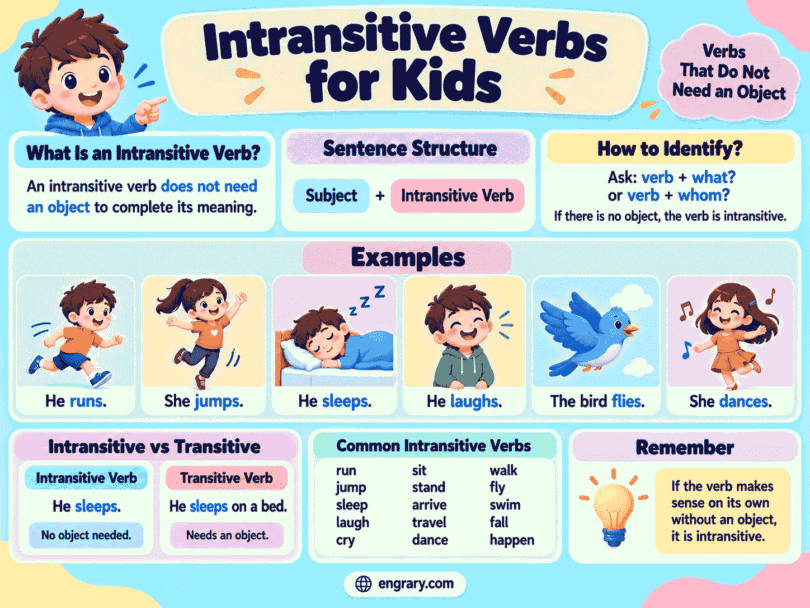
Intransitive verbs help children understand that some actions and events do not need a direct object. Learning them makes it easier to tell the difference between the verb itself and extra details that show how, when, or where something happens.
You’ll learn what makes a verb intransitive, what can come after it, how to separate extra details from direct objects, how some verbs can be both transitive and intransitive, and how to identify intransitive verbs in sentences.
What Makes a Verb Intransitive?
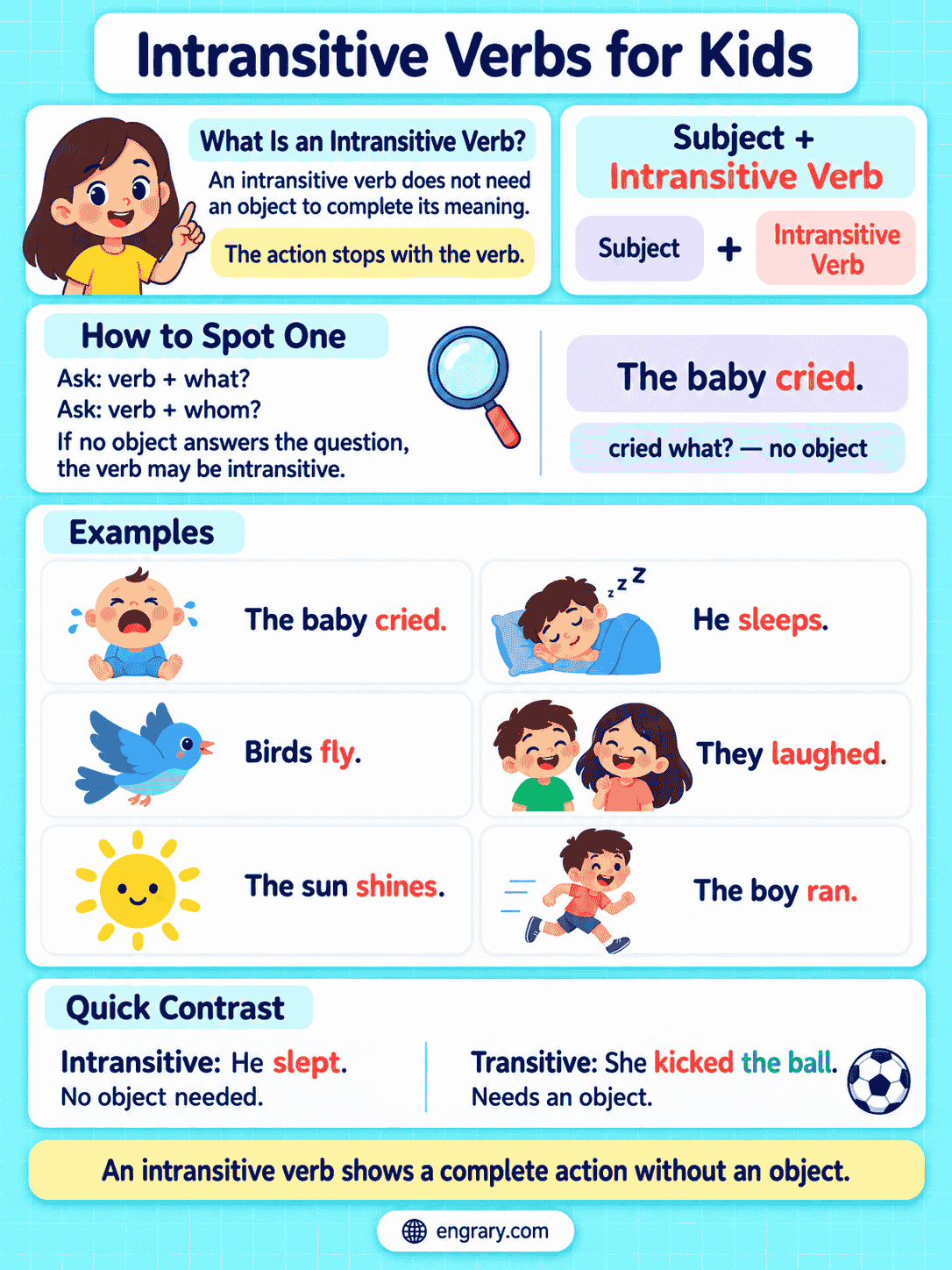
A verb is intransitive when it is used without a direct object.
For example:
The baby slept.
There is no object receiving the action.
Another example:
The guests arrived.
The verb arrived completes the meaning without a direct object.
The basic idea is:
intransitive verb → no direct object
Intransitive Verbs Do Not Need a Direct Object
An intransitive verb can complete the sentence without an object after it.
Examples:
The baby cried.
The dog ran.
The children laughed.
The guests arrived.
It rained.
The bird flew.
Noah waited.
Each verb works without a direct object.
For example:
The children laughed.
There is no person or thing receiving the action.
So laughed is intransitive.
Easy Intransitive Verb Examples
Many common verbs can be used intransitively.
Examples include:
- arrive
- come
- cough
- cry
- fall
- fly
- happen
- laugh
- live
- rain
- rise
- run
- sleep
- sneeze
- smile
- stand
- stay
- wait
- walk
- work
In sentences:
The guests arrived.
The baby cried.
The bird flew.
It rained.
Noah waited.
The children laughed.
These sentences do not contain direct objects.
What Can Come After an Intransitive Verb?
An intransitive verb does not need a direct object, but other words can still come after it.
Those words may tell:
- how something happens;
- when it happens;
- where it happens.
Examples:
The baby slept peacefully.
The dog ran quickly.
The children laughed loudly.
The guests arrived at noon.
The boy ran to school.
Noah waited outside.
The words after the verb add extra information, but they do not receive the action.
Why Extra Details Are Not Direct Objects
Not every word or phrase after a verb is a direct object.
Compare:
The boy ran to school.
The words to school tell where he ran.
They form a prepositional phrase.
They do not receive the action.
So ran is intransitive.
Now compare:
The boy carried the bag.
Ask:
carried what?
Answer:
the bag
So:
carried = transitive verb
the bag = direct object
Another comparison:
She walked into the room.
into the room = prepositional phrase
But:
She opened the door.
the door = direct object
This distinction is important because extra details and direct objects do different jobs.
Intransitive Verbs in Sentences
| Sentence | Intransitive Verb | Extra Detail |
|---|---|---|
| The baby slept peacefully. | slept | peacefully |
| The guests arrived at noon. | arrived | at noon |
| The dog ran quickly. | ran | quickly |
| It rained all night. | rained | all night |
| The children laughed loudly. | laughed | loudly |
| The bird flew away. | flew | away |
| Noah waited outside. | waited | outside |
| The glass fell onto the floor. | fell | onto the floor |
| Mia smiled warmly. | smiled | warmly |
| The baby cried during the night. | cried | during the night |
| Ava walked slowly. | walked | slowly |
| The workers rested after lunch. | rested | after lunch |
In each sentence, the extra detail adds information but does not act as a direct object.
Transitive vs Intransitive Verbs
A transitive verb has a direct object.
An intransitive verb does not.
| Transitive Use | Intransitive Use |
|---|---|
| She opened the door. | The door opened. |
| He drives a van. | He drives carefully. |
| We ate lunch. | We ate early. |
| They played football. | They played outside. |
| She left school. | She left. |
The core difference is:
transitive → direct object present
intransitive → no direct object
For example:
We ate lunch.
Ask:
ate what?
Answer:
lunch
So ate is transitive.
Now compare:
We ate early.
early tells when we ate.
It is not a direct object.
So ate is intransitive in this sentence.
Verbs That Can Be Both Transitive and Intransitive
Many verbs can work both ways.
Their classification depends on how they are used in the sentence.
Open
Transitive:
She opened the door.
Direct object:
the door
Intransitive:
The door opened.
There is no direct object.
Eat
Transitive:
We ate lunch.
Direct object:
lunch
Intransitive:
We ate early.
There is no direct object.
Drive
Transitive:
He drives a van.
Direct object:
a van
Intransitive:
He drives carefully.
There is no direct object.
The same verb can therefore be transitive in one sentence and intransitive in another.
When the Event Happens to the Subject
Some verbs can describe an event that happens to the subject itself.
Compare:
Mia opened the door.
Here, Mia performs an action on an object.
Now compare:
The door opened.
Here, the event happens to the door.
Other examples:
The glass broke.
The temperature increased.
The weather changed.
The balloon burst.
The lesson began.
In these sentences, there is no direct object after the verb.
Use the What? or Whom? Test
The what? / whom? test can help you check for a direct object.
Example:
The baby slept.
Ask:
slept what?
There is no direct-object answer.
So slept is intransitive.
Another:
The guests arrived at noon.
Ask:
arrived what?
There is no direct object.
at noon only tells when they arrived.
So arrived is intransitive.
One more:
Noah waited outside.
Ask:
waited what?
There is no direct object.
So waited is intransitive.
Use this test together with the meaning of the sentence.
Can Intransitive Verbs Be Passive?
Intransitive verbs normally do not form passive sentences because they do not have direct objects.
Compare:
Mia opened the door.
Here, the door is the direct object.
A passive sentence is possible:
The door was opened by Mia.
Now compare:
The guests arrived.
There is no direct object.
So a normal passive version cannot be formed from this sentence.
This is another useful way to see the difference between transitive and intransitive uses.
How to Find an Intransitive Verb in a Sentence
Use a simple process.
First, find the verb.
Next, look for a direct object.
Ask:
verb + what?
or:
verb + whom?
If no direct object receives the action, the verb is intransitive in that sentence.
Example:
Mia laughed loudly.
Verb:
laughed
Direct object:
none
Therefore:
laughed = intransitive verb
Another example:
Noah waited outside.
Verb:
waited
Direct object:
none
Therefore:
waited = intransitive verb
Now compare:
Mia carried the bag.
Carried what?
the bag
Here, carried is transitive because it has a direct object.
Common Intransitive Verb Mistakes
| Mistake | Correct Understanding |
|---|---|
| Nothing can come after an intransitive verb. | Adverbs and prepositional phrases can follow it. |
| Every word after a verb is an object. | Extra details may show how, when, or where. |
| A verb is always transitive or always intransitive. | Many verbs can work both ways. |
| “To school” is an object in “ran to school.” | It is a prepositional phrase. |
| Every action verb needs an object. | Many action verbs work without direct objects. |
| Intransitive verbs normally form passive sentences. | They usually cannot because they lack direct objects. |
| An intransitive verb must end the sentence. | Extra information may follow it. |
For example:
The dog ran quickly.
quickly describes how the dog ran. It is not a direct object.
Similarly:
The dog ran through the park.
through the park tells where the dog ran. It is a prepositional phrase, not an object.
FAQs
An intransitive verb is a verb used without a direct object. For example, slept is intransitive in The baby slept.
No. An intransitive verb does not take a direct object in that sentence.
Yes. Adverbs and prepositional phrases can follow an intransitive verb. For example, The dog ran quickly and The boy ran to school both contain extra information but no direct object.
A transitive verb has a direct object, while an intransitive verb does not. Compare She opened the door with The door opened.
Yes. Many verbs can be used both ways. For example, eat is transitive in We ate lunch but intransitive in We ate early.
You May Also Like



Leave a Comment