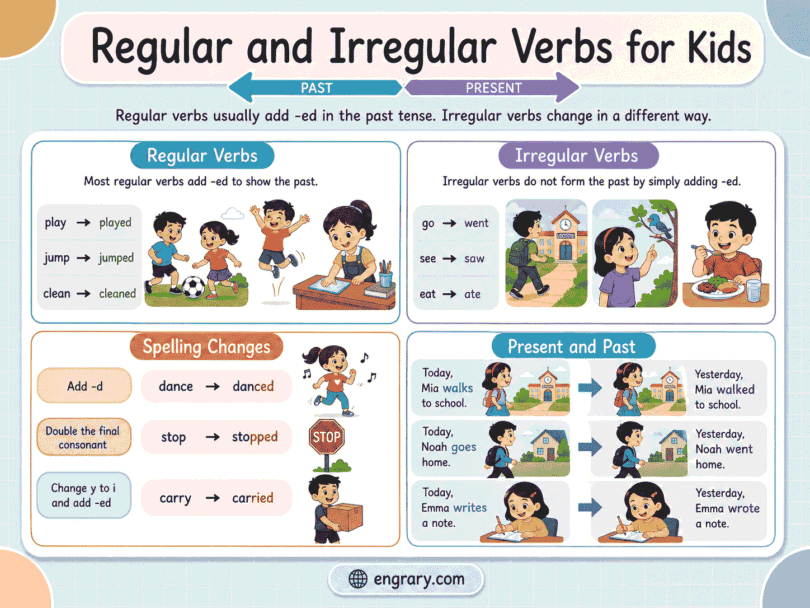
Regular and irregular verbs are important because they help children talk and write about actions that happened in the past. Once children understand how these verbs change, they can avoid common mistakes such as goed, eated, and studyed and use past-tense verbs more naturally.
You’ll learn how regular and irregular verbs are different, how regular past forms are spelled, which irregular verbs children use most often, and how useful patterns can make them easier to remember. You’ll also practice forming, identifying, correcting, and using both verb types in sentences.
What Are Regular and Irregular Verbs?
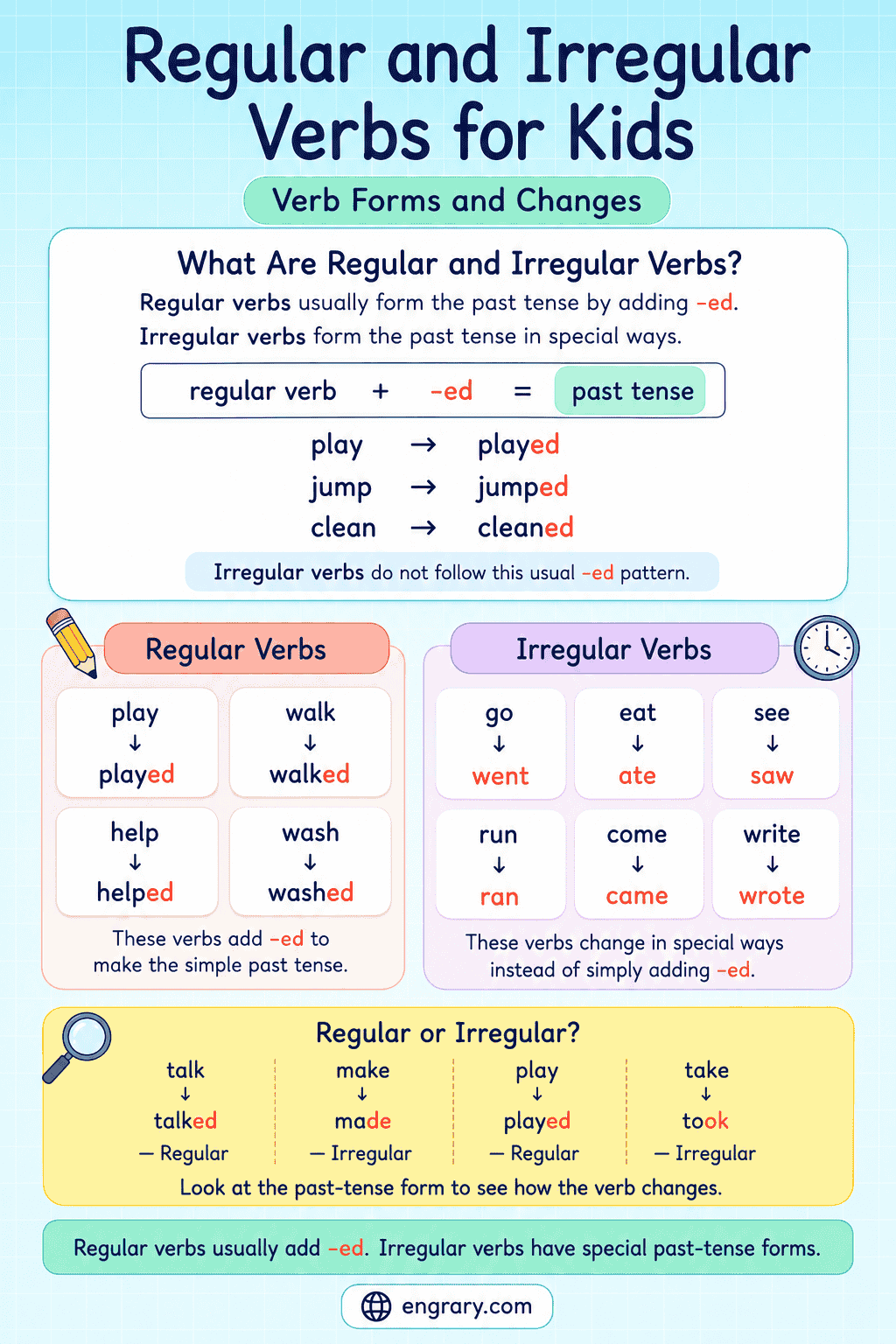
Regular and irregular verbs are two groups based on how they form their past tense.
A regular verb follows a common spelling pattern, usually by adding -ed or -d.
An irregular verb does not follow that normal pattern. Its past form may change in another way or sometimes stay exactly the same.
Compare:
- play → played
- walk → walked
- go → went
- eat → ate
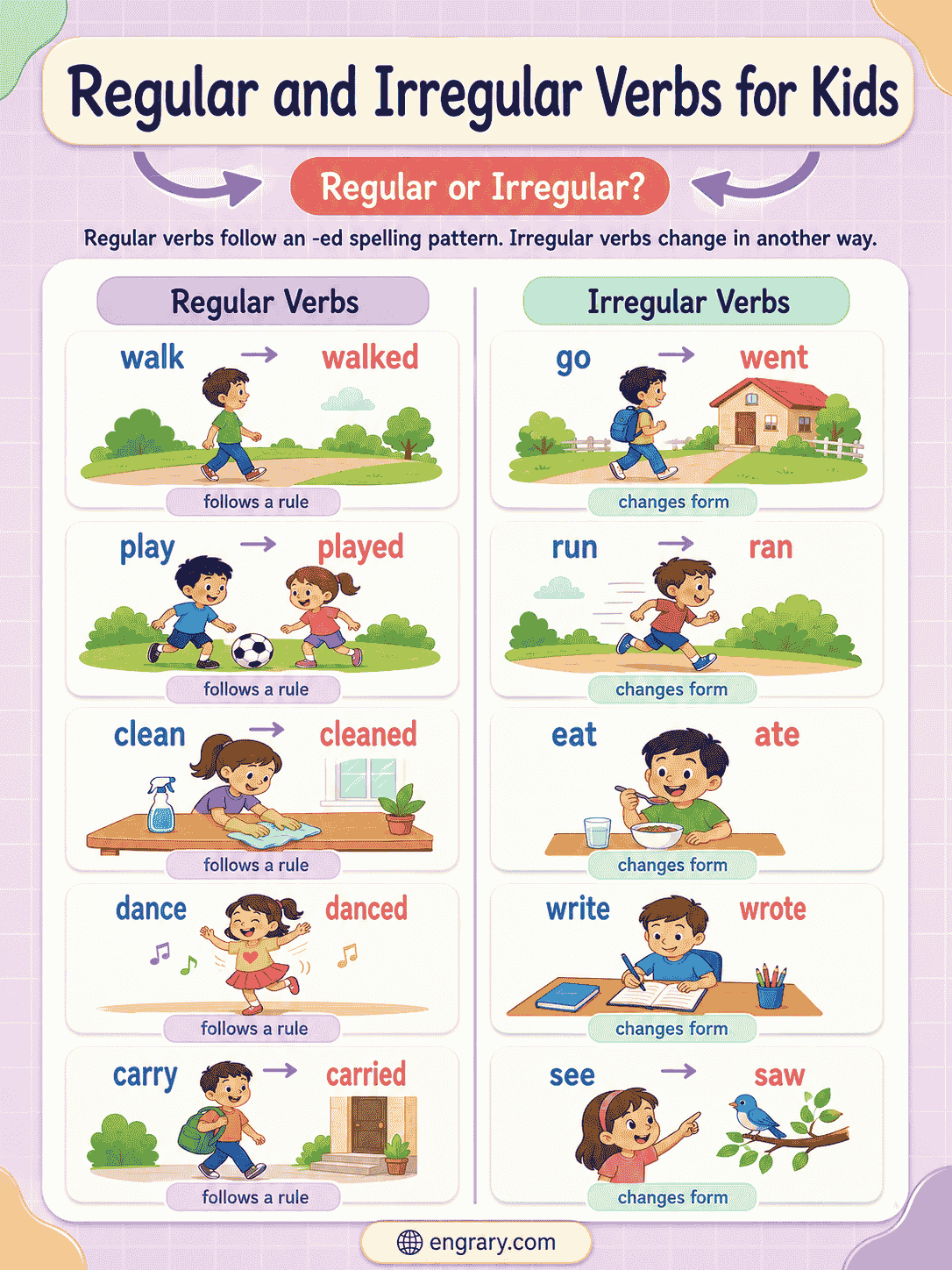
The verbs play and walk are regular because their past forms follow the normal -ed pattern. The verbs go and eat are irregular because their past forms change differently.
What Is a Regular Verb?
A regular verb forms its simple past by following the normal -ed or -d spelling pattern.
For example:
- help → helped
- jump → jumped
- clean → cleaned
- smile → smiled
Look at this sentence:
Mia played outside yesterday.
The base verb is play. Its past form is played, so play is a regular verb.
Regular verbs are easier to predict because they follow common spelling rules.
What Is an Irregular Verb?
An irregular verb does not form its past tense by simply following the normal -ed or -d pattern.
For example:
- go → went
- see → saw
- eat → ate
- run → ran
- buy → bought
Look at this sentence:
Noah went to the library yesterday.
The base verb is go, but its past form is went, not goed. Therefore, go is an irregular verb.
Some irregular verbs do not visibly change at all:
- cut → cut
- put → put
- hit → hit
So an irregular verb does not always have a completely different-looking past form.
Regular vs. Irregular Verbs
The main difference is how the past form is made.
| Feature | Regular Verbs | Irregular Verbs |
|---|---|---|
| Follow the normal -ed/-d pattern | Yes | No |
| Past form is predictable | Usually | Not always |
| Example | play → played | go → went |
| Can stay unchanged | Usually no | Sometimes: cut → cut |
| Need individual practice | Less often | Often |
A useful question is:
Does the past form follow the normal -ed or -d pattern?
If yes, the verb is regular.
If not, it is irregular.
Base Form and Past Form
The base form is the basic form of a verb.
Examples include:
- walk
- play
- eat
- go
The past form tells us that the action happened before now.
For example:
| Base Form | Past Form |
|---|---|
| walk | walked |
| play | played |
| eat | ate |
| go | went |
Compare:
I walk to school every day.
I walked to school yesterday.
Now compare:
We go to the park on Saturdays.
We went to the park yesterday.
Knowing the base form and past form helps children decide whether a verb is regular or irregular.
How Regular Verbs Form the Past Tense
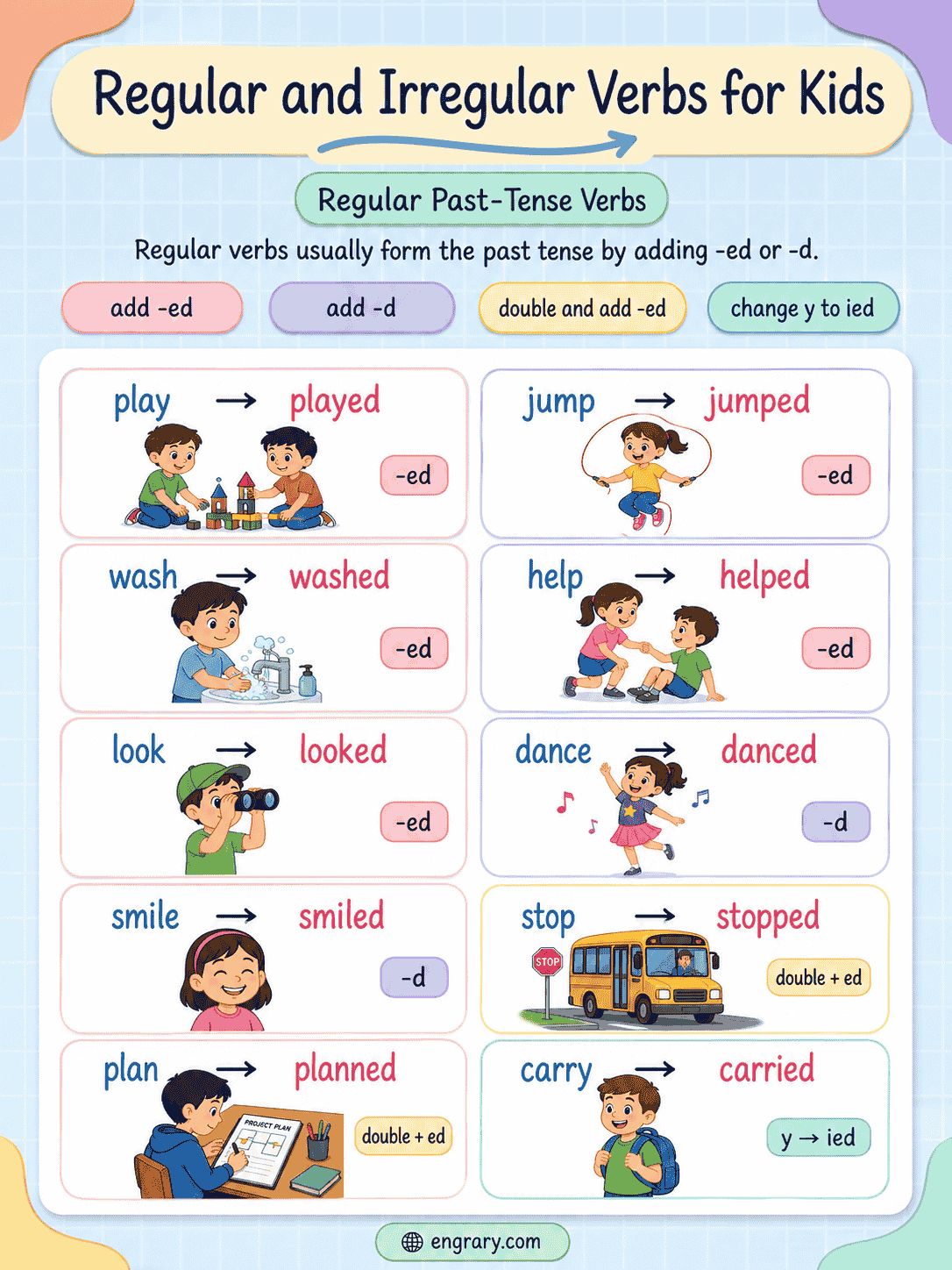
Regular verbs follow predictable spelling patterns when they change into the past tense.
Add -ed to Most Verbs
For many regular verbs, simply add -ed.
Examples include:
- walk → walked
- jump → jumped
- help → helped
- wash → washed
- call → called
In sentences:
Ava helped her teacher.
The children jumped over the puddle.
This is the most common regular past-tense pattern.
Add -d to Verbs Ending in e
If the base verb already ends in e, add only -d.
For example:
- smile → smiled
- live → lived
- dance → danced
- bake → baked
Incorrect:
smile → smileed
Correct:
smile → smiled
The final e is already present, so we do not add another one.
Change Consonant + y to -ied
When a verb ends in a consonant followed by y, change y to i and add -ed.
For example:
- study → studied
- carry → carried
- cry → cried
- hurry → hurried
Incorrect:
study → studyed
Correct:
study → studied
However, when a vowel comes before y, keep the y and simply add -ed.
For example:
- play → played
- enjoy → enjoyed
- stay → stayed
Compare:
- study → studied
- play → played
The letter before y helps determine the spelling.
Double the Final Consonant in Some Short Verbs
Some short regular verbs double the final consonant before adding -ed.
For example:
- stop → stopped
- plan → planned
- hop → hopped
- drop → dropped
Incorrect:
stop → stoped
Correct:
stop → stopped
Children do not need to learn every advanced doubling rule at once. For now, it is enough to recognize these common short-verb patterns.
How to Tell if a Verb Is Regular or Irregular
You can use a simple method.
- Find the base form.
- Think about its past form.
- Check whether the past form follows the normal -ed/-d pattern.
- If it does, the verb is regular.
- If it changes another way or stays unchanged, it is irregular.
For example:
play → played
The past form follows the regular pattern, so play is regular.
go → went
The past form does not follow the -ed pattern, so go is irregular.
cut → cut
The past form stays the same instead of becoming cutted, so cut is irregular.
This method works better than guessing from the base verb alone.
Regular and Irregular Verb Examples
A side-by-side comparison makes the difference easier to see.
| Base Verb | Past Form | Type |
|---|---|---|
| ask | asked | regular |
| clean | cleaned | regular |
| help | helped | regular |
| jump | jumped | regular |
| live | lived | regular |
| play | played | regular |
| study | studied | regular |
| stop | stopped | regular |
| go | went | irregular |
| eat | ate | irregular |
| run | ran | irregular |
| see | saw | irregular |
| buy | bought | irregular |
| take | took | irregular |
| cut | cut | irregular |
| write | wrote | irregular |
Common Regular Verbs
Children use many regular verbs every day.
Examples include ask → asked, call → called, clean → cleaned, help → helped, jump → jumped, look → looked, open → opened, play → played, start → started, walk → walked, wash → washed, and work → worked.
These verbs follow one of the regular past-tense spelling patterns.
Common Irregular Verbs Kids Should Know
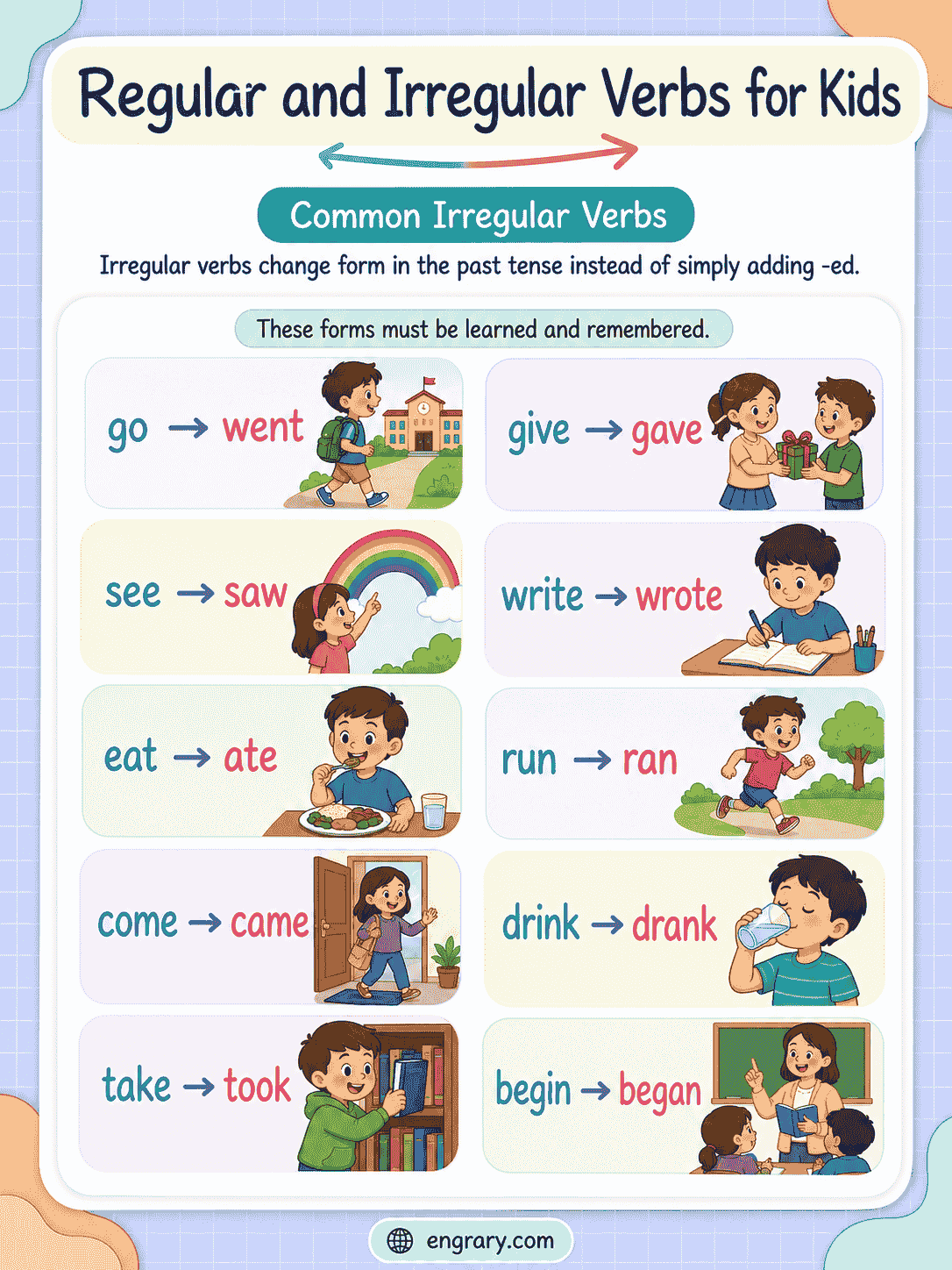
Some irregular verbs appear very often in everyday English.
| Base Verb | Past Form |
|---|---|
| be | was/were |
| begin | began |
| bring | brought |
| buy | bought |
| come | came |
| do | did |
| drink | drank |
| eat | ate |
| find | found |
| get | got |
| give | gave |
| go | went |
| have | had |
| make | made |
| read | read |
| run | ran |
| say | said |
| see | saw |
| sing | sang |
| sit | sat |
| sleep | slept |
| take | took |
| teach | taught |
| think | thought |
| write | wrote |
Children do not need to memorize every irregular verb at once. Learning a few common forms at a time is usually more manageable.
Useful Irregular Verb Patterns
Irregular verbs do not follow one single rule, but some share useful patterns.
Recognizing these groups can make them easier to remember.
Irregular Verbs That Stay the Same
Some irregular verbs have the same base and past forms.
Examples:
- cut → cut
- hit → hit
- hurt → hurt
- put → put
For example:
Yesterday, Mia cut the paper.
The past form is still cut, not cutted.
This pattern shows that an irregular verb does not always need to look different in the past.
Irregular Verbs With Vowel Changes
Some irregular verbs change a vowel.
For example:
- begin → began
- drink → drank
- sing → sang
- sit → sat
- swim → swam
In sentences:
The children sang a song.
Noah drank some water.
These forms share a general vowel-change pattern, but children should still learn each verb individually.
Irregular Verbs With Other Changes
Some irregular verbs change in other ways.
Examples include:
- buy → bought
- bring → brought
- teach → taught
- think → thought
- catch → caught
- sleep → slept
- keep → kept
These patterns can help with memory, but there is no single spelling rule that works for every irregular verb.
Irregular Verbs With the Same Past and Past Participle
Many irregular verbs have one form for the past and the same form for the past participle.
For example:
- buy → bought → bought
- bring → brought → brought
- find → found → found
- make → made → made
- teach → taught → taught
This can make these verbs easier to learn because only one new form must be remembered after the base form.
Base, Past, and Past Participle Forms
English verbs can have several forms. Three useful forms are the base form, past form, and past participle.
| Base | Past | Past Participle |
|---|---|---|
| play | played | played |
| walk | walked | walked |
| buy | bought | bought |
| eat | ate | eaten |
| go | went | gone |
| sing | sang | sung |
| write | wrote | written |
The base form is the basic verb.
The past form commonly describes a finished action in the past.
The past participle often appears with helping verbs such as has, have, or had.
Compare:
Noah ate lunch.
Noah has eaten lunch.
The first sentence uses the past form ate. The second uses the past participle eaten with has.
Irregular Verbs With Three Different Forms
Some irregular verbs have three different forms.
For example:
- go → went → gone
- eat → ate → eaten
- sing → sang → sung
- write → wrote → written
- take → took → taken
These forms need practice because the past and past participle are not always the same.
Detailed perfect-tense rules belong in a separate lesson. Here, children only need to recognize that the third form exists and may differ from the simple past.
Using Regular and Irregular Verbs to Talk About the Past
Both regular and irregular verbs help us describe actions that already happened.
Regular verbs in sentences:
Ava played outside yesterday.
Noah helped his teacher.
We walked to the library.
Irregular verbs in sentences:
Ava went home.
Noah ate lunch.
We saw a rabbit.
A sentence can contain both types:
Mia walked to the park and saw her friend.
Here:
- walked — regular;
- saw — irregular.
Another example:
Noah opened the door and went inside.
The verb opened is regular, while went is irregular.
Using verbs in complete sentences helps children remember their forms more effectively than studying isolated lists alone.
Tips for Learning Irregular Verbs
Irregular verbs take practice because their past forms cannot always be predicted from one spelling rule.
A few simple strategies can help.
Learn common verbs first.
Start with everyday verbs such as go, come, eat, see, take, give, make, and write.
Learn verbs in small groups.
A short group such as sing → sang, drink → drank, begin → began is easier to review than a huge list.
Notice useful patterns.
Group verbs that stay the same or have similar changes.
Use each verb in a sentence.
Instead of memorizing only go → went, write: We went to the park yesterday.
Review regularly.
Short, repeated practice usually works better than trying to memorize many verbs at once.
Common Regular and Irregular Verb Mistakes
Children often make mistakes by applying the regular -ed rule to every verb or by forgetting regular spelling changes.
| Incorrect | Correct | Why? |
|---|---|---|
| goed | went | go is irregular |
| eated | ate | eat is irregular |
| runned | ran | run is irregular |
| buyed | bought | buy is irregular |
| teached | taught | teach is irregular |
| smileed | smiled | add only -d after final e |
| studyed | studied | consonant + y changes to -ied |
| stoped | stopped | the final consonant doubles |
Another common error involves past participles.
Incorrect:
She has went home.
Correct:
She has gone home.
The verb go has three different forms:
go → went → gone
Children should first master the simple past before spending too much time on past participles.
Regular and Irregular Verbs Practice for Kids
Complete each activity before checking the answer key.
Regular or Irregular?
Write regular or irregular.
- play → played
- go → went
- walk → walked
- eat → ate
- smile → smiled
- cut → cut
- study → studied
- see → saw
- stop → stopped
- buy → bought
Form the Past of Regular Verbs
Write the correct past form.
- help
- smile
- study
- stop
- play
- carry
- wash
- plan
Choose the Correct Irregular Past Form
Choose the correct answer.
- go → (goed / went)
- eat → (eated / ate)
- run → (runned / ran)
- buy → (buyed / bought)
- see → (seed / saw)
- teach → (teached / taught)
- drink → (drinked / drank)
- take → (taked / took)
Complete the Verb Table
Fill in the missing information.
| Base Verb | Past Form | Type |
|---|---|---|
| walk | ______ | regular |
| go | ______ | irregular |
| study | ______ | regular |
| eat | ______ | irregular |
| cut | ______ | irregular |
| smile | ______ | regular |
| buy | ______ | irregular |
| stop | ______ | regular |
Complete the Sentences
Choose the correct past form.
- Yesterday, Mia (walk / walked) to school.
- Noah (go / went) to the library yesterday.
- Ava (help / helped) her teacher.
- We (see / saw) a rabbit in the yard.
- The children (play / played) outside after lunch.
- Ben (eat / ate) an apple.
- Mia (study / studied) for the test.
- Dad (buy / bought) some bread.
Find Regular and Irregular Verbs in Sentences
Identify each bold past-tense verb as regular or irregular.
- Mia walked home.
- Noah went inside.
- Ava opened the window.
- We saw a bird.
- The children played outside.
- Ben ate lunch.
Correct the Mistakes
Rewrite each verb correctly.
- Yesterday, Noah goed home.
- Mia studyed for the test.
- Ava buyed a new notebook.
- The dog stoped near the gate.
- Ben eated his lunch.
- We teached the game to our friends.
Base, Past, or Past Participle?
Choose the correct form.
- Noah has (ate / eaten) lunch.
- Mia has (went / gone) home.
- We have (saw / seen) that movie.
- Ava has (wrote / written) a story.
- The children have (sang / sung) the song.
Write Sentences With Regular and Irregular Verbs
Write:
- one sentence with a regular past-tense verb;
- one sentence with an irregular past-tense verb;
- one sentence containing both a regular and an irregular verb;
- one sentence using went;
- one sentence using played;
- one sentence using a past participle with has or have.

Answer Key
Regular or Irregular?
- play → played — regular
- go → went — irregular
- walk → walked — regular
- eat → ate — irregular
- smile → smiled — regular
- cut → cut — irregular
- study → studied — regular
- see → saw — irregular
- stop → stopped — regular
- buy → bought — irregular
Form the Past of Regular Verbs
- help → helped
- smile → smiled
- study → studied
- stop → stopped
- play → played
- carry → carried
- wash → washed
- plan → planned
Choose the Correct Irregular Past Form
- went
- ate
- ran
- bought
- saw
- taught
- drank
- took
Complete the Verb Table
| Base Verb | Past Form | Type |
|---|---|---|
| walk | walked | regular |
| go | went | irregular |
| study | studied | regular |
| eat | ate | irregular |
| cut | cut | irregular |
| smile | smiled | regular |
| buy | bought | irregular |
| stop | stopped | regular |
Complete the Sentences
- walked
- went
- helped
- saw
- played
- ate
- studied
- bought
Find Regular and Irregular Verbs in Sentences
- walked — regular
- went — irregular
- opened — regular
- saw — irregular
- played — regular
- ate — irregular
Correct the Mistakes
- Yesterday, Noah went home.
- Mia studied for the test.
- Ava bought a new notebook.
- The dog stopped near the gate.
- Ben ate his lunch.
- We taught the game to our friends.
Base, Past, or Past Participle?
- eaten
- gone
- seen
- written
- sung
Write Sentences With Regular and Irregular Verbs
Answers will vary. Possible answers include:
- Mia walked to school.
- Noah went to the library.
- Ava played outside and saw a bird.
- We went to the park yesterday.
- The children played soccer after school.
- Noah has eaten his lunch.
FAQs
Regular verbs form their past tense using the normal -ed or -d pattern, such as walk → walked. Irregular verbs form the past differently, such as go → went.
Look at the past form. If it follows the normal -ed/-d spelling pattern, it is regular. If it changes another way or stays unchanged, it is irregular.
No. Some irregular verbs stay the same. For example, cut → cut, put → put, and hit → hit.
Go is an irregular verb, so it does not follow the normal -ed rule. Its correct past form is went.
A past participle is a verb form often used with helping verbs such as has, have, or had. For example, eat → ate → eaten, and we say has eaten.
You May Also Like
- Verbs for Kids
- Helping Verbs for Kids
- Linking Verbs for Kids
- Subject-Verb Agreement
- Common Irregular Verbs