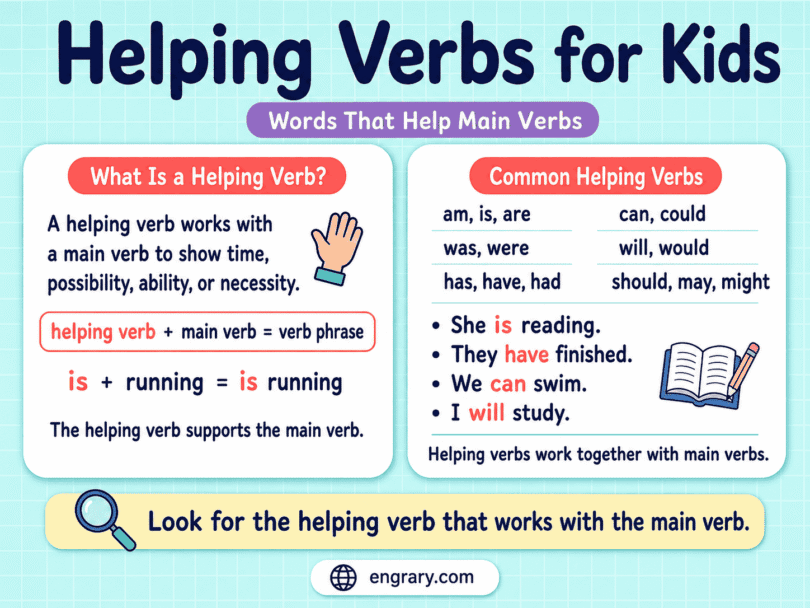
Helping verbs are an important part of English grammar because they work with main verbs to add useful information. They can help show when something happens, form questions and negative sentences, and express ideas such as ability, possibility, or necessity.
You’ll learn what helping verbs are, how they work with main verbs, how to find them in verb phrases, and how words such as is, have, do, can, and will are used. You’ll also practice identifying and using helping verbs correctly in sentences.
What Is a Helping Verb?
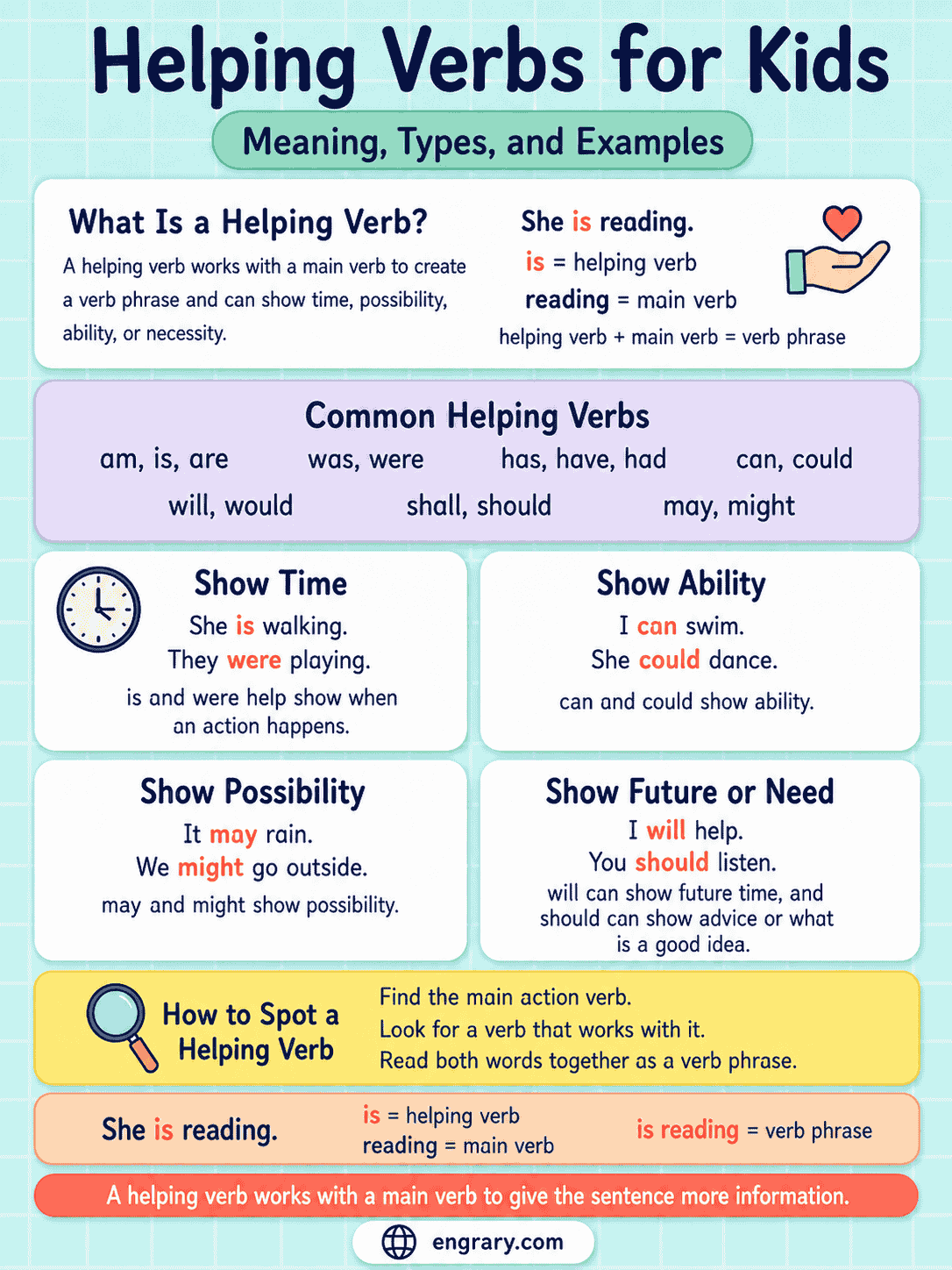
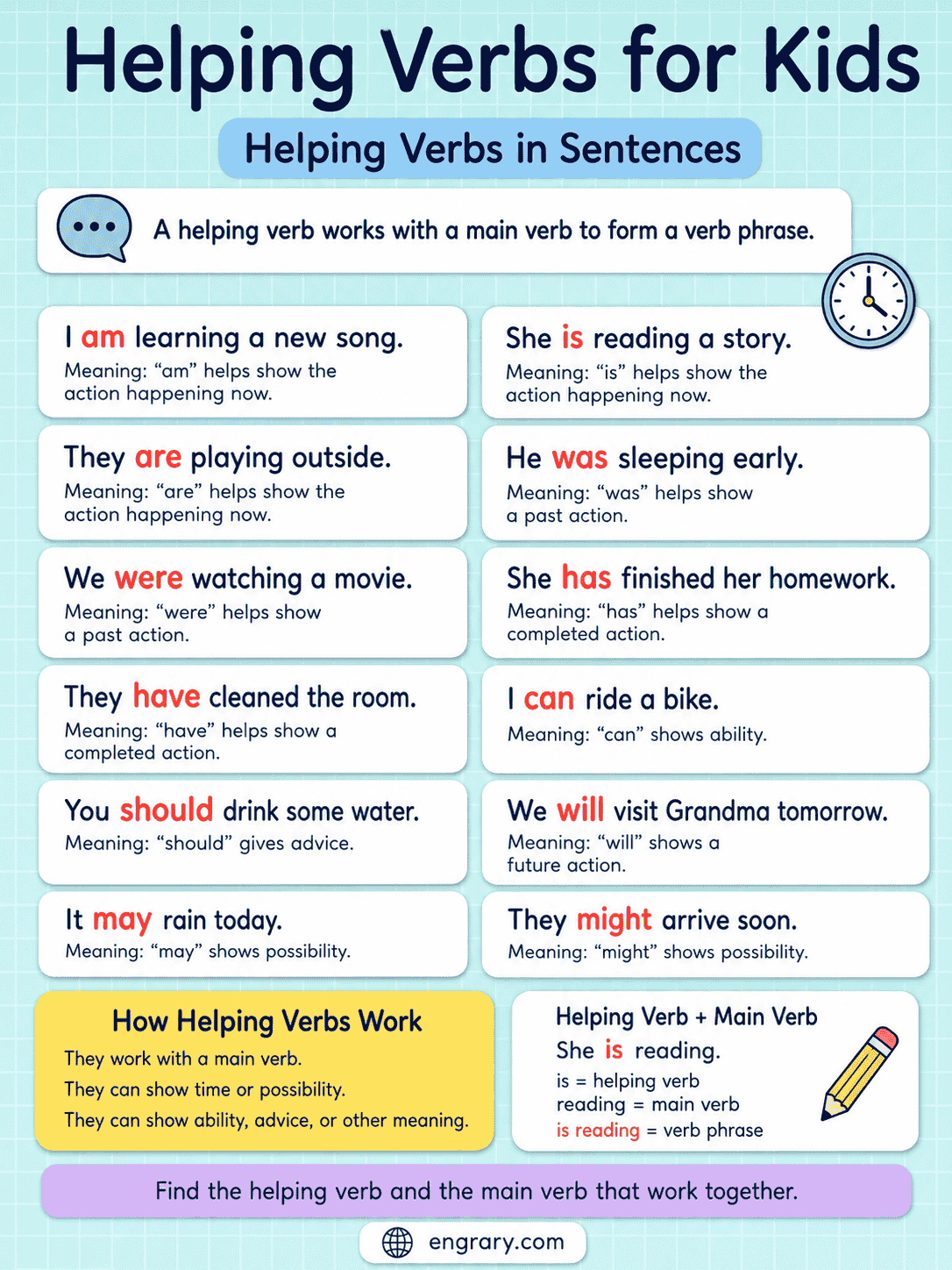
A helping verb is a verb that works with a main verb. Together, they form a verb phrase.
Helping verbs are also called auxiliary verbs.
Look at this sentence:
Mia is reading a book.
The main action is reading. The word is helps the main verb.
- helping verb — is
- main verb — reading
- verb phrase — is reading
The helping verb adds information to the main verb instead of carrying the main meaning by itself.
Helping Verbs and Main Verbs
A main verb carries the central meaning of the verb phrase. It tells what someone or something does, feels, experiences, or is doing.
A helping verb supports that main verb.
Consider:
Noah has finished his homework.
The main verb is finished because it tells the main action. The word has helps form the complete verb phrase has finished.
Another example is:
The children are playing outside.
Here:
- are — helping verb
- playing — main verb
- are playing — verb phrase
Finding the main verb first often makes the helping verb easier to identify.
What Is a Verb Phrase?
A verb phrase is a main verb together with one or more helping verbs.
Examples include:
- is running
- was sleeping
- has finished
- will arrive
- can swim
- has been reading
The complete verb phrase works together in the sentence.
For example:
Ava will visit her grandmother tomorrow.
The word will is the helping verb, while visit is the main verb. Together, will visit forms the verb phrase.
Helping Verb Examples
The table below shows how helping verbs and main verbs work together.
| Sentence | Helping Verb | Main Verb | Verb Phrase |
|---|---|---|---|
| Mia is reading. | is | reading | is reading |
| Noah has finished. | has | finished | has finished |
| They will play. | will | play | will play |
| Ava can swim. | can | swim | can swim |
| We were waiting. | were | waiting | were waiting |
| Ben did finish. | did | finish | did finish |
Notice that the helping verb usually appears before the main verb.
However, you should look at the complete sentence because the same word can sometimes have a different job.
How to Find Helping Verbs in a Sentence
A simple step-by-step method can help you find helping verbs.
First, find the main action or state expressed by the main verb.
Consider:
Lily has completed her drawing.
The main action is completed.
Next, look immediately before the main verb for another verb that helps it.
The word has comes before completed and works with it.
So:
- main verb — completed
- helping verb — has
- verb phrase — has completed
Now consider:
The dog is barking loudly.
The main action is barking, while is helps form the verb phrase is barking.
A useful method is:
- Find the main verb.
- Look before it for a helping verb.
- Check whether the two verbs work together.
- Read the complete verb phrase.
Sometimes a verb phrase contains more than one helping verb, so do not stop after finding the first one.
Primary Helping Verbs
Three important groups of helping verbs come from be, have, and do.
They are often called primary helping verbs.
Using Forms of Be as Helping Verbs
Forms of be include:
- am
- is
- are
- was
- were
- be
- being
- been
These words can act as helping verbs when they work with another verb.
For example:
I am reading.
Mia is writing.
The children are playing.
Noah was sleeping.
We were waiting.
In each sentence, the form of be helps another verb.
However, forms of be are not always helping verbs. Sometimes they act as linking verbs. You will see that difference later.
Using Have, Has, and Had as Helping Verbs
The forms have, has, and had can work as helping verbs.
For example:
I have finished my work.
Mia has completed the puzzle.
They had left before noon.
In these sentences:
- have helps finished;
- has helps completed;
- had helps left.
Together, each pair forms a verb phrase.
Remember that have, has, and had are not always helping verbs. They can also be main verbs depending on the sentence.
Using Do, Does, and Did as Helping Verbs
The verbs do, does, and did can help form questions, negative sentences, or emphatic statements.
For example:
Do you like apples?
Does Mia play soccer?
Did Noah finish his work?
They can also appear in negative sentences:
I do not understand.
Ava does not like carrots.
We did not leave early.
Here, do, does, and did help the main verbs.
Like have, these words can also act as main verbs in other sentences.
Modal Helping Verbs
Modal helping verbs add meanings such as ability, possibility, permission, advice, necessity, or future intention.
Common Modal Helping Verbs
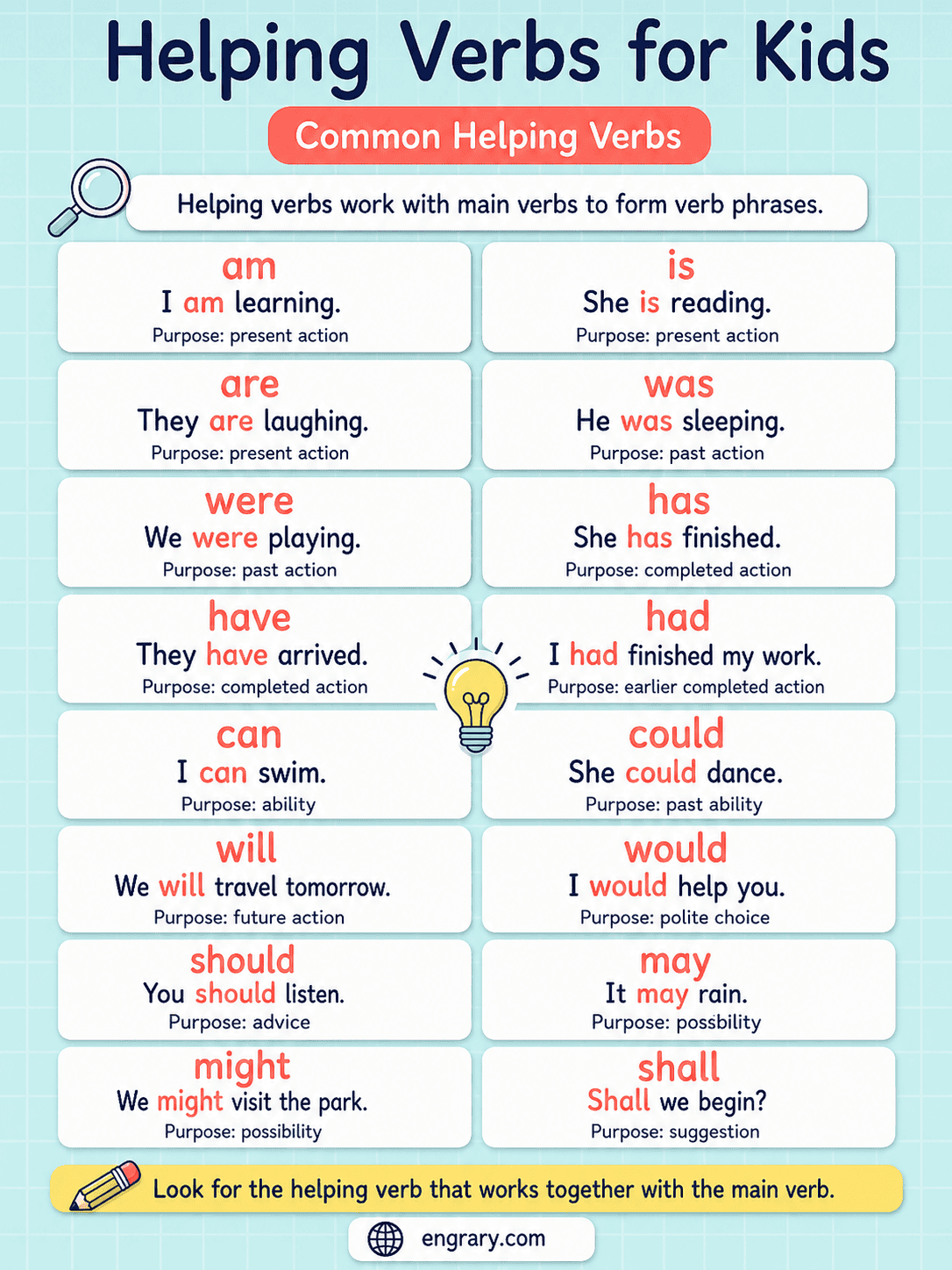
Common modal helping verbs include:
- can
- could
- may
- might
- must
- should
- will
- would
The modal comes before the main verb.
For example:
Ava can swim.
It might rain.
You should study.
We will leave soon.
The main verb after a modal usually stays in its base form.
Correct:
She can swim.
Incorrect:
She can swims.
What Modal Helping Verbs Mean
Different modals can add different meanings.
| Modal | Common Meaning | Example |
|---|---|---|
| can | ability | Mia can skate. |
| could | ability or possibility | Noah could help. |
| may | permission or possibility | You may enter. |
| might | possibility | It might rain. |
| must | necessity | We must leave. |
| should | advice | You should rest. |
| will | future intention | Ava will call. |
| would | possible or polite meaning | I would help. |
These meanings can change slightly according to context, so children do not need to memorize every possible use at once.
How Helping Verbs Work in Sentences
Helping verbs can add important grammatical information to a main verb.
Helping Verbs and Verb Tenses
Helping verbs often help form verb tenses and show when an action happens or how it continues.
Compare:
Mia is reading.
Mia was reading.
The main verb reading stays the same, but is and was help show different times.
Now compare:
Noah has finished his work.
Noah had finished his work.
The helping verbs help show the relationship between the completed action and time.
Another example is:
Ava will visit tomorrow.
The helping verb will helps express future meaning.
You do not need to learn every English tense to understand helping verbs. The important idea is that helping verbs often work with main verbs to build different verb forms.
Helping Verbs in Questions and Negative Sentences
Helping verbs often appear in questions.
For example:
Do you read every night?
Does Mia walk to school?
Did Noah call?
They also appear in negative sentences:
I do not know.
She does not agree.
They did not finish.
Forms of be and other helping verbs can also form questions and negatives.
For example:
Is Ava reading?
Ava is not reading.
Can Noah swim?
Noah cannot swim yet.
These patterns show why helping verbs are useful in everyday English.
More Than One Helping Verb in a Verb Phrase
Some verb phrases contain more than one helping verb.
Consider:
Mia has been reading.
The complete verb phrase is has been reading.
- has — helping verb
- been — helping verb
- reading — main verb
Another example is:
We will be leaving soon.
Here:
- will — helping verb
- be — helping verb
- leaving — main verb
A modal can also appear with another helping verb:
They might have finished.
In this sentence:
- might — helping verb
- have — helping verb
- finished — main verb
Therefore, do not assume that every verb phrase contains only one helping verb.
Helping Verb or Main Verb? Check the Sentence
Some words can act as helping verbs in one sentence and main verbs in another.
The complete sentence tells you their job.
Consider has:
Ava has finished her drawing.
Here, has helps the main verb finished.
Now compare:
Ava has a new backpack.
Here, has is the main verb because it carries the main meaning.
The same thing happens with do.
Do you play soccer?
Here, do is a helping verb.
But:
I do my homework after dinner.
Here, do is the main verb.
Another pair is:
Noah did finish the race.
Here, did helps finish.
Noah did his chores.
Here, did is the main verb.
Always look for another verb that the word is helping before you classify it.
Helping Verb or Linking Verb?
Forms of be can work as helping verbs or linking verbs.
Compare:
Noah is running.
Here, is helps the main verb running, so is is a helping verb.
Now look at:
Noah is tired.
There is no second verb after is. Instead, is connects Noah with the describing word tired.
Therefore, is is a linking verb.
Another pair is:
The dogs are barking.
Are helps barking, so it is a helping verb.
The dogs are noisy.
Are connects dogs with noisy, so it is a linking verb.
A quick check can help:
- form of be + another verb → often a helping verb;
- form of be + a describing or naming word → often a linking verb.
This distinction is useful, but detailed linking-verb rules belong in a separate lesson.
Common Helping Verb Mistakes
Children often make mistakes when they identify only part of the verb phrase or assume that certain words always have the same job.
Missing the Main Verb
Incorrect idea:
In is running, only is is the verb.
Better explanation:
Is is the helping verb, while running is the main verb.
Together, they form is running.
Missing a Second Helping Verb
Consider:
She has been reading.
Both has and been are helping verbs. The main verb is reading.
Do not stop after finding the first helper.
Calling Every Form of Be a Helping Verb
Incorrect idea:
Is is always a helping verb.
Compare:
Mia is reading.
is = helping verb
Mia is happy.
is = linking verb
The sentence determines the job.
Calling Have or Do a Helping Verb Every Time
Compare:
Ava has finished.
has = helping verb
Ava has a dog.
has = main verb
Likewise:
Do you play?
do = helping verb
I do my chores.
do = main verb
Treating a Modal as the Main Verb
Consider:
Noah can swim.
The modal can is the helping verb. The main verb is swim.
Incorrect:
Noah can swims.
Correct:
Noah can swim.
The main verb normally stays in its base form after a modal.
Helping Verbs Practice for Kids
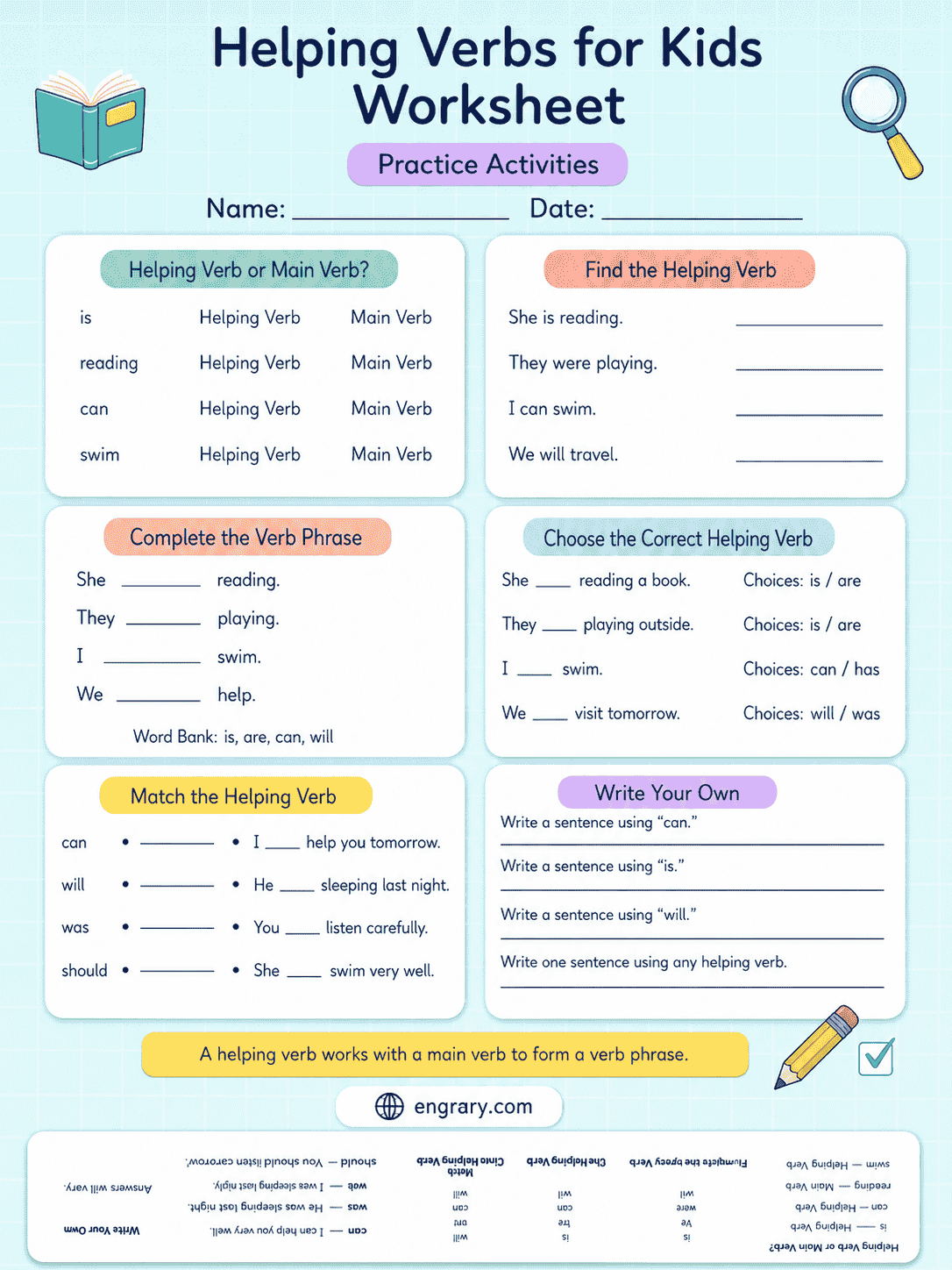
Complete each activity before checking the answer key.
Find the Helping and Main Verbs
Identify the helping verb and main verb in each sentence.
- Mia is reading a story.
- Noah has finished his homework.
- The children are playing outside.
- Ava will visit her aunt.
- Ben can swim across the pool.
- We were waiting for the bus.
Find the Complete Verb Phrase
Write the complete verb phrase. Then identify all helping verbs and the main verb.
- Lily has completed the puzzle.
- The dogs are barking loudly.
- Mia has been reading quietly.
- We will be leaving soon.
- They might have finished already.
- Noah was practicing after school.
Choose the Correct Helping Verb
Choose the correct word.
- Mia (is / are) reading a book.
- The boys (is / are) playing outside.
- Ava (has / have) finished her drawing.
- They (has / have) completed the project.
- (Do / Does) Noah like apples?
- (Do / Does) the students need pencils?
- We (did / does) not finish yesterday.
- Mia (can / cans) swim well.
Helping, Main, or Linking Verb?
Identify the bold verb as helping, main, or linking.
- Mia is reading.
- Mia is tired.
- Noah has finished his work.
- Noah has a bicycle.
- Do you play soccer?
- I do my chores after school.
- The dogs are barking.
- The dogs are noisy.
Correct the Mistakes
Rewrite each sentence correctly.
- Ava can swims quickly.
- The boys is playing outside.
- Mia have finished her homework.
- Does Noah likes soccer?
- They has been waiting.
- She do not understand the question.
Write Sentences With Helping Verbs
Write:
- one sentence with is or are as a helping verb;
- one sentence with has or have as a helping verb;
- one sentence with can;
- one sentence with will;
- one sentence containing two helping verbs;
- one question using do, does, or did.
Answer Key
Find the Helping and Main Verbs
- helping verb — is; main verb — reading
- helping verb — has; main verb — finished
- helping verb — are; main verb — playing
- helping verb — will; main verb — visit
- helping verb — can; main verb — swim
- helping verb — were; main verb — waiting
Find the Complete Verb Phrase
- has completed
helping verb — has
main verb — completed - are barking
helping verb — are
main verb — barking - has been reading
helping verbs — has, been
main verb — reading - will be leaving
helping verbs — will, be
main verb — leaving - might have finished
helping verbs — might, have
main verb — finished - was practicing
helping verb — was
main verb — practicing
Choose the Correct Helping Verb
- is
- are
- has
- have
- Does
- Do
- did
- can
Helping, Main, or Linking Verb?
- is — helping
- is — linking
- has — helping
- has — main
- do — helping
- do — main
- are — helping
- are — linking
Correct the Mistakes
- Ava can swim quickly.
- The boys are playing outside.
- Mia has finished her homework.
- Does Noah like soccer?
- They have been waiting.
- She does not understand the question.
Write Sentences With Helping Verbs
Answers will vary. Possible answers include:
- Mia is reading a book.
- Noah has finished his homework.
- Ava can swim well.
- We will visit the library tomorrow.
- They have been waiting outside.
- Do you like apples?
FAQs
A helping verb works with a main verb to form a verb phrase and add information. In Mia is reading, is is the helping verb and reading is the main verb.
Common helping verbs include forms of be, have, and do, such as is, are, was, have, has, do, does, and did. Modal helping verbs include can, could, may, might, must, should, will, and would.
Find the main verb first, then look directly before it for another verb that helps it. In Noah has finished, finished is the main verb and has is the helping verb.
Yes. In Mia has been reading, both has and been are helping verbs, while reading is the main verb.
A helping verb works with another verb, as in is running. A linking verb connects the subject to a describing or naming word, as in is tired.
You May Also Like