Subject-verb agreement is an important part of English grammar because it helps sentences sound correct and clear. When children learn how subjects and verbs work together, they can avoid common mistakes such as She walk or The dogs runs and write more natural English sentences.
You’ll learn what subject-verb agreement means, how to find the subject and verb, how singular and plural subjects affect verb forms, and how to handle pronouns, be, have, do, compound subjects, and tricky sentences. You’ll also practice choosing and correcting verbs in complete sentences.
What Is Subject-Verb Agreement?
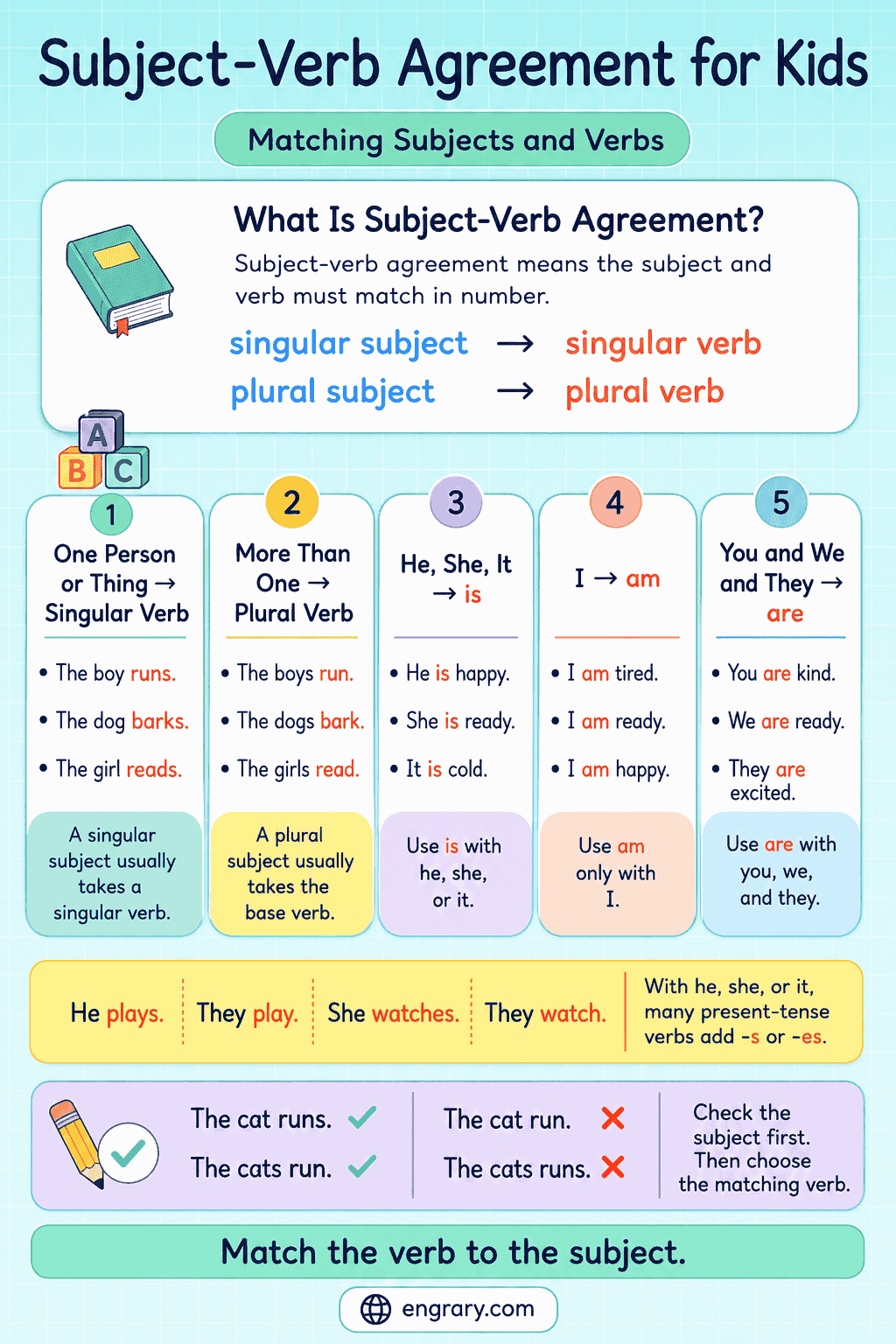
Subject-verb agreement means that the subject and verb in a sentence must match correctly.
The subject tells us who or what the sentence is mainly about. The verb tells us what the subject does, experiences, or is.
Look at these sentences:
The dog runs.
The dogs run.
In the first sentence, dog is singular, so we use runs.
In the second sentence, dogs is plural, so we use run.
This matching between the subject and verb is called subject-verb agreement.
What Is the Subject?
The subject tells who or what the sentence is mainly about.
For example:
Mia reads every night.
The sentence is mainly about Mia, so Mia is the subject.
Another example is:
The birds sing in the tree.
The sentence is mainly about the birds, so birds is the subject.
Subjects can be singular or plural.
A singular subject names one person, animal, place, thing, or idea:
- Ava;
- the dog;
- my teacher;
- the book.
A plural subject names more than one:
- Ava and Mia;
- the dogs;
- my teachers;
- the books.
Finding the subject first makes choosing the correct verb much easier.
What Is the Verb?
A verb tells what the subject does, experiences, or is.
For example:
The baby cries.
The verb cries tells what the baby does.
The children play outside.
The verb play tells what the children do.
Some verbs show a state instead of an action:
Noah is tired.
Here, is is the verb.
For subject-verb agreement, the important question is:
Which verb form matches the subject?
Singular and Plural Subject-Verb Agreement
The basic rule is simple:
A singular subject takes a singular verb.
A plural subject takes a plural verb.
Compare:
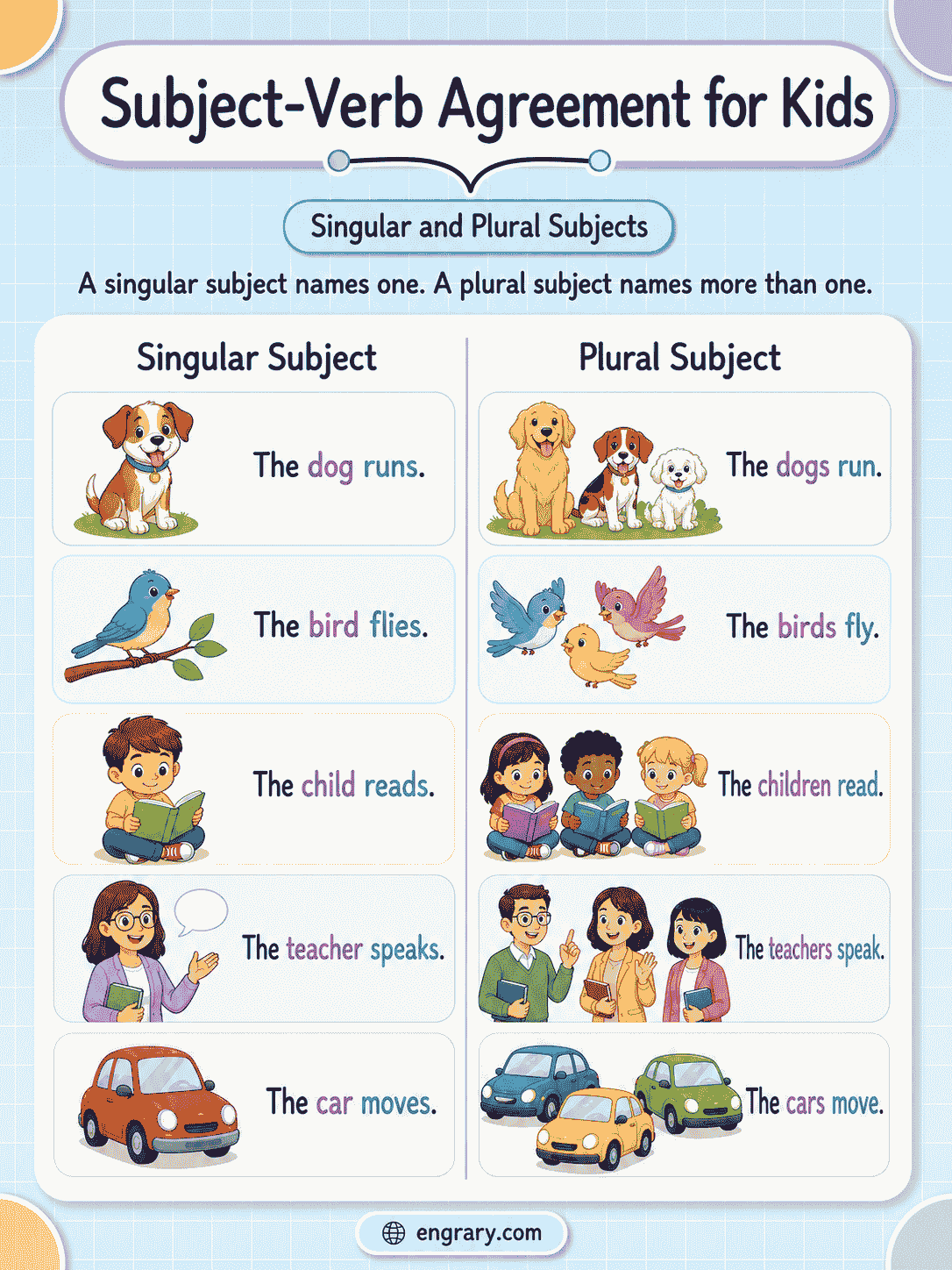
| Singular Subject | Plural Subject |
|---|---|
| The bird sings. | The birds sing. |
| The dog runs. | The dogs run. |
| Mia reads. | Mia and Ava read. |
| He plays. | They play. |
The subject and verb must match even when other words appear in the sentence.
For example:
The boy walks to school every morning.
The subject boy is singular, so walks agrees with it.
Now compare:
The boys walk to school every morning.
The subject boys is plural, so we use walk.
Agreement is easiest when you identify the subject before choosing the verb.
The -s Rule With Singular and Plural Subjects
One part of subject-verb agreement can feel confusing because nouns and verbs use -s differently.
Look at nouns:
- one dog;
- two dogs.
The plural noun usually gets -s.
Now look at verbs in the simple present:
- the dog runs;
- the dogs run.
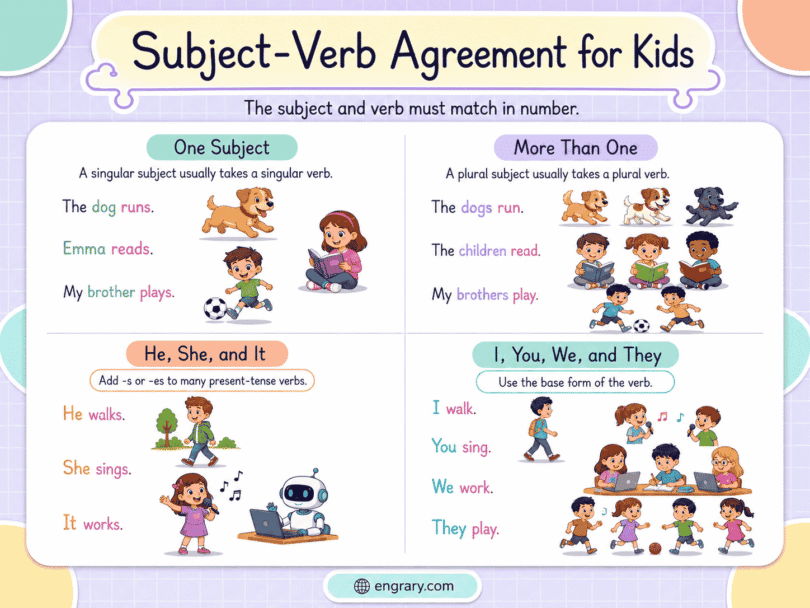
With many present-tense verbs, a singular subject such as he, she, it, Mia, the boy, or the dog takes a verb ending in -s.
For example:
- she walks;
- he reads;
- it works;
- Mia plays;
- the dog barks.
Plural subjects usually use the base form:
- they walk;
- the boys read;
- the machines work;
- Mia and Noah play;
- the dogs bark.
A useful comparison is:
Nouns
- one cat
- two cats
Verbs
- the cat jumps
- the cats jump
Remember that the noun and verb do not both take -s in the same way.
Subject Pronouns and Verb Agreement
Subject pronouns also need to agree with their verbs.
The main subject pronouns are:
- I;
- you;
- he;
- she;
- it;
- we;
- they.
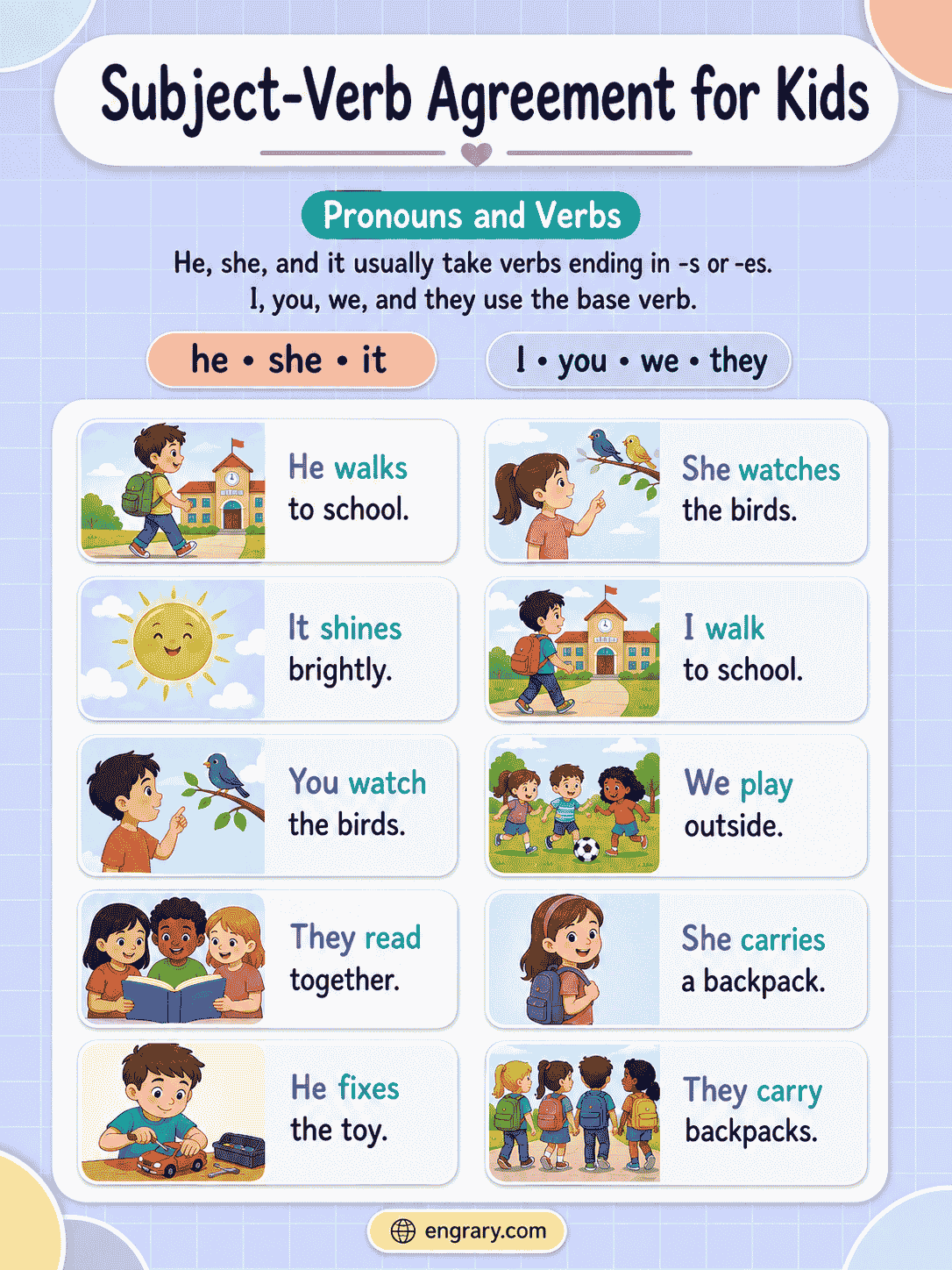
With many simple-present verbs, he, she, and it take the verb ending in -s.
| Subject Pronoun | Example |
|---|---|
| I | I play. |
| you | You play. |
| he | He plays. |
| she | She plays. |
| it | It works. |
| we | We play. |
| they | They play. |
Compare:
She reads every night.
They read every night.
Another example:
He walks to school.
We walk to school.
A useful memory pattern is:
he / she / it + verb-s
for many regular simple-present verbs.
However, some common verbs have special forms, so we need to learn those separately.
Agreement With Be, Have, and Do
The verbs be, have, and do do not follow the ordinary verb + s pattern in every form. Their common forms must match the subject correctly.
Forms of Be: Am, Is, Are, Was, and Were
In the present tense, use:
| Subject | Form of Be |
|---|---|
| I | am |
| he, she, it | is |
| you, we, they | are |
Examples:
- I am ready.
- Mia is happy.
- The dog is hungry.
- You are helpful.
- We are ready.
- The students are quiet.
In the past tense, the common pattern is:
| Subject | Form of Be |
|---|---|
| I, he, she, it | was |
| you, we, they | were |
Examples:
- I was tired.
- Noah was absent.
- The dog was sleepy.
- You were early.
- We were excited.
- The children were ready.
These forms should agree with the subject rather than with any nearby noun.
Has and Have
Use has with he, she, it, and most singular noun subjects.
For example:
- She has a pencil.
- Noah has a new book.
- The dog has a red collar.
Use have with I, you, we, they, and plural noun subjects.
For example:
- I have a pencil.
- You have a question.
- We have homework.
- They have new books.
- The students have notebooks.
Compare:
Mia has a backpack.
Mia and Ava have backpacks.
Do and Does
Use does with he, she, it, and most singular noun subjects.
For example:
- He does his chores.
- Mia does her homework.
- The machine does the job quickly.
Use do with I, you, we, they, and plural noun subjects.
For example:
- I do my homework.
- You do your best.
- We do our chores.
- They do their work.
These forms also appear in questions:
Does Mia play soccer?
Do the students need pencils?
The subject still determines which form we use.
Compound Subjects With And
A compound subject contains two or more subjects joined together.
When two subjects are joined by and, they usually take a plural verb.
For example:
Mia and Noah play soccer.
The subject contains two people, so we use the plural verb play.
Another example:
The dog and the cat are sleeping.
Because the subject contains both dog and cat, we use are.
More examples:
- Ava and Ben read together.
- The teacher and principal are talking.
- My brother and sister have new bikes.
- The pencil and notebook belong to Mia.
A simple rule can help:
subject + and + subject → usually plural verb
How to Find the True Subject
Sometimes another noun appears between the subject and the verb. That nearby noun can make agreement confusing.
Look at this sentence:
The box of crayons is heavy.
A child may notice the plural word crayons and choose are, but the true subject is box.
The phrase of crayons gives extra information about the box.
So:
- subject — box
- extra phrase — of crayons
- verb — is
The correct sentence is:
The box of crayons is heavy.
Now look at:
The students in our class are ready.
The subject is students, not class.
Therefore:
- subject — students;
- extra phrase — in our class;
- verb — are.
A useful strategy is:
- Find the verb.
- Ask who or what the sentence is mainly about.
- Identify the true subject.
- Ignore extra words between the subject and verb for a moment.
- Match the verb with the true subject.
More examples:
The basket of apples is full.
The subject is basket.
The dogs near the fence bark loudly.
The subject is dogs.
The teacher with the red folders is waiting.
The subject is teacher.
Always match the verb with the true subject, not simply with the nearest noun.
Tricky Subjects and Agreement
Some subjects can be confusing because their meaning may sound plural even though standard English treats them as singular.
Words Like Everyone, Someone, and Each
Words such as everyone, everybody, someone, somebody, and each normally take singular verbs.
For example:
Everyone is ready.
Everybody likes the game.
Someone has my pencil.
Somebody knows the answer.
Each student brings a notebook.
These words may refer to several people, but grammatically they are treated as singular in standard English.
Compare:
Incorrect:
Everyone are ready.
Correct:
Everyone is ready.
Another example:
Incorrect:
Each student have a pencil.
Correct:
Each student has a pencil.
Collective Nouns
A collective noun names a group, such as team, class, family, or group.
In American English, when the group acts as one unit, a collective noun usually takes a singular verb.
For example:
The team plays well.
The class is ready.
The family lives nearby.
The subject names several people, but the group is treated as one unit.
Detailed collective-noun agreement can become more complicated, so this article focuses only on the common American-English pattern.
Common Subject-Verb Agreement Mistakes
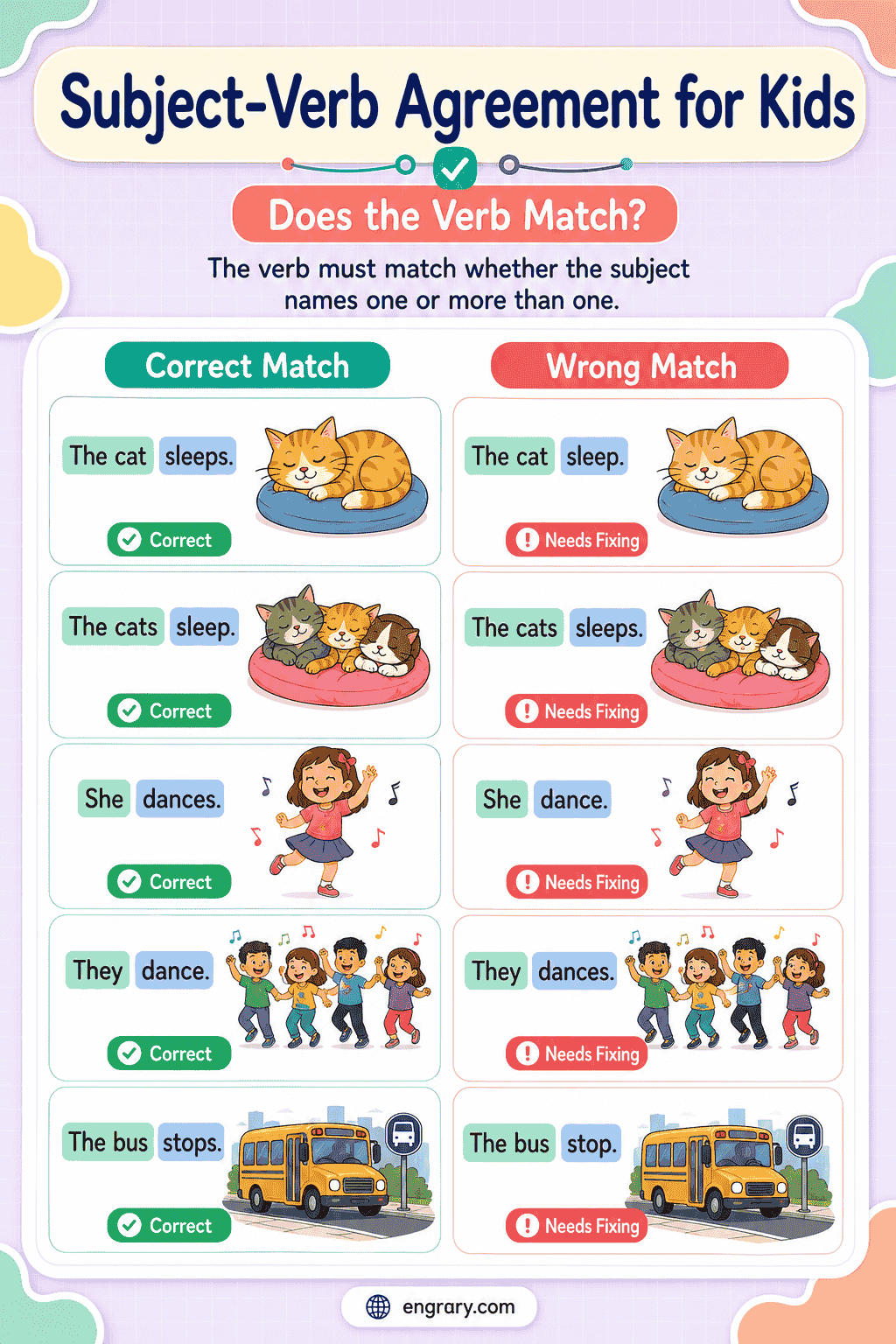
Agreement mistakes often happen when children choose a verb form that does not match the subject.
Adding -s With a Plural Subject
Incorrect:
The dogs runs outside.
Correct:
The dogs run outside.
The plural subject dogs takes run, not runs.
Forgetting -s With a Singular Subject
Incorrect:
Mia walk to school.
Correct:
Mia walks to school.
The singular subject Mia takes walks in the simple present.
Matching the Verb With a Nearby Noun
Incorrect:
The box of crayons are heavy.
Correct:
The box of crayons is heavy.
The true subject is box, not crayons.
Using the Wrong Form of Be
Incorrect:
The children is ready.
Correct:
The children are ready.
The subject children is plural.
Using Have Instead of Has
Incorrect:
Noah have a pencil.
Correct:
Noah has a pencil.
The singular subject Noah takes has.
Using Do Instead of Does
Incorrect:
Mia do her homework after school.
Correct:
Mia does her homework after school.
Treating Everyone or Each as Plural
Incorrect:
Everyone are excited.
Correct:
Everyone is excited.
Likewise:
Each student has a book.
Subject-Verb Agreement Practice for Kids
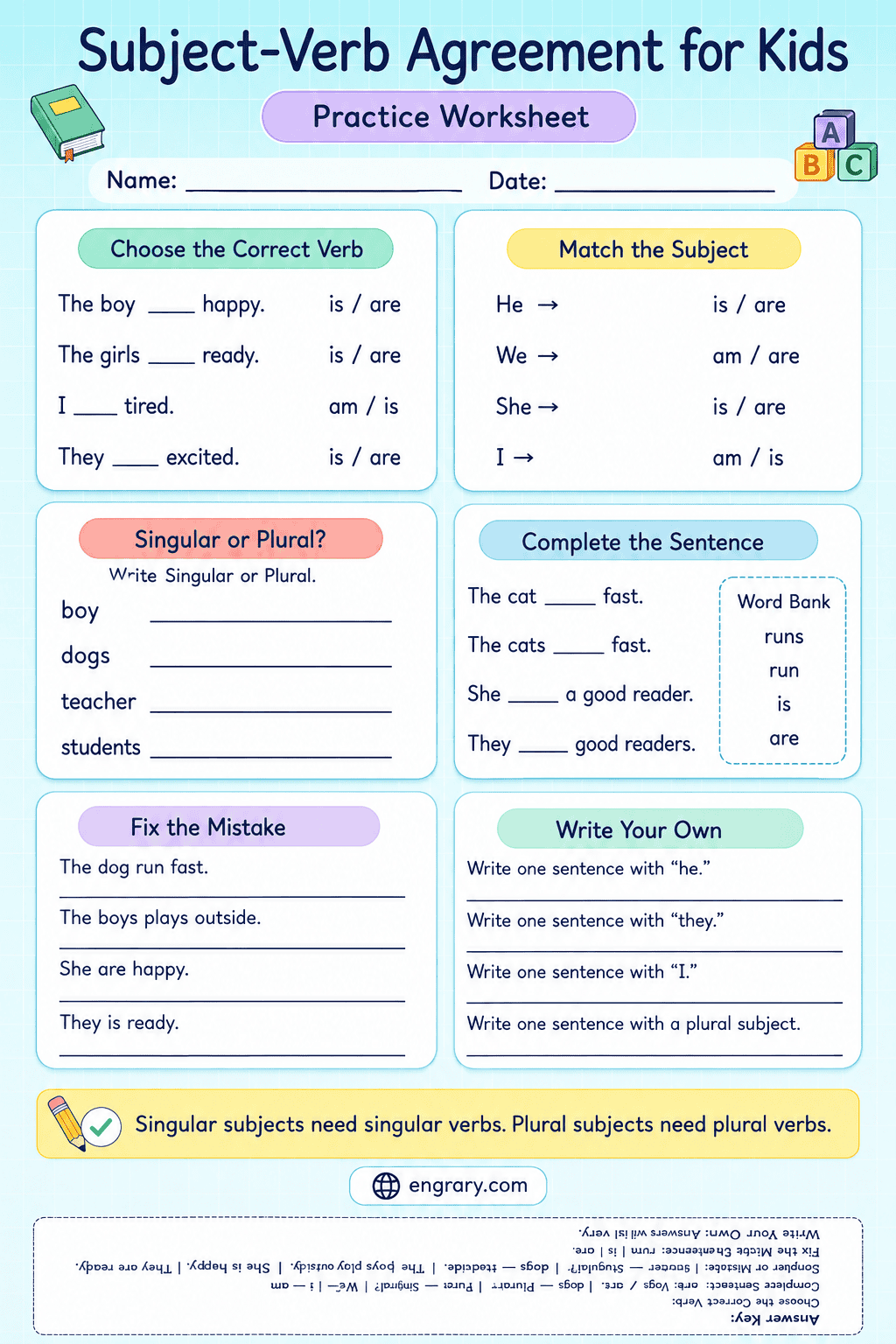
Complete each activity before checking the answer key.
Find the Subject and Decide Its Number
Identify the subject and write singular or plural.
- The dog barks loudly.
- The students read quietly.
- Mia walks to school.
- Ava and Noah play outside.
- The birds sing every morning.
- My teacher helps us.
Choose the Correct Verb
Choose the correct form.
- The dog (run / runs) quickly.
- The dogs (run / runs) quickly.
- Mia (read / reads) every evening.
- They (play / plays) outside.
- He (walk / walks) to school.
- We (need / needs) more paper.
- The bird (sing / sings) in the tree.
- The children (laugh / laughs) loudly.
Choose the Correct Form of Be, Have, or Do
Choose the correct answer.
- I (am / is) ready.
- Mia (is / are) excited.
- The students (is / are) quiet.
- Noah (was / were) tired yesterday.
- We (was / were) at school.
- Ava (has / have) a new notebook.
- They (has / have) two pencils.
- Mia (do / does) her homework.
- We (do / does) our chores.
- The dog (has / have) a long tail.
Find the True Subject
Choose the verb that agrees with the true subject.
- The box of crayons (is / are) heavy.
- The basket of apples (is / are) full.
- The students in our class (is / are) ready.
- The dog near the trees (bark / barks) loudly.
- The books on the desk (belong / belongs) to Ava.
- The teacher with the folders (is / are) waiting.
Compound Subject Practice
Choose the correct verb.
- Mia and Noah (plays / play) soccer.
- The dog and cat (is / are) sleeping.
- Ava and Ben (reads / read) together.
- My brother and sister (has / have) bicycles.
- The teacher and principal (is / are) talking.
- A pencil and notebook (belongs / belong) to Mia.
Correct the Mistakes
Rewrite each sentence correctly.
- The boys runs outside.
- Mia walk to school every day.
- The children is ready.
- Noah have a blue backpack.
- The box of crayons are heavy.
- Everyone are excited.
- Ava and Mia plays together.
- She do her homework after dinner.
Write Sentences With Correct Agreement
Write:
- one sentence with a singular subject and a present-tense verb;
- one sentence with a plural subject;
- one sentence using he, she, or it;
- one sentence using has;
- one sentence with two subjects joined by and;
- one sentence with extra words between the subject and verb.
Answer Key
Find the Subject and Decide Its Number
- dog — singular
- students — plural
- Mia — singular
- Ava and Noah — plural
- birds — plural
- teacher — singular
Choose the Correct Verb
- runs
- run
- reads
- play
- walks
- need
- sings
- laugh
Choose the Correct Form of Be, Have, or Do
- am
- is
- are
- was
- were
- has
- have
- does
- do
- has
Find the True Subject
- is
- is
- are
- barks
- belong
- is
Compound Subject Practice
- play
- are
- read
- have
- are
- belong
Correct the Mistakes
- The boys run outside.
- Mia walks to school every day.
- The children are ready.
- Noah has a blue backpack.
- The box of crayons is heavy.
- Everyone is excited.
- Ava and Mia play together.
- She does her homework after dinner.
Write Sentences With Correct Agreement
Answers will vary. Possible answers include:
- The dog runs across the yard.
- The students read quietly.
- She plays soccer after school.
- Noah has a new pencil.
- Ava and Mia walk home together.
- The basket of apples is on the table.
FAQs
Subject-verb agreement means the subject and verb in a sentence must match correctly. For example, we say The dog runs but The dogs run.
Find the true subject first and decide whether it is singular or plural. Then choose the verb form that matches that subject.
In the simple present, many singular subjects take a verb ending in -s, while plural subjects use the base form. Therefore, we say the dog runs but the dogs run.
Two subjects joined by and usually take a plural verb. For example, Mia and Noah play outside.
The true subject is box, which is singular. The phrase of crayons gives extra information but does not change the subject, so the correct verb is is.
You May Also Like
- Verbs for Kids
- Singular and Plural Nouns
- Helping Verbs for Kids
- Linking Verbs for Kids
- Pronouns for Kids
- Simple Present Tense
- Collective Nouns