

Verbs and adverbs perform different jobs in English sentences. A verb expresses an action, state, condition, event, or experience, while an adverb adds information about that verb or another part of the sentence.
This article explains verb vs adverb through clear definitions, comparison tables, sentence structure, adverb meanings, identification clues, and common mistakes. You will also learn why not all adverbs end in -ly and how adverbs differ from adjectives.

What Is a Verb?
A verb expresses an action, state, condition, event, or experience.
Examples:
run
write
know
feel
exist
Sentence examples:
She runs every morning.
He knows the answer.
They feel tired.
The weather changed suddenly.
A verb does not always describe a physical action.
For example:
She knows the answer.
Here, knows expresses a state.
He seems tired.
Here, seems expresses a condition or appearance.
The key idea is:
verb = expresses what happens, what someone does, or what state exists
What Is an Adverb?
An adverb adds information about a verb, adjective, another adverb, clause, or whole sentence.
Examples:
quickly
often
here
very
yesterday
Sentence examples:
She ran quickly.
They often travel.
Come here.
The film was very interesting.
Adverbs commonly tell us:
- how
- when
- where
- how often
- to what degree
The key idea is:
adverb = adds information about an action, quality, or sentence
Verb vs Adverb: Quick Difference
The main difference lies in what each word does in the sentence.
| Verb | Adverb |
|---|---|
| Expresses an action, state, condition, event, or experience | Adds information about a verb or another part of the sentence |
| Forms the core of a verb or verb phrase | Functions mainly as a modifier |
| Can change for tense or agreement | Does not show tense or subject agreement |
| She runs quickly. | She runs quickly. |
| They work carefully. | They work carefully. |
| He speaks softly. | He speaks softly. |
A simple distinction is:
verb = what happens or what state exists
adverb = gives more information about that action or state
Verb vs Adverb Sentence Structure
Sentence structure can help identify each word class.
| Word Class | Common Pattern | Example |
|---|---|---|
| Verb after subject | subject + verb | She runs. |
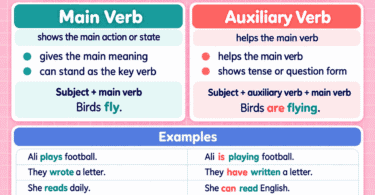
| Verb phrase | auxiliary + main verb | She is running. |
| Adverb after verb | verb + adverb | She runs quickly. |
| Adverb before verb | adverb + verb | She often runs. |
| Adverb + adjective | adverb + adjective | very happy |
| Adverb + adverb | adverb + adverb | really quickly |
These patterns are useful clues, but word function is more important than position alone.
Verb vs Adverb Examples
The following examples show the difference clearly.
| Verb | Adverb |
|---|---|
| She runs quickly. | quickly modifies runs |
| He spoke softly. | softly modifies spoke |
| They arrived early. | early modifies arrived |
| She works carefully. | carefully modifies works |
| We meet often. | often modifies meet |
| He waited patiently. | patiently modifies waited |
The verb carries the main action or state meaning, while the adverb adds more detail.

How Adverbs Modify Verbs
One of the most common jobs of an adverb is to modify a verb.
Consider:
She walked slowly.
walked = verb
slowly = adverb
The verb tells what she did.
The adverb tells how she did it.
Another example:
They arrived yesterday.
arrived = verb
yesterday = adverb of time
Another:
He works here.
works = verb
here = adverb of place
Another:
She often reads.
reads = verb
often = adverb of frequency
The adverb changes or adds to the meaning without becoming part of the action itself.
What Information Can an Adverb Add?
Adverbs can add several kinds of information.
Manner
An adverb of manner tells how something happens.
She spoke quietly.
He drove carefully.
They worked quickly.
Time
An adverb of time tells when something happens.
We arrived yesterday.
She will leave soon.
They met today.
Place
An adverb of place tells where something happens.
Come here.
They waited outside.
She looked everywhere.
Frequency
An adverb of frequency tells how often something happens.
She often reads.
They rarely complain.
He always arrives early.
Degree
An adverb of degree tells to what extent something applies.
She runs very quickly.
The room is extremely quiet.
He was quite tired.
These categories explain why adverbs can modify more than just verbs.
Adverbs Do Not Only Modify Verbs
The definition “an adverb modifies a verb” is incomplete because adverbs can modify several kinds of words and structures.
Adverb Modifying an Adjective
The test was very difficult.
very modifies difficult.
She is extremely happy.
extremely modifies happy.
Adverb Modifying Another Adverb
She ran really quickly.
really modifies quickly.
He spoke very softly.
very modifies softly.
Adverb Modifying a Whole Sentence
Fortunately, nobody was hurt.
Probably, they will arrive soon.
These adverbs comment on the whole sentence rather than only one verb.
How to Identify Verbs and Adverbs
The best way to identify a verb or adverb is to check what job the word performs.
Check What the Word Does
Ask whether the word expresses an action, state, condition, event, or experience.
Examples:
She runs.
He knows.
They exist.
These words function as verbs.
Now compare:
She runs quickly.
They arrived yesterday.
He often reads.
These words add information and function as adverbs.
Check What the Adverb Modifies
In:
She runs quickly.
quickly modifies runs.
In:
It is very cold.
very modifies the adjective cold.
In:
He speaks extremely slowly.
extremely modifies the adverb slowly.
Checking what the word modifies is one of the strongest identification methods.
Look at Tense and Sentence Position
Verbs can change for tense or agreement.
Examples:
work → worked
write → wrote
She works.
They work.
Adverbs do not show tense or subject agreement.
However, adverbs can appear in different positions.
Compare:
She often reads.
She reads often.
Yesterday, she called.
So position is useful, but it should not be the only test.
Do All Adverbs End in -ly?
No. Many adverbs end in -ly, but many common adverbs do not.
Common -ly adverbs include:
quickly
carefully
slowly
quietly
politely
However, many common adverbs have no -ly ending:
fast
often
here
there
soon
today
very
For example:
He runs fast.
She often reads.
Come here.
The word ending alone does not determine the class.
Also, some -ly words are adjectives rather than adverbs.
Examples:
friendly
lovely
lonely
Compare:
She is friendly.
Here, friendly is an adjective.
So -ly is a useful clue, but not a complete rule.
Verb vs Adverb vs Adjective
Adverbs are often confused with adjectives, so a short comparison helps.
| Verb | Adverb | Adjective |
|---|---|---|
| run | quickly | quick |
| speak | softly | soft |
| work | carefully | careful |
| respond | politely | polite |
| move | slowly | slow |
Compare:
She is quiet.
quiet = adjective because it describes the subject.
She speaks quietly.
quietly = adverb because it describes how she speaks.
Another example:
He is a careful driver.
careful = adjective
He drives carefully.
carefully = adverb
The main distinction is:
adjective → describes a noun or pronoun
adverb → modifies a verb, adjective, adverb, clause, or sentence
Common Mistakes With Verbs and Adverbs
Many errors happen when learners rely on word endings or sentence position instead of grammatical function.
| Mistake | Correct Understanding |
|---|---|
| Every verb shows physical action | Verbs can also express states or conditions |
| An adverb only modifies a verb | It can also modify adjectives, adverbs, clauses, and sentences |
| Every adverb ends in -ly | Many common adverbs do not |
| Every -ly word is an adverb | Some -ly words are adjectives |
| Any word after a verb is an adverb | It may be an object, complement, or phrase |
| Word position alone determines the class | Grammatical function is more important |
| fast cannot be an adverb | fast can function as an adverb |
For example:
She opened the door.
opened = verb
the door = object
The words after the verb are not an adverb.
Compare:
She opened the door slowly.
Here, slowly is an adverb because it describes how she opened it.
FAQs
A verb expresses an action, state, condition, event, or experience, while an adverb adds information about a verb or another part of the sentence.
Yes. In She runs quickly, quickly modifies the verb runs by explaining how she runs.
No. Words such as fast, often, here, soon, today, and very can function as adverbs without ending in -ly.
Look for the word that expresses an action, state, condition, event, or experience. Tense and subject-agreement changes can also provide clues.
Check whether the word adds information about how, when, where, how often, or to what degree something happens or modifies another word or the whole sentence.
You May Also Like


Leave a Comment