

Transitive and intransitive verbs differ mainly in whether they take a direct object. A transitive verb takes an object that receives or is affected by the action, while an intransitive verb does not take a direct object.
This article explains transitive vs intransitive verbs through clear definitions, sentence structures, side-by-side examples, direct-object tests, passive-voice clues, and common verbs that can work in both ways. You will also learn why words after an intransitive verb are not always objects and how to identify each use accurately.
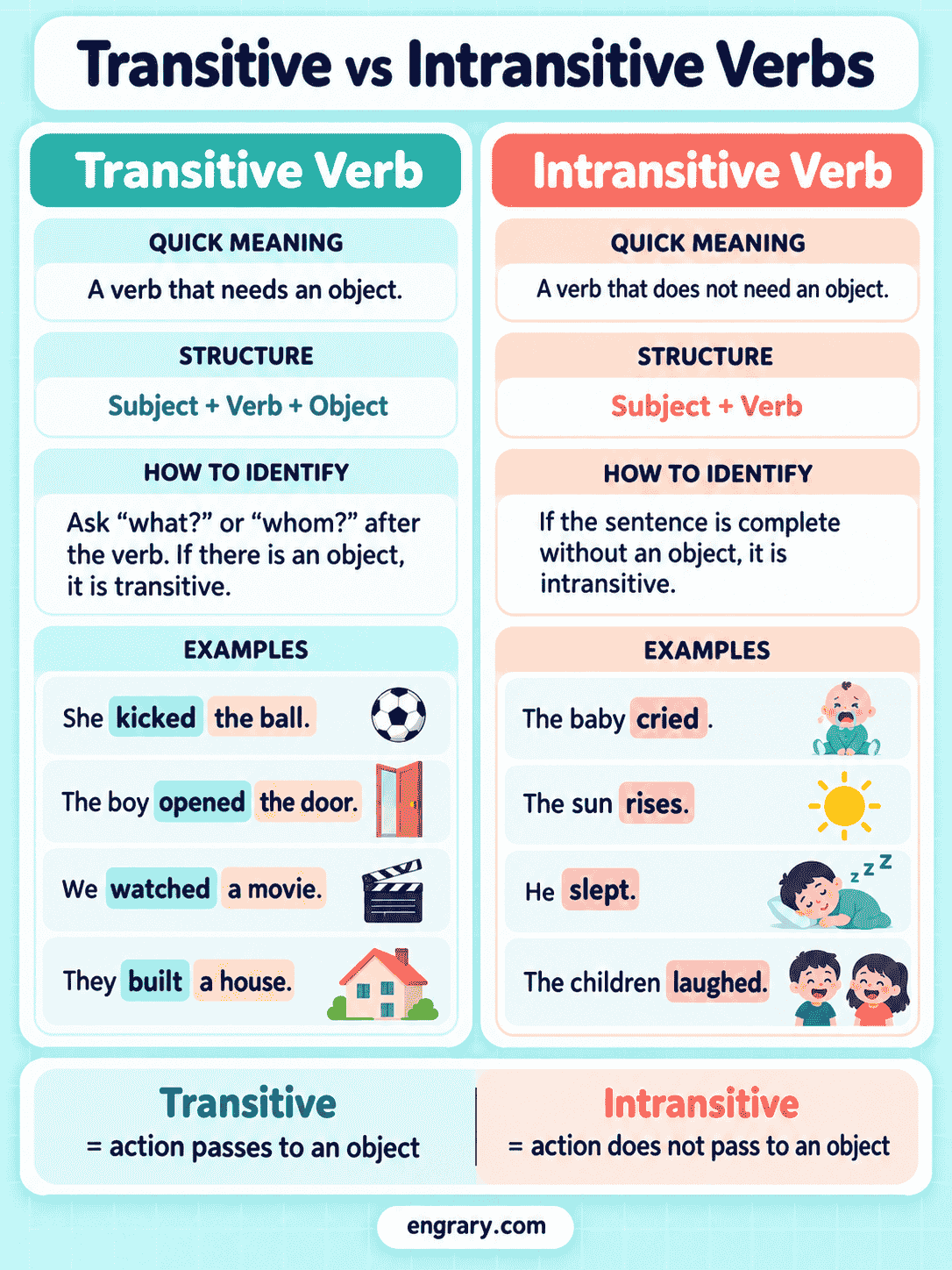
What Is a Transitive Verb?
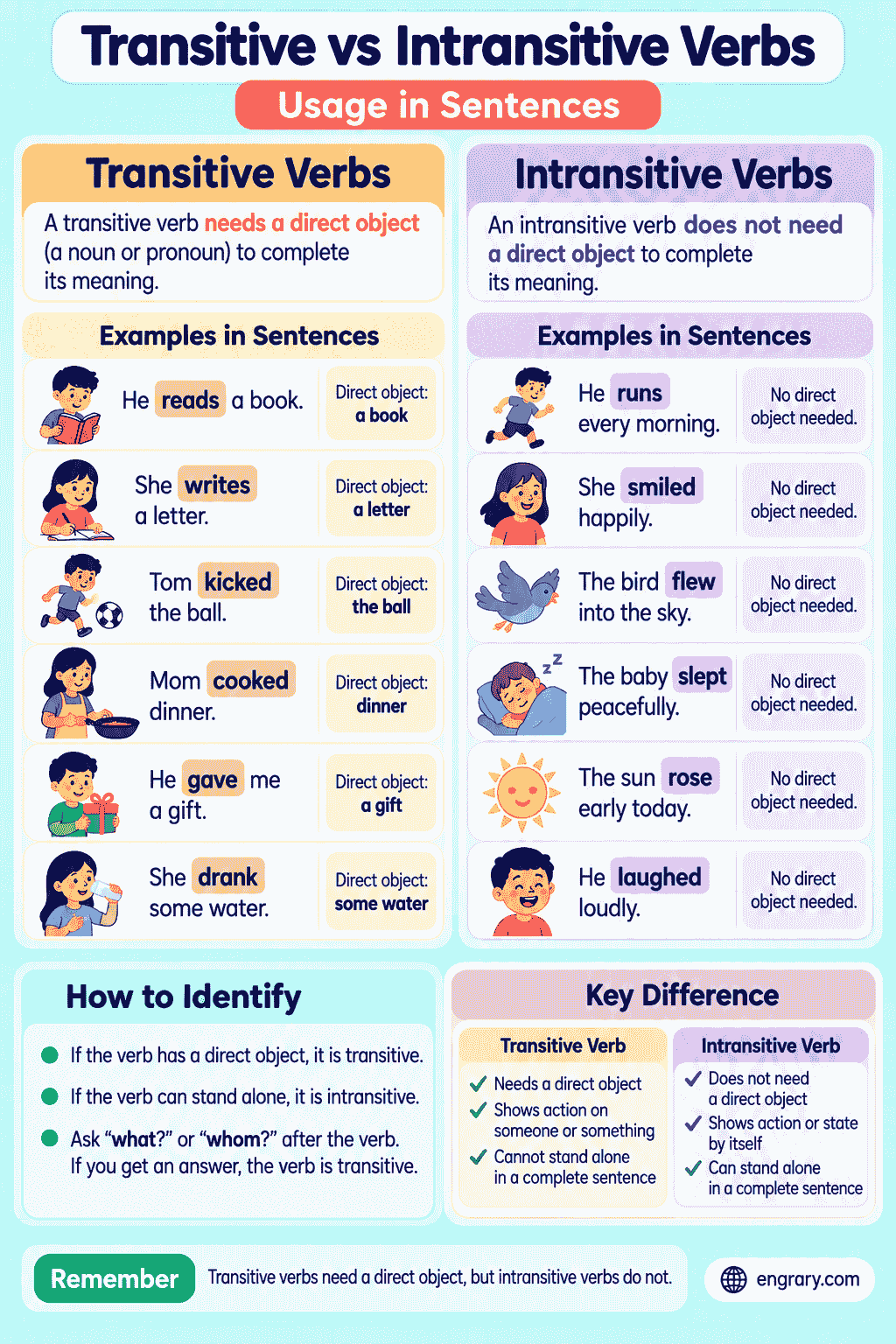
A transitive verb takes a direct object.
The direct object tells who or what receives or is directly affected by the action.
For example:
She opened the door.
opened = transitive verb
the door = direct object
Another example:
I bought a book.
bought = transitive verb
a book = direct object
A common pattern is:
subject + transitive verb + direct object
More examples:
They watched the film.
He kicked the ball.
Sara wrote a letter.
We cleaned the room.
In each sentence, the verb takes a direct object.
What Is an Intransitive Verb?
An intransitive verb does not take a direct object.
For example:
The baby cried.
They arrived early.
It rained all night.
She laughed loudly.
In these sentences, no person or thing receives the action as a direct object.
A common pattern is:
subject + intransitive verb
An intransitive verb may still be followed by an adverb, prepositional phrase, or another modifier.
For example:
She laughed loudly.
They arrived at noon.
The words after the verb add information, but they are not direct objects.
Transitive vs Intransitive Verbs: Quick Difference
The clearest difference is whether the verb takes a direct object.
| Transitive Verb | Intransitive Verb |
|---|---|
| Takes a direct object | Does not take a direct object |
| The action affects a person or thing | No direct object receives the action |
| Common pattern: subject + verb + object | Common pattern: subject + verb |
| She opened the door. | The door opened. |
| He drives a van. | He drives carefully. |
| They won the match. | They won. |
A useful point is:
Transitivity belongs to the verb’s use in a sentence, not always to the verb permanently.
Many English verbs can function as transitive in one sentence and intransitive in another.
Transitive vs Intransitive Verb Structure
Sentence structure often makes the distinction easier to identify.
| Verb Type | Structure | Example |
|---|---|---|
| Transitive | subject + verb + direct object | She opened the door. |
| Intransitive | subject + verb | The baby cried. |
| Intransitive + modifier | subject + verb + modifier | She laughed loudly. |
| Intransitive + prepositional phrase | subject + verb + prepositional phrase | They arrived at noon. |
The important point is that a word or phrase after a verb is not automatically a direct object.
Transitive vs Intransitive Verb Examples
Many verbs can work in either pattern depending on whether a direct object is present.
| Transitive Use | Intransitive Use |
|---|---|
| She opened the door. | The door opened slowly. |
| He drives a van. | He drives carefully. |
| We started the meeting. | The meeting started at nine. |
| They increased the price. | Prices increased quickly. |
| She entered the room. | Please enter. |
| He left the school. | We should leave now. |
| She won the competition. | Did you win? |
| I changed the plan. | The weather changed suddenly. |
In the transitive examples, the verb takes a direct object.
In the intransitive examples, no direct object follows the verb.
Verbs That Can Be Both Transitive and Intransitive
Many common English verbs can function in both ways. The sentence determines the role.
Eat
Transitive: She ate an apple.
Here, an apple is the direct object.
Intransitive: She ate early.
Here, ate has no direct object.
Read
Transitive: He read the book.
the book = direct object
Intransitive: He read quietly.
quietly is an adverb, not an object.
Write
Transitive: She wrote a letter.
a letter = direct object
Intransitive: She writes every morning.
No direct object appears.
Drive
Transitive: He drives a bus.
a bus = direct object
Intransitive: He drives carefully.
carefully describes how he drives.
Open
Transitive: She opened the window.
the window = direct object
Intransitive: The window opened slowly.
No direct object follows opened.
Begin
Transitive: The teacher began the lesson.
the lesson = direct object
Intransitive: The lesson began at nine.
No direct object is present.
Change
Transitive: She changed the plan.
the plan = direct object
Intransitive: The weather changed suddenly.
No direct object follows the verb.
Start
Transitive: They started the meeting.
the meeting = direct object
Intransitive: The meeting started at ten.
No direct object follows started.
These examples show why a verb should not be classified from the word alone. Its grammatical use depends on the full sentence.
How to Identify Transitive and Intransitive Verbs
A few practical tests can help you determine whether a verb is being used transitively or intransitively.
Look for a Direct Object
First, check whether the verb takes a direct object.
Example:
She opened the door.
The action of opening affects the door.
Therefore:
opened = transitive
the door = direct object
Now compare:
The door opened.
There is no direct object.
Therefore, opened is intransitive in this sentence.
Ask What or Whom
A useful shortcut is to ask what? or whom? after the verb.
Example:
She bought what?
a dress
So bought is transitive.
He called whom?
his friend
So called is transitive.
Now compare:
She laughed what?
There is no valid direct-object answer.
So laughed is intransitive.
This test works well in many simple sentences.
Try the Passive Voice Test
Passive voice can provide another useful clue.
Consider:
Sara wrote the letter.
The direct object is:
the letter
It can become the subject of a passive sentence:
The letter was written by Sara.
That is strong evidence that wrote is being used transitively.
Now compare:
The baby slept.
There is no direct object that can become the subject of a natural passive sentence.
So slept is intransitive here.
The passive test works best as supporting evidence. Direct-object analysis should remain the main test.
Intransitive Verbs With Modifiers
An intransitive verb can still have words and phrases after it.
These may describe:
- manner
- time
- place
- duration
- frequency
Examples:
She laughed loudly.
They arrived at noon.
He slept on the sofa.
We waited for an hour.
The baby cried all night.
She walked slowly.
In:
They arrived at noon.
at noon is a prepositional phrase.
It is not a direct object.
In:
She laughed loudly.
loudly is an adverb.
It is not a direct object.
This distinction prevents the mistake of treating every word after a verb as an object.
Transitive Verbs With Two Objects
Some transitive verbs can take both an indirect object and a direct object.
For example:
She gave me a gift.
me = indirect object
a gift = direct object
Another example:
He sent his friend a message.
his friend = indirect object
a message = direct object
The verbs gave and sent are still transitive because they take direct objects.
The direct object usually answers what?, while the indirect object often identifies the person who receives or benefits from the action.
Transitive vs Intransitive vs Linking Verbs
These three verb uses follow different sentence patterns.
| Transitive Verb | Intransitive Verb | Linking Verb |
|---|---|---|
| Takes a direct object | Takes no direct object | Connects subject to complement |
| She opened the door. | The door opened. | The door is open. |
| He grew tomatoes. | Plants grew. | The sky grew dark. |
| Action affects an object | No object receives the action | Complement describes or identifies subject |
The same verb can sometimes appear in more than one pattern.
For example:
They grew tomatoes.
Transitive
The plants grew.
Intransitive
The sky grew dark.
Linking
The full sentence determines the function.
Common Mistakes With Transitive and Intransitive Verbs
Most mistakes happen when learners classify the verb without checking its sentence structure.
| Mistake | Correct Understanding |
|---|---|
| Every verb is permanently transitive or intransitive | Many verbs can function as either |
| Anything after a verb is a direct object | Adverbs and prepositional phrases are not direct objects |
| Every action verb is transitive | Some action verbs are intransitive |
| Intransitive verbs cannot have words after them | They can be followed by modifiers |
| Transitive verbs always take only one object | Some can take direct and indirect objects |
| The verb word alone determines the type | Sentence use determines the classification |
A reliable method is to identify the verb first and then check whether it takes a direct object in that specific sentence.
FAQs
A transitive verb takes a direct object, while an intransitive verb does not take a direct object.
Yes. For example, open is transitive in She opened the door, but intransitive in The door opened.
Ask what? or whom? after the verb. In She bought a dress, ask bought what? The answer a dress is the direct object.
Yes. It can be followed by adverbs or prepositional phrases, as in She laughed loudly or They arrived at noon.
Normally, no. Passive voice requires a direct object from the active sentence, and an intransitive verb does not take one.
You May Also Like



Leave a Comment