
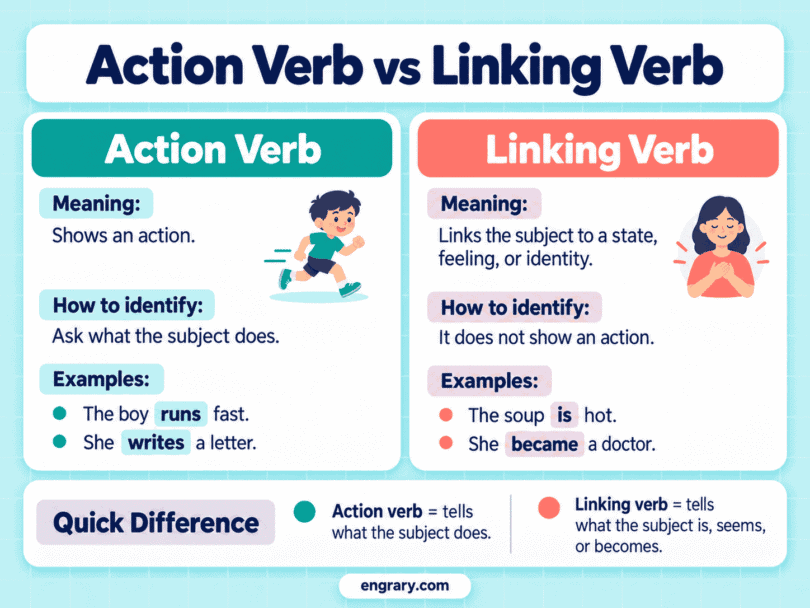
Action verbs and linking verbs perform different jobs in a sentence. Action verbs show what a subject does, experiences, or causes, while linking verbs connect the subject to a description or identity. Understanding this difference helps you identify sentence structure and use verbs more accurately.
This article explains action verb vs linking verb through clear definitions, comparison tables, sentence patterns, context-dependent verbs, direct objects, subject complements, and simple identification tests. You will also see how linking verbs differ from helping verbs and how adjective and adverb use changes with the verb type.

What Is an Action Verb?
An action verb describes something the subject does, experiences, thinks, or causes.
Examples:
She runs every morning.
He opened the door.
They built a house.
I considered the idea.
The action may be physical, mental, or related to an event or process.
Some action verbs take a direct object:
She opened the door.
Others do not:
The baby cried.
So an action verb does not always need an object.
What Is a Linking Verb?
A linking verb connects the subject of a sentence to a subject complement that describes or identifies it.
Examples:
She is tired.
The soup tastes salty.
He became captain.
The linking verb does not transfer an action to an object. Instead, it connects the subject to information about that same subject.
A common pattern is:
subject + linking verb + subject complement
For example:
Mia is happy.
Mia = subject
is = linking verb
happy = subject complement
Action Verb vs Linking Verb: Quick Difference
The main difference lies in what the verb does inside the sentence.
| Action Verb | Linking Verb |
|---|---|
| Shows an action, event, experience, or process | Connects the subject to a description or identity |
| May take a direct object | Takes a subject complement |
| Can be physical or mental | Commonly shows state, appearance, identity, or change |
| The subject performs or experiences something | The subject is described or identified |
| She tasted the soup. | The soup tastes good. |
| They grew tomatoes. | The sky grew dark. |
The same verb can sometimes function differently depending on the sentence.
Action and Linking Verb Structure
Sentence structure often reveals whether a verb is functioning as action or linking.
| Verb Type | Common Structure | Example |
|---|---|---|
| Intransitive action verb | subject + verb | Birds fly. |
| Transitive action verb | subject + verb + direct object | She opened the door. |
| Linking verb + adjective | subject + linking verb + adjective | She is happy. |
| Linking verb + noun | subject + linking verb + noun | He became captain. |
This structural difference is especially useful when the same verb can perform more than one role.
Action Verb vs Linking Verb Examples
The following sentence pairs show the difference clearly.
| Action Verb Sentence | Linking Verb Sentence |
|---|---|
| She tasted the soup. | The soup tastes delicious. |
| He smelled the flowers. | The flowers smell fresh. |
| She felt the fabric. | The fabric feels soft. |
| He looked at the screen. | He looks tired. |
| They grew tomatoes. | The sky grew dark. |
| She turned the handle. | The leaves turned yellow. |
| He got the package. | The weather got colder. |
In the action sentences, the verb describes what the subject does.
In the linking sentences, the verb connects the subject to a description.
Verbs That Can Be Action or Linking
Several common verbs can function as either action verbs or linking verbs. The full sentence determines their role.
Feel
Action: She felt the fabric.
Here, felt describes an action performed on the fabric.
Linking: The fabric feels soft.
Here, feels connects fabric to the description soft.
Look
Action: He looked at the clock.
Here, looked describes an action.
Linking: He looks tired.
Here, looks connects he to tired.
Smell
Action: She smelled the flowers.
The subject performs the action of smelling.
Linking: The flowers smell sweet.
The word sweet describes the flowers.
Taste
Action: I tasted the soup.
The verb describes an action performed by the subject.
Linking: The soup tastes salty.
The word salty describes the soup.
Grow
Action: They grow vegetables.
Here, grow describes an action.
Linking: The sky grew dark.
Here, grew connects the sky to its new condition, dark.
Turn
Action: She turned the key.
Here, turned shows an action.
Linking: The leaves turned yellow.
Here, turned connects the leaves to the new description yellow.
Get
Action: He got a message.
Here, got describes receiving something.
Linking: The weather got colder.
Here, got connects the weather to the new condition colder.
These examples show why a verb should not be classified by the word alone. Its function depends on how it works in the sentence.

Direct Objects and Subject Complements
Action verbs and linking verbs often differ in what follows them.
Direct Object After an Action Verb
A direct object receives the action of a transitive verb.
Example:
She tasted the soup.
tasted = action verb
the soup = direct object
Another example:
He opened the door.
opened = action verb
the door = direct object
The direct object receives the action.
Predicate Adjectives After Linking Verbs
A predicate adjective describes the subject after a linking verb.
Examples:
The soup tastes good.
She looks tired.
The blanket feels soft.
The flowers smell fresh.
The music sounds beautiful.
The sky grew dark.
The room remained quiet.
In every example, the adjective describes the subject rather than the verb.
Predicate Nouns After Linking Verbs
A predicate noun or noun phrase identifies or renames the subject.
Examples:
She is a teacher.
He became captain.
Mia is my sister.
Tom was the winner.
Leo became team leader.
The complement refers back to the subject.
The basic comparison is:
| Action Verb | Linking Verb |
|---|---|
| May be followed by a direct object | Followed by a subject complement |
| She tasted the soup. | The soup tastes good. |
| the soup receives the action | good describes the subject |
How to Identify Action and Linking Verbs
A few practical checks can help you identify the verb type correctly.
Look at What the Verb Does
First, ask whether the subject performs or experiences an action.
She tasted the soup.
They grew vegetables.
He turned the handle.
These verbs function as action verbs because the subject does something.
Now compare:
The soup tastes salty.
The sky grew dark.
The leaves turned yellow.
These verbs connect the subject to a description, so they function as linking verbs.
Check What Comes After the Verb
Look at the word or phrase after the verb.
If it receives the action, it may be a direct object:
She tasted the soup.
If it describes or identifies the subject, it is a subject complement:
The soup tastes salty.
He became captain.
This test often gives a clearer answer than memorizing lists.
Try the Be Replacement Test
Another useful clue is replacing the possible linking verb with a form of be.
The soup tastes good.
The soup is good.
The basic relationship still makes sense, so tastes is likely a linking verb.
Now compare:
She tasted the soup.
She was the soup.
The meaning no longer works, so tasted functions as an action verb.
The replacement test is helpful, but the full sentence should still determine the final classification.
Action Verb vs Linking Verb vs Helping Verb
Action, linking, and helping verbs perform different grammatical jobs.
| Action Verb | Linking Verb | Helping Verb |
|---|---|---|
| Shows an action, event, or process | Connects subject to complement | Supports another verb |
| She runs. | She is tired. | She is running. |
| He opened the door. | He became angry. | He has finished. |
| They built a house. | They seem ready. | They will leave. |
Forms of be can create confusion.
Compare:
She is tired.
is = linking verb
She is reading.
is = helping verb
The role depends on what the verb does in the sentence.
Adjective vs Adverb After the Verb
The word that follows a linking verb often describes the subject, so an adjective is commonly used.
Correct:
She looks tired.
The soup tastes good.
The blanket feels soft.
The flowers smell fresh.
Here, the adjectives describe the subjects.
With an action verb, an adverb may describe how the action happens.
She looked carefully at the painting.
He spoke quietly.
They worked quickly.
Compare:
She looks tired.
looks = linking verb
tired = adjective describing she
She looks carefully at the picture.
looks = action verb
carefully = adverb describing the action
Common Mistakes With Action and Linking Verbs
Several mistakes happen when the verb is classified without looking at the full sentence.
| Mistake | Correct Understanding |
|---|---|
| Every sense verb is linking | Sense verbs depend on context |
| Every form of be is linking | Be can also function as a helping verb |
| Every action verb takes an object | Some action verbs are intransitive |
| Linking verbs take direct objects | They connect subjects to subject complements |
| The verb word alone determines its type | Sentence function determines the role |
| Adverbs always follow verbs | Linking verbs often take adjectives that describe the subject |
A reliable approach is to check the verb, what follows it, and how the words relate to the subject.
FAQs
An action verb describes what the subject does, experiences, or causes. A linking verb connects the subject to a word or phrase that describes or identifies it.
Yes. For example, taste is an action verb in I tasted the soup, but it is a linking verb in The soup tastes good.
Check whether the verb connects the subject to a description. In The flowers smell fresh, fresh describes the flowers, so smell is linking.
Is is not an action verb. It can function as a linking verb, as in She is tired, or a helping verb, as in She is reading.
A direct object receives the action of a verb, while a subject complement describes or identifies the subject after a linking verb.
You May Also Like



Leave a Comment