
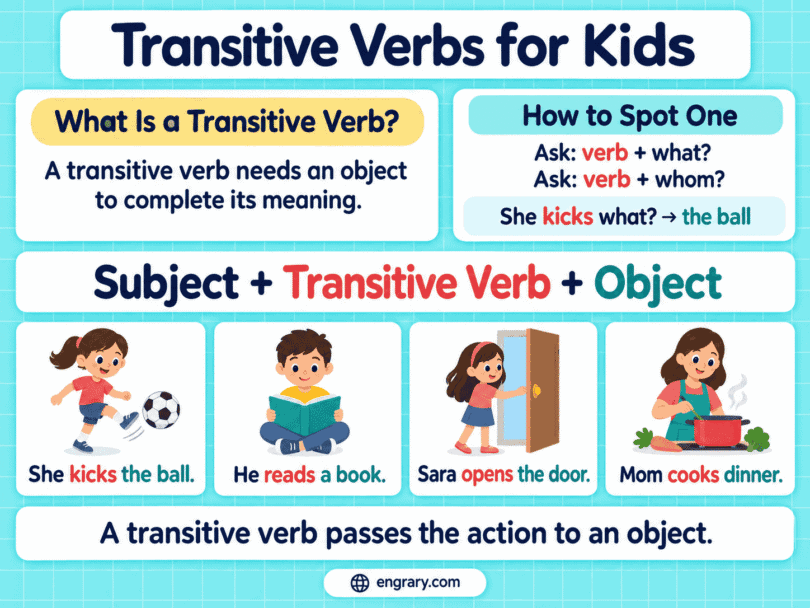
Transitive verbs help children understand how actions connect to people, animals, places, or things in a sentence. Learning them makes it easier to identify the verb, find the direct object, and understand basic sentence structure.
You’ll learn what makes a verb transitive, how direct objects work, how to use the what? or whom? test, and how transitive verbs differ from intransitive verbs.
What Makes a Verb Transitive?
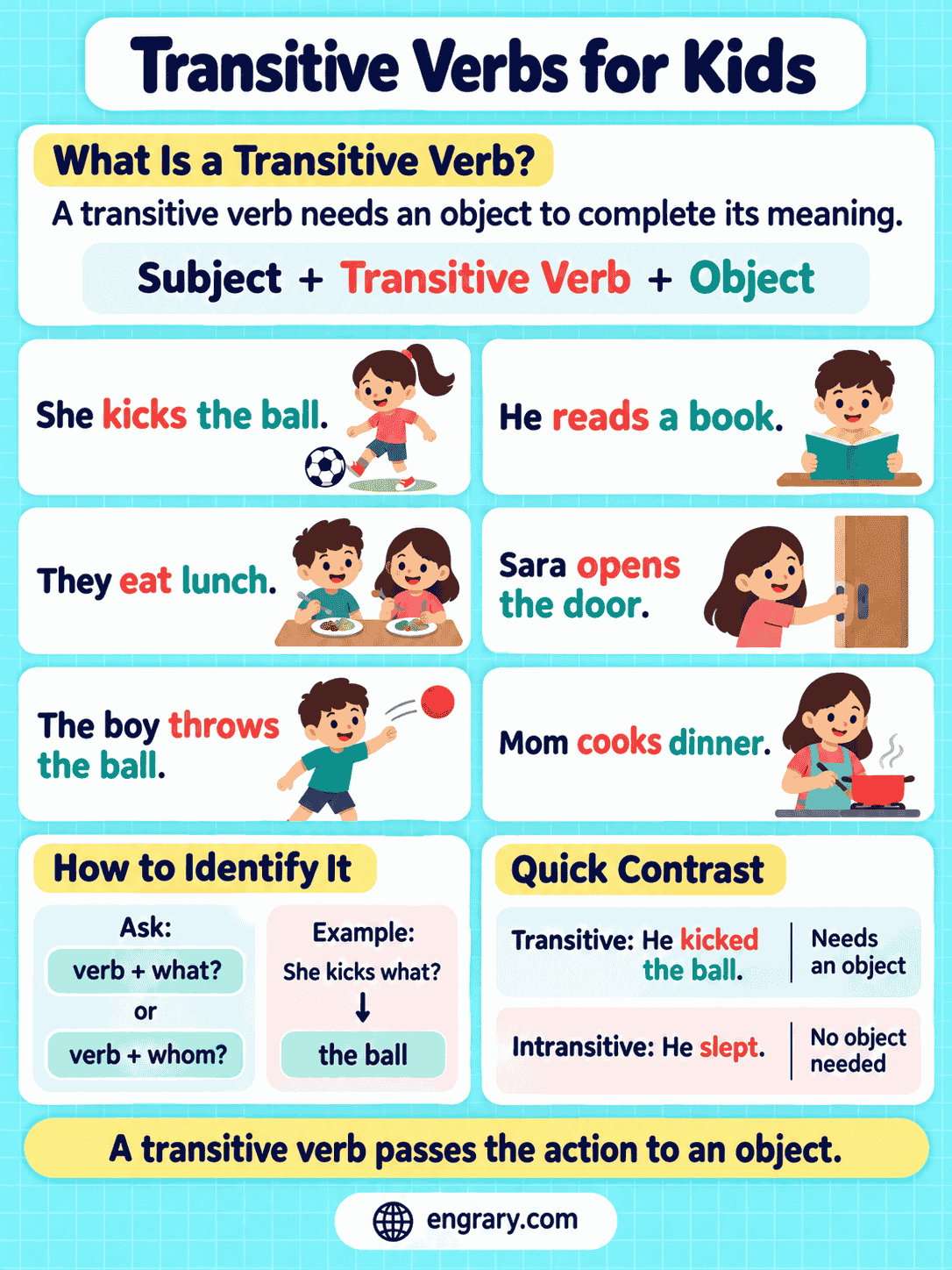
A verb is transitive when it is used with a direct object.
For example:
Mia opens the door.
The verb opens acts on the door.
So:
opens = transitive verb
the door = direct object
The basic idea is:
transitive verb → action connects to a direct object
Another example:
Noah kicked the ball.
The action kicked affects the ball.
Therefore, kicked is transitive in this sentence.
What Is a Direct Object?
A direct object is the person, animal, place, thing, or idea that directly receives the action of the verb.
For example:
Ava read the story.
Ask:
read what?
Answer:
the story
So:
read = transitive verb
the story = direct object
Another example:
Mia called Noah.
Ask:
called whom?
Answer:
Noah
Therefore:
called = transitive verb
Noah = direct object
The Subject + Verb + Object Pattern
Many transitive sentences follow this pattern:
Subject + Verb + Object
For example:
Mia reads books.
Subject: Mia
Verb: reads
Object: books
Another example:
Noah kicked the ball.
Subject: Noah
Verb: kicked
Object: the ball
A simple pattern is:
S + V + O
This structure helps children see how the action moves from the subject to the object.
Easy Transitive Verb Examples
Many common verbs can be used transitively.
Examples include:
- open
- close
- carry
- kick
- throw
- read
- write
- buy
- make
- need
- want
- watch
- take
- find
- use
- help
- catch
- choose
- clean
- draw
In sentences:
Mia opens the window.
Noah kicks the ball.
Dad carries the boxes.
Ava reads a book.
We need help.
The children watch the film.
She draws a picture.
The teacher helps the students.
Each verb has a direct object that receives or completes the action.
Use the What? or Whom? Test
A simple test can help identify a transitive verb.
First, find the verb.
Then ask:
verb + what?
or:
verb + whom?
For example:
The teacher explained the lesson.
Ask:
explained what?
Answer:
the lesson
Therefore:
explained = transitive verb
the lesson = direct object
Another example:
Mia called Noah.
Ask:
called whom?
Answer:
Noah
So called is transitive.
The quick pattern is:
verb + what? / whom? → direct object
Transitive Verbs in Sentences
| Sentence | Transitive Verb | Direct Object |
|---|---|---|
| Mia opened the door. | opened | the door |
| Noah kicked the ball. | kicked | the ball |
| Ava read the story. | read | the story |
| Dad fixed the chair. | fixed | the chair |
| We watched the film. | watched | the film |
| The teacher explained the rule. | explained | the rule |
| Mia carried the bag. | carried | the bag |
| Noah wrote a letter. | wrote | a letter |
| Ava bought a pencil. | bought | a pencil |
| The child closed the window. | closed | the window |
| We cleaned the room. | cleaned | the room |
| Dad made a table. | made | a table |
In each sentence, the verb acts on a direct object.
Transitive vs Intransitive Verbs
A transitive verb has a direct object in the sentence.
An intransitive verb does not.
| Transitive Use | Intransitive Use |
|---|---|
| She opened the door. | The door opened. |
| He drives a van. | He drives carefully. |
| We ate lunch. | We ate early. |
| She left school. | She left. |
| They played football. | They played outside. |
The core difference is:
transitive → direct object present
intransitive → no direct object
For example:
They played football.
Played what?
football
So played is transitive.
By contrast:
They played outside.
outside tells where they played. It is not a direct object.
So played is intransitive in this sentence.
Verbs That Can Be Both Transitive and Intransitive
Many verbs can be transitive in one sentence and intransitive in another.
The sentence use determines the classification.
Open
She opened the door.
opened = transitive
the door = direct object
Compare:
The door opened.
There is no direct object.
So opened = intransitive
Play
We played football.
played = transitive
football = direct object
Compare:
We played outside.
There is no direct object.
So played = intransitive
Write
He wrote a poem.
wrote = transitive
a poem = direct object
Compare:
He wrote for an hour.
There is no direct object.
So wrote = intransitive
Therefore, do not classify a verb only by the word itself. Check how it works in the sentence.
Transitive Verbs With Two Objects
Some transitive verbs can take two objects.
For example:
Mia gave Noah a book.
Verb:
gave
Indirect object:
Noah
Direct object:
a book
Ask:
gave what?
Answer:
a book
So a book is the direct object.
Other verbs that can work this way include:
- give
- send
- show
- tell
- teach
- bring
Examples:
Dad gave Mia a gift.
The teacher showed us the answer.
Noah sent Ava a message.
Keep in mind that the main focus of transitive verbs is still the direct object.
Direct Object vs Prepositional Phrase
Not every phrase after a verb is a direct object.
Compare:
The boy ran to school.
The words to school form a prepositional phrase.
They tell where the boy ran.
They do not receive the action.
Therefore, ran is intransitive here.
Now compare:
The boy carried the bag.
Ask:
carried what?
Answer:
the bag
So the bag is the direct object, and carried is transitive.
Another example:
She walked into the room.
into the room = prepositional phrase
But:
She opened the door.
the door = direct object
This difference is important because children should not assume that every word after a verb is an object.
Transitive Verbs With Pronoun Objects
A direct object can also be a pronoun.
Examples:
Mia called him.
Noah helped her.
We invited them.
She thanked us.
The teacher praised him.
Ask:
called whom?
Answer:
him
Therefore, him is the direct object.
Common object pronouns include:
- me
- you
- him
- her
- it
- us
- them
How to Find a Transitive Verb in a Sentence
Use this simple process.
First, find the verb.
Next, ask:
what?
or:
whom?
after the verb.
If the answer is a direct object, the verb is transitive in that sentence.
For example:
She bought a book.
Bought what?
a book
Therefore:
bought = transitive verb
a book = direct object
Another example:
Noah helped Mia.
Helped whom?
Mia
Therefore:
helped = transitive verb
Mia = direct object
Now compare:
Noah laughed loudly.
Laughed what?
There is no direct object.
So laughed is intransitive.
Common Transitive Verb Mistakes
| Mistake | Correct Understanding |
|---|---|
| Every action verb is transitive. | Some action verbs do not take direct objects. |
| Every word after a verb is an object. | It may be an adverb or prepositional phrase. |
| A verb is always transitive or always intransitive. | Many verbs can be both depending on use. |
| The subject receives the action. | The direct object receives the action. |
| Every sentence needs a direct object. | Only transitive uses require one. |
| “to school” is the object in “ran to school.” | It is a prepositional phrase. |
| A direct object must be a noun. | A pronoun can also function as a direct object. |
For example:
The dog ran quickly.
There is no direct object, so ran is intransitive.
By contrast:
The dog chased the ball.
the ball receives the action, so chased is transitive.
FAQs
A transitive verb is a verb used with a direct object. For example, kicked is transitive in Noah kicked the ball because the ball receives the action.
A direct object receives the action of a transitive verb. In Mia opened the door, the door is the direct object.
Find the verb and ask what? or whom? after it. If the answer gives a direct object, the verb is transitive in that sentence.
A transitive verb has a direct object, while an intransitive verb does not. Compare She opened the door with The door opened.
Yes. Many verbs can work both ways. For example, play is transitive in We played football but intransitive in We played outside.
You May Also Like



Leave a Comment