
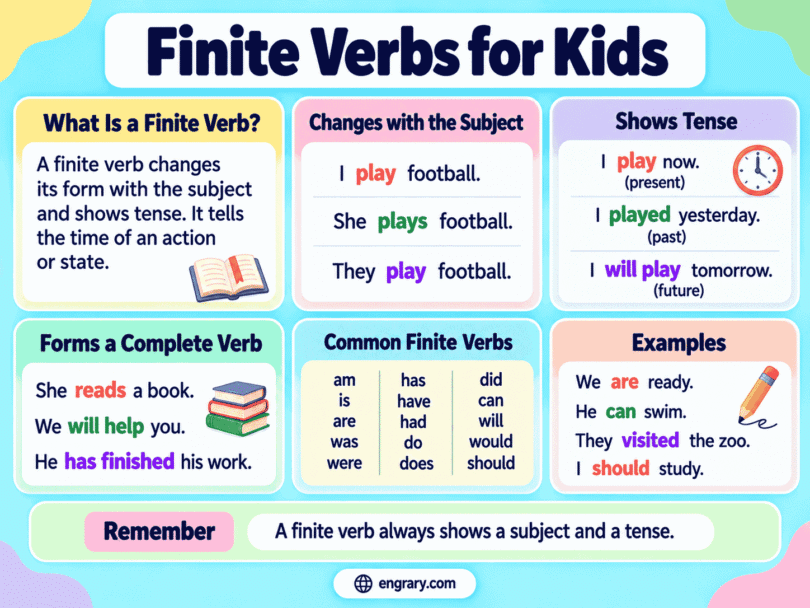
Finite verbs help children understand how verbs show tense and connect with the subject of a clause. Learning them makes it easier to see why some verb forms change with time or subject while others do not.
You’ll learn what makes a verb finite, how finite verbs show tense and subject agreement, how they differ from non-finite and main verbs, and how to identify them in sentences and verb phrases.
What Makes a Verb Finite?
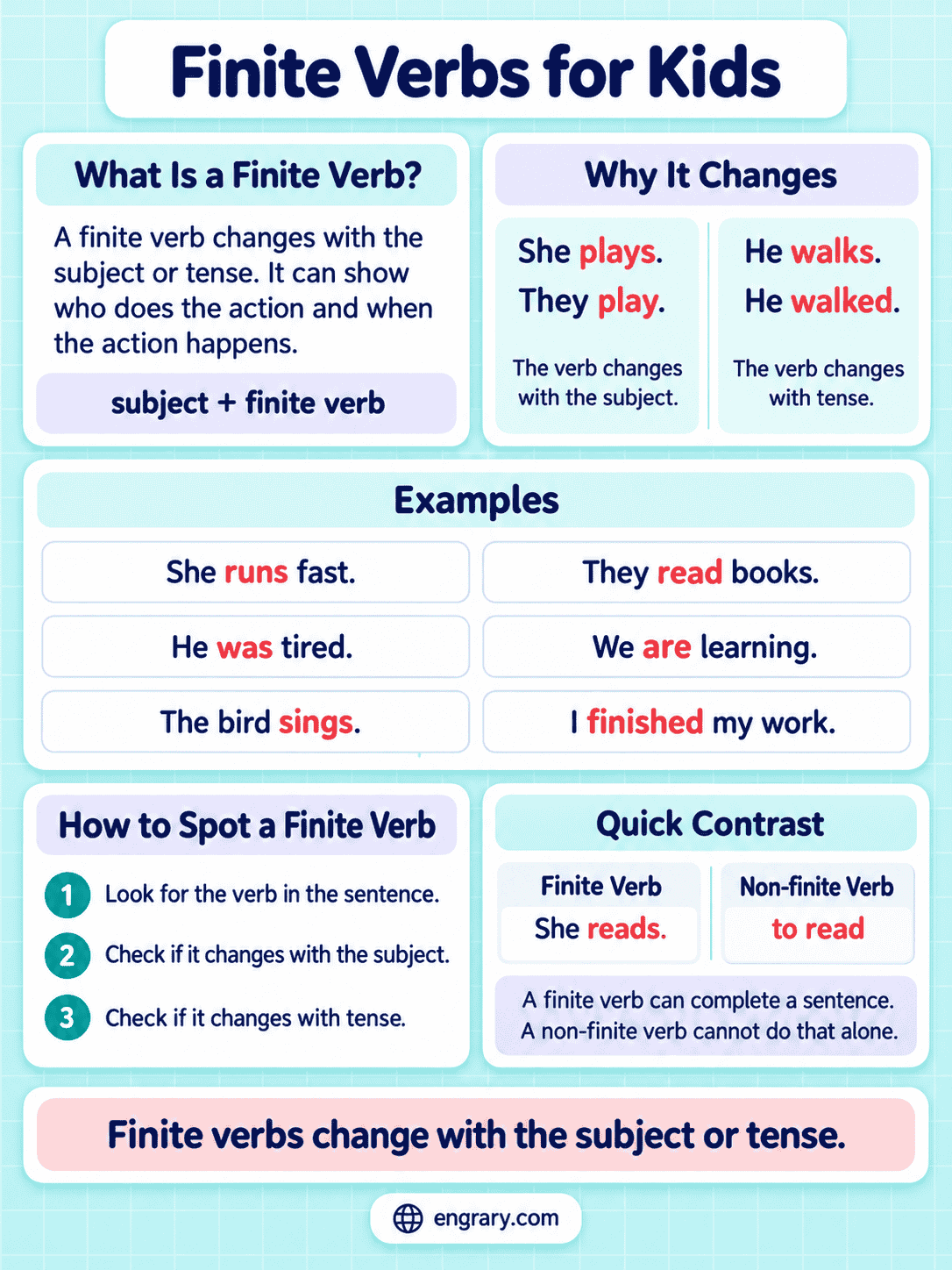
A finite verb is a verb form that carries grammatical information such as tense and can show agreement with the subject.
For example:
Mia plays outside.
Mia played yesterday.
They play outside.
The finite verb changes according to tense or subject.
The simple idea is:
finite verb → shows tense and works with the subject of the clause
Finite Verbs Show Tense
Finite verbs help show when an action, event, or state happens.
Compare:
Mia plays every day.
Mia played yesterday.
The first sentence uses the present tense.
The second uses the past tense.
Another example:
Noah is tired.
Noah was tired.
The change from is to was changes the tense.
More examples:
They walk to school.
They walked to school yesterday.
Ava writes every evening.
Ava wrote yesterday.
The finite verb carries the tense of the clause.
Finite Verbs Change With the Subject
Finite verbs can also change when the subject changes.
Compare:
I play outside.
She plays outside.
They play outside.
The form plays agrees with the singular subject she.
Another example:
I am ready.
She is ready.
They are ready.
The verb changes according to the subject.
A simple pattern is:
subject changes → finite verb may change
This is called subject-verb agreement.
Common Finite Verb Examples
Common finite verb forms include:
- am
- is
- are
- was
- were
- play
- plays
- played
- run
- runs
- ran
- read
- reads
- know
- knows
- knew
- have
- has
- had
- do
- does
- did
In sentences:
Mia reads every night.
Noah ran home.
She knows the answer.
They were tired.
Dad has a car.
Ava did her work.
Each bold verb carries tense or subject agreement in its clause.
Finite vs Non-Finite Verbs
Finite and non-finite verbs do different grammatical jobs.
| Finite Verb | Non-Finite Verb |
|---|---|
| shows tense | does not show tense by itself |
| can show agreement with the subject | does not change for person or number |
| works as the finite center of a clause | cannot normally form a complete finite clause alone |
| plays | to play |
| is | playing |
| went | gone |
| has | finished |
The basic contrast is:
finite → tense and agreement
non-finite → no independent tense or agreement
For example:
She plays every day.
plays is finite.
But:
She likes to play outside.
to play is non-finite.
Finite and Non-Finite Verbs in the Same Sentence
A sentence can contain both finite and non-finite verb forms.
For example:
She wants to swim.
Finite verb:
wants
Non-finite verb:
to swim
Another example:
They decided to leave.
Finite verb:
decided
Non-finite verb:
to leave
Now compare:
She is reading.
Finite verb:
is
Non-finite verb:
reading
One more:
Noah has finished his work.
Finite verb:
has
Non-finite verb:
finished
The presence of several verb forms does not mean that all of them are finite.
Where Is the Finite Verb in a Verb Phrase?
In a verb phrase, the finite verb is usually the first verb that carries tense or agreement.
For example:
She is reading.
Finite verb:
is
Other verb form:
reading
Another:
They have finished.
Finite verb:
have
Other verb form:
finished
Another:
She will be waiting.
Finite verb:
will
Other verb forms:
be, waiting
One more:
They were being watched.
Finite verb:
were
Other verb forms:
being, watched
This is important because the last verb in a verb phrase is not always the finite verb.
Finite Verb vs Main Verb
A finite verb and a main verb are not always the same thing.
Compare:
| Sentence | Finite Verb | Main Verb |
|---|---|---|
| She reads. | reads | reads |
| She is reading. | is | reading |
| They have finished. | have | finished |
| We will travel. | will | travel |
| Noah can swim. | can | swim |
In a simple sentence:
She reads.
The same word is both finite and main.
But:
She is reading.
is = finite verb
reading = main verb
Therefore, children should not automatically treat the main verb as the finite verb.
Finite Verbs and Clauses
A finite verb is closely connected with a clause.
Example:
Mia reads books.
There is one clause.
Finite verb:
reads
Now look at:
Mia reads books because Noah likes stories.
This sentence contains two clauses:
Mia reads books.
Noah likes stories.
Finite verbs:
- reads
- likes
Each clause has its own finite verb or finite verb phrase.
Another example:
Ava smiled when Noah arrived.
Finite verbs:
- smiled
- arrived
The finite verbs help organize the clause structure of the sentence.
Finite Verbs in Questions
Finite verbs also appear in questions.
For example:
Does Mia play football?
Finite verb:
does
Main verb:
play
Another:
Is Noah sleeping?
Finite verb:
is
Main verb:
sleeping
Another:
Can Ava swim?
Finite verb:
can
Main verb:
swim
In these examples, the finite verb is an auxiliary or modal that carries the grammatical information for the clause.
Finite Verbs in Negative Sentences
Finite verbs also carry tense and agreement in negative sentences.
Examples:
Mia does not play football.
Finite verb:
does
Noah is not sleeping.
Finite verb:
is
They have not finished.
Finite verb:
have
Ava was not feeling well.
Finite verb:
was
The negative word not does not change which verb is finite.
How to Find the Finite Verb in a Sentence
Use a simple process.
First, find all the verbs in the sentence.
Next, ask:
- Which verb shows tense?
- Which verb changes when the subject changes?
- In a verb phrase, which verb comes first and carries tense or agreement?
For example:
She has been singing.
Verb forms:
has, been, singing
Finite verb:
has
Non-finite forms:
been, singing
Another example:
They were playing.
Finite verb:
were
Non-finite form:
playing
Now:
Mia writes every day.
There is only one verb.
Finite verb:
writes
Finite Verbs in Sentences
The following examples show finite verbs in different sentence structures.
| Sentence | Finite Verb | Other Verb Form |
|---|---|---|
| Mia reads every night. | reads | — |
| Noah ran home. | ran | — |
| She is reading. | is | reading |
| They have finished. | have | finished |
| We will travel tomorrow. | will | travel |
| Ava can swim. | can | swim |
| Dad was working. | was | working |
| The children were laughing. | were | laughing |
| She wants to leave. | wants | to leave |
| They decided to stay. | decided | to stay |
| Mia has written a story. | has | written |
| Noah does not agree. | does | agree |
| Ava is drawing a picture. | is | drawing |
| We may leave early. | may | leave |
| Dad had finished the work. | had | finished |
The finite verb carries tense, agreement, or other finite grammatical information for the clause.
Common Finite Verb Mistakes
| Mistake | Correct Understanding |
|---|---|
| The main verb is always the finite verb. | An auxiliary or modal may be finite instead. |
| Every verb in a sentence is finite. | Sentences can contain finite and non-finite forms. |
| -ing forms are always finite. | They normally need a finite auxiliary in a finite verb phrase. |
| Infinitives are finite verbs. | Infinitives are non-finite. |
| The last verb in a phrase is finite. | The finite verb is usually the first tense-bearing verb in the phrase. |
| A complete finite clause does not need a finite verb. | Standard finite clauses normally contain one. |
| Past participles are always finite. | They can be non-finite, as in has finished. |
| Finite verb and action verb mean the same thing. | Finite describes grammatical form, not only action meaning. |
For example:
She is reading.
is is finite.
reading is non-finite and functions as the main verb.
Similarly:
They have finished.
have is finite.
finished is non-finite.
FAQs
A finite verb is a verb form that carries tense and can show agreement with the subject. For example, plays is finite in Mia plays outside.
Finite verbs can change form to show time. For example, play can become played, while is can become was.
A finite verb carries tense or agreement, while a non-finite verb does not show them independently. Compare plays with to play.
Yes. In She is reading, is is the finite auxiliary, while reading is the non-finite main verb.
Find the verb that carries tense or subject agreement. In a verb phrase, it is usually the first verb. For example, has is finite in She has been singing.
You May Also Like



Leave a Comment