Main verbs tell the most important action or state in a sentence. Learning to find them helps children understand how verb phrases work and makes it easier to separate main verbs from helping and linking verbs.
You’ll learn how main verbs work alone and with helping verbs, how words such as have, do, and be can change jobs, and how to identify the main verb in different sentences.

What Does the Main Verb Do?
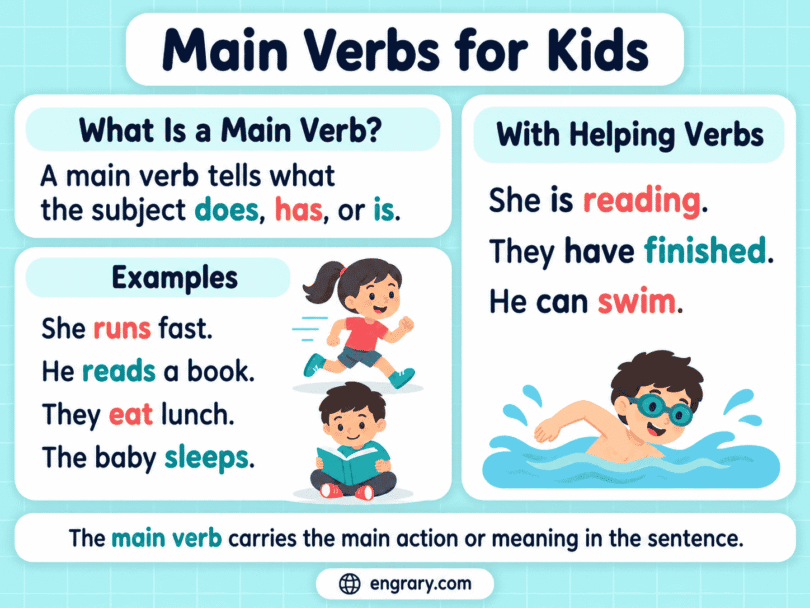
A main verb carries the central action or state meaning in a clause.
For example:
Mia runs.
Noah reads.
The baby slept.
She knows the answer.
In each sentence, the bold verb carries the main meaning.
The simple idea is:
main verb → tells the main action or state
Main Verbs Can Work Alone
Many sentences use a main verb without a helping verb.
Examples:
The dog barks.
Mia reads.
We laughed.
The baby slept.
Noah writes neatly.
The children played outside.
In these sentences, the main verb carries the meaning by itself.
For example:
Mia reads.
The verb reads tells the main action. No helping verb is needed.
Main Verbs Can Work With Helping Verbs
A main verb can also appear with one or more helping verbs.
| Sentence | Helping Verb | Main Verb |
|---|---|---|
| She is reading. | is | reading |
| They have finished. | have | finished |
| Noah can swim. | can | swim |
| We will travel tomorrow. | will | travel |
| Mia was drawing. | was | drawing |
| The children are playing. | are | playing |
The helping verb adds grammatical information, while the main verb carries the central meaning.
For example:
She is reading.
is helps form the verb phrase.
reading tells the main action.
Common Main Verbs Kids Use
Children use many common main verbs in everyday speech and writing.
Examples include:
- run
- walk
- read
- write
- eat
- drink
- sleep
- play
- build
- carry
- swim
- draw
- like
- need
- want
- know
In sentences:
Mia writes a story.
The children build a tower.
Noah likes music.
We need help.
The dog runs quickly.
She wants some water.
These verbs carry the main meaning of their clauses.
Action and State Main Verbs
Main verbs do not always describe visible actions.
Some main verbs describe actions.
Others describe states, feelings, possession, or relationships.
| Action Main Verbs | State Main Verbs |
|---|---|
| run | know |
| write | like |
| build | need |
| swim | want |
| draw | belong |
| carry | own |
Examples:
The boy runs quickly.
She knows the answer.
Mia likes music.
The bag belongs to Noah.
He owns a bicycle.
Therefore, it is more accurate to say that a main verb carries the main action or state, not simply that it shows an action.
Main Verb vs Helping Verb
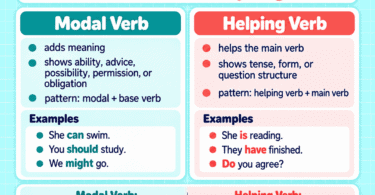
Main verbs and helping verbs perform different jobs.
| Main Verb | Helping Verb |
|---|---|
| carries the main meaning | supports the main verb |
| can often work alone | usually works with another verb |
| shows an action or state | adds tense, possibility, ability, or other grammar |
| read, run, know, build | is, have, can, will |
Compare:
She reads every night.
Here, reads is the main verb.
Now compare:
She is reading.
is is the helping verb.
reading is the main verb.
The key difference is:
main verb → main action or state
helping verb → supports the main verb
When Have, Do, and Be Change Jobs
Some common verbs can work as main verbs in one sentence and helping verbs in another.
Have
Main verb:
I have a bicycle.
Here, have means possess.
Helping verb:
I have finished my homework.
Here:
have = helping verb
finished = main verb
Do
Main verb:
I do my homework after dinner.
Here, do carries the main action.
Helping verb:
Do you like apples?
Here:
do = helping verb
like = main verb
Be
Main verb:
She is happy.
Here, is functions as the main linking verb.
Helping verb:
She is running.
Here:
is = helping verb
running = main verb
This shows why children should identify a verb by its job in the sentence rather than memorizing fixed lists.
How to Find the Main Verb in a Sentence
A simple method can help.
First, find the verb or verb phrase.
Next, ask:
Which verb carries the main action or state?
For example:
She is singing.
The main action is:
singing
So:
is = helping verb
singing = main verb
Another example:
They have eaten lunch.
The main action is:
eaten
So:
have = helping verb
eaten = main verb
One more:
Noah can jump high.
The main action is:
jump
So:
can = helping verb
jump = main verb
Do not simply choose the first verb in the sentence. Instead, look for the verb that carries the main meaning.
One Main Verb With More Than One Helping Verb
A main verb can have several helping verbs before it.
For example:
She might have finished.
Helping verbs:
- might
- have
Main verb:
- finished
Another example:
They may have been waiting.
Helping verbs:
- may
- have
- been
Main verb:
- waiting
The helping verbs add grammatical meaning, while the final main verb carries the central action.
Can a Linking Verb Be the Main Verb?
Yes.
A linking verb can function as the main verb of a sentence.
For example:
The soup is hot.
Here, is connects the soup with the description hot.
So is is:
- a linking verb;
- the main verb.
Compare:
The soup is boiling.
Here:
is = helping verb
boiling = main verb
Another example:
Mia seems tired.
The verb seems is both a linking verb and the main verb.
Therefore, main verb and linking verb are not opposite categories.
Main Verbs in Sentences
The following examples show main verbs working alone and with helping verbs.
| Sentence | Main Verb |
|---|---|
| Mia reads every night. | reads |
| The dog barked loudly. | barked |
| We are playing outside. | playing |
| Noah has finished his work. | finished |
| She can draw well. | draw |
| The children were laughing. | laughing |
| I need some water. | need |
| He owns a bicycle. | owns |
| Mia will sing tonight. | sing |
| They have arrived. | arrived |
| The soup is hot. | is |
| Noah likes football. | likes |
The number of verbs in the sentence may change, but the main verb carries the clause’s central meaning.
Main Verbs in Different Forms
A main verb can change form according to subject and tense.
For example:
play
She plays outside.
They played yesterday.
They are playing now.
Similarly:
write
Noah writes neatly.
Noah wrote yesterday.
Noah is writing now.
The form changes, but the verb still carries the main action.
Another example:
eat
The children eat lunch at noon.
Mia ate early.
Noah is eating now.
This section shows why the same main verb may appear in several forms.
Common Main Verb Mistakes
| Mistake | Correct Understanding |
|---|---|
| The first verb is always the main verb. | A helping verb may come before the main verb. |
| Main verbs only show actions. | They can also show states. |
| Is is always a helping verb. | It can also be a main linking verb. |
| Have is always a helping verb. | It can be a main verb or a helping verb. |
| Do is always a helping verb. | It can also carry the main action. |
| Every sentence needs a helping verb. | Many sentences use only a main verb. |
| Main verb and action verb mean exactly the same thing. | Main verbs can express actions, states, or linking relationships. |
For example:
She is running.
Here, is helps and running is the main verb.
By contrast:
She is happy.
Here, is is the main linking verb.
FAQs
A main verb carries the central action or state meaning in a clause. For example, reads is the main verb in Mia reads every night.
Common main verbs include run, read, write, eat, sleep, build, carry, swim, like, need, know, and want.
Find the verb or verb phrase, then identify the verb that carries the main action or state. In She is singing, singing is the main verb.
A main verb carries the main meaning, while a helping verb supports it. In They have finished, have is helping and finished is the main verb.
Yes. In The soup is hot, is functions as both the linking verb and the main verb.
You May Also Like