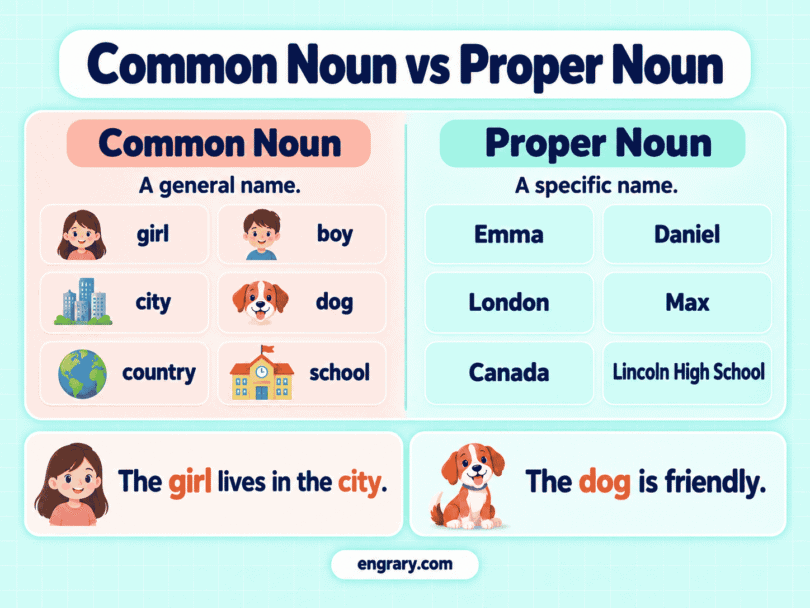
Common and proper nouns help children understand the difference between general names and specific names. Once learners recognize this difference, they can use capitalization more accurately and identify nouns more easily in sentences.
You’ll learn what common and proper nouns are, how they differ, and how general names connect to specific names. In addition, you’ll see easy comparison tables, examples for people, places, animals, things, days, months, holidays, and languages, along with sentence examples and common mistakes.

What Is a Common Noun?
A common noun gives a general name to a person, place, animal, thing, or idea.
Examples include:
- girl
- teacher
- city
- river
- dog
- school
- book
- country
For example:
The teacher opened the door.
We visited a city.
A dog barked outside.
In these sentences, the nouns give general names rather than identifying one specific person, place, or animal.
The basic idea is:
common noun → general name
Common nouns normally begin with lowercase letters. However, a common noun still takes a capital letter when it appears at the beginning of a sentence.
What Is a Proper Noun?
A proper noun gives the specific name of a particular person, place, organization, day, month, language, holiday, or other named entity.
Examples include:
- Emma
- London
- Nile
- Canada
- January
- English
- Christmas
- Pacific Ocean
For example:
Emma opened the door.
We visited London.
They crossed the Nile.
Unlike common nouns, proper nouns identify specific names.
The basic idea is:
proper noun → specific name
Proper nouns normally begin with capital letters.
Difference Between Common and Proper Nouns
The main difference between a common noun and a proper noun is whether the word gives a general name or a specific name.
| Feature | Common Noun | Proper Noun |
|---|---|---|
| Meaning | general name | specific name |
| Capitalization | usually lowercase | normally capitalized |
| Person example | girl | Emma |
| Place example | city | London |
| River example | river | Nile |
| Country example | country | Canada |
| Time example | month | January |
For example, city can refer to any city. By contrast, London identifies one specific city.
Similarly, girl gives a general name, while Emma gives the specific name of one person.
Therefore, the easiest way to remember the difference is:
common noun → general
proper noun → specific
Easy Common and Proper Noun Examples
The following table shows common nouns beside related proper nouns.
| Common Noun | Proper Noun |
|---|---|
| girl | Emma |
| boy | Noah |
| teacher | Mr. Adams |
| doctor | Dr. Lee |
| city | London |
| country | Canada |
| river | Nile |
| ocean | Pacific Ocean |
| mountain | Mount Everest |
| school | Greenfield School |
| park | Central Park |
| street | Oxford Street |
| continent | Asia |
| lake | Lake Victoria |
| month | January |
| day | Monday |
| holiday | Christmas |
| language | English |
| dog | Max |
| cat | Luna |
| horse | Star |
| planet | Saturn |
| company | Microsoft |
| university | Harvard University |
| ship | Titanic |
| newspaper | The Times |
These pairs show the relationship between a general category and a specific named member of that category.
For example:
river → Nile
Here, river is general, while Nile names one specific river.
Likewise:
dog → Max
The noun dog can refer to any dog, whereas Max names one particular dog.
Common and Proper Nouns for People
Common nouns for people name general roles, relationships, occupations, or groups. Proper nouns, however, identify specific people.
| Common Noun | Proper Noun |
|---|---|
| girl | Emma |
| boy | Noah |
| teacher | Mr. Adams |
| doctor | Dr. Lee |
| scientist | Albert Einstein |
| singer | Adele |
| writer | William Shakespeare |
| nurse | Nurse Carter |
For example:
The teacher entered the classroom.
Mr. Adams entered the classroom.
The first sentence uses a general occupational name. By contrast, the second identifies one specific teacher.
Similarly:
A scientist developed the idea.
Albert Einstein became a famous scientist.
A title can also form part of a proper name when it appears with a specific person’s name.
Common and Proper Nouns for Places
Place nouns create some of the clearest common-and-proper comparisons.
| Common Noun | Proper Noun |
|---|---|
| city | London |
| country | Canada |
| river | Nile |
| ocean | Pacific Ocean |
| mountain | Mount Everest |
| park | Central Park |
| school | Greenfield School |
| street | Oxford Street |
| continent | Asia |
| lake | Lake Victoria |
For example:
We visited a city.
We visited London.
Likewise:
The river flows through several regions.
The Nile flows through northeastern Africa.
In each pair, the common noun names the type of place, while the proper noun identifies one specific place.
Common and Proper Nouns for Animals and Things
Animals can have general names and individual names. In addition, some objects, products, ships, planets, and organizations have established proper names.
| Common Noun | Proper Noun |
|---|---|
| dog | Max |
| cat | Luna |
| horse | Star |
| parrot | Coco |
| planet | Saturn |
| ship | Titanic |
| company | Microsoft |
| newspaper | The Times |
For example:
The dog ran across the garden.
Max ran across the garden.
Similarly:
The planet has many rings.
Saturn has a well-known ring system.
The common noun identifies the category, whereas the proper noun gives a specific name.
Common and Proper Nouns for Days, Months, Holidays, and Languages
Names of specific days, months, holidays, and languages are proper nouns.
| General Category | Proper Name |
|---|---|
| day | Monday |
| month | January |
| holiday | Christmas |
| language | English |
| country | Canada |
| continent | Asia |
For example:
Our meeting is on Monday.
School begins again in January.
They celebrate Christmas in December.
Mia is learning English.
These words are proper nouns, so they normally begin with capital letters.
By contrast, general words such as day, month, holiday, and language are common nouns.
Capitalization of Common and Proper Nouns
Capitalization is one of the easiest ways to distinguish common and proper nouns.
The basic rule is:
common noun → usually lowercase
proper noun → normally capitalized
Compare:
The girl lives in London.
Our teacher visited Canada.
The river is called the Nile.
A common noun does not become a proper noun simply because it begins with a capital letter at the start of a sentence.
For example:
Teacher is the first word in this sentence.
Here, teacher is still a common noun even though sentence position requires a capital letter.
The following examples show common capitalization errors:
| Incorrect | Correct |
|---|---|
| london | London |
| january | January |
| canada | Canada |
| pacific ocean | Pacific Ocean |
| the Teacher | the teacher |
| the River | the river |
Therefore, capitalization helps identify proper nouns, but meaning still matters.
Common and Proper Nouns in Sentences
Common and proper nouns often appear together in the same sentence.
| Sentence | Common Noun | Proper Noun |
|---|---|---|
| Emma visited the park. | park | Emma |
| The teacher spoke to Noah. | teacher | Noah |
| We traveled to London by train. | train | London |
| The river is called the Nile. | river | Nile |
| Our school closes in June. | school | June |
| The dog named Max barked. | dog | Max |
| Luna slept on the chair. | chair | Luna |
| Canada is a large country. | country | Canada |
| Monday is a busy day for us. | day | Monday |
| Saturn is a planet. | planet | Saturn |
These examples show that one sentence can easily contain both noun types.
For instance:
Emma visited the library in London.
Proper nouns:
- Emma
- London
Common noun:
- library
Similarly:
Noah walked his dog through Central Park.
Proper nouns:
- Noah
- Central Park
Common noun:
- dog
Can a Common Noun Become Part of a Proper Name?
Yes. A common noun can become part of a full proper name when the complete expression identifies one specific person, place, organization, or other named entity.
Examples include:
park → Central Park
school → Greenfield School
river → Nile River
ocean → Pacific Ocean
street → Oxford Street
Consider:
The children played in the park.
Here, park is a common noun.
By contrast:
The children played in Central Park.
Here, Central Park is a proper noun because it identifies one specific park.
Similarly:
The school is nearby.
Greenfield School is nearby.
The first sentence uses a general name, while the second uses a specific name.
Common Mistakes With Common and Proper Nouns
Learners often confuse common and proper nouns because of capitalization or specificity.
| Incorrect | Correct | Reason |
|---|---|---|
| london | London | London is a specific city name |
| january | January | January is a month name |
| canada | Canada | Canada is a country name |
| pacific ocean | Pacific Ocean | specific ocean name |
| the Teacher entered | the teacher entered | teacher is used generally |
| Max the Dog | Max the dog | dog is a common noun |
| monday | Monday | day name is proper |
| english | English | language name is proper |
Another common mistake is assuming that every capitalized noun is proper.
For example:
River flows through the valley.
If River begins the sentence as a general noun, capitalization comes from sentence position rather than proper-noun status.
Similarly, not every specific description is automatically a proper noun. A proper noun normally functions as an established or conventional name.
FAQs
A common noun gives a general name, while a proper noun gives a specific name. For example, city is a common noun, whereas London is a proper noun.
Common noun examples include girl, teacher, city, river, dog, school, and month. Related proper nouns include Emma, Mr. Adams, London, Nile, Max, Greenfield School, and January.
Proper nouns normally begin with capital letters because they identify specific names. For example, country is common, while Canada is proper.
Yes. A common noun can form part of a proper name. For example, park is common, while Central Park is proper. Similarly, school is common, while Greenfield School is proper.
Yes. For example, Emma visited the library in London contains the proper nouns Emma and London and the common noun library.
You May Also Like