Nouns name people, places, animals, things, and ideas. Some nouns give a general name, while others give the exact name of a particular person, place, animal, organization, day, month, holiday, or event.
Learning the difference between common and proper nouns helps children choose capital letters correctly and make their writing more specific. This guide explains the main rules, useful examples, common mistakes, and practice activities with answers.

What Are Common and Proper Nouns?
A common noun gives a general name. A proper noun gives the specific name of a particular person, place, animal, thing, group, or event.
Compare:
- girl → Ava;
- city → Boston;
- dog → Max;
- school → Lincoln Elementary School;
- holiday → Thanksgiving.
The words on the left name general categories. The words on the right give actual names.
A Quick Review of Nouns
A noun is a word that names a:
- person;
- place;
- animal;
- thing;
- idea.
| Noun Type | Example |
|---|---|
| person | teacher |
| place | park |
| animal | rabbit |
| thing | pencil |
| idea | kindness |
Common and proper nouns belong to the same broad noun family. Their main difference is whether they give a general category or a specific name.
Common Nouns Give General Names
A common noun names a general person, place, animal, thing, or idea.
Examples include:
- girl;
- teacher;
- city;
- country;
- dog;
- river;
- school;
- holiday;
- kindness.
In sentences:
- The girl opened the door.
- Our teacher read a story.
- We visited a city.
- The dog slept near the window.
- The school has a library.
Common nouns usually begin with lowercase letters unless they appear at the beginning of a sentence or in a title.
Proper Nouns Give Specific Names
A proper noun gives the actual name of a specific person, place, animal, thing, group, day, month, holiday, book, movie, or event.
Examples include:
- Mia;
- Boston;
- Rover;
- Monday;
- July;
- Thanksgiving;
- Pacific Ocean;
- Lincoln Elementary School.
In sentences:
- Mia opened the door.
- We visited Boston.
- Rover slept near the window.
- School begins on Monday.
- Our school is Lincoln Elementary School.
Proper nouns begin with capital letters because they are names.
How Common and Proper Nouns Are Different
The easiest way to tell the two types apart is to ask whether the noun gives a general category or an actual name.
| Feature | Common Noun | Proper Noun |
|---|---|---|
| meaning | general name | specific name |
| capitalization | usually lowercase | begins with a capital letter |
| person | girl | Ava |
| place | city | Seattle |
| animal | dog | Max |
| organization | school | Lincoln Elementary School |
| time word | month | August |
A common noun tells what kind of person, place, animal, or thing something is. A proper noun tells its exact name.
For example:
Ava visited a city.
In this sentence:
- Ava is a proper noun because it is a person’s name;
- city is a common noun because it gives a general place category.
Capitalization Is a Clue
Capitalization helps children recognize proper nouns, but it is not the definition.
A noun is proper because it is a name. The capital letter shows that name in writing.
Compare:
We visited the park.
The word park is common because it names a general place.
We visited Central Park.
The words Central Park form a proper noun because they give the official name of a particular park.
Children should use this process:
- Find the noun.
- Ask whether it gives a general category or an actual name.
- If it is a name, capitalize it correctly.
- Check the whole sentence for context.
Common Noun Examples
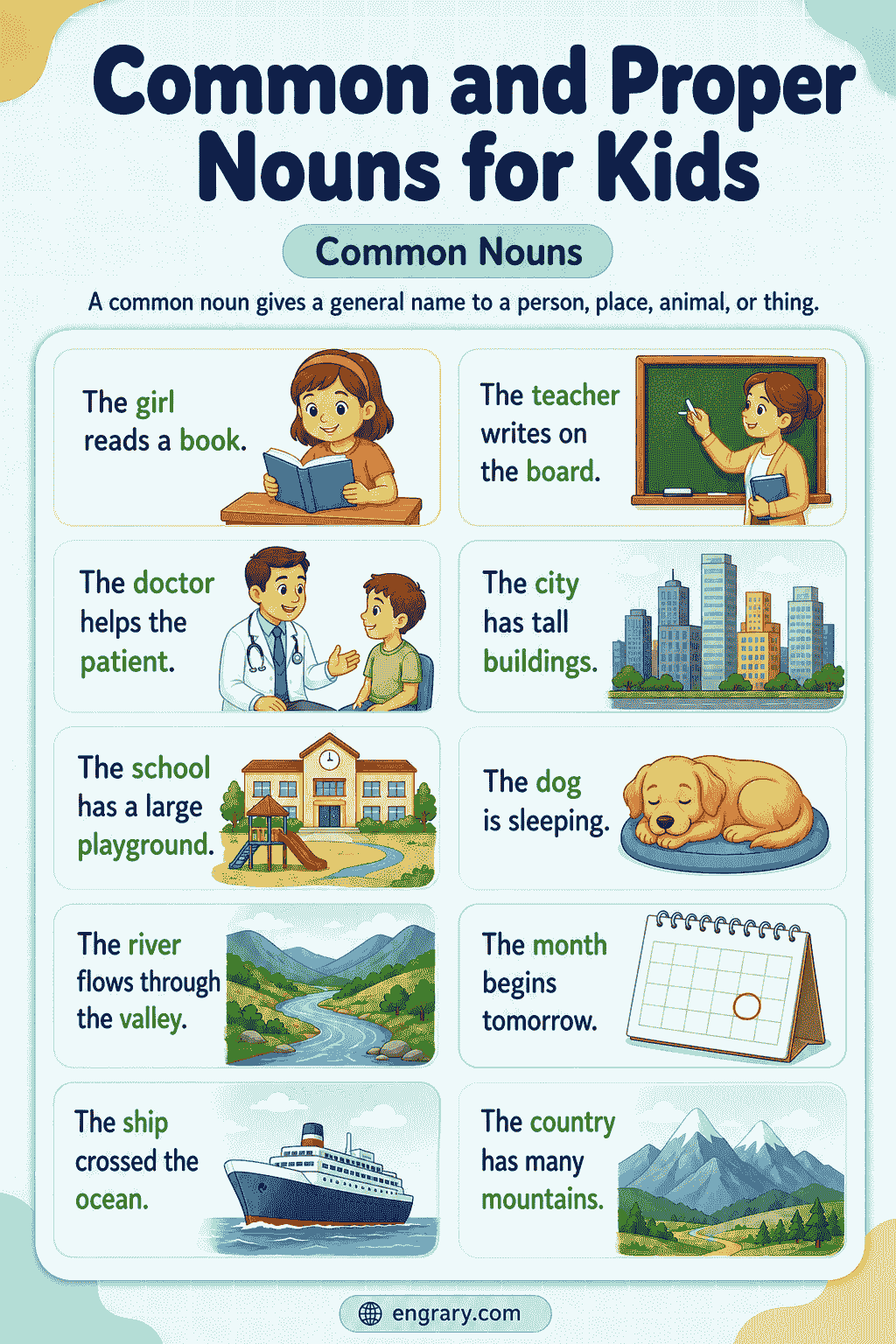
Common nouns appear in everyday speech and writing. They name broad categories instead of individual names.
Types of Common Nouns
| Category | Common Noun Examples |
|---|---|
| people | girl, boy, teacher, doctor, friend |
| places | city, school, park, river, country |
| animals | dog, cat, rabbit, horse, bird |
| things | book, chair, pencil, bicycle, computer |
| ideas | kindness, courage, happiness, honesty, friendship |
| time and events | day, month, holiday, festival |
Examples in sentences:
- The doctor spoke to the patient.
- A rabbit ran across the yard.
- We walked beside the river.
- Her kindness helped the new student.
- The holiday begins next week.
These nouns tell what something is, but they do not give its exact name.
Proper Noun Examples
Proper nouns identify particular people, animals, places, organizations, days, months, holidays, works, and events.
Names of People and Pets
Names of specific people are proper nouns.
Examples:
- Ava Johnson;
- Noah Carter;
- Mrs. Davis;
- Dr. Maya Chen;
- President Abraham Lincoln.
Names of pets are also proper nouns:
- Max;
- Whiskers;
- Snowball;
- Star.
Compare:
| Common Noun | Proper Noun |
|---|---|
| girl | Ava |
| teacher | Mrs. Davis |
| doctor | Dr. Chen |
| dog | Max |
| cat | Whiskers |
In sentences:
- The doctor entered the room.
- Dr. Chen entered the room.
- The dog is sleeping.
- Max is sleeping.
Places and Geographical Names
Names of particular places and geographical features are proper nouns.
Examples include:
- New York City;
- Texas;
- Canada;
- Central Park;
- Main Street;
- Pacific Ocean;
- Lake Erie;
- Rocky Mountains;
- Mississippi River.
General place words remain common nouns:
- city;
- state;
- country;
- park;
- street;
- ocean;
- lake;
- mountains;
- river.
Compare:
| General Place | Specific Place |
|---|---|
| city | Denver |
| country | Canada |
| park | Central Park |
| river | Mississippi River |
| lake | Lake Michigan |
| ocean | Atlantic Ocean |
When a category word forms part of the official name, it also begins with a capital letter.
Correct:
Mississippi River
Incorrect:
Mississippi river
Schools, Organizations, and Companies
Official names of schools, organizations, clubs, companies, and institutions are proper nouns.
Examples:
- Lincoln Elementary School;
- American Red Cross;
- National Geographic Society;
- Apple;
- Disney;
- Green Valley Library.
General descriptions remain common nouns:
- school;
- organization;
- company;
- club;
- library;
- museum.
Compare:
- Our school is nearby.
- We attend Lincoln Elementary School.
- The company created a new product.
- Apple created a new product.
Days, Months, and Holidays
Names of days, months, and holidays are proper nouns.
Days:
- Monday;
- Tuesday;
- Friday;
- Sunday.
Months:
- January;
- April;
- August;
- December.
Holidays:
- Thanksgiving;
- Memorial Day;
- New Year’s Day;
- Independence Day.
Examples:
- Our class meets on Monday.
- Mia’s birthday is in August.
- We visit family on Thanksgiving.
- The school is closed for Memorial Day.
General category words remain common nouns:
- day;
- month;
- holiday.
Languages and Nationalities
Names of languages and nationalities begin with capital letters.
Examples:
- English;
- Spanish;
- French;
- American;
- Canadian;
- Japanese.
In sentences:
- Ava speaks English and Spanish.
- Noah is American.
- We learned about Japanese culture.
- The class read a French folktale.
These words may sometimes describe nouns, but they still begin with capital letters because they come from proper names.
Books, Movies, and Named Events
Titles of books, movies, and named events act as proper names.
Examples:
- Charlotte’s Web;
- Toy Story;
- The Lion King;
- Earth Day;
- the Summer Olympics;
- World War II.
The main words in a title usually begin with capital letters.
Examples in sentences:
- Our class read Charlotte’s Web.
- We watched Toy Story.
- Students planted trees for Earth Day.
- Athletes competed in the Summer Olympics.
A general event word remains common:
We attended an event.
A named event is proper:
We attended the Summer Olympics.

Capitalizing Proper Nouns
Proper nouns need capital letters so readers can recognize names clearly.
Capitalizing Multiword Proper Nouns
A proper noun can contain more than one word.
Examples:
- New York City;
- Lincoln Elementary School;
- United States of America;
- Martin Luther King Jr. Day;
- Pacific Ocean.
Capitalize the important words in the full name.
Correct:
- New York City;
- Rocky Mountains;
- Green Valley Library.
Incorrect:
- New york city;
- rocky Mountains;
- Green valley library.
Young learners do not need every advanced title-capitalization rule. However, they should recognize that a complete name may contain several capitalized words.
Official Names and General Descriptions
A general description is a common noun. An official name is a proper noun.
| General Description | Official Name |
|---|---|
| the school | Lincoln Elementary School |
| the river | Colorado River |
| the park | Central Park |
| the hospital | Mercy Children’s Hospital |
| the museum | American Museum of Natural History |
Compare:
We visited the museum.
We visited the American Museum of Natural History.
The word museum is common in the first sentence. In the second sentence, it forms part of an official name and is capitalized.
Days and Months Versus Seasons
Days and months are proper nouns, but seasons are usually common nouns.
| Proper Nouns | Common Nouns |
|---|---|
| Monday | spring |
| July | summer |
| Friday | fall |
| December | winter |
Examples:
- School begins on Monday.
- We travel in summer.
- My birthday is in December.
- Snow often falls in winter.
Do not usually capitalize a season in an ordinary sentence.
Incorrect:
We swim in Summer.
Correct:
We swim in summer.
A season may use a capital letter when it forms part of an official title or event name, but that is a special case.
Common Nouns at the Beginning of Sentences
A common noun may begin with a capital letter because it starts a sentence.
Example:
School begins tomorrow.
The word School is capitalized because it is the first word in the sentence. It remains a common noun because it does not give a specific school’s name.
Another example:
Dogs need exercise.
The word Dogs is common even though it begins with a capital letter.
Therefore, children should not decide that a noun is proper only because its first letter is capitalized.
Words That Can Be Common or Proper
Some nouns can be common or proper depending on how they are used.
Context tells the reader whether the word gives a general role or acts as a name.
Family Words Used as Names
Family words are usually common nouns when they follow words such as:
- my;
- your;
- his;
- her;
- our;
- their.
Examples:
- my mom;
- your dad;
- her grandma;
- our uncle.
However, a family word becomes proper when it is used in place of the person’s name.
Compare:
- My mom is cooking.
- I asked Mom for help.
- Ava’s grandpa lives nearby.
- We visited Grandpa.
A helpful rule is:
Capitalize a family word when it is used as a name. Use lowercase when it follows a possessive word such as my, your, his, or her.
Titles Used With Names
A title is capitalized when it forms part of a person’s name.
Examples:
- Dr. Chen;
- Mrs. Davis;
- President Lincoln;
- Principal Carter.
Use lowercase when the title is general.
Compare:
- The doctor entered the room.
- Dr. Chen entered the room.
- Our principal spoke to the class.
- Principal Carter spoke to the class.
The title becomes part of the proper noun when it appears directly with the name.
How Context Changes the Noun Type
The same category word may be common in one sentence and part of a proper noun in another.
| Common Use | Proper Use |
|---|---|
| the park | Central Park |
| the river | Colorado River |
| the principal | Principal Davis |
| my mother | I asked Mother |
| the university | Boston University |
Compare:
The principal greeted the students.
The word principal is common because it gives a general job title.
Principal Davis greeted the students.
The phrase Principal Davis is proper because it identifies a particular person.

Common and Proper Nouns in Sentences
Complete sentences help children use meaning and context instead of relying only on capitalization.
Common and Proper Nouns in the Same Sentence
A sentence can contain both common and proper nouns.
Example:
Ava visited the museum in Chicago.
- Ava — proper noun;
- museum — common noun;
- Chicago — proper noun.
Another example:
Our class reads Charlotte’s Web on Friday.
- class — common noun;
- Charlotte’s Web — proper title;
- Friday — proper noun.
A third example:
Max followed the boy through Central Park.
- Max — proper noun;
- boy — common noun;
- Central Park — proper noun.
Making Sentences More Specific
Proper nouns make writing more exact.
General sentence:
The girl visited the city.
More specific sentence:
Ava visited Denver.
Another example:
The dog ran through the park.
More specific:
Max ran through Central Park.
Writers can replace general nouns with suitable proper nouns when exact names matter.
| General Noun | Specific Name |
|---|---|
| girl | Ava |
| city | Denver |
| dog | Max |
| school | Lincoln Elementary School |
| river | Mississippi River |
Specific names can make stories, descriptions, and reports clearer.

Common Mistakes With Common and Proper Nouns
Children often make capitalization mistakes when they rely only on the first letter or do not check the noun’s meaning.
| Incorrect | Correct | Explanation |
|---|---|---|
| ava | Ava | a person’s name is proper |
| new york city | New York City | important words in the place name are capitalized |
| monday | Monday | days are proper nouns |
| july | July | months are proper nouns |
| Summer | summer | seasons are usually common nouns |
| my Mom | my mom | lowercase after my |
| i asked mom | I asked Mom | family word used as a name |
| Mississippi river | Mississippi River | the category word is part of the official name |
| doctor chen | Dr. Chen | title used with a name is capitalized |
| central park | Central Park | both words belong to the official name |
A Capital Letter Does Not Always Mean Proper
A capital letter may appear because a word:
- begins a sentence;
- appears in a title;
- forms part of a proper noun.
For example:
Teacher gave us a new assignment.
The word Teacher begins the sentence, but it is still a common noun because it does not identify a particular teacher by name.
By contrast:
Mrs. Davis gave us a new assignment.
The words Mrs. Davis form a proper noun because they name a specific person.
Meaning comes first. Capitalization helps show the meaning correctly.
Common and Proper Nouns Practice for Kids
Complete the activities before checking the answer key.
Common or Proper?
Write common or proper.
- teacher
- Ava
- city
- Denver
- dog
- Max
- Monday
- month
- school
- Lincoln Elementary School
Match General Nouns With Specific Names
Match each common noun with a suitable proper noun.
- girl
- city
- dog
- school
- river
- holiday
a. Thanksgiving
b. Mississippi River
c. Ava
d. Max
e. Denver
f. Lincoln Elementary School
Capitalize the Proper Nouns
Rewrite each word or phrase correctly.
- noah
- texas
- monday
- july
- pacific ocean
- lincoln elementary school
- thanksgiving
- charlotte’s web
Find Common and Proper Nouns in Sentences
Identify each bold noun as common or proper.
- Mia visited the library.
- The dog followed Noah.
- Our class meets on Tuesday.
- We traveled to California in the summer.
- Max slept beside the chair.
- The students read Charlotte’s Web.
Capital Letter or Lowercase Letter?
Choose the correct form.
- Monday / monday
- Summer / summer
- Mom / mom in “I asked ___ for help.”
- Mom / mom in “My ___ is cooking.”
- School / school in “___ begins tomorrow.”
- Principal / principal in “Our ___ spoke.”
- Principal Carter / principal Carter
- English / english
Replace Common Nouns With Proper Nouns
Replace the bold common noun with a suitable proper noun.
- The girl opened the door.
- We visited the city.
- The dog ran through the yard.
- Our school has a large library.
- The boat crossed the river.
- We celebrate the holiday in November.
Replace Proper Nouns With Common Categories
Replace each proper noun with a matching common noun.
- Boston
- Monday
- Spanish
- Thanksgiving
- Max
- Lincoln Elementary School
Days, Months, Holidays, or Seasons?
Sort these words into four groups:
- Monday;
- August;
- winter;
- Thanksgiving;
- Friday;
- April;
- summer;
- Memorial Day.
Groups:
- days;
- months;
- holidays;
- seasons.
Family Word or Name?
Choose the correct form.
- My Mom / mom is reading.
- I asked Mom / mom for help.
- Ava’s Grandpa / grandpa lives nearby.
- We visited Grandma / grandma.
- His Dad / dad drives a bus.
- Dad / dad made breakfast.
Capitalize Titles Correctly
Rewrite each phrase correctly.
- doctor chen
- the Doctor
- principal carter
- our Principal
- president lincoln
- the President
Correct Capitalization Mistakes
Rewrite each sentence correctly.
- ava lives in texas.
- We visit central park on monday.
- My Mom speaks english.
- School begins in August and ends before Summer.
- doctor chen works at mercy children’s hospital.
- We read charlotte’s web on friday.
- I asked mom to visit the museum.
- The mississippi river is long.
Edit a Paragraph With Common and Proper Nouns
Correct the capitalization mistakes.
on monday, ava and noah visited central park with their dog max. Their teacher, mrs. davis, asked them to write about the park. Ava wrote that Summer was her favorite season. Noah wrote about the hudson river and new york city.
Write Sentences With Common and Proper Nouns
Write:
- one sentence with a common noun for a person;
- one sentence with a proper name for a person;
- one sentence with a common place noun and a proper place noun;
- one sentence with a day or month;
- one sentence using a family word as a name;
- one sentence containing both a common noun and a proper noun.
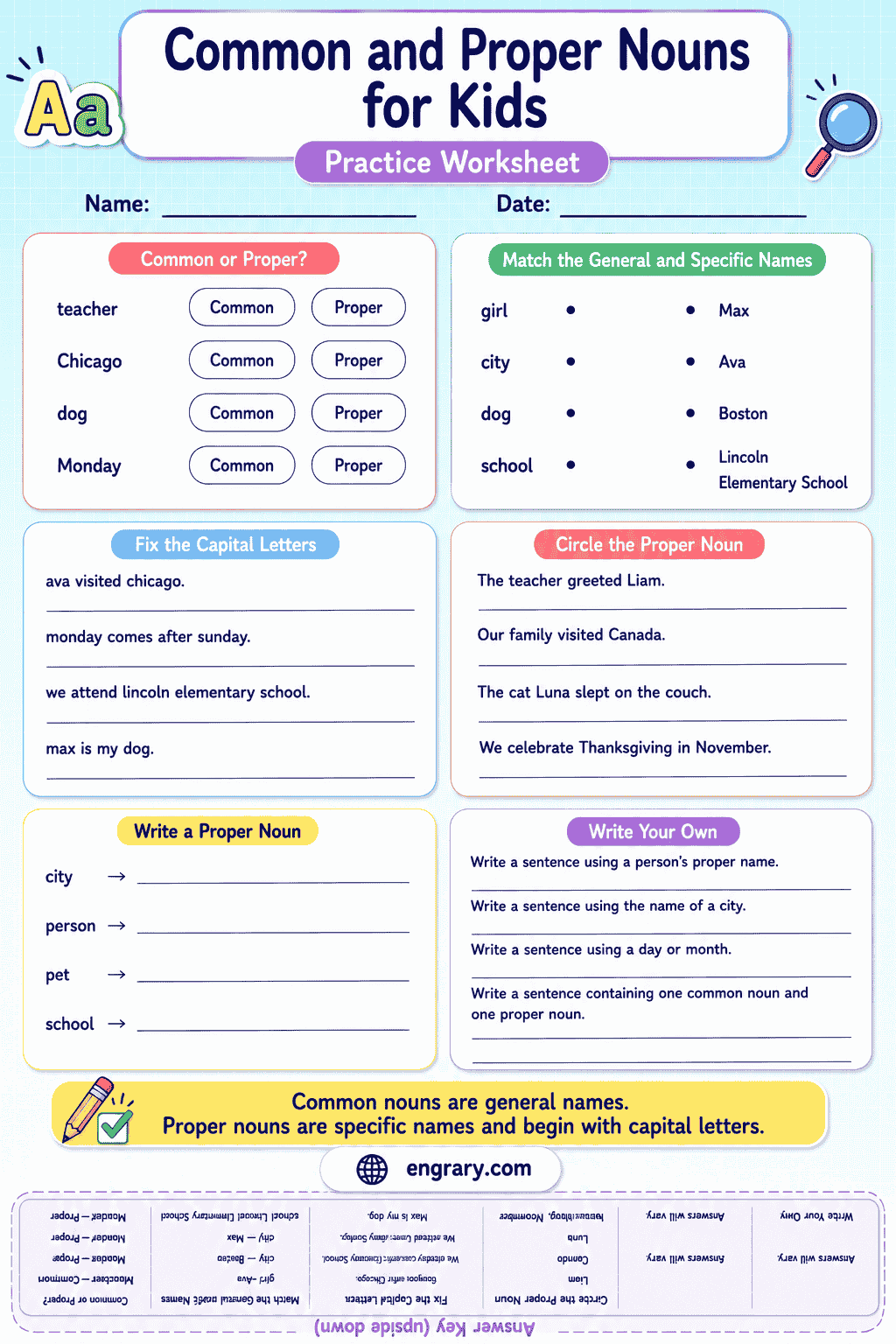
Common and Proper Nouns Practice Answer Key
Common or Proper?
- common
- proper
- common
- proper
- common
- proper
- proper
- common
- common
- proper
Match General Nouns With Specific Names
- girl — c. Ava
- city — e. Denver
- dog — d. Max
- school — f. Lincoln Elementary School
- river — b. Mississippi River
- holiday — a. Thanksgiving
Capitalize the Proper Nouns
- Noah
- Texas
- Monday
- July
- Pacific Ocean
- Lincoln Elementary School
- Thanksgiving
- Charlotte’s Web
Find Common and Proper Nouns in Sentences
- Mia — proper; library — common
- dog — common; Noah — proper
- class — common; Tuesday — proper
- California — proper; summer — common
- Max — proper; chair — common
- students — common; Charlotte’s Web — proper
Capital Letter or Lowercase Letter?
- Monday
- summer
- Mom
- mom
- School
- principal
- Principal Carter
- English
In item 5, School begins with a capital letter because it starts the sentence, but it remains a common noun.
Replace Common Nouns With Proper Nouns
Sample answers:
- Ava opened the door.
- We visited Denver.
- Max ran through the yard.
- Lincoln Elementary School has a large library.
- The boat crossed the Mississippi River.
- We celebrate Thanksgiving in November.
Other suitable proper nouns are acceptable.
Replace Proper Nouns With Common Categories
- city
- day
- language
- holiday
- dog
- school
Days, Months, Holidays, or Seasons?
Days
- Monday;
- Friday.
Months
- August;
- April.
Holidays
- Thanksgiving;
- Memorial Day.
Seasons
- winter;
- summer.
Family Word or Name?
- mom
- Mom
- grandpa
- Grandma
- dad
- Dad
Capitalize Titles Correctly
- Dr. Chen
- the doctor
- Principal Carter
- our principal
- President Lincoln
- the president
Correct Capitalization Mistakes
- Ava lives in Texas.
- We visit Central Park on Monday.
- My mom speaks English.
- School begins in August and ends before summer.
- Dr. Chen works at Mercy Children’s Hospital.
- We read Charlotte’s Web on Friday.
- I asked Mom to visit the museum.
- The Mississippi River is long.
Edit a Paragraph With Common and Proper Nouns
Corrected paragraph:
On Monday, Ava and Noah visited Central Park with their dog Max. Their teacher, Mrs. Davis, asked them to write about the park. Ava wrote that summer was her favorite season. Noah wrote about the Hudson River and New York City.
Write Sentences With Common and Proper Nouns
Sample answers:
- The teacher opened the book.
- Mrs. Davis opened the book.
- We visited a park called Central Park.
- Our class meets on Monday.
- I asked Mom for help.
- Ava carried a backpack to school.
Other answers are acceptable when the noun types and capital letters are correct.
FAQs
A common noun gives a general name, while a proper noun gives the exact name of a particular person, place, animal, thing, organization, or event. For example, city is common and Chicago is proper.
Proper nouns begin with capital letters because they are specific names. The capital letter helps readers recognize the name clearly.
Yes. A common noun begins with a capital letter when it starts a sentence or appears in a title. For example, School is still a common noun in the sentence “School begins tomorrow.”
Days and months are proper nouns, so words such as Monday and July need capital letters. Seasons such as spring, summer, fall, and winter are usually common nouns.
Yes. Context can change how a word is used. In my mom, the word mom is common. In I asked Mom, it acts as a name and becomes proper.
You May Also Like
- Nouns for Kids
- Proper Nouns for Kids
- Capitalization Rules for Kids
- Singular and Plural Nouns
- Possessive Nouns for Kids
- Concrete and Abstract Nouns
- Collective Nouns
- Countable and Uncountable Nouns