Nouns can name people, places, animals, objects, feelings, qualities, and ideas. Some nouns name things we can experience directly through our senses, while others name things we understand through thought or emotion.
Learning the difference between concrete and abstract nouns helps children classify words correctly and improve their writing. Concrete nouns add sensory detail, while abstract nouns express feelings, qualities, relationships, and important ideas.
What Are Concrete and Abstract Nouns?
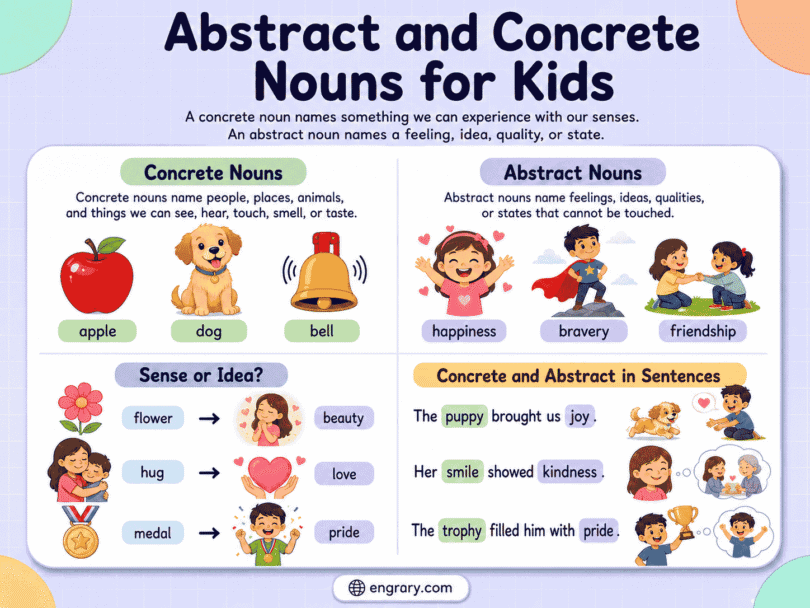
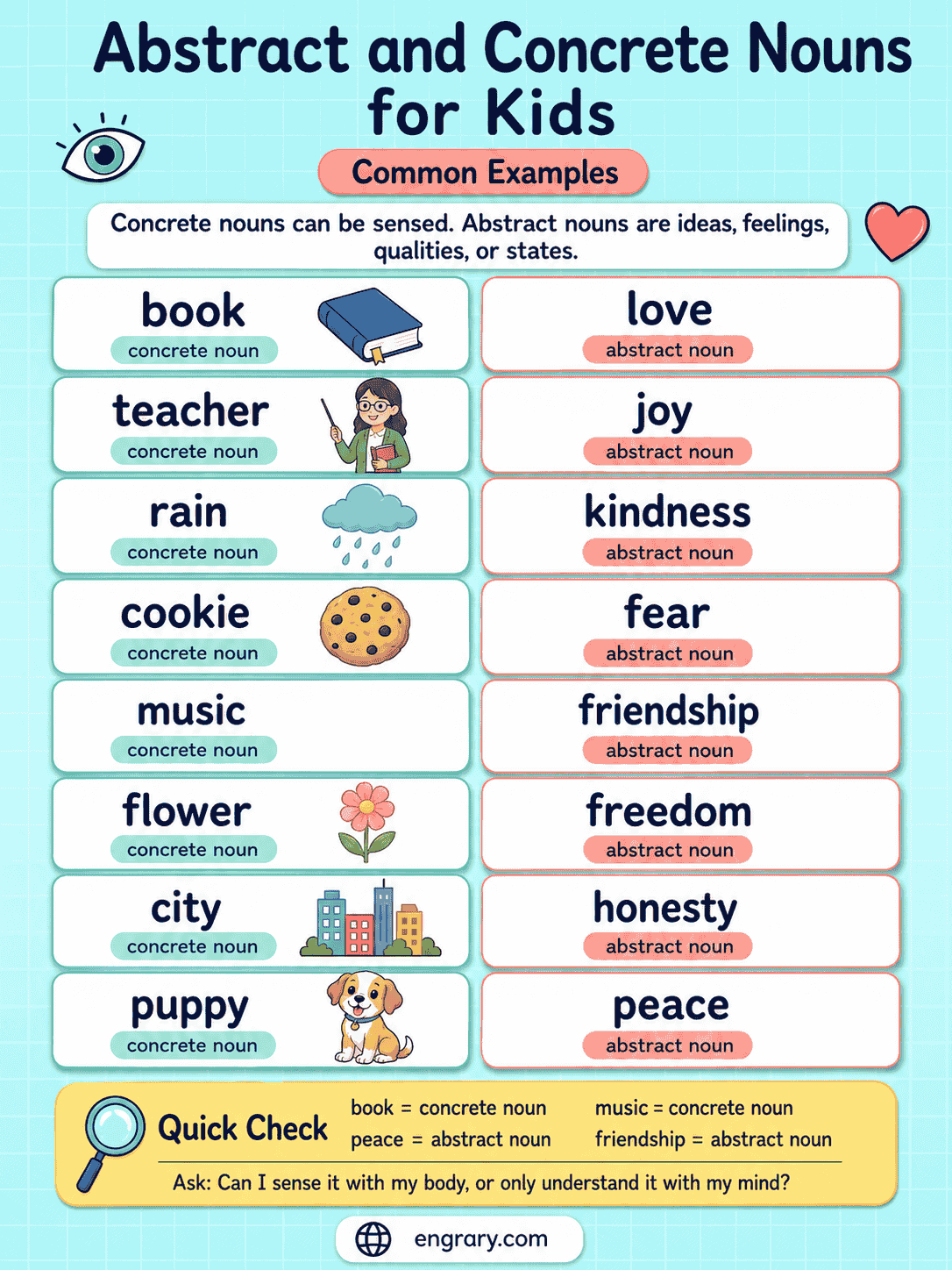
A concrete noun names something that can be directly experienced through sight, hearing, smell, taste, or touch.
An abstract noun names a feeling, quality, idea, state, relationship, or concept that does not have a separate physical form.
Compare:
- bell → sound we can hear;
- perfume → scent we can smell;
- blanket → object we can touch;
- happiness → feeling we understand;
- courage → quality a person may show;
- freedom → idea people can value.
A Quick Review of Nouns
A noun is a word that names a:
- person;
- place;
- animal;
- thing;
- idea.
| Noun Type | Example |
|---|---|
| person | teacher |
| place | park |
| animal | rabbit |
| thing | pencil |
| idea | honesty |
Concrete and abstract are two ways to classify nouns according to what they name.
Concrete Nouns Name Things We Can Sense
Concrete nouns name things that have a physical or sensory presence.
Examples include:
- child;
- dog;
- school;
- mountain;
- thunder;
- perfume;
- soup;
- warmth.
A concrete noun does not have to name something solid that can be held. It may name something detected through only one sense.
For example:
- thunder can be heard;
- perfume can be smelled;
- soup can be tasted;
- warmth can be felt;
- a rainbow can be seen.
Examples in sentences:
- The bell rang loudly.
- Smoke filled the kitchen.
- The lemon tasted sour.
- Warmth came from the fireplace.
- The blanket felt soft.
Abstract Nouns Name Nonphysical Ideas and Feelings
Abstract nouns name things that do not exist as separate physical objects.
They may name:
- emotions;
- qualities;
- ideas;
- states;
- conditions;
- relationships;
- processes.
Examples include:
- happiness;
- courage;
- freedom;
- honesty;
- childhood;
- friendship;
- growth;
- knowledge.
Examples in sentences:
- Ava showed great kindness.
- The team celebrated its success.
- Friendship requires trust.
- Noah faced the challenge with courage.
- Reading increases knowledge.
Abstract nouns are real. However, they cannot be directly seen, heard, smelled, tasted, or touched as separate physical things.
How Concrete and Abstract Nouns Are Different
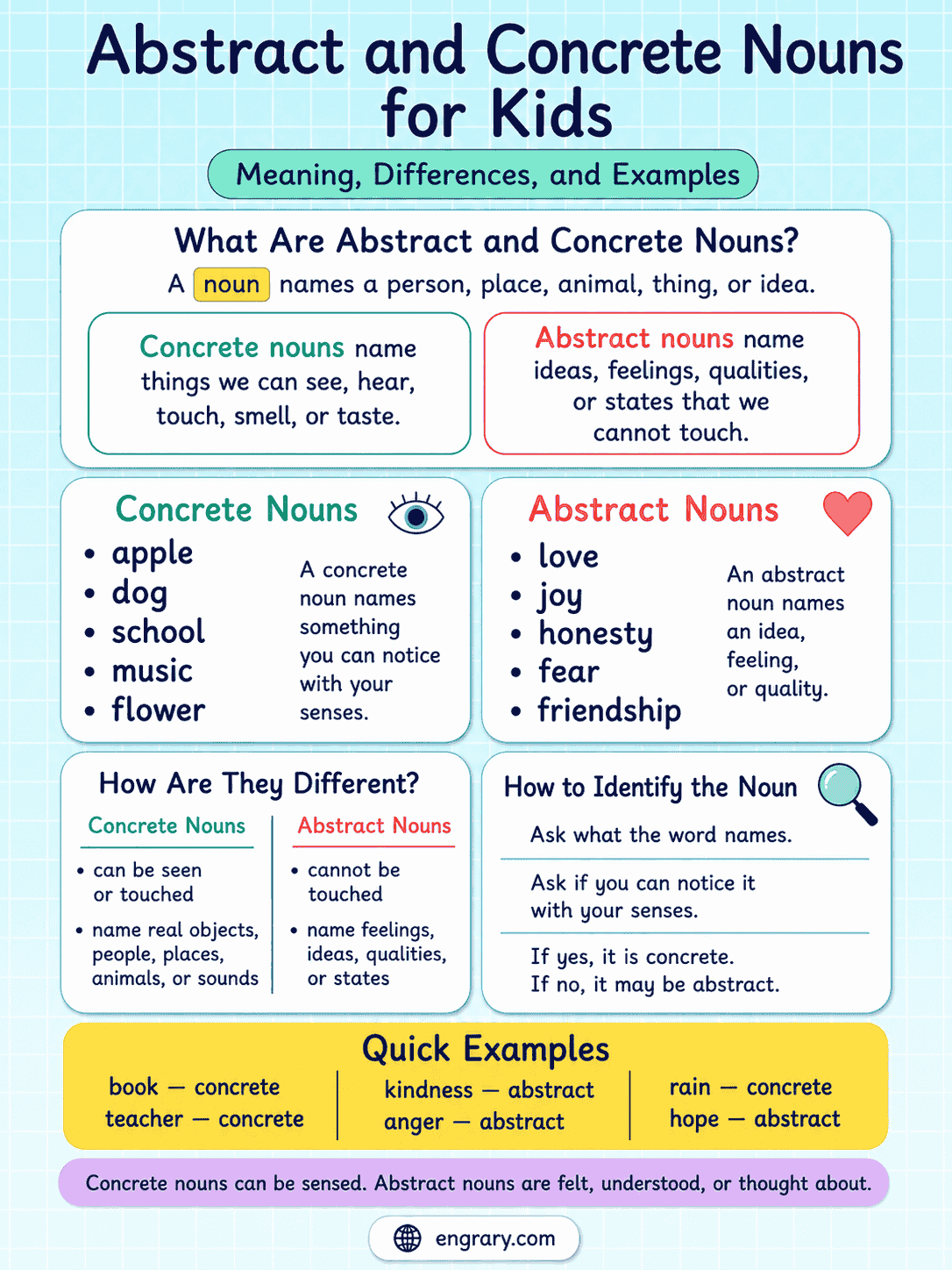
The main difference is whether the noun names something directly experienced through the physical senses.
| Feature | Concrete Noun | Abstract Noun |
|---|---|---|
| what it names | something physical or sensory | a nonphysical feeling, quality, idea, state, or relationship |
| how it is understood | directly through the senses | through thought, experience, or emotion |
| person and stage | child | childhood |
| object and idea | trophy | achievement |
| physical sign and feeling | smile | happiness |
| sound and quality | music | beauty |
| person and relationship | friend | friendship |
A concrete noun may represent an abstract idea without becoming abstract.
For example:
- a trophy may represent success;
- a gift may show generosity;
- a smile may reveal happiness.
The physical object or sign remains concrete. The meaning connected with it is abstract.
The Five-Senses Test
Children can use the five senses to identify many concrete nouns.
Ask:
Can I directly see, hear, smell, taste, or touch what this noun names?
If the answer is yes, the noun is usually concrete.
| Sense | Concrete Noun Examples |
|---|---|
| sight | rainbow, bird, mountain |
| hearing | thunder, bell, music |
| smell | perfume, smoke, aroma |
| taste | lemon, sugar, soup |
| touch | blanket, water, warmth |
A concrete noun does not need to connect with all five senses.
For example:
- thunder is mainly heard;
- a rainbow is mainly seen;
- perfume is mainly smelled.
Some concrete nouns connect with several senses. An apple can be seen, touched, smelled, and tasted.
Nouns Can Belong to Other Categories Too
Concrete and abstract are not the only noun classifications.
A noun may belong to several categories at the same time.
Examples:
- dog is concrete, common, singular, and countable;
- Ava is concrete, proper, and singular;
- happiness is abstract and common;
- friendships is abstract, common, plural, and countable in some contexts.
Calling a noun concrete or abstract does not stop it from being common, proper, singular, plural, or another noun type.
Concrete Noun Examples
Concrete nouns include more than ordinary objects. They can name people, places, animals, substances, sounds, smells, tastes, and physical sensations.
People, Places, Animals, and Objects
People have a physical presence, so nouns naming people are concrete.
Examples:
- child;
- teacher;
- doctor;
- Ava;
- Noah.
Places are also concrete because they can be physically experienced.
Examples:
- park;
- library;
- city;
- Boston;
- classroom.
Animals are concrete nouns too.
Examples:
- dog;
- rabbit;
- eagle;
- dolphin;
- Max.
Physical objects and materials include:
- table;
- pencil;
- bicycle;
- computer;
- water;
- sand;
- wood;
- milk.
| Category | Concrete Noun Examples |
|---|---|
| people | teacher, child, Ava |
| places | park, school, Chicago |
| animals | dog, rabbit, eagle |
| objects | book, chair, bicycle |
| substances | water, sand, milk |
Both common and proper nouns may be concrete.
- girl is concrete and common;
- Mia is concrete and proper;
- city is concrete and common;
- Denver is concrete and proper.
Sounds, Smells, Tastes, and Sensations
Children sometimes think concrete nouns must name objects they can hold. However, anything directly experienced through a physical sense may be concrete.
Concrete nouns connected with hearing include:
- thunder;
- music;
- noise;
- laughter;
- whistle.
Concrete nouns connected with smell include:
- perfume;
- smoke;
- aroma;
- scent.
Concrete nouns connected with taste include:
- sweetness;
- salt;
- lemon;
- soup;
- chocolate.
Concrete nouns connected with touch or physical sensation include:
- warmth;
- cold;
- water;
- wind;
- blanket.
Examples in sentences:
- Thunder shook the windows.
- Soft music filled the room.
- The aroma of bread came from the kitchen.
- The lemon had a sour taste.
- The sun’s warmth reached the porch.
These nouns may be difficult to hold, but they can be directly experienced through the senses.
Abstract Noun Examples
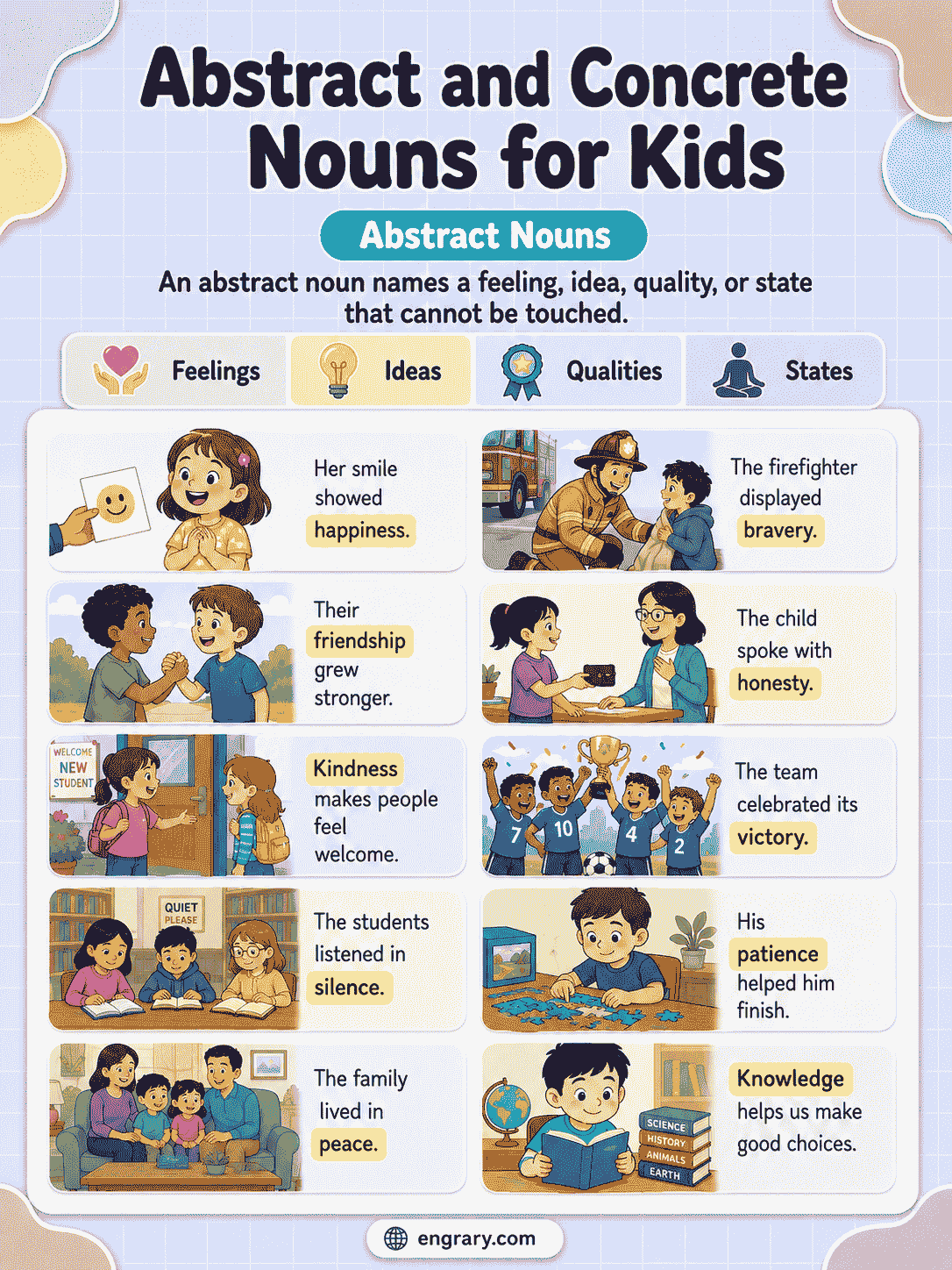
Abstract nouns cover much more than emotions. They can name qualities, beliefs, conditions, relationships, and stages of life.
Feelings and Emotions
Abstract nouns often name emotions.
Examples include:
- happiness;
- sadness;
- anger;
- fear;
- excitement;
- love;
- pride;
- hope.
Examples in sentences:
- Mia felt great happiness.
- The sudden noise caused fear.
- Noah spoke with pride.
- The family never lost hope.
- The children could not hide their excitement.
A person may show an emotion through an action or expression, but the emotion itself remains abstract.
Qualities and Traits
Abstract nouns can name personal qualities.
Examples include:
- honesty;
- kindness;
- bravery;
- patience;
- wisdom;
- generosity;
- loyalty;
- creativity.
Examples:
- Ava showed honesty by telling the truth.
- The firefighter acted with bravery.
- Teaching young children requires patience.
- His generosity helped the community.
- The dog’s loyalty impressed the family.
Qualities can influence behavior, but they do not have separate physical forms.
Ideas and Concepts
Ideas and concepts are abstract nouns.
Examples include:
- freedom;
- justice;
- truth;
- peace;
- equality;
- education;
- knowledge;
- responsibility.
Examples in sentences:
- Everyone deserves freedom.
- The class discussed justice.
- Reading builds knowledge.
- The two groups worked for peace.
- Students learned the value of responsibility.
People may discuss, protect, or value these ideas, but they cannot touch them like physical objects.
States and Relationships
Abstract nouns may also name stages, conditions, or relationships.
Examples include:
- childhood;
- health;
- safety;
- sleep;
- poverty;
- friendship;
- teamwork;
- trust;
- leadership.
Examples:
- Childhood can be full of discovery.
- Regular exercise supports good health.
- The school made student safety a priority.
- Strong friendship grows through trust.
- The players used teamwork.
- Good leadership helped the group succeed.
Children may see evidence of these states and relationships, but they do not see the abstract noun itself.
Physical Signs Versus Abstract Ideas
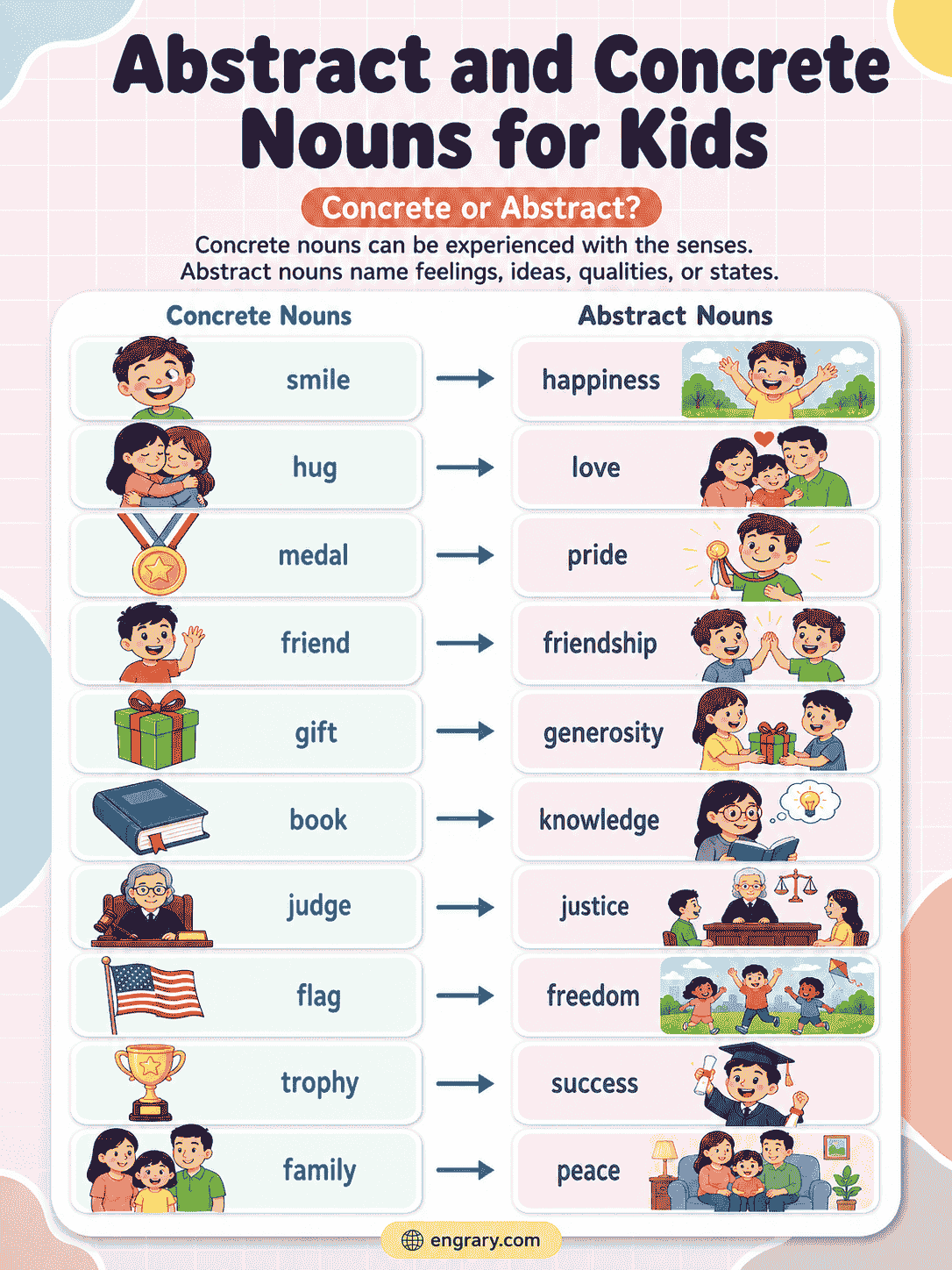
A physical sign may show an abstract feeling, quality, or idea. However, the sign and the meaning are not the same noun type.
Concrete Signs and the Ideas They Show
| Concrete Sign or Object | Abstract Idea or Feeling |
|---|---|
| smile | happiness |
| tears | sadness |
| trophy | achievement |
| hug | love |
| gift | generosity |
| handshake | agreement |
| medal | success |
Consider a smile. A child can see the smile, so smile is concrete. The smile may show happiness, but happiness is abstract.
Similarly:
- tears are concrete, while sadness is abstract;
- a trophy is concrete, while achievement is abstract;
- a hug is concrete, while love is abstract;
- a medal is concrete, while success is abstract.
Examples in sentences:
Ava held the trophy with pride.
- Ava — concrete;
- trophy — concrete;
- pride — abstract.
Noah gave his friend a hug to show gratitude.
- Noah — concrete;
- friend — concrete;
- hug — concrete;
- gratitude — abstract.
This distinction helps children avoid classifying an abstract noun by the physical evidence connected to it.
Words That Change With Context
Some words can have different meanings or perform different jobs depending on the sentence.
How Context Changes a Word
Consider the word love:
I love my family.
Here, love is a verb because it expresses an action or feeling.
Their love was strong.
Here, love is an abstract noun because it names a feeling.
Now consider light:
The lamp gave off light.
Here, light is a concrete noun because it can be seen.
Her explanation brought light to the problem.
Here, light is used figuratively to suggest understanding.
Another example is sound:
The bell made a loud sound.
Here, sound is a concrete noun because it can be heard.
That idea sounds helpful.
Here, sounds is a verb.
Children should read the complete sentence before deciding how a word is being used.
Forming Abstract Nouns
Many abstract nouns come from adjectives or verbs. Common endings can help children recognize them.
However, not every adjective or verb changes in the same way, so unfamiliar forms may need to be learned individually.
Abstract Nouns Made From Adjectives
An adjective describes a noun. Some adjectives can change into abstract nouns.
| Adjective | Abstract Noun |
|---|---|
| kind | kindness |
| happy | happiness |
| brave | bravery |
| honest | honesty |
| loyal | loyalty |
| patient | patience |
| wise | wisdom |
Examples:
- kind → kindness;
- brave → bravery;
- honest → honesty.
In sentences:
- Ava is kind.
- Ava showed kindness.
Another pair is:
- The firefighter was brave.
- The firefighter showed bravery.
Common abstract-noun endings include:
- -ness;
- -ity;
- -y;
- -ence;
- -dom.
These endings can be helpful clues, but children should not add them randomly to every adjective.
Abstract Nouns Made From Verbs
Some verbs can change into abstract nouns.
| Verb | Abstract Noun |
|---|---|
| decide | decision |
| educate | education |
| move | movement |
| grow | growth |
| arrive | arrival |
| discover | discovery |
| agree | agreement |
Examples in sentences:
- The students decided quickly.
- Their decision surprised the teacher.
Another pair is:
- The plant grew rapidly.
- Its growth was easy to see.
Common endings include:
- -tion;
- -ment;
- -al;
- -th;
- -ery.
These changes can support vocabulary and spelling, but they do not follow one rule that works for every word.
Concrete and Abstract Nouns in Sentences
Complete sentences help children understand how concrete and abstract nouns work together.
Concrete and Abstract Nouns in the Same Sentence
A sentence may contain both types.
The child held the trophy with pride.
- child — concrete;
- trophy — concrete;
- pride — abstract.
Music filled the room with happiness.
- music — concrete because it can be heard;
- room — concrete;
- happiness — abstract.
Ava gave her friend a gift to show gratitude.
- Ava — concrete;
- friend — concrete;
- gift — concrete;
- gratitude — abstract.
The team lifted the medal after its victory.
- team — concrete because it names people;
- medal — concrete;
- victory — abstract.
Children should examine what each noun names rather than classifying the entire sentence as one type.
How Concrete Nouns Add Sensory Detail
Concrete nouns help readers picture, hear, smell, taste, or feel a scene.
Vague sentence:
Something made a noise outside.
More specific sentence:
Thunder shook the windows.
Another vague sentence:
There was food in the kitchen.
More specific sentence:
Soup bubbled beside a loaf of warm bread.
Concrete nouns make writing clearer by naming exact people, places, objects, sounds, smells, tastes, and textures.
Compare:
| General Sentence | Sentence With Concrete Detail |
|---|---|
| Something flew overhead. | An eagle flew overhead. |
| We heard a sound. | A whistle echoed across the field. |
| There was a smell. | The aroma of cinnamon filled the room. |

How Abstract Nouns Express Ideas and Feelings
Abstract nouns help writers express emotions, values, themes, and qualities.
Examples:
- Hope helped Mia continue.
- The team showed courage during the game.
- Noah valued his friend’s honesty.
- The neighbors worked together in peace.
- Their friendship became stronger.
Balanced writing often combines both types.
Noah held the medal with pride.
The concrete noun medal creates a clear image, while the abstract noun pride explains the emotion.
The family exchanged hugs and felt happiness after the reunion.
The nouns family and hugs are concrete. The noun happiness is abstract.
Common Mistakes With Concrete and Abstract Nouns
Children often make errors when they focus only on whether something can be touched or whether they can see evidence of it.
| Incorrect Idea | Better Explanation |
|---|---|
| Only touchable objects are concrete. | Anything directly experienced through a physical sense may be concrete. |
| Abstract nouns are not real. | They name real feelings, qualities, ideas, states, and relationships without separate physical forms. |
| Happiness is concrete because a smile can be seen. | The smile is concrete, but happiness is abstract. |
| Music is abstract because it cannot be held. | Music is concrete because it can be heard. |
| Every feeling word is a noun. | The word must perform the job of a noun in the sentence. |
| A noun can belong to only one category. | A noun may belong to several classifications at once. |
Concrete Nouns Are Not Only Things We Can Touch
Touch is only one of the five senses.
These are all concrete nouns:
- rainbow — seen;
- thunder — heard;
- perfume — smelled;
- sugar — tasted;
- warmth — felt.
A child cannot hold thunder or perfume’s aroma, but these nouns name sensory experiences.
Therefore, the better question is not:
Can I touch it?
Instead, ask:
Can I directly experience it through at least one physical sense?
Abstract Nouns Are Real but Nonphysical
Abstract does not mean imaginary or unimportant.
Ideas and feelings such as:
- love;
- justice;
- honesty;
- friendship;
- fear;
- knowledge;
are real parts of human life.
However, they do not exist as separate physical objects.
A child may see actions that show honesty, but the child does not see honesty itself. Likewise, people may experience friendship through conversations and shared activities, but friendship remains an abstract relationship.
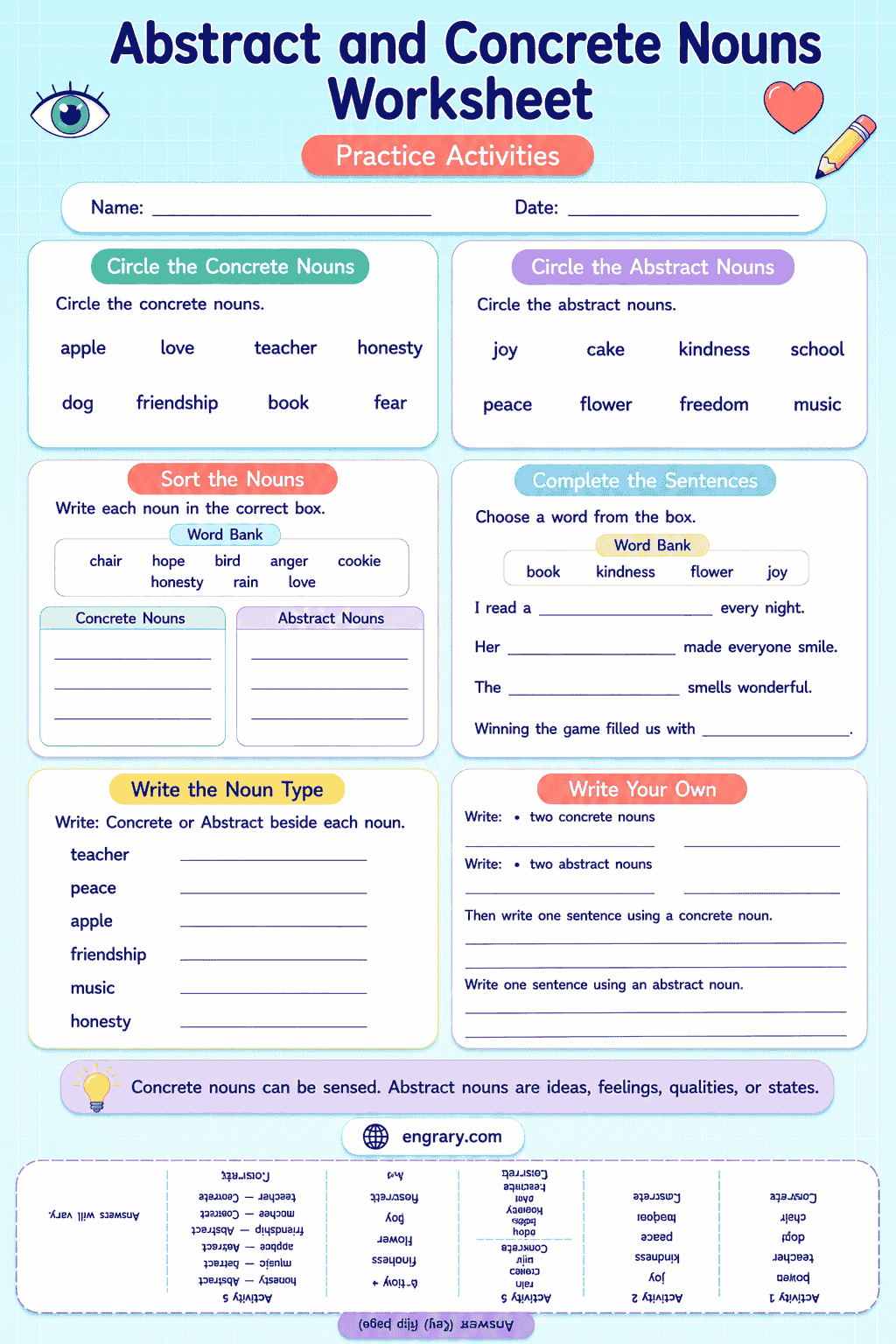
Concrete and Abstract Nouns Practice for Kids
Complete the activities before checking the answer key.
Concrete or Abstract?
Write concrete or abstract.
- apple
- happiness
- thunder
- courage
- teacher
- freedom
- perfume
- friendship
- blanket
- honesty
Sort Concrete Nouns by Sense
Place each noun under its clearest sense.
- rainbow;
- thunder;
- perfume;
- sugar;
- blanket;
- whistle;
- smoke;
- lemon;
- warmth;
- mountain.
Groups:
- sight;
- hearing;
- smell;
- taste;
- touch.
Sort Abstract Nouns by Type
Sort the nouns into the correct groups.
- joy;
- honesty;
- freedom;
- friendship;
- fear;
- bravery;
- justice;
- teamwork;
- happiness;
- patience;
- knowledge;
- trust.
Groups:
- feelings;
- qualities;
- ideas;
- relationships.
Find Concrete and Abstract Nouns in Sentences
Identify each bold noun as concrete or abstract.
- The child showed great kindness.
- Thunder filled the room with fear.
- Ava held the trophy with pride.
- The music brought happiness.
- The teacher praised Noah’s honesty.
- The team used courage and patience.
Physical Sign or Abstract Meaning?
Write concrete sign or abstract meaning.
- smile
- happiness
- tears
- sadness
- trophy
- achievement
- hug
- love
- medal
- success
Choose a Concrete or Abstract Noun
Choose the word that best completes each sentence.
- The ___ rang loudly.
bell / honesty - Ava showed great ___.
kindness / blanket - The ___ smelled sweet.
perfume / justice - The team celebrated its ___.
victory / pencil - Soft ___ filled the room.
music / courage - Strong ___ helped Noah continue.
hope / bicycle - The ___ tasted sour.
lemon / friendship - Good ___ helped the players cooperate.
teamwork / table
Form Abstract Nouns
Change each word into an abstract noun.
- kind
- happy
- brave
- honest
- decide
- educate
- grow
- agree
Use Context to Classify the Noun
Identify the bold word’s job and meaning.
- Their love was strong.
- I love my family.
- The lamp gave off light.
- The bell made a loud sound.
- That idea sounds helpful.
- The plant showed rapid growth.
Write:
- abstract noun;
- concrete noun;
- verb.
Add Concrete Details to Sentences
Replace the bold vague word with a suitable concrete noun.
- A thing flew over the trees.
- We heard a loud sound outside.
- A pleasant smell filled the kitchen.
- The child ate some food.
- Something soft covered the bed.
Add Abstract Nouns to Sentences
Complete each sentence with a suitable abstract noun.
- Ava showed ___ by telling the truth.
- The firefighters acted with ___.
- The friends built their relationship through ___.
- The team celebrated its ___.
- Noah continued because he had ___.
Correct Classification Mistakes
Rewrite each explanation correctly.
- Music is abstract because it cannot be touched.
- Happiness is concrete because a smile can be seen.
- Perfume is abstract because it cannot be held.
- A trophy is abstract because it represents achievement.
- Friendship is concrete because friends can be seen.
- Thunder is abstract because it is not an object.
Edit a Paragraph With Concrete and Abstract Nouns
Read the paragraph and list the bold nouns under concrete or abstract.
Ava carried a trophy into the classroom. Her pride was clear, and her classmates showed happiness. The teacher praised Ava’s effort, courage, and patience.
Write Sentences With Concrete and Abstract Nouns
Write:
- one sentence with a concrete noun for a person;
- one sentence with a concrete noun connected to sound;
- one sentence with an abstract feeling;
- one sentence with an abstract quality;
- one sentence containing both a concrete and an abstract noun;
- one sentence that uses a concrete sign to show an abstract feeling.
Concrete and Abstract Nouns Practice Answer Key
Concrete or Abstract?
- concrete
- abstract
- concrete
- abstract
- concrete
- abstract
- concrete
- abstract
- concrete
- abstract
Sort Concrete Nouns by Sense
Sight
- rainbow;
- mountain.
Hearing
- thunder;
- whistle.
Smell
- perfume;
- smoke.
Taste
- sugar;
- lemon.
Touch
- blanket;
- warmth.
Some concrete nouns can connect with more than one sense, but these answers use the clearest sense for each word.
Sort Abstract Nouns by Type
Feelings
- joy;
- fear;
- happiness.
Qualities
- honesty;
- bravery;
- patience.
Ideas
- freedom;
- justice;
- knowledge.
Relationships
- friendship;
- teamwork;
- trust.
Find Concrete and Abstract Nouns in Sentences
- child — concrete; kindness — abstract
- thunder — concrete; fear — abstract
- trophy — concrete; pride — abstract
- music — concrete; happiness — abstract
- teacher — concrete; honesty — abstract
- team — concrete; courage — abstract; patience — abstract
Physical Sign or Abstract Meaning?
- concrete sign
- abstract meaning
- concrete sign
- abstract meaning
- concrete sign
- abstract meaning
- concrete sign
- abstract meaning
- concrete sign
- abstract meaning
Choose a Concrete or Abstract Noun
- bell
- kindness
- perfume
- victory
- music
- hope
- lemon
- teamwork
Form Abstract Nouns
- kindness
- happiness
- bravery
- honesty
- decision
- education
- growth
- agreement
Use Context to Classify the Noun
- love — abstract noun
- love — verb
- light — concrete noun
- sound — concrete noun
- sounds — verb
- growth — abstract noun
Add Concrete Details to Sentences
Sample answers:
- An eagle flew over the trees.
- We heard loud thunder outside.
- The aroma of cinnamon filled the kitchen.
- The child ate a bowl of soup.
- A blanket covered the bed.
Other clear concrete nouns are acceptable.
Add Abstract Nouns to Sentences
Sample answers:
- Ava showed honesty by telling the truth.
- The firefighters acted with bravery.
- The friends built their relationship through trust.
- The team celebrated its victory.
- Noah continued because he had hope.
Other suitable abstract nouns are acceptable.
Correct Classification Mistakes
- Music is concrete because it can be heard.
- Happiness is abstract. A smile is a concrete sign that may show happiness.
- Perfume or its scent is concrete because it can be smelled.
- A trophy is concrete, while achievement is abstract.
- Friendship is abstract. Friends are concrete people.
- Thunder is concrete because it can be heard.
Edit a Paragraph With Concrete and Abstract Nouns
Concrete nouns
- Ava;
- trophy;
- classroom;
- classmates;
- teacher.
Abstract nouns
- pride;
- happiness;
- effort;
- courage;
- patience.
Write Sentences With Concrete and Abstract Nouns
Sample answers:
- The teacher opened the door.
- Thunder shook the windows.
- Mia felt happiness after the game.
- Noah showed honesty.
- The child held the medal with pride.
- Ava’s smile showed her excitement.
Other answers are acceptable when the nouns are classified correctly.
FAQs
A concrete noun names something directly experienced through sight, hearing, smell, taste, or touch. An abstract noun names a feeling, quality, idea, state, relationship, or concept without a separate physical form.
No. A concrete noun may be experienced through any physical sense. For example, thunder is heard, perfume is smelled, and warmth is felt.
No. Abstract nouns name real emotions, ideas, qualities, states, and relationships. They are called abstract because they do not exist as separate physical objects.
A smile is a concrete physical sign. Happiness is the abstract feeling that the smile may show. Seeing evidence of a feeling is not the same as directly seeing the feeling itself.
Yes. For example, Ava is concrete, proper, and singular. The noun dog is concrete, common, singular, and countable.
You May Also Like
- Nouns for Kids
- Common and Proper Nouns for Kids
- Concrete Nouns for Kids
- Abstract Nouns for Kids
- Singular and Plural Nouns
- Countable and Uncountable Nouns
- Collective Nouns
- Adjectives for Kids
- Descriptive Writing for Kids