Nouns help us name the people, animals, places, objects, events, feelings, qualities, and ideas we discuss every day. Words such as teacher, rabbit, school, pencil, birthday, kindness, and freedom are all nouns.
Although nouns may seem simple at first, they can take many forms and perform several jobs in sentences. This guide explains the main noun types, plural and possessive rules, countable and uncountable nouns, noun phrases, common mistakes, and practice activities with answers.

What Is a Noun?
A noun is a word that names a person, animal, place, object, substance, event, feeling, quality, or idea.
| What the noun names | Example |
|---|---|
| Person | teacher |
| Animal | rabbit |
| Place | library |
| Object | pencil |
| Substance | water |
| Event | birthday |
| Feeling | joy |
| Quality | kindness |
| Idea | freedom |
For example:
The teacher opened the book.
A rabbit ran through the garden.
Her kindness helped the class.
The birthday begins at noon.
The familiar definition “a noun names a person, place, or thing” gives children a useful starting point. However, it does not cover every noun because nouns can also name animals, materials, events, feelings, qualities, and ideas.
Some nouns name physical things:
- backpack;
- dog;
- school;
- table.
In contrast, other nouns name things that cannot be touched:
- courage;
- friendship;
- happiness;
- knowledge.
Nouns often tell readers who or what a sentence discusses. However, pronouns may sometimes replace them.
The dog barked.
Ava opened the door.
The children showed great courage.
In each example, the noun identifies an animal, object, or quality.
Finding Nouns in Sentences
Children can find nouns more accurately by using meaning and sentence clues together.
A Simple Noun-Finding Method
Follow these steps:
- Read the complete sentence.
- Look for names of people, animals, places, objects, substances, events, feelings, qualities, or ideas.
- Notice words such as a, an, the, this, my, or a number before the possible noun.
- Check whether an adjective describes the word.
- Decide what job the word performs.
Consider this sentence:
The cheerful student carried three books.
The nouns are:
- student, which names a person;
- books, which name objects.
Here, the introduces student, while cheerful describes it. Similarly, the number three introduces books.
Words such as a, an, the, this, and my are often called determiners because they introduce or point to nouns.
Determiners and Adjectives as Clues
Determiners and adjectives can help children locate nouns, but they do not prove that a word is a noun.
the very old house
In this phrase, house is the noun. Meanwhile, old describes the house, and very strengthens the adjective.
Another example is:
Her kindness impressed the teacher.
The nouns are:
- kindness, which names a quality;
- teacher, which names a person.
Therefore, children should ask what a word names and how it functions rather than assuming that every word after the is a noun.
Finding Several Nouns
A sentence may contain more than one noun.
Ava carried her backpack into the classroom.
The nouns are:
- Ava;
- backpack;
- classroom.
Although all three are nouns, they do not belong to exactly the same categories. Ava is a proper noun, while backpack and classroom are common nouns.
Main Types of Nouns
Nouns can be classified in several ways.
| Noun category | Question it answers | Example |
|---|---|---|
| Common or proper | Is the name general or specific? | city / Boston |
| Concrete or abstract | Can it be sensed, or is it an idea or quality? | bell / courage |
| Collective | Does it name a group? | team |
| Singular or plural | Does it name one or more than one? | book / books |
| Countable or uncountable | Can it be counted as separate units? | apple / water |
| Possessive | Does it show ownership or connection? | student’s |
| Compound | Is it formed from two or more words? | classroom |
These categories do not compete with one another. Instead, each label describes a different feature.
For instance:
The team’s uniforms were clean.
The noun team’s is:
- common;
- collective;
- singular;
- countable;
- possessive.
Likewise, Boston is a proper and singular noun that names a physical place.
Consequently, one noun may belong to several categories at the same time.
Common and Proper Nouns
A common noun gives a general name, whereas a proper noun gives a specific name.
| Common noun | Proper noun |
|---|---|
| girl | Ava |
| teacher | Ms. Carter |
| city | Denver |
| river | Colorado River |
| school | Lincoln Elementary School |
| month | October |
Compare:
The girl opened the door.
Ava opened the door.
The word girl names any girl, so it is common. By contrast, Ava names one specific person, so it is proper.
Another comparison is:
We visited a museum.
We visited the American Museum of Natural History.
Here, museum is general, while the full institution name is specific.
Capitalizing Proper Nouns
Proper nouns begin with capital letters. In addition, multiword names and titles capitalize the words required by standard naming and title rules.
Examples include:
- person: Jordan Lee;
- city: Seattle;
- state: California;
- country: United States;
- day: Monday;
- month: July;
- holiday: Thanksgiving;
- organization: National Park Service;
- book title: Charlotte’s Web.
Correct:
We traveled to California in June.
Incorrect:
We traveled to california in june.
Common nouns, however, remain lowercase unless they begin a sentence.
Correct:
We visited the library after school.
Incorrect:
We visited the Library after school.
Capital letters do not simply show importance. Rather, they mark specific names, titles, and other required forms.

Concrete and Abstract Nouns
Concrete nouns name things that people can detect through the senses. Abstract nouns, on the other hand, name feelings, ideas, qualities, conditions, or experiences.
| Concrete noun examples | Abstract noun examples |
|---|---|
| bell | freedom |
| child | childhood |
| friend | friendship |
| hero | courage |
| flower | beauty |
| thunder | happiness |
Concrete Nouns
Concrete nouns may be:
- seen;
- heard;
- touched;
- smelled;
- tasted.
For example:
We heard the thunder.
Thunder cannot be touched, but it can be heard. Therefore, it is concrete.
Other concrete nouns include:
- apple;
- perfume;
- teacher;
- music box;
- sand.
Abstract Nouns
Abstract nouns name things people understand or experience mentally rather than through touch or sight.
Her kindness encouraged everyone.
The noun kindness names a quality, so it is abstract.
Common abstract nouns include:
- bravery;
- childhood;
- courage;
- excitement;
- friendship;
- happiness;
- honesty;
- knowledge;
- peace;
- trust.
Compare:
The hero showed great courage.
The noun hero names a person and is concrete. Meanwhile, courage names a quality and is abstract.

Collective Nouns
A collective noun names a group of people, animals, or things.
Common examples include:
- audience;
- class;
- crowd;
- family;
- flock;
- group;
- herd;
- jury;
- team;
- committee.
For example:
The class entered the library.
A flock of birds flew over the field.
The team practices every afternoon.
Agreement with Collective Nouns
A collective noun is usually singular because it names one group.
In standard American English, a singular verb generally follows when the group acts as one unit.
The team is ready.
The family lives near the park.
The committee meets every Tuesday.
Although each group contains several members, the sentence presents those members as one unit.
Collective nouns are also common nouns because they provide general group names rather than specific ones.

Singular and Plural Nouns
A singular noun names one person, animal, place, object, or idea. In contrast, a plural noun names more than one.
| Singular | Plural |
|---|---|
| book | books |
| bus | buses |
| city | cities |
| child | children |
| sheep | sheep |
Examples:
One student entered the room.
Three students entered the room.
The first noun is singular, whereas the second is plural.
Regular Plural Nouns
Most plural nouns follow common spelling patterns.
| Ending or pattern | Plural rule | Example |
|---|---|---|
| most nouns | add -s | cat → cats |
| s, x, z, ch, sh | add -es | box → boxes |
| consonant + y | change y to ies | city → cities |
| vowel + y | add -s | toy → toys |
| some f or fe nouns | change to -ves | leaf → leaves |
| many f or fe nouns | add -s | roof → roofs |
Adding -s
Most nouns simply add -s.
book → books
pencil → pencils
rabbit → rabbits
Adding -es
Nouns ending in s, x, z, ch, or sh often add -es.
bus → buses
box → boxes
dish → dishes
watch → watches
Additionally, some words ending in a single z double the final letter.
quiz → quizzes
Changing y to ies
When a consonant appears before y, change y to ies.
city → cities
baby → babies
berry → berries
However, when a vowel comes before y, simply add -s.
toy → toys
key → keys
day → days
Plurals Ending in f or fe
Some nouns change f or fe to ves.
leaf → leaves
knife → knives
wife → wives
Nevertheless, many other nouns simply add -s.
roof → roofs
chief → chiefs
belief → beliefs
Because this pattern contains exceptions, children should learn common forms through regular reading and practice.
Irregular Plural Nouns
Irregular plurals do not follow the usual -s or -es pattern.
| Singular | Plural |
|---|---|
| child | children |
| person | people |
| man | men |
| woman | women |
| tooth | teeth |
| foot | feet |
| mouse | mice |
| goose | geese |
For example:
One child played outside.
Three children played outside.
Similarly:
The mouse ran behind the box.
Two mice hid under the table.
Some singular and plural forms remain identical.
| Singular | Plural |
|---|---|
| sheep | sheep |
| deer | deer |
| fish | fish in many common uses |
Therefore, the number or sentence context shows whether the noun is singular or plural.

Possessive Nouns
Possessive nouns show ownership, belonging, connection, or another close relationship.
Examples include:
- Ava’s notebook;
- the teacher’s desk;
- the dogs’ bowls;
- the children’s books.
A possessive noun does not always express literal ownership.
the school’s entrance
The school does not own the entrance like a person owns an object. Instead, the possessive form shows a close connection.
Singular Possessive Nouns
Add ’s to most singular nouns.
| Singular noun | Possessive form |
|---|---|
| student | student’s |
| teacher | teacher’s |
| dog | dog’s |
| child | child’s |
For example:
The student’s backpack is blue.
The dog’s collar is red.
Plural Possessive Nouns
For a regular plural noun already ending in s, add only an apostrophe.
| Plural noun | Possessive form |
|---|---|
| students | students’ |
| teachers | teachers’ |
| dogs | dogs’ |
Examples:
The students’ projects covered the wall.
The dogs’ bowls were full.
If an irregular plural does not end in s, add ’s.
| Irregular plural | Possessive form |
|---|---|
| children | children’s |
| people | people’s |
| men | men’s |
| women | women’s |
Thus:
The children’s books are on the shelf.
The women’s team won the game.
Plural and Possessive Nouns
Plural nouns and possessive nouns perform different jobs.
| Form | Meaning | Example |
|---|---|---|
| dog | one dog | The dog is sleeping. |
| dogs | more than one dog | The dogs are sleeping. |
| dog’s | belonging to one dog | The dog’s collar is red. |
| dogs’ | belonging to several dogs | The dogs’ bowls are full. |
A similar pattern appears with teacher:
| Form | Meaning |
|---|---|
| teacher | one teacher |
| teachers | more than one teacher |
| teacher’s | belonging to one teacher |
| teachers’ | belonging to several teachers |
Most importantly, apostrophes do not make ordinary nouns plural.
Incorrect:
Three cat’s slept outside.
Correct:
Three cats slept outside.
Incorrect:
The students books were on the table.
Correct:
The students’ books were on the table.

Countable and Uncountable Nouns
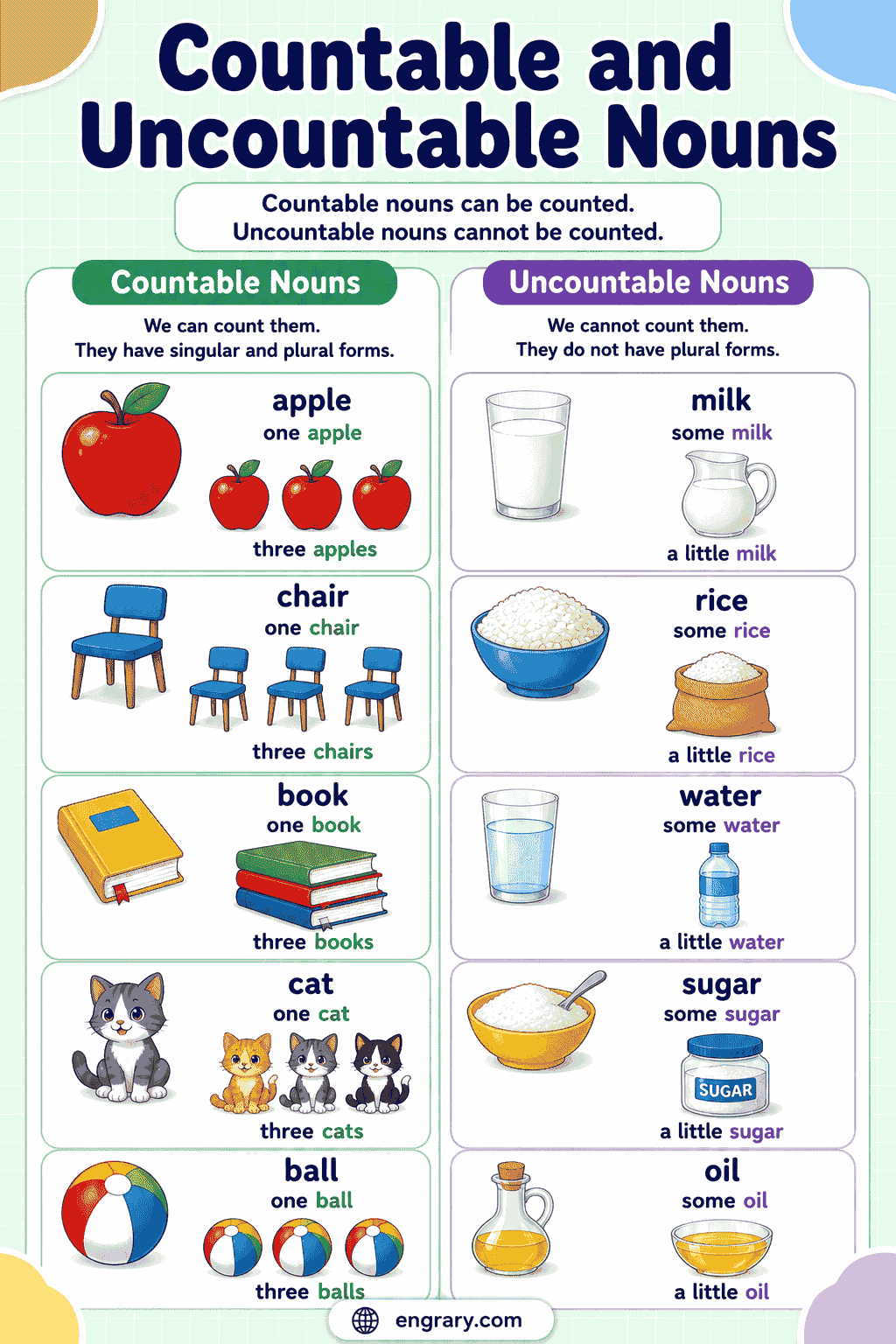
Countable nouns name things English treats as separate units. Therefore, they can normally use numbers and have singular and plural forms.
Uncountable nouns, by comparison, name substances, materials, information, activities, or broad ideas treated as masses rather than separate units.
| Countable nouns | Uncountable nouns |
|---|---|
| one apple, three apples | some rice |
| a chair, several chairs | some furniture |
| an idea, two ideas | some information |
| one bottle, four bottles | some water |
Words Used with Countable Nouns
Countable nouns can use:
- a or an;
- numbers;
- many;
- a few.
Examples:
a book
three books
many books
a few books
Words Used with Uncountable Nouns
Uncountable nouns often use:
- some;
- much;
- a little;
- a lot of;
- a unit expression.
Examples:
some water
much water
a little water
a glass of water
Compare the patterns:
| Countable nouns | Uncountable nouns |
|---|---|
| a book | some water |
| many books | much water |
| a few books | a little water |
| three books | a glass of water |
Common Countable and Uncountable Nouns
Common countable nouns include:
- apple;
- chair;
- idea;
- pencil;
- student;
- toy.
Meanwhile, common uncountable nouns include:
- advice;
- furniture;
- homework;
- information;
- milk;
- rice;
- traffic;
- water.
Incorrect:
an information
Correct:
some information
Or:
a piece of information
Incorrect:
two furnitures
Correct:
two pieces of furniture
Incorrect:
many homework
Although much homework is grammatical, it may sound formal in an affirmative sentence.
More natural:
a lot of homework
Another possible expression is:
several assignments
Unit Expressions
Unit expressions allow speakers to count portions or items connected to uncountable nouns.
| Uncountable noun | Countable expression |
|---|---|
| water | a glass of water |
| rice | a bowl of rice |
| information | a piece of information |
| furniture | a piece of furniture |
| advice | a piece of advice |
Therefore, instead of saying two furnitures, say two pieces of furniture.
Nouns That Can Be Countable or Uncountable
Some nouns change countability when their meaning changes.
| Uncountable meaning | Countable meaning |
|---|---|
| We ate chicken. | Three chickens crossed the road. |
| The table is made of glass. | Please bring two glasses. |
| I need paper. | I wrote three papers. |
| She has long hair. | I found a hair on my shirt. |
| Teaching takes experience. | The trip was an exciting experience. |
In:
We ate chicken.
the noun refers to food as a substance.
However, in:
Three chickens crossed the road.
the noun refers to individual animals.
Likewise, papers in “I wrote three papers” means written assignments or articles, not sheets of material. Similarly, two glasses refers to drinking containers rather than two amounts of the substance called glass.
Consequently, context determines the noun’s meaning and countability.
Compound Nouns
Compound nouns combine two or more words to name one person, place, object, or idea.
Examples include:
- classroom;
- toothbrush;
- bus stop;
- ice cream;
- mother-in-law.
Three Forms of Compound Nouns
| Form | Example |
|---|---|
| Closed | classroom |
| Open | bus stop |
| Hyphenated | mother-in-law |
A closed compound appears as one word.
classroom
notebook
sunlight
By contrast, an open compound appears as separate words.
bus stop
ice cream
post office
A hyphenated compound uses one or more hyphens.
mother-in-law
runner-up
Children should learn each compound noun’s standard spelling because no single rule determines which form it uses.
Plural Compound Nouns
Most compound nouns form the plural on the main word.
toothbrush → toothbrushes
bus stop → bus stops
mother-in-law → mothers-in-law
In mother-in-law, the main word is mother. Therefore, that word becomes plural.

Nouns in Sentences
A Noun can perform several jobs in sentences.
Nouns as Subjects
The subject tells who or what the sentence is mainly about. It may perform an action or receive a description.
The dog barked.
Here, dog performs the action.
Friendship matters.
In this example, friendship is the idea being discussed.
The sky is blue.
Here, sky receives a description after the linking verb.
Nouns as Direct Objects
A direct object receives the action of the verb.
Ava opened the door.
The noun door receives the action of opened.
Similarly:
Noah read the book.
The noun book receives the action of read.
Compare:
| Sentence job | Example |
|---|---|
| Subject | The dog chased the ball. |
| Direct object | The dog chased the ball. |
Nouns as Indirect Objects
An indirect object tells who receives or benefits from the direct object.
Mia gave Noah a pencil.
- Indirect object: Noah
- Direct object: pencil
The pencil is the object being given, while Noah receives it.
Nouns After Linking Verbs
A noun may identify or rename the subject after a linking verb.
Ava is a student.
Mr. Lee became the principal.
In both cases, the noun after the verb identifies the subject.
Nouns After Prepositions
A noun may also follow a preposition.
The book is on the desk.
We walked through the park.
The nouns desk and park are objects of prepositions.

Noun Phrases
A noun phrase contains a noun and the words that introduce, describe, or complete it.
Examples include:
- the small brown dog;
- three new library books;
- Ava’s bright red backpack;
- those two tall trees.
Finding the Head Noun
The main noun in a noun phrase is often called the head noun.
In:
three new library books
the head noun is books.
The other words explain:
- how many books;
- what kind of books;
- which books.
Likewise, in:
Ava’s bright red backpack
the head noun is backpack.
The remaining words show:
- whose backpack it is;
- what color it is.
Expanding Noun Phrases
Noun phrases help writers add useful detail.
Compare:
The dog barked.
The small brown dog barked.
The second sentence gives readers a clearer picture because the noun phrase includes descriptive words.
However, extra description should remain relevant. Too many adjectives can make a sentence difficult to read.
Nouns and Other Parts of Speech
A word’s part of speech depends on how it functions in a sentence.
Nouns and Pronouns
A pronoun can replace a noun or noun phrase.
Repetitive:
Ava found Ava’s notebook.
Improved:
Ava found her notebook.
The possessive word her refers back to Ava and avoids repeating Ava’s.
Another example is:
Noah carried the books. He placed them on the desk.
Here:
- He replaces Noah;
- them replaces books.
Nouns and Adjectives
An adjective describes a noun.
the bright light
- Adjective: bright
- Noun: light
Another example:
The happy child smiled.
The noun is child, whereas happy describes it.
Sometimes one noun modifies another noun.
the school bus
Both school and bus are nouns. However, school helps identify the kind of bus.
Similarly:
a chicken sandwich
Both words are nouns, but chicken gives more information about sandwich.
Nouns and Verbs
Some words can function as nouns or verbs.
| Noun use | Verb use |
|---|---|
| We went for a walk. | We walk every day. |
| I heard a ring. | The bells ring. |
| Her answer was correct. | Please answer the question. |
| Their play was funny. | The children play outside. |
In:
We went for a walk.
the word walk names an activity, so it is a noun.
However, in:
We walk every day.
the same word shows an action, so it is a verb.
Therefore, children should check how a word functions instead of classifying it from memory alone.
Common Noun Mistakes
Noun mistakes often involve capitalization, plural spelling, apostrophes, countability, or word identification.
Capitalizing Common Nouns
Incorrect:
We visited the Library after school.
Correct:
We visited the library after school.
Because library is a general name, it remains lowercase.
Forgetting Proper-Noun Capitals
Incorrect:
We traveled to california in june.
Correct:
We traveled to California in June.
Both corrected words are proper nouns.
Adding an Apostrophe to a Plural
Incorrect:
Three cat’s slept outside.
Correct:
Three cats slept outside.
An ordinary plural does not need an apostrophe.
Confusing Plural and Possessive Nouns
Incorrect:
The students books were on the table.
Correct:
The students’ books were on the table.
Because the books belong to several students, the apostrophe follows the plural s.
Using the Wrong Irregular Plural
Incorrect:
Two childs played outside.
Correct:
Two children played outside.
Another example is:
The mouses ran away.
Correct:
The mice ran away.
Using Uncountable Nouns Incorrectly
Incorrect:
She gave me an information.
Correct:
She gave me some information.
Another correct version is:
She gave me a piece of information.
Incorrect:
We bought new furnitures.
Correct:
We bought new furniture.
Incorrect:
There is many water.
Correct:
There is a lot of water.
Confusing Nouns and Adjectives
Consider:
The happy child smiled.
The noun is child, while happy is the adjective.
Incorrect identification:
happy is the noun
Correct identification:
child is the noun
Noun Practice with Answers
These activities help children identify nouns, classify noun types, form plurals and possessives, and correct common errors.

Identify the Nouns
Find all the nouns in each sentence.
- The teacher opened the book.
- A rabbit ran through the garden.
- Ava carried her backpack into the classroom.
- Kindness can change a friendship.
- The birthday begins at noon.
Sort What Each Noun Names
Choose from:
person · animal · place · object · event · feeling, quality, or idea
- teacher
- rabbit
- library
- pencil
- birthday
- courage
- friendship
- horse
Common or Proper Noun
Choose common or proper.
- city
- Denver
- teacher
- Ms. Carter
- river
- Colorado River
- Monday
- month
Correct the Capitalization
- We traveled to california in june.
- ava attends lincoln elementary school.
- My favorite holiday is thanksgiving.
- We visited the library on monday.
- jordan lee lives in seattle.
Concrete or Abstract Noun
Choose concrete or abstract.
- apple
- honesty
- thunder
- courage
- dog
- happiness
- flower
- knowledge
Identify the Collective Noun
Find the collective noun.
- The team practiced after school.
- A flock of birds flew over the field.
- The class entered the library.
- The crowd cheered loudly.
- Our family visits every summer.
Choose the Collective-Noun Verb
Choose the correct verb for standard American English.
- The team is / are ready.
- The class begins / begin at 9:00.
- The committee meets / meet every Tuesday.
- The family lives / live near the park.
Singular or Plural
Choose singular or plural.
- child
- children
- books
- mouse
- sheep in “five sheep”
- city
- women
- toy
Form the Regular Plural
- book
- box
- city
- toy
- leaf
- dish
- key
- knife
- quiz
Complete the Irregular Plural
- child → ______
- person → ______
- tooth → ______
- foot → ______
- mouse → ______
- goose → ______
- sheep → ______
- woman → ______
Form the Possessive Noun
- the backpack belonging to one student
- the books belonging to several students
- the toys belonging to the children
- the desk belonging to one teacher
- the team made up of women
Choose the Correct Noun Form
- The dog / dog’s collar is red.
- Three dogs / dog’s played outside.
- The dogs / dogs’ bowls were full.
- The desk belonging to one teacher was clean: teacher’s / teachers’
- The students / students’ projects covered the wall.
- The childrens / children’s books were new.
Countable or Uncountable
Choose countable or uncountable.
- apple
- water
- chair
- furniture
- idea
- information
- pencil
- rice
Choose the Correct Quantity Expression
- a / some information
- many / much books
- a few / a little water
- three / much chairs
- a piece of / an advice
- a few / a little homework
- a bowl of rice / a rice
- a few / a little pencils
Identify the Compound Noun
Find the compound noun and name its form as closed, open, or hyphenated.
- The classroom was quiet.
- We waited at the bus stop.
- My mother-in-law visited us.
- Ava bought a toothbrush.
- The ice cream melted.
Identify the Noun’s Job
Choose from:
subject · direct object · object of a preposition
- The dog chased the ball. — dog
- The dog chased the ball. — ball
- The book is on the desk. — desk
- Friendship matters. — friendship
- We walked through the park. — park
- Noah read the story. — story
Find the Head Noun
- the small brown dog
- three new library books
- Ava’s bright red backpack
- those two tall trees
- the old wooden bridge
Noun or Verb?
Identify the bold word as a noun or verb.
- We went for a walk.
- We walk every morning.
- Her answer was correct.
- Please answer the question.
- I heard a ring.
- The bells ring loudly.
Correct the Noun Mistake
- We visited the Library after school.
- We traveled to california in june.
- Three cat’s slept outside.
- The students books were on the table.
- Two childs played outside.
- She gave me an information.
- We bought new furnitures.
- There is many water.
- The team are ready.
Write Your Own Sentences
- Write a sentence with a proper noun.
- Write a sentence with an abstract noun.
- Write a sentence with a collective noun.
- Write a sentence with a plural noun.
- Write a sentence with a singular possessive noun.
- Write a sentence with a plural possessive noun.
Answer Key
Identify the nouns
- teacher, book
- rabbit, garden
- Ava, backpack, classroom
- kindness, friendship
- birthday, noon
Sort what each noun names
- person
- animal
- place
- object
- event
- feeling, quality, or idea
- feeling, quality, or idea
- animal
Common or proper noun
- common
- proper
- common
- proper
- common
- proper
- proper
- common
Correct the capitalization
- We traveled to California in June.
- Ava attends Lincoln Elementary School.
- My favorite holiday is Thanksgiving.
- We visited the library on Monday.
- Jordan Lee lives in Seattle.
Concrete or abstract noun
- concrete
- abstract
- concrete
- abstract
- concrete
- abstract
- concrete
- abstract
Identify the collective noun
- team
- flock
- class
- crowd
- family
Choose the collective-noun verb
- is
- begins
- meets
- lives
Singular or plural
- singular
- plural
- plural
- singular
- plural
- singular
- plural
- singular
Form the regular plural
- books
- boxes
- cities
- toys
- leaves
- dishes
- keys
- knives
- quizzes
Complete the irregular plural
- children
- people
- teeth
- feet
- mice
- geese
- sheep
- women
Form the possessive noun
- student’s backpack
- students’ books
- children’s toys
- teacher’s desk
- women’s team
Choose the correct noun form
- dog’s
- dogs
- dogs’
- teacher’s
- students’
- children’s
Countable or uncountable
- countable
- uncountable
- countable
- uncountable
- countable
- uncountable
- countable
- uncountable
Choose the correct quantity expression
- some information
- many books
- a little water
- three chairs
- a piece of advice
- a little homework
- a bowl of rice
- a few pencils
Identify the compound noun
- classroom — closed
- bus stop — open
- mother-in-law — hyphenated
- toothbrush — closed
- ice cream — open
Identify the noun’s job
- subject
- direct object
- object of a preposition
- subject
- object of a preposition
- direct object
Find the head noun
- dog
- books
- backpack
- trees
- bridge
Noun or verb?
- noun
- verb
- noun
- verb
- noun
- verb
Correct the noun mistake
- We visited the library after school.
- We traveled to California in June.
- Three cats slept outside.
- The students’ books were on the table.
- Two children played outside.
- She gave me some information.
Or: She gave me a piece of information. - We bought new furniture.
- There is a lot of water.
- The team is ready.
Write your own sentences: possible answers
- Ava lives in Denver.
- Friendship makes difficult days easier.
- The team practices after school.
- Three birds landed on the fence.
- The teacher’s desk was clean.
- The students’ projects covered the wall.
FAQs
A noun is a word that names a person, animal, place, object, substance, event, feeling, quality, or idea.
Major noun types include common, proper, concrete, abstract, collective, singular, plural, possessive, countable, uncountable, and compound nouns.
Yes. For example, team can be a common, collective, singular, concrete, and countable noun.
A plural noun names more than one, while a possessive noun shows ownership or connection. For example, dogs is plural, dog’s shows possession by one dog, and dogs’ shows possession by several dogs.
They can look for words that name people, animals, places, things, events, feelings, qualities, or ideas. Determiners, numbers, and adjectives may also help point to the noun.
You May Also Like