Words do different jobs in sentences. Some words name people and things, others show actions, and many add details or connect ideas. These jobs are called the parts of speech.
Learning parts of speech helps children understand how sentences work. It also makes grammar, reading, and writing easier because students can see why each word appears and what it contributes.
What Are Parts of Speech?
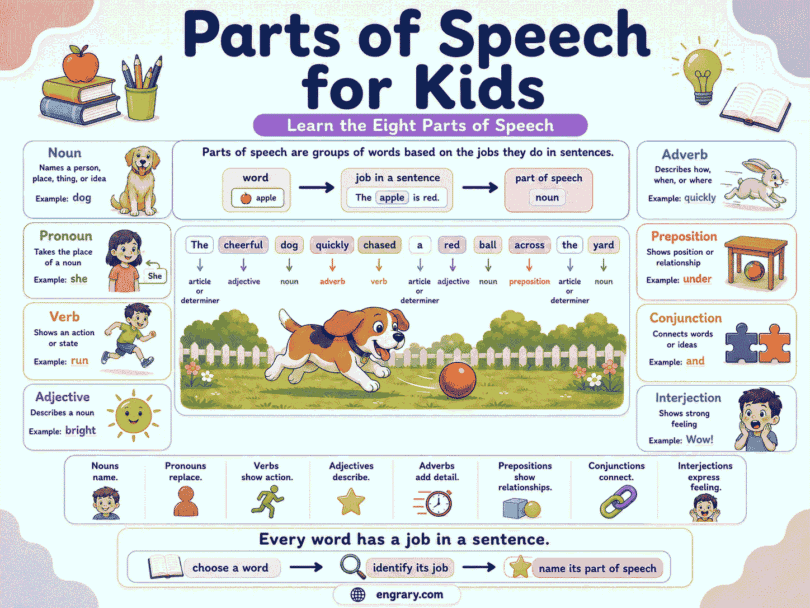
Parts of speech are groups of words based on the jobs they perform in sentences. The traditional eight parts of speech are nouns, pronouns, verbs, adjectives, adverbs, prepositions, conjunctions, and interjections.
A word’s category depends on how it functions in a particular sentence. Therefore, children should read the whole sentence before deciding which part of speech a word belongs to.
Why Word Jobs Matter
Parts of speech help sentences communicate complete ideas. Each category contributes something different.
For example:
The cheerful dog quickly ran across the yard.
In this sentence:
- dog names an animal;
- cheerful describes the dog;
- ran shows an action;
- quickly explains how the dog ran;
- across shows a relationship between the action and the yard.
When children understand these jobs, they can:
- identify sentence errors;
- choose better words;
- add useful details;
- connect ideas clearly;
- improve punctuation;
- write more varied sentences.
Parts of speech are not merely labels to memorize. Instead, they are tools for understanding how language works.
The Eight Parts of Speech
The following table gives an overview of the traditional eight categories.
| Part of Speech | Main Job | Example Word | Example Sentence |
|---|---|---|---|
| Noun | names a person, place, animal, thing, or idea | teacher | The teacher smiled. |
| Pronoun | refers to a noun or person | she | She smiled. |
| Verb | shows action, state, or being | runs | The child runs. |
| Adjective | describes a noun or pronoun | bright | We saw a bright light. |
| Adverb | modifies a verb, adjective, or adverb | quickly | The rabbit moved quickly. |
| Preposition | shows a relationship | under | The cat slept under the chair. |
| Conjunction | connects words or ideas | and | Ava and Mia laughed. |
| Interjection | expresses a reaction | wow | Wow! That is amazing. |
Articles such as a, an, and the are often taught separately. Modern grammar usually places them in a broader group called determiners.
How to Identify a Word’s Job
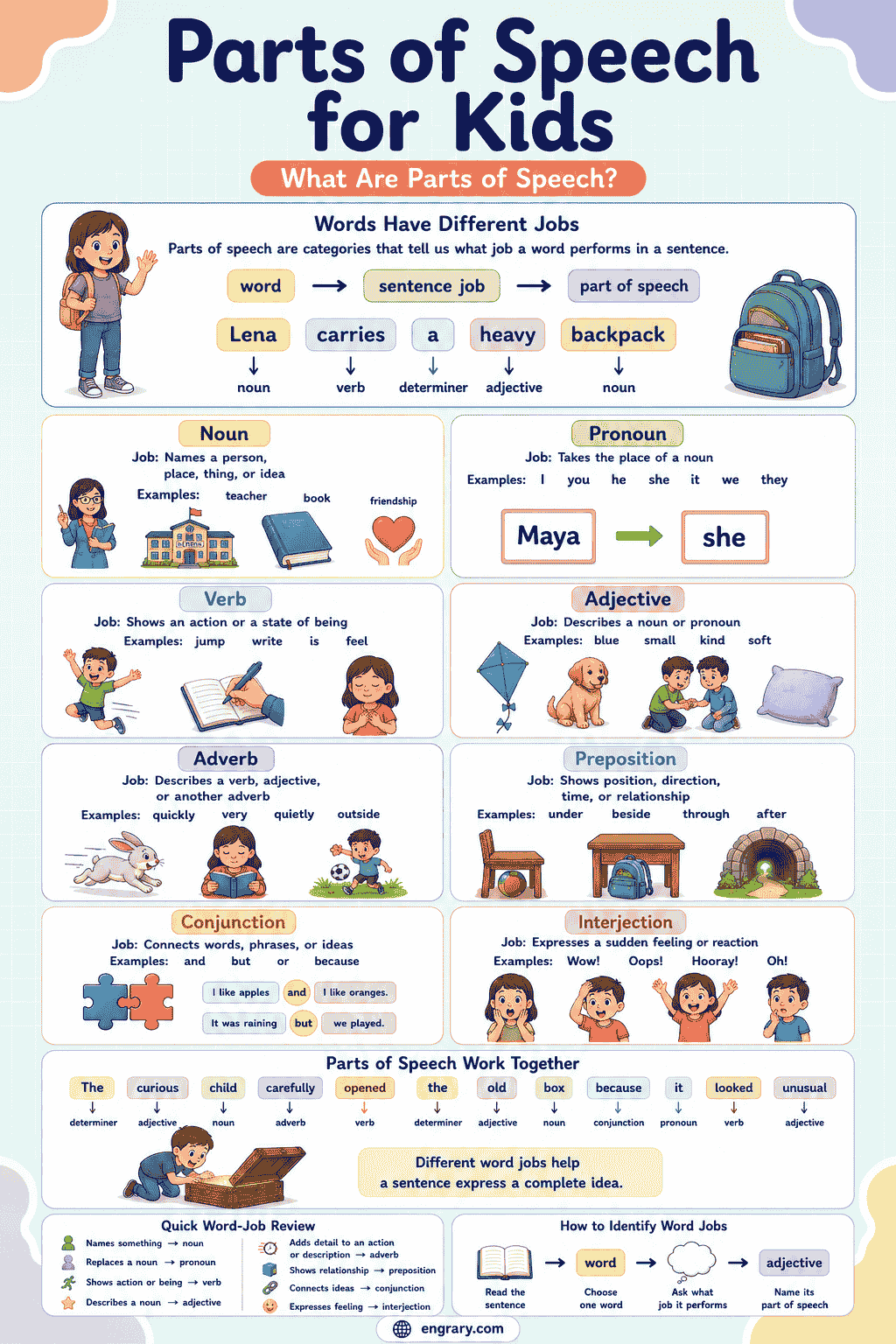
Children can use this process whenever they need to identify a part of speech:
- Read the whole sentence.
- Find the word being examined.
- Ask what job the word performs.
- Look at the words around it.
- Choose the category that matches its function.
Helpful questions include:
- Does the word name someone or something?
- Does it refer to a noun?
- Does it show an action or state?
- Does it describe a noun or pronoun?
- Does it add detail to an action or description?
- Does it show a relationship?
- Does it connect words or ideas?
- Does it express a reaction?
Consider the word light:
- Please turn on the light. — noun
- Mia carried a light backpack. — adjective
The spelling stays the same, but the sentence job changes.
Nouns and Pronouns
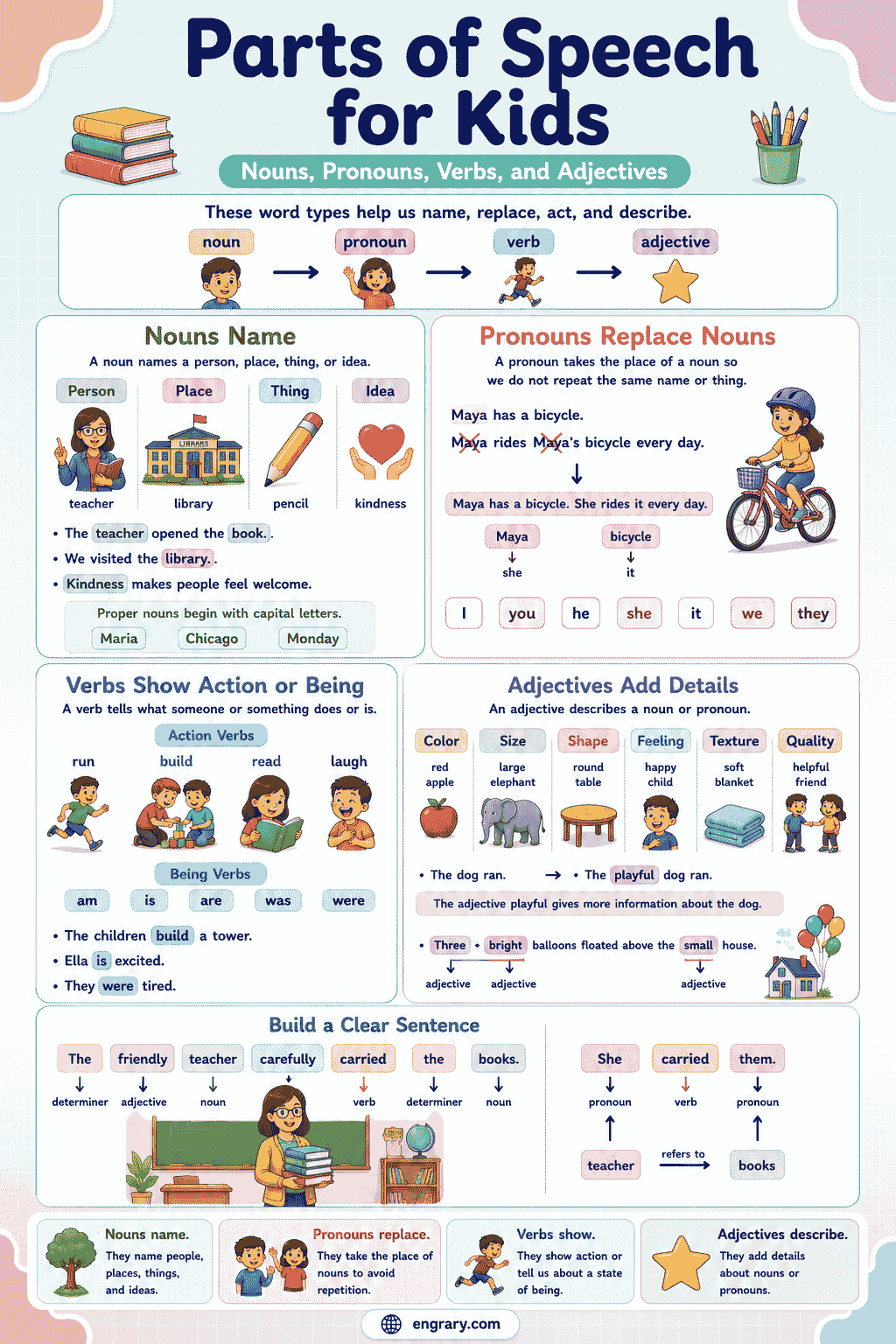
Nouns and pronouns often work together. Nouns name people, places, animals, things, and ideas, while pronouns refer to those nouns or to people and things understood from context.
Nouns and Their Main Types
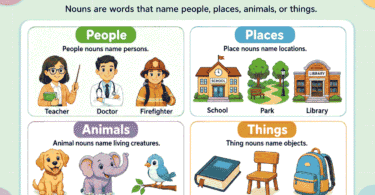
A noun names a person, place, animal, thing, or idea.
Examples include:
- person: teacher, doctor, Ava;
- place: school, park, Boston;
- animal: dog, eagle, horse;
- thing: pencil, table, backpack;
- idea: courage, happiness, freedom.
A common noun gives a general name, while a proper noun names one particular person, place, organization, or title.
| Common Noun | Proper Noun |
|---|---|
| girl | Ava |
| city | Boston |
| school | Lincoln Elementary School |
| river | Mississippi River |
Proper nouns begin with capital letters.
Nouns can also be concrete or abstract. A concrete noun names something people can experience through the senses.
- apple
- chair
- music box
- dog
An abstract noun names an idea, feeling, or quality.
- honesty
- fear
- joy
- patience
Although children cannot touch honesty or joy, these words are still nouns because they name ideas.
How Pronouns Refer to Nouns
A pronoun refers to a person, animal, place, thing, or idea without repeating the same noun again and again.
Repetitive:
Ava found Ava’s notebook, and Ava placed Ava’s notebook in Ava’s bag.
Improved:
Ava found her notebook and placed it in her bag.
The pronouns her and it make the sentence smoother. In this example, her refers to Ava, while it refers to the notebook.
Pronouns should point clearly to the nouns they represent.
Clear:
- The boys finished their project.
- Liam packed his lunch.
- The dog wagged its tail.
Unclear:
- Ava spoke to Mia after she arrived.
The word she could refer to Ava or Mia. A clearer sentence would name the correct person.
Common Pronouns for Kids
Several pronoun groups appear often in elementary writing.
| Pronoun Type | Examples |
|---|---|
| Subject pronouns | I, you, he, she, it, we, they |
| Object pronouns | me, you, him, her, it, us, them |
| Possessive pronouns | mine, yours, his, hers, ours, theirs |
| Demonstrative pronouns | this, that, these, those |
Subject pronouns often perform the action.
- She opened the window.
- They played soccer.
Object pronouns receive the action or follow a preposition.
- Mia called him.
- The teacher spoke to us.
Possessive pronouns show ownership and stand alone.
- The red backpack is mine.
- Those pencils are theirs.
Verbs Show Action or State
A verb shows an action, state, condition, or connection. Every complete sentence needs a verb, although the verb may contain more than one word.
Examples:
- The bird flies.
- Mia knows the answer.
- The soup is hot.
- Noah has finished his work.
Physical and Mental Action Verbs
Physical action verbs describe actions that can usually be seen.
- jump
- carry
- write
- climb
- throw
- whisper
Examples:
- The athlete jumped over the hurdle.
- Ava carried the box.
- Students wrote their answers.
Mental action verbs describe actions that happen in the mind.
- think
- remember
- understand
- prefer
- believe
- notice
For instance:
- Noah remembered the address.
- Mia understands the lesson.
- I prefer the blue notebook.
Therefore, verbs are not limited to visible movement.
Linking Verbs
A linking verb connects the subject with a word that describes or identifies it.
Common linking verbs include:
- am;
- is;
- are;
- was;
- were;
- seem;
- become;
- look;
- feel;
- smell;
- taste.
Examples:
- The sky is blue.
- The soup smells delicious.
- Mia seems tired.
- Noah became captain.
Some words can act as action verbs or linking verbs.
| Action Verb | Linking Verb |
|---|---|
| Mia smelled the flower. | The flower smelled sweet. |
| Noah looked through the window. | Noah looked nervous. |
| Ava felt the fabric. | The fabric felt soft. |
The surrounding words reveal the verb’s job.
Helping Verbs and Verb Phrases
A helping verb works with a main verb. Together, the words form a verb phrase.
Examples:
- is running
- has finished
- will visit
- can swim
- should listen
In the phrase is running, is helps the main verb running. Similarly, will supports visit in will visit.
Sentence examples:
- The dog is barking.
- Mia has completed her assignment.
- We will travel tomorrow.
- Ava can solve the puzzle.
Children should identify the entire verb phrase rather than labeling only the final word.
Adjectives Describe Nouns and Pronouns
An adjective gives information about a noun or pronoun. It may describe color, size, shape, condition, feeling, number, or quality.
Examples include:
- a green kite;
- three small boxes;
- a helpful teacher;
- The puppy is playful.
Adjectives Before Nouns
Adjectives commonly appear before the nouns they describe.
- a soft blanket
- the noisy class
- an old bridge
- several bright balloons
Sometimes more than one adjective describes the same noun.
- a small red wagon
- a cheerful young student
- three ripe yellow bananas
To identify the adjective, children can find the noun first and then ask which word adds information about it.
Adjectives After Linking Verbs
Adjectives may also appear after linking verbs.
| Before a Noun | After a Linking Verb |
|---|---|
| a soft blanket | The blanket feels soft. |
| a noisy class | The class seems noisy. |
| an old bridge | The bridge looks old. |
In each sentence, the adjective describes the subject.
Compare:
- The rabbit is quick.
- The rabbit runs quickly.
The word quick describes the rabbit, so it is an adjective. In contrast, quickly explains how the rabbit runs, so it is an adverb.
Adverbs Add More Detail
An adverb modifies a verb, an adjective, or another adverb. It can explain how, when, where, how often, or to what degree something happens.
What Adverbs Modify
Many adverbs modify verbs.
- The rabbit ran quickly.
- Ava spoke softly.
- We arrived yesterday.
- The children waited outside.
Other adverbs modify adjectives.
- The puzzle was very difficult.
- The water felt extremely cold.
An adverb can also modify another adverb.
- The turtle moved surprisingly slowly.
- Noah answered very confidently.
Not every adverb ends in -ly, and not every -ly word is an adverb. Words such as friendly, lovely, and lonely are usually adjectives.
Common Types of Adverbs
Adverbs can be grouped by the kind of information they provide.
| Type | Question | Example |
|---|---|---|
| Manner | How? | carefully |
| Time | When? | tomorrow |
| Place | Where? | nearby |
| Frequency | How often? | often |
| Degree | To what extent? | very |
Sentence examples:
- Mia completed the task carefully.
- We will leave tomorrow.
- The dog waited nearby.
- Ava often reads before bed.
- The movie was very funny.
A word’s location does not determine its category by itself. Instead, its function in the sentence reveals whether it acts as an adverb.
Prepositions Show Relationships
A preposition shows a relationship between a noun or pronoun and another part of the sentence. These relationships often involve place, time, direction, or movement.
Prepositions of Place, Time, and Direction
Place prepositions show location.
- under the table
- beside the window
- inside the box
- near the school
Time prepositions show when something happens.
- after lunch
- before class
- during the game
- at noon
Direction or movement prepositions show where someone or something moves.
- toward the door
- through the tunnel
- across the field
- into the room
For example:
- The cat slept under the chair.
- We will leave after lunch.
- Ava walked toward the library.
Prepositional Phrases
A preposition usually begins a prepositional phrase. The phrase often follows this pattern:
preposition + noun or pronoun
Examples:
- in the box
- near Ava
- behind them
- after school
The entire phrase adds information to the sentence.
- The keys are on the table.
- We played after lunch.
- The dog ran through the gate.
A preposition normally has a noun or pronoun following it. However, some words can act as adverbs when no noun or pronoun follows.
- The children went inside. — adverb
- The children went inside the classroom. — preposition
Conjunctions Connect Words and Ideas
A conjunction connects words, phrases, clauses, or complete ideas.
Examples:
- cats and dogs;
- tired but happy;
- before school or after lunch;
- We stayed inside because it was raining.
Coordinating Conjunctions
The seven coordinating conjunctions can be remembered with FANBOYS:
- for;
- and;
- nor;
- but;
- or;
- yet;
- so.
Young learners most often use and, but, or, so, and yet.
Examples:
- Ava packed pencils and paper.
- Noah was tired, but he finished the project.
- Would you like milk or water?
- It was raining, so we stayed indoors.
- Mia was nervous, yet she gave a clear speech.
Coordinating conjunctions connect equal words or ideas.
Subordinating Conjunctions
A subordinating conjunction connects a dependent idea to a complete idea.
Common examples include:
- because;
- when;
- if;
- although;
- while;
- before;
- after.
Examples:
- We stayed inside because it was raining.
- When the bell rang, the students entered.
- Ava will come if she finishes her homework.
- Although the trail was steep, we kept walking.
Some words can act as prepositions or conjunctions.
- We played after lunch. — preposition
- We played after lunch ended. — conjunction
In the first sentence, after introduces a noun phrase. In the second, it introduces a clause containing a subject and verb.
Interjections Express Reactions
An interjection expresses a sudden feeling, reaction, greeting, or response. It often stands apart from the rest of the sentence.
Examples include:
- Wow!
- Oops!
- Hooray!
- Oh!
- Hey!
- Yikes!
Strong and Mild Interjections
Strong interjections often take an exclamation mark.
- Wow! That painting is beautiful.
- Oops! I dropped my pencil.
- Hooray! Our team won.
- Yikes! That insect is huge.
Milder interjections may be followed by a comma.
- Oh, I understand now.
- Well, we should begin.
- Hey, that is my notebook.
The punctuation reflects the strength of the reaction.
Interjections and Exclamatory Sentences
An interjection is not the same as an exclamatory sentence.
- Wow! That is amazing. — contains an interjection
- That is amazing! — exclamatory sentence without an interjection
The second sentence expresses strong feeling through punctuation, but it does not contain a separate reaction word.
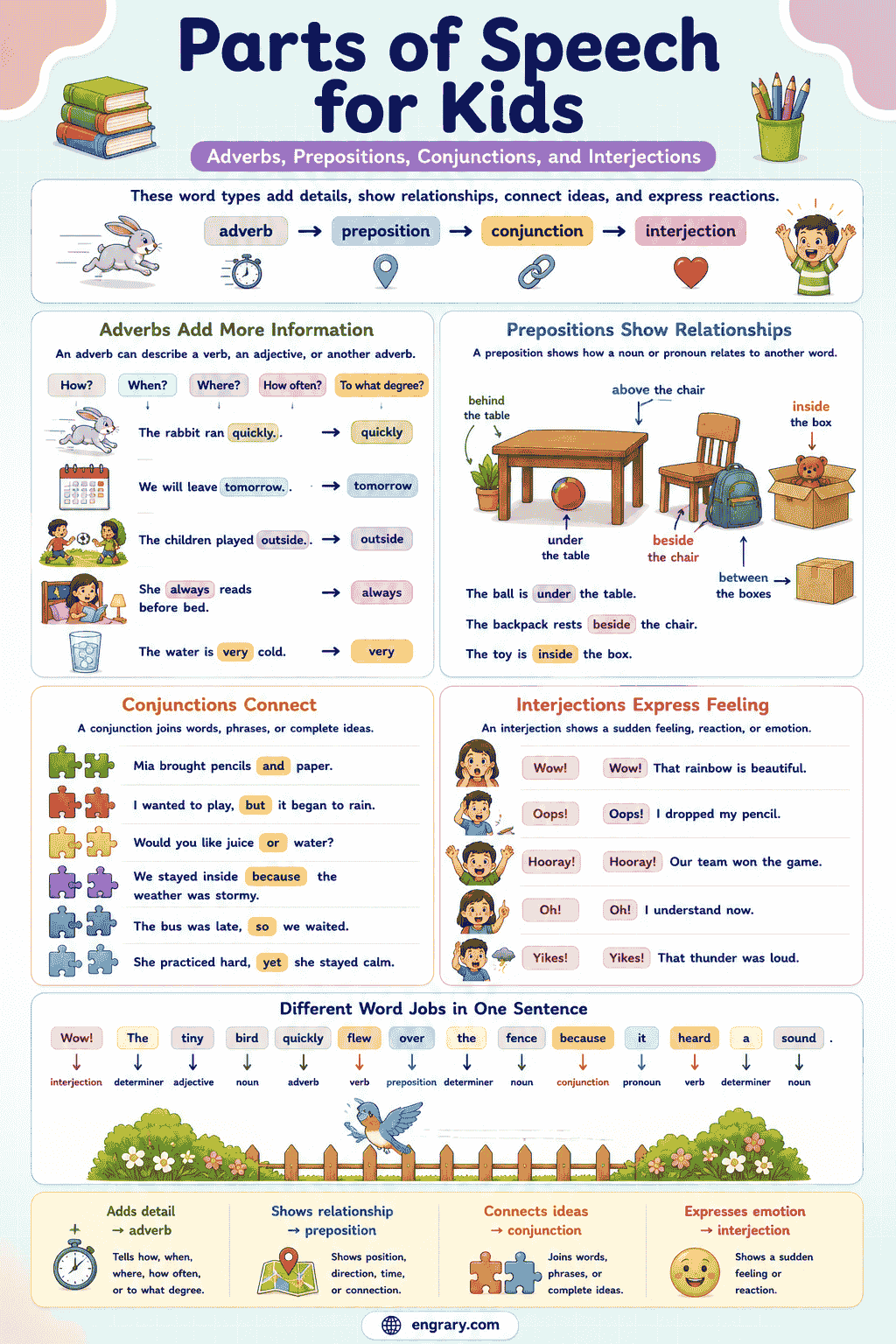
How Parts of Speech Work Together
Sentences usually contain several parts of speech working together. Each word contributes a different job.
Analyze a Complete Sentence
Consider this sentence:
Wow, the playful puppy quickly ran across the yard, but it stopped near Ava.
| Word | Part of Speech | Job |
|---|---|---|
| Wow | interjection | expresses a reaction |
| the | article/determiner | introduces puppy |
| playful | adjective | describes puppy |
| puppy | noun | names an animal |
| quickly | adverb | modifies ran |
| ran | verb | shows action |
| across | preposition | begins a relationship phrase |
| yard | noun | names a place |
| but | conjunction | connects two ideas |
| it | pronoun | refers to puppy |
| stopped | verb | shows action |
| near | preposition | begins another phrase |
| Ava | proper noun | names a person |
This example shows that a complete sentence may contain nearly every major word category.
Words That Can Have Different Jobs
Some words belong to different parts of speech in different sentences.
| Word | First Job | Second Job |
|---|---|---|
| water | We drank water. — noun | Please water the plants. — verb |
| clean | The room is clean. — adjective | Please clean the room. — verb |
| fast | The fast car won. — adjective | The car moved fast. — adverb |
| inside | Wait inside. — adverb | Wait inside the room. — preposition |
| watch | My watch is new. — noun | Watch the road. — verb |
Therefore, children should never classify a word without reading the sentence around it.
Where A, An, and The Fit
The words a, an, and the are articles. Traditional school grammar sometimes groups articles with adjectives because they come before nouns.
Modern grammar usually treats them as determiners because they introduce or identify nouns.
Examples:
- a book;
- an apple;
- the classroom.
Since article use includes separate rules about sound, countability, and meaning, it is best studied in a dedicated lesson.
Commonly Confused Parts of Speech
Several word classes perform related jobs, so children may confuse them. Direct comparisons can make the differences clearer.
Verbs, Adjectives, and Adverbs
A verb shows action or state. An adjective describes a noun or pronoun, while an adverb adds detail to a verb, adjective, or another adverb.
| Word Job | Example |
|---|---|
| Verb | The rabbit ran. |
| Adjective | The rabbit is quick. |
| Adverb | The rabbit ran quickly. |
Another example:
- Ava is careful. — adjective
- Ava writes carefully. — adverb
- Ava writes carefully. — verb
The word writes names the action. Meanwhile, carefully tells how the action happens.
Prepositions, Adverbs, and Conjunctions
Some relationship words change jobs according to what follows them.
| Sentence | Job |
|---|---|
| We waited outside. | adverb |
| We waited outside the classroom. | preposition |
| We left after lunch. | preposition |
| We left after lunch ended. | conjunction |
A preposition usually introduces a noun or pronoun. An adverb can stand without that object, while a conjunction may introduce a clause containing a subject and verb.
Common Parts-of-Speech Mistakes
Children often make identification mistakes because they focus on a word’s appearance rather than its function.
| Mistake | Better Understanding |
|---|---|
| Every verb shows physical action. | Verbs may also show mental action, state, or being. |
| Every word ending in -ly is an adverb. | Words such as friendly and lovely are usually adjectives. |
| Adjectives always come before nouns. | They may also follow linking verbs. |
| Every location word is a preposition. | A preposition normally introduces a noun or pronoun. |
| A word has one permanent category. | Its job can change from sentence to sentence. |
| Pronouns always replace a nearby noun exactly. | They refer to people or things understood from context. |
| Articles are always adjectives. | Modern grammar usually calls them determiners. |
The best correction strategy is to read the full sentence and ask what the word is doing there.
Parts of Speech Practice for Kids
Complete the activities before checking the answer key.
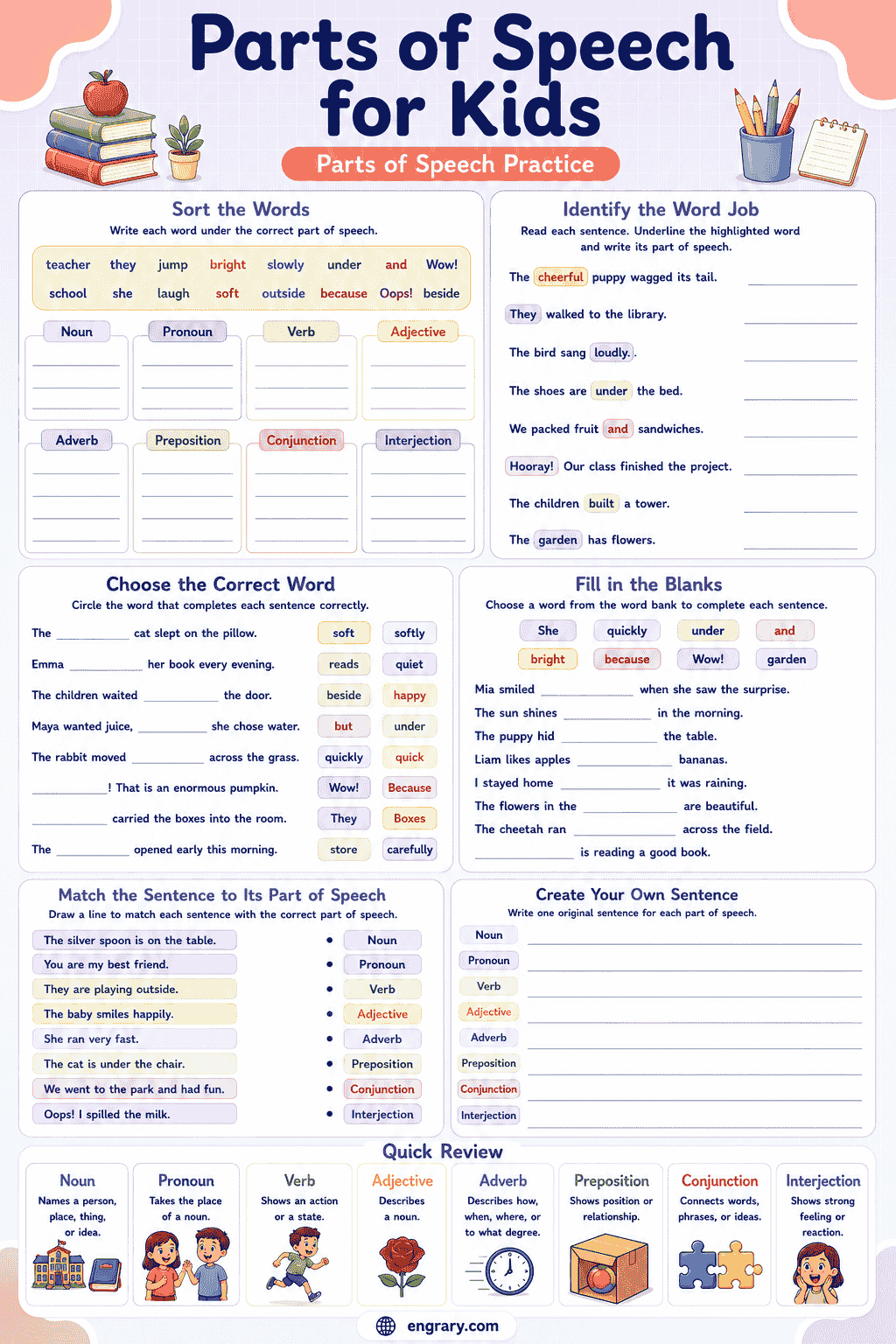
Match, Identify, and Sort Words
A. Match each part of speech with its job
- Noun
- Verb
- Adjective
- Adverb
- Preposition
- Conjunction
- Pronoun
- Interjection
a. connects words or ideas
b. describes a noun or pronoun
c. names a person, place, thing, or idea
d. expresses a reaction
e. refers to a noun or person
f. adds detail to a verb, adjective, or adverb
g. shows action or state
h. shows a relationship
B. Identify the bold word
- The teacher opened the door.
- She greeted the class.
- Noah carried the books.
- We saw a bright rainbow.
- Ava answered quietly.
- The dog slept under the table.
- Mia wanted juice and water.
- Hooray! We finished the project.
C. Sort the words
Place each word in the correct category.
Word bank: river, they, jump, colorful, slowly, beneath, because, wow
| Noun | Pronoun | Verb | Adjective | Adverb | Preposition | Conjunction | Interjection |
|---|
Label Words in Complete Sentences
Identify the part of speech of each bold word.
- The small bird sang sweetly.
- They walked through the tunnel.
- Oops! I dropped the glass.
- Ava and Mia laughed.
- The soup smells delicious.
- We left after lunch.
- Noah can solve the puzzle.
- The honest student returned the wallet.
Compare and Correct Word Jobs
A. Choose the correct word
- The careful/carefully child crossed the street.
- The child crossed the street careful/carefully.
- The music sounds beautiful/beautifully.
- Ava performed beautiful/beautifully.
- The dog waited inside/inside the house.
Choose the preposition phrase. - We left after lunch/after lunch ended.
Choose the conjunction phrase.
B. Correct the wrong label
- In “The dog barked loudly,” loudly is a verb.
- In “The blanket feels soft,” soft is an adverb.
- In “We waited outside,” outside is a preposition.
- In “Please water the flowers,” water is a noun.
- In “Hooray! We won,” Hooray is a conjunction.
Build and Write Sentences
- Write a sentence containing one noun and one verb.
- Add an adjective to describe the noun.
- Add an adverb to describe the verb.
- Write a sentence containing a prepositional phrase.
- Write a sentence joining two ideas with a conjunction.
- Write a sentence beginning with an interjection.
- Use one word in two sentences with different parts-of-speech jobs.
Parts of Speech Practice Answer Key
Match, Identify, and Sort Words
A. Match each part of speech with its job
- Noun — c
- Verb — g
- Adjective — b
- Adverb — f
- Preposition — h
- Conjunction — a
- Pronoun — e
- Interjection — d
B. Identify the bold word
- teacher — noun
- she — pronoun
- carried — verb
- bright — adjective
- quietly — adverb
- under — preposition
- and — conjunction
- hooray — interjection
C. Sort the words
| Category | Answer |
|---|---|
| Noun | river |
| Pronoun | they |
| Verb | jump |
| Adjective | colorful |
| Adverb | slowly |
| Preposition | beneath |
| Conjunction | because |
| Interjection | wow |
Label Words in Complete Sentences
- small — adjective; sweetly — adverb
- they — pronoun; through — preposition
- oops — interjection; glass — noun
- and — conjunction; laughed — verb
- smells — linking verb; delicious — adjective
- after — preposition
- can solve — verb phrase
- honest — adjective
Compare and Correct Word Jobs
A. Choose the correct word
- careful
- carefully
- beautiful
- beautifully
- inside the house
- after lunch ended
B. Correct the wrong label
- Loudly is an adverb because it explains how the dog barked.
- Soft is an adjective because it describes the blanket.
- Outside is an adverb because it stands without a following noun or pronoun.
- Water is a verb because it shows the action.
- Hooray is an interjection because it expresses a reaction.
Build and Write Sentences
Sample answers:
- The dog barked.
- The playful dog barked.
- The playful dog barked loudly.
- The cat slept under the chair.
- Ava finished her work, and she packed her bag.
- Wow! That rainbow is beautiful.
- We drank water. Please water the plants.
Other answers are acceptable when each word performs the requested sentence job.
FAQs
Parts of speech are groups of words based on the jobs they perform in sentences, such as naming, describing, connecting, or showing action.
The traditional eight parts of speech are nouns, pronouns, verbs, adjectives, adverbs, prepositions, conjunctions, and interjections.
Yes. A word’s category can change according to its sentence job. For example, water is a noun in “Drink water,” but it is a verb in “Water the plants.”
An adjective describes a noun or pronoun, while an adverb modifies a verb, adjective, or another adverb. For example, quick is an adjective, while quickly is an adverb.
They are articles and belong to the broader determiner group. Some traditional lessons group them with adjectives, but modern grammar usually treats them separately.
You May Also Like