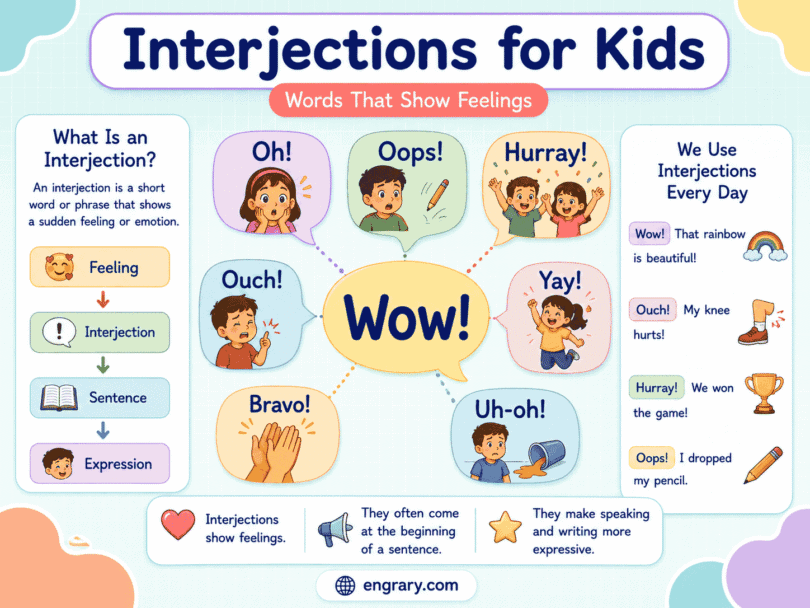
Interjections are short expressions that show sudden feelings, reactions, greetings, warnings, or responses. Words such as wow, oops, ouch, and hooray can make speech and writing sound more natural and expressive.
Children use interjections more effectively when they understand the feeling behind each one. They also need to know when to use a comma, when to add an exclamation mark, and when an interjection may sound too informal or unnecessary.

What Is an Interjection?
An interjection is a short word, phrase, or sound that expresses a sudden reaction, feeling, greeting, warning, or response.
Examples include:
- Wow!
- Oh!
- Oops!
- Hooray!
- Phew!
- Uh-oh!
Interjections often appear at the beginning of a sentence. However, they may also stand alone or appear later in informal speech and writing.
How Interjections Show Reactions
Interjections tell readers how a speaker reacts to a situation.
Compare:
The roller coaster was exciting.
Wow! The roller coaster was exciting.
Both sentences give the same basic information. However, the second sentence also shows excitement.
Interjections may express:
- surprise;
- joy;
- pain;
- fear;
- disappointment;
- disgust;
- relief;
- hesitation;
- approval;
- warning;
- greeting;
- attention.
For example:
- Ouch! My finger hurts.
- Hooray! Our class won the contest.
- Oh no! I forgot my homework.
- Phew! We finished on time.
Interjections as a Part of Speech
Interjections are one of the traditional eight parts of speech.
Unlike nouns, verbs, adjectives, and adverbs, an interjection often stands apart from the grammar of the main sentence.
Consider:
Wow! The puppy jumped over the box.
The sentence The puppy jumped over the box remains complete without Wow! The interjection simply adds the speaker’s reaction.
A useful identification question is:
Does this word or phrase express a reaction without performing the main grammatical job in the sentence?
Words, Phrases, and Sounds
Interjections are not always single words.
Single words
- wow;
- ouch;
- hooray;
- yikes;
- phew.
Short phrases
- oh no;
- no way;
- thank goodness;
- good grief.
Sounds and vocal reactions
- ah;
- hmm;
- ugh;
- shh;
- uh-oh.
Examples:
- Oh no! The glass is broken.
- Thank goodness! Everyone is safe.
- Hmm, I need to think.
- Shh! The baby is sleeping.
How Interjections Change Sentence Meaning
An interjection usually changes the emotion of a sentence rather than its basic fact.
Without an interjection:
The glass is broken.
With an interjection:
Oh no! The glass is broken.
The first sentence reports what happened. In contrast, the second also shows worry or disappointment.
Another comparison is:
We won the game.
Hooray! We won the game.
The second version communicates celebration as well as information.
Common Interjections for Kids
Children hear interjections in conversations, stories, comics, games, and personal messages. The most suitable choice depends on the feeling and the situation.
What Feelings Do Interjections Express?
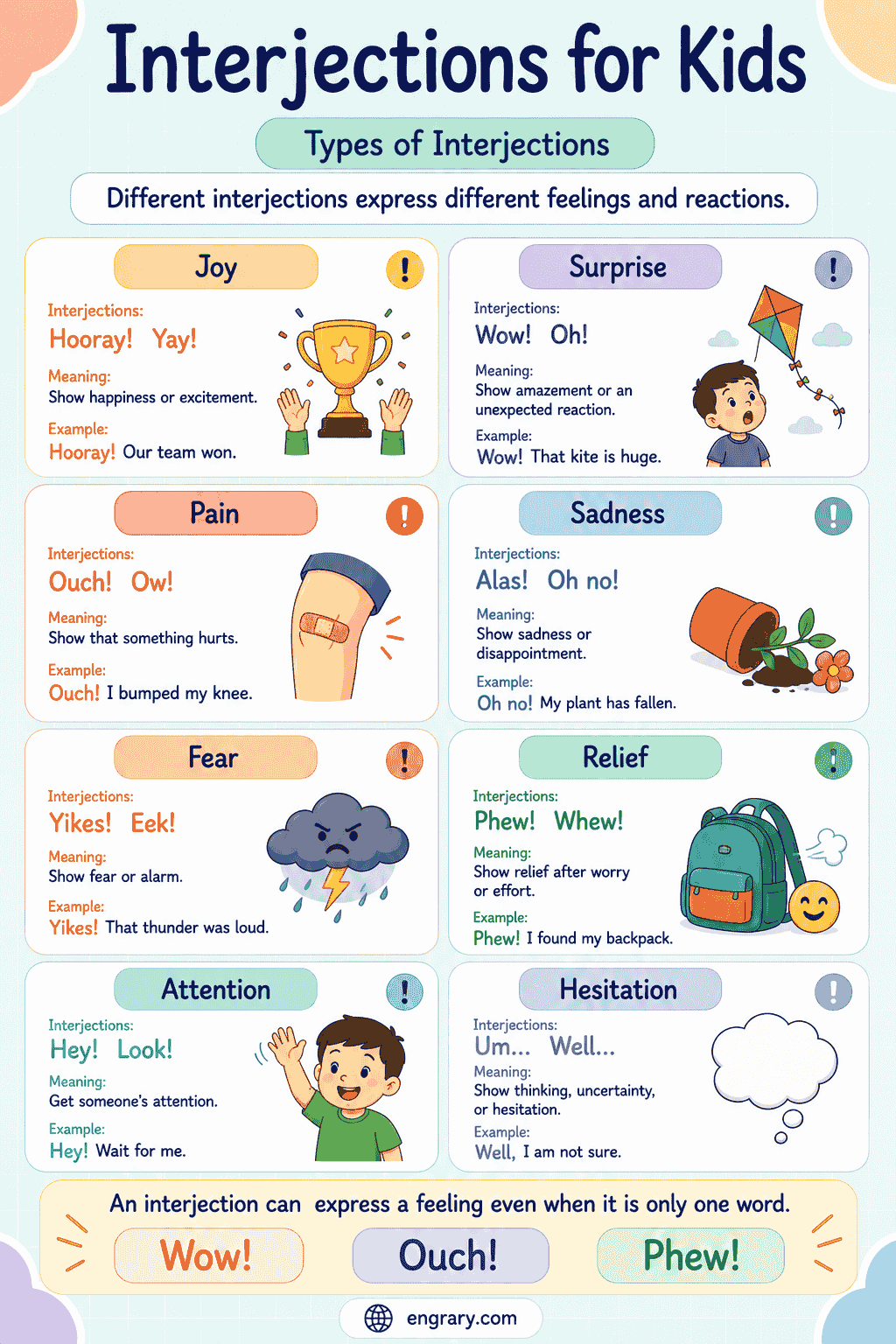
| Feeling or Purpose | Common Interjections |
|---|---|
| Surprise | wow, oh, whoa |
| Joy | hooray, yay |
| Pain | ouch, ow |
| Fear | yikes, oh no |
| Mistake | oops, uh-oh |
| Disappointment | aw, oh no |
| Disgust | yuck, ugh |
| Relief | phew, thank goodness |
| Hesitation | um, hmm, well |
| Attention | hey |
| Silence | shh |
| Approval | great, excellent |
Tone and context can change the exact meaning.
For instance, oh may show:
- surprise: Oh! I did not see you there.
- realization: Oh, I understand now.
- disappointment: Oh no! We missed the bus.
- sympathy: Oh, I am sorry to hear that.
Surprise and Excitement
Common interjections for surprise or excitement include:
- wow;
- whoa;
- oh;
- no way.
Examples:
- Wow! That science model looks amazing.
- Whoa! The wave is enormous.
- Oh! I did not expect to see you here.
- No way! You finished the puzzle already.
Because these reactions are often strong, they commonly take exclamation marks.
Joy, Approval, and Celebration
Children may use these expressions to show happiness, success, or approval:
- hooray;
- yay;
- great;
- excellent.
Examples:
- Hooray! Our team won.
- Yay! School is closed tomorrow.
- Great! You solved the problem.
- Excellent! Your answer is correct.
Some words, such as great and excellent, act as independent evaluative responses in these examples. In other sentences, they may function as adjectives.
Compare:
- Great! You finished the project. — independent response
- Ava had a great idea. — adjective
Pain, Fear, and Warning
Common interjections and warning expressions include:
- ouch;
- ow;
- yikes;
- hey;
- watch out.
Examples:
- Ouch! That thorn scratched me.
- Ow! My ankle hurts.
- Yikes! That path looks slippery.
- Hey! Stay away from the wet floor.
- Watch out! A ball is coming toward you.
The phrase watch out is a warning command rather than a simple interjection, but it performs a similar practical role in conversation.
Mistakes, Disappointment, and Disgust
Useful examples include:
- oops;
- uh-oh;
- oh no;
- aw;
- yuck;
- ugh.
Examples:
- Oops! I spilled the paint.
- Uh-oh! The door is locked.
- Oh no! I left my lunch at home.
- Aw, the puppy looks lonely.
- Yuck! This milk tastes sour.
- Ugh! My shoes are covered in mud.
The surrounding sentence clarifies the exact reaction.
Relief, Hesitation, and Attention
Some interjections express softer or more thoughtful reactions.
Common examples include:
- phew;
- thank goodness;
- well;
- hmm;
- um;
- hey;
- shh.
Examples:
- Phew! We arrived before the bell.
- Thank goodness! The lost dog is safe.
- Well, we could try another plan.
- Hmm, this question is difficult.
- Um, may I ask something?
- Hey, look at this picture.
- Shh! The play is beginning.
Common Words Used as Interjections
| Interjection | Common Purpose | Example |
|---|---|---|
| wow | surprise or admiration | Wow! That mural is beautiful. |
| oops | mistake | Oops! I dropped the marker. |
| ouch | pain | Ouch! That hurt. |
| hooray | celebration | Hooray! We finished first. |
| yikes | fear or concern | Yikes! The stairs are icy. |
| phew | relief | Phew! We made it on time. |
| hmm | thought or hesitation | Hmm, I need another clue. |
| ugh | disgust or frustration | Ugh! This box is too heavy. |
| hey | greeting or attention | Hey! Wait for me. |
| shh | request for silence | Shh! The baby is asleep. |

Strong and Mild Interjections
Interjections may express strong or mild reactions. As a result, the strength of the feeling often affects punctuation.
Strong Interjections Versus Mild Interjections
| Strong Interjection | Mild Interjection |
|---|---|
| Wow! That is incredible. | Oh, I understand. |
| Ouch! That hurt. | Well, we can try again. |
| Hooray! We won. | Hmm, I need to think. |
| Yikes! The road is icy. | Yes, I finished the task. |
A strong interjection usually expresses a sudden or powerful reaction. Therefore, it often takes an exclamation mark.
A mild interjection shows a softer response, hesitation, or realization. Consequently, it commonly takes a comma.
These are useful patterns rather than absolute rules. Tone and context can make the same word sound stronger or milder.
How Tone Changes Meaning
Consider well:
- Well, I agree with you. — thoughtful response
- Well! I did not expect that. — surprise or annoyance
Now consider oh:
- Oh! There you are. — surprise
- Oh, I understand. — realization
- Oh no! The cake burned. — disappointment
Because written language has no audible voice, punctuation and surrounding words help reveal the intended tone.
Punctuation With Interjections
Punctuation helps readers understand the strength of an interjection.
When to Use a Comma or an Exclamation Mark
Use an exclamation mark after a clearly strong reaction.
- Wow! That building is tall.
- Ouch! My hand hurts.
- Hooray! We passed the test.
- Yikes! The dog is running toward us.
Use a comma after a clearly mild response.
- Oh, I understand now.
- Well, we should begin.
- Hmm, this answer may be wrong.
- Yes, I brought my notebook.
Sometimes the entire sentence ends with an exclamation mark:
Wow, that building is tall!
This structure is also correct because the whole sentence expresses strong feeling.
For beginners, separating the interjection is often easiest:
Wow! That building is tall.
Capitalizing Interjections
Capitalize an interjection when it begins a sentence or stands alone.
- Wow! That is impressive.
- Oops! I made a mistake.
- Oh, I forgot my pencil.
An interjection in the middle of a sentence may begin with a lowercase letter.
The answer, well, is difficult to explain.
However, middle-position interjections are less common in children’s writing. Beginning-position examples are usually clearer.

Interjections in Sentences
Interjections most often appear at the beginning of a sentence, although they can also stand alone or appear later.
Interjections at the Beginning of Complete Sentences
Beginning-position interjections show the reaction before the main message.
- Wow! The fireworks are beautiful.
- Oops, I wrote the wrong answer.
- Oh, I remember that story.
- Hooray! We completed the challenge.
- Phew! The test is over.
The main sentence still needs normal grammar.
Less complete:
Wow! Looks beautiful.
Clearer in formal written work:
Wow! The painting looks beautiful.
Standalone Interjections
An interjection can appear by itself.
- Wow!
- Ouch!
- Hooray!
- Uh-oh.
- Hmm.
These expressions communicate meaningful reactions even though they are not ordinary subject-and-verb sentences.
For example, a child who touches something hot may simply say:
Ouch!
The situation provides the meaning.
Interjections in the Middle or at the End
An interjection may occasionally appear in the middle of a sentence.
The answer, well, is not simple.
End-position use is less common and may sound informal.
We finally finished—hooray!
For children, beginning-position interjections are usually the clearest and most natural choice.

Interjections in Speech and Writing
Interjections are especially common in conversation, dialogue, comics, stories, and personal messages.
Interjections in Conversations
Interjections help spoken English sound natural.
“Hey, are you coming to the game?” Noah asked.
“Yes, I will be there,” Ava replied.
“Great!” Noah said.
The expressions show attention, response, and approval.
Another conversation might be:
“Oops! I forgot the tickets,” Mia said.
“Oh no! Should we go back?” Liam asked.
Interjections for Story Writing and Dialogue
Interjections can reveal how a character feels.
Plain:
The lights went out.
With a reaction:
“Yikes!” Ava cried as the lights went out.
Another example is:
“Hooray!” the students shouted when the final bell rang.
Interjections can make a scene feel immediate. However, they should match the character, action, and tone.
Formal and Informal Use
Interjections work well in:
- conversations;
- stories;
- comics;
- text messages;
- personal letters;
- speech bubbles.
They are less common in:
- formal reports;
- academic essays;
- scientific explanations;
- professional communication.
Informal:
Wow! The experiment worked.
More formal:
The experiment produced the expected result.
When to Avoid or Limit Interjections
Avoid or limit interjections when they:
- make formal writing sound too casual;
- repeat a feeling already shown clearly;
- interrupt the sentence unnecessarily;
- do not match the situation;
- appear too frequently.
For example, a science report should not say:
Hooray! The water reached its boiling point.
A more suitable version is:
The water reached its boiling point.
Overused:
Wow! We reached the park. Hooray! The sun was shining. Oh! We saw a bird. Yay! We found a bench.
Improved:
We reached the sunny park and found a bench near the trees. “Wow!” Mia said when a bright blue bird landed nearby.
The improved version uses one meaningful reaction instead of several unnecessary ones.
Interjections Versus Similar Forms
Children may confuse interjections with exclamatory sentences, adjectives, adverbs, greetings, and other expressions.
Interjections Versus Exclamations
An interjection is a short reaction word, sound, or phrase. An exclamatory sentence is a complete sentence that expresses strong feeling.
| Example | Classification |
|---|---|
| Wow! | interjection |
| Wow! That is amazing. | interjection plus statement |
| That is amazing! | exclamatory sentence |
| What an amazing painting! | exclamatory sentence |
Therefore, an exclamation mark does not automatically make a word an interjection.
Interjections Versus Feeling Words and Other Parts of Speech
Not every word connected with emotion is an interjection.
- Ava felt happy. — adjective
- Ava smiled happily. — adverb
- Ava felt joy. — noun
- Hooray! Ava won. — interjection
A word’s grammatical job matters more than its topic.
Compare well:
- Well, I think you are correct. — interjection
- Ava sings well. — adverb
Compare good:
- Good! You solved the problem. — independent response
- That is a good answer. — adjective
Greetings and Responses as Interjections
In many school grammar lessons, greetings and short responses are treated as interjections when they stand independently.
- Hello! It is nice to meet you.
- Hi! How are you?
- Yes, I finished the assignment.
- No, that is not my notebook.
Other grammar systems may classify some of these expressions separately. For a child-focused lesson, the school-grammar classification is acceptable when the word functions as a greeting or response.
Words That Can Have Different Jobs
| Word | Reaction or Response Use | Other Use |
|---|---|---|
| well | Well, let us begin. | Ava writes well. |
| good | Good! You finished. | That is a good idea. |
| right | Right, we should leave. | Turn right at the corner. |
| fine | Fine, we can continue. | The weather is fine. |
Context determines the word’s job.
Common Interjection Mistakes
| Mistake | Better Understanding |
|---|---|
| Every emotion word is an interjection. | A word must function as a reaction or response. |
| Every interjection needs an exclamation mark. | Mild interjections often use commas. |
| Every exclamatory sentence contains an interjection. | A sentence can express strong feeling without one. |
| An interjection must be one word. | It may be a phrase or sound. |
| Interjections belong in every paragraph. | They should be used only when they add meaning. |
| Formal reports need expressive interjections. | Formal writing usually uses neutral language. |
| The same interjection always shows one feeling. | Tone and context may change its meaning. |
| Any word before a comma is an interjection. | Its function must show a reaction or response. |
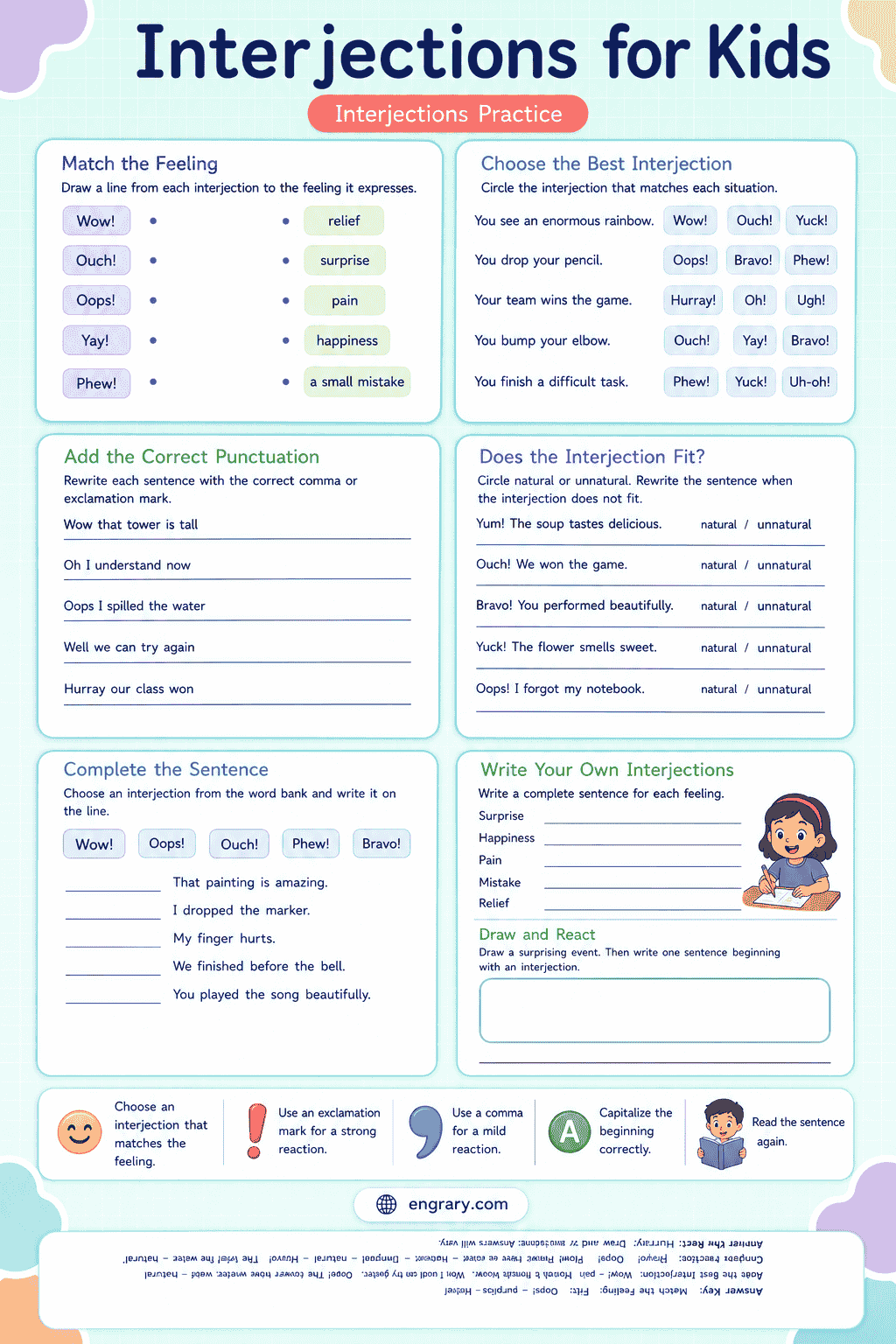
Interjections Practice for Kids
Complete the activities before checking the answer key.
Identify the Interjection
Find the interjection in each sentence.
- Wow! That rainbow is bright.
- Oops, I dropped the pencil.
- Hooray! We won the game.
- Oh, I understand the rule.
- Yikes! The road is slippery.
- Phew! We finished on time.
Match Interjections With Feelings
Match each interjection with its most likely feeling.
- Hooray
- Ouch
- Phew
- Yuck
- Oops
- Hmm
a. pain
b. relief
c. mistake
d. disgust
e. celebration
f. hesitation
Choose Strong or Mild Reactions
Use the punctuation and context to write strong or mild.
- Wow! That was incredible.
- Well, we can try again.
- Ouch! My finger hurts.
- Hmm, I need another clue.
- Hooray! Our class won.
- Oh, I remember now.
Punctuate Interjections Correctly
Use an exclamation mark for the strong reactions and a comma for the mild reactions.
- Wow ___ That tower is enormous.
- Oh ___ I understand the directions now.
- Hooray ___ We completed the project.
- Well ___ we should ask the teacher.
- Ouch ___ That scratch hurts.
- Hmm ___ this question needs more thought.
Interjection or Exclamatory Sentence?
Write interjection or exclamatory sentence.
- Wow!
- What a beautiful garden!
- Ouch!
- That roller coaster was exciting!
- Hooray!
- How quickly the storm arrived!
Choose the Best Interjection
Choose the expression that best fits each situation.
- You accidentally spill your drink.
a. Hooray!
b. Oops!
c. Phew! - Your team wins the final game.
a. Hooray!
b. Yuck!
c. Ouch! - You touch a sharp thorn.
a. Hmm!
b. Ouch!
c. Yay! - You finish a difficult test just before time ends.
a. Phew!
b. Ugh!
c. Uh-oh! - You smell spoiled food.
a. Wow!
b. Yuck!
c. Hooray!
Correct Interjection Mistakes
Rewrite each sentence with correct capitalization and missing punctuation.
- wow that model is amazing
- oh i understand the rule now
- well we can try another way
- hooray we won the championship
- hmm i need to think about that
- ouch that really hurt
Edit Overused Interjections
Rewrite this paragraph using only one useful interjection.
Wow! We arrived at the park. Hooray! The sun was shining. Oh! We saw a colorful bird. Yay! It landed near our bench.
Write Sentences and Dialogue With Interjections
- Write a sentence with a strong interjection.
- Write a sentence with a mild interjection.
- Write a sentence using an interjection for pain.
- Write a sentence using an interjection for relief.
- Write two lines of dialogue using one interjection naturally.
- Write one formal sentence without an interjection.
Interjections Practice Answer Key
Identify the Interjection
- Wow
- Oops
- Hooray
- Oh
- Yikes
- Phew
Match Interjections With Feelings
- Hooray — e. celebration
- Ouch — a. pain
- Phew — b. relief
- Yuck — d. disgust
- Oops — c. mistake
- Hmm — f. hesitation
Choose Strong or Mild Reactions
- strong
- mild
- strong
- mild
- strong
- mild
Punctuate Interjections Correctly
- Wow! That tower is enormous.
- Oh, I understand the directions now.
- Hooray! We completed the project.
- Well, we should ask the teacher.
- Ouch! That scratch hurts.
- Hmm, this question needs more thought.
Interjection or Exclamatory Sentence?
- interjection
- exclamatory sentence
- interjection
- exclamatory sentence
- interjection
- exclamatory sentence
Choose the Best Interjection
- b. Oops!
- a. Hooray!
- b. Ouch!
- a. Phew!
- b. Yuck!
Correct Interjection Mistakes
- Wow! That model is amazing.
- Oh, I understand the rule now.
- Well, we can try another way.
- Hooray! We won the championship.
- Hmm, I need to think about that.
- Ouch! That really hurt.
Edit Overused Interjections
Sample answer:
We arrived at the sunny park and noticed a colorful bird near our bench. “Wow!” Mia said as it landed beside us.
Other clear revisions are acceptable when they keep only one useful interjection.
Write Sentences and Dialogue With Interjections
Sample answers:
- Hooray! Our class finished the project.
- Well, we can begin after lunch.
- Ouch! That thorn scratched my hand.
- Phew! We reached school before the bell.
- “Oops! I dropped the marker,” Ava said.
“That is okay,” Mia replied. - The experiment produced the expected result.
Other answers are acceptable when the interjection matches the situation and uses suitable punctuation.
FAQs
An interjection is a short word, phrase, or sound that expresses a sudden feeling, reaction, greeting, warning, or response.
Common examples include wow, oops, ouch, hooray, yikes, phew, hmm, ugh, and oh no.
No. Strong interjections often use exclamation marks, while mild interjections commonly use commas.
An interjection is a reaction word or phrase, while an exclamatory sentence is a complete sentence that expresses strong feeling.
Interjections are usually limited in formal reports and academic writing, although they may appear in quoted speech or examples.
Check Out These Too
- Parts of Speech for Kids
- Feelings Words for Kids
- Exclamatory Sentences
- Sentence Types for Kids
- Punctuation for Kids
- Dialogue Writing for Kids
- Story Writing Words for Kids
- Adjectives for Kids
- Adverbs for Kids
- Conjunctions for Kids