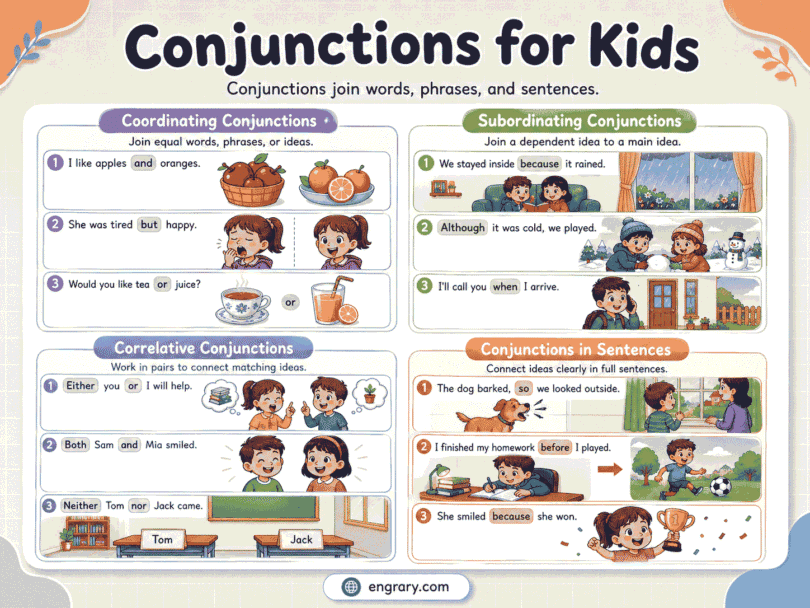
Conjunctions help us connect words and ideas so our sentences sound smoother and more complete. Common conjunctions such as and, but, or, because, if, and when show how one part of a sentence relates to another.
This guide explains the three main types of conjunctions, how they join words, phrases, and clauses, and how they help form compound and complex sentences. It also covers punctuation, commonly confused conjunctions, frequent mistakes, and practice activities with answers.
What Is a Conjunction?
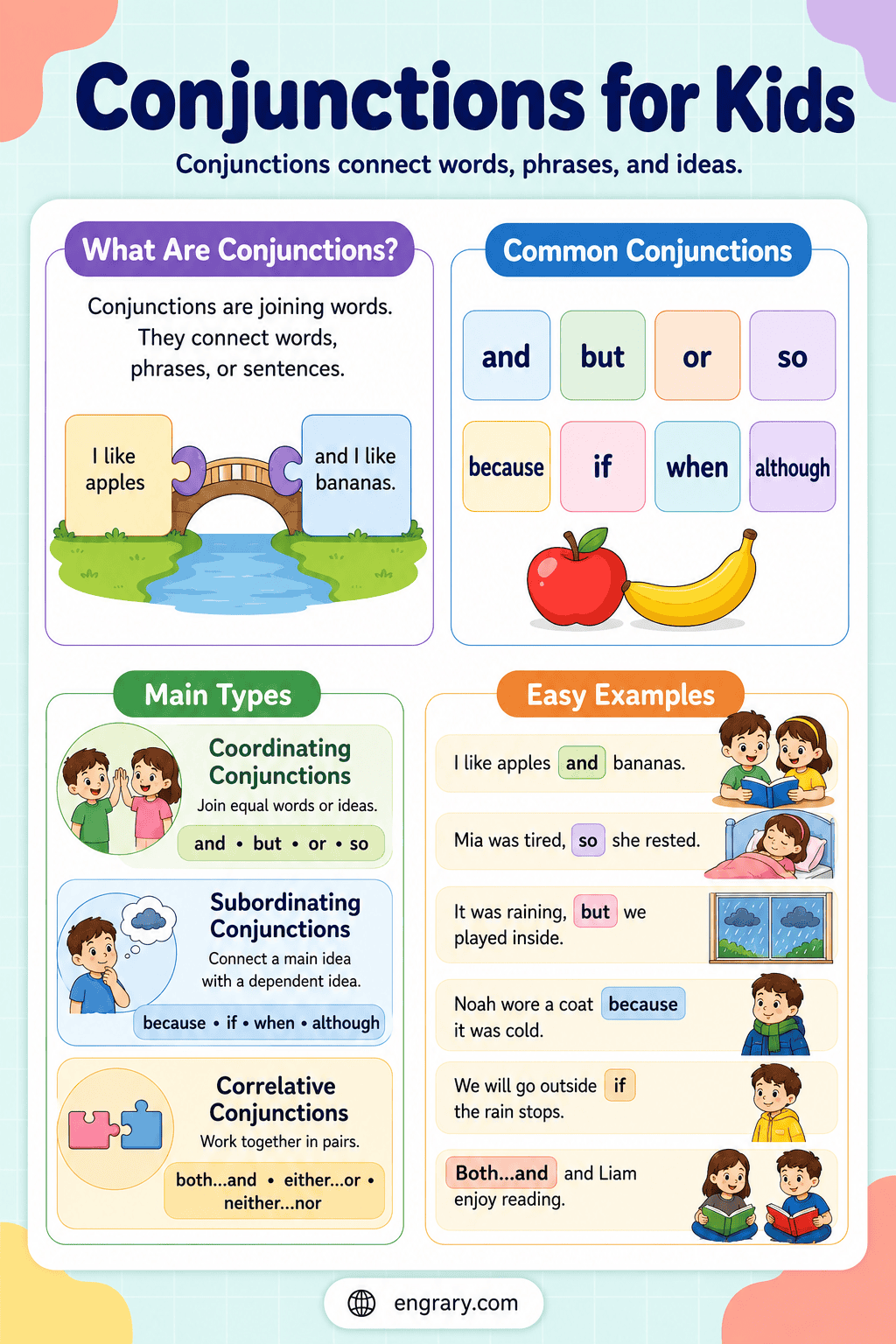
A conjunction is a word or group of words that connects words, phrases, or clauses.
Read these examples:
Ava packed pencils and markers.
We can play inside or in the yard.
I wanted to go outside, but it was raining.
Each conjunction creates a connection:
- and adds information;
- or gives a choice;
- but shows contrast.
Conjunctions can also explain reasons, show results, express time, or introduce conditions.
We stayed inside because it was raining.
It stopped raining, so we went outside.
Call me when you arrive.
We will play outside if the weather improves.
Choosing the right conjunction helps readers understand how ideas relate.
What Conjunctions Can Join
Conjunctions can connect words, phrases, or clauses.
| What is joined? | Example |
|---|---|
| Words | apples and oranges |
| Phrases | before school or after lunch |
| Clauses | I was tired, but I finished my work. |
Joining Words
A conjunction can connect two or more words with the same job in a sentence.
We packed notebooks and pencils.
Here, and joins two nouns.
The puppy was small but energetic.
In this sentence, but joins two describing words.
Joining Phrases
A conjunction can also connect groups of words.
We can meet before school or after lunch.
The conjunction or joins two prepositional phrases.
Noah likes reading mystery books and drawing cartoons.
Here, and joins two verb phrases.
Joining Clauses
A clause contains a subject and a verb.
The rain stopped, so we went outside.
The conjunction so connects two clauses:
- The rain stopped.
- We went outside.
Both clauses express complete thoughts.
Conjunctions also show different relationships between ideas.
| Relationship | Common conjunctions | Example |
|---|---|---|
| Addition | and, both…and | Mia packed paper and markers. |
| Contrast | but, yet, although | It was cold, but we played outside. |
| Choice | or, either…or | Would you like milk or juice? |
| Reason | because, since, for | We stayed home because it snowed. |
| Result | so | It snowed, so school closed. |
| Condition | if, unless | We will go if the rain stops. |
| Time | when, before, after, while | Wash your hands before you eat. |
| Negative choice | nor, neither…nor | She chose neither red nor blue. |
Main Types of Conjunctions
There are three main types of conjunctions.
| Type | Main job | Common examples |
|---|---|---|
| Coordinating | joins equal words, phrases, or clauses | and, but, or, so |
| Subordinating | connects a dependent clause to an independent clause | because, although, if, when |
| Correlative | uses a pair to connect matching elements | both…and, either…or |
Each type builds a different kind of relationship.
Mia packed a notebook and a pencil.
The coordinating conjunction and joins two nouns.
We stayed inside because it was raining.
The subordinating conjunction because introduces a reason.
Either Ava or Noah will lead the group.
The correlative conjunctions either and or work as a pair.
Coordinating Conjunctions
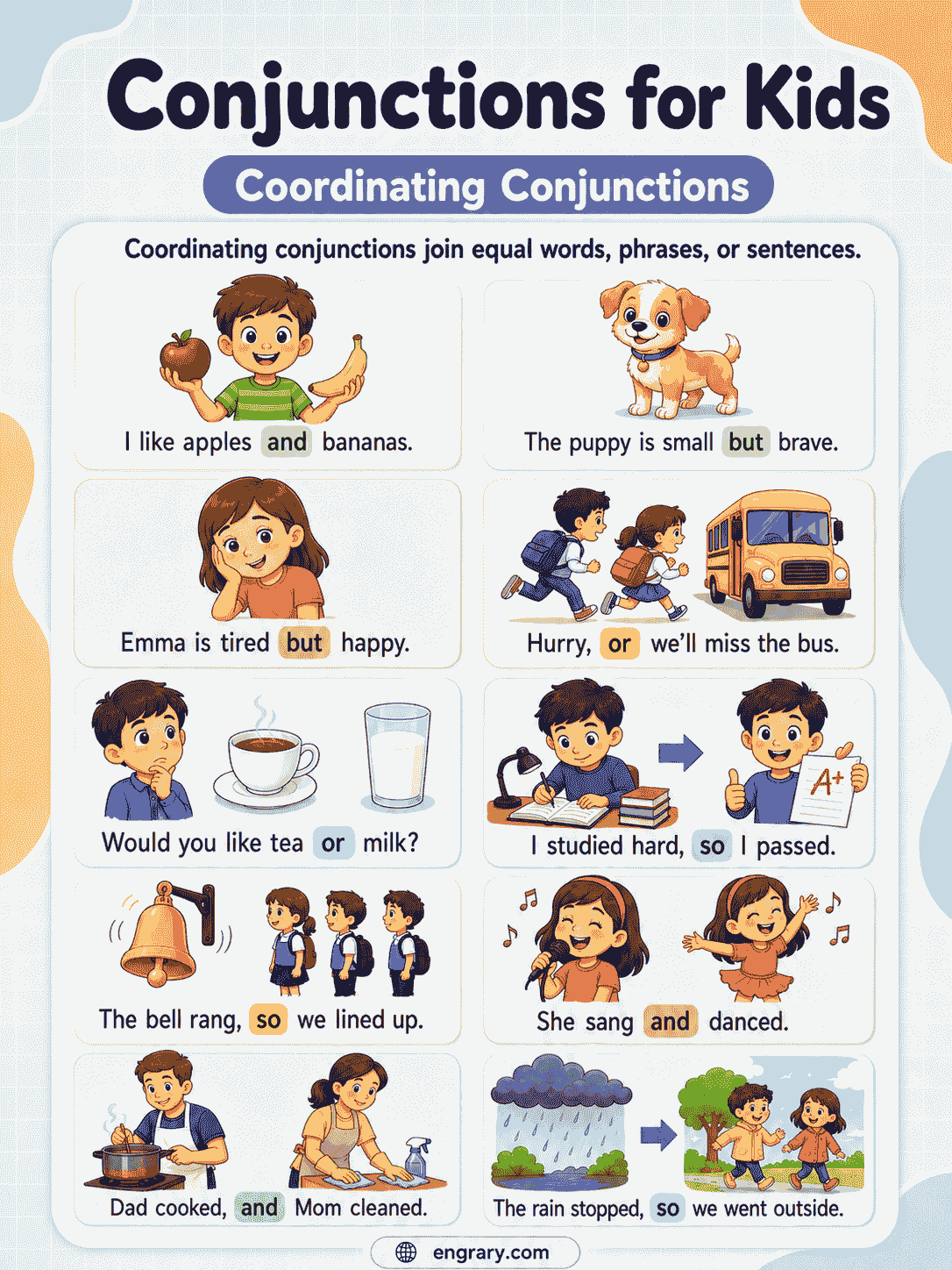
Coordinating conjunctions connect words, phrases, or clauses with equal grammatical importance.
They can join:
- two nouns;
- two verbs;
- two describing words;
- two phrases;
- two independent clauses.
Ava packed pencils and markers.
We can walk or ride the bus.
The puzzle was difficult but interesting.
FANBOYS Conjunctions
The seven coordinating conjunctions can be remembered with the word FANBOYS:
- For;
- And;
- Nor;
- But;
- Or;
- Yet;
- So.
| Conjunction | Main use | Example |
|---|---|---|
| for | gives a reason | I wore a coat, for it was cold. |
| and | adds information | We packed lunch and water. |
| nor | adds another negative idea | She did not call, nor did she text. |
| but | shows contrast | I was tired, but I finished. |
| or | gives a choice | Would you like tea or milk? |
| yet | shows unexpected contrast | It was difficult, yet she continued. |
| so | shows a result | It rained, so we stayed inside. |
Children use and, but, or, and so most often in everyday writing. The conjunctions for, nor, and yet also belong to FANBOYS, although they may sound more formal in some sentences.
Building Compound Sentences
A compound sentence contains two independent clauses joined correctly.
An independent clause expresses a complete thought and can stand alone.
The rain stopped.
We went outside.
A coordinating conjunction can combine the two clauses:
The rain stopped, and we went outside.
Another example:
Mia wanted to swim, but the pool was closed.
Both parts can stand alone:
Mia wanted to swim.
The pool was closed.
A common compound-sentence pattern is:
independent clause + comma + coordinating conjunction + independent clause
Examples:
The sky grew dark, so we went home.
Noah practiced every day, yet he still felt nervous.
We can leave now, or we can wait for Ava.
Commas with Coordinating Conjunctions
Use a comma before a coordinating conjunction when it joins two independent clauses.
I finished my homework, and I packed my bag.
Both sides are complete thoughts.
Do not usually add a comma when the conjunction joins only words.
Correct:
We packed sandwiches and juice.
Incorrect:
We packed sandwiches, and juice.
A comma is also unnecessary when a conjunction joins short phrases.
We played in the yard and near the pond.
Compare the structures:
| Structure | Comma? | Example |
|---|---|---|
| two words | no | pencils and markers |
| two phrases | usually no | before school or after lunch |
| two independent clauses | yes | I called, but no one answered. |
Subordinating Conjunctions
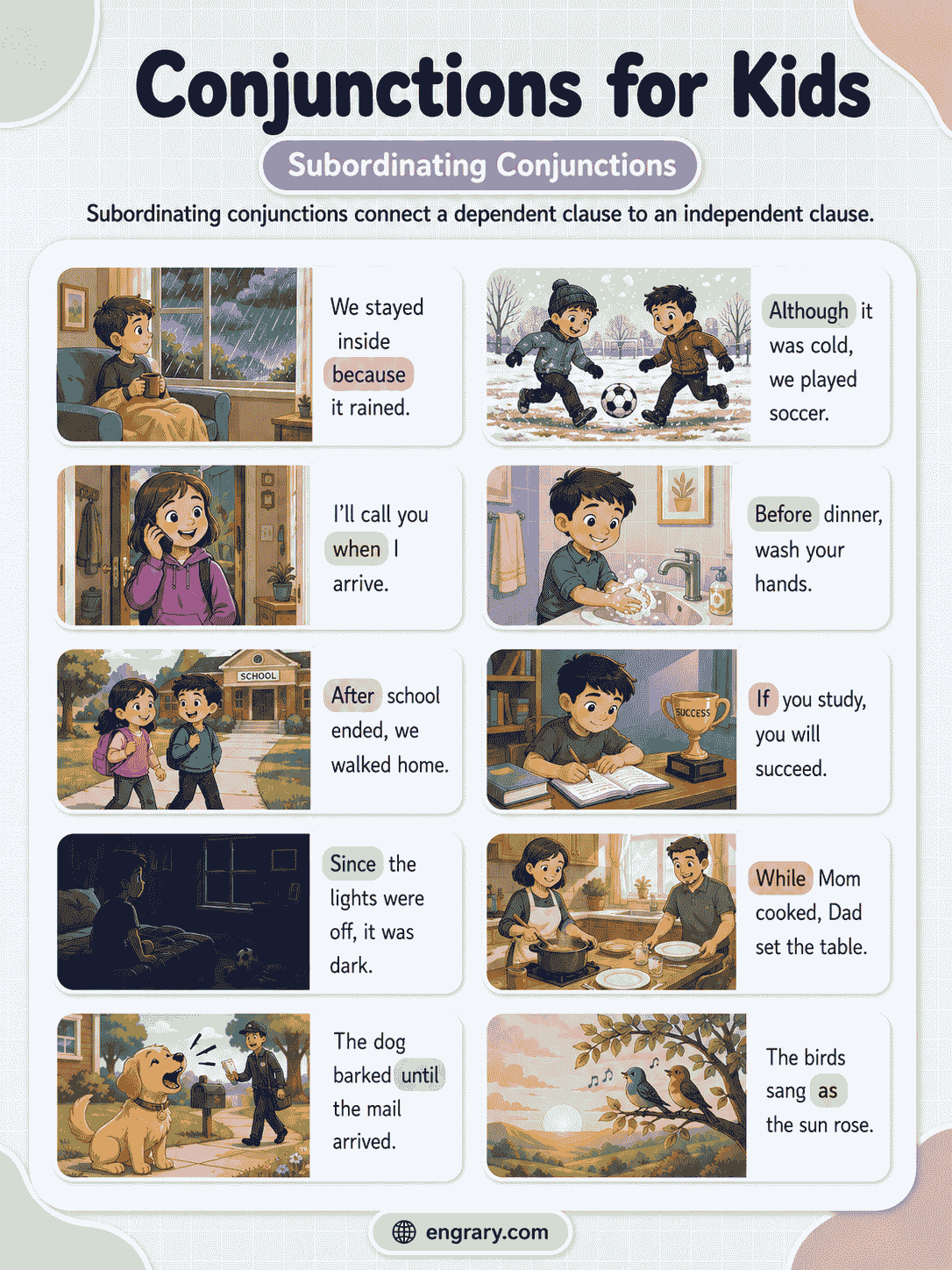
Subordinating conjunctions connect a dependent clause to an independent clause.
An independent clause can stand alone:
We stayed inside.
A dependent clause cannot usually stand alone:
because it was raining
Together, they form a complete sentence:
We stayed inside because it was raining.
The subordinating conjunction because shows why the action happened.
Subordinating Conjunctions by Meaning
Subordinating conjunctions can show time, reason, contrast, condition, place, or purpose.
Time
Common time conjunctions include:
- after;
- before;
- once;
- until;
- when;
- whenever;
- while.
Wash your hands before you eat.
We waited until the bus arrived.
Read quietly while the baby sleeps.
Reason or Cause
Common reason conjunctions include:
- because;
- since;
- as.
We left early because the road was icy.
Since the store was closed, we returned home.
Contrast
Common contrast conjunctions include:
- although;
- though;
- even though;
- whereas;
- while.
Although the test was difficult, Mia stayed calm.
Noah likes soccer, whereas Liam prefers basketball.
Condition
Common condition conjunctions include:
- if;
- unless;
- as long as;
- provided that.
We can play outside if the rain stops.
You cannot enter unless you have a ticket.
Place
Place conjunctions include:
- where;
- wherever.
Sit where you can see the board.
Take your notebook wherever you go.
Purpose
Purpose conjunctions include:
- so that;
- in order that.
Speak clearly so that everyone can hear.
We left early so that we could avoid traffic.
Independent and Dependent Clauses
Understanding clauses helps children use subordinating conjunctions correctly.
| Clause type | Can stand alone? | Example |
|---|---|---|
| Independent clause | yes | We stayed inside. |
| Dependent clause | no | because it was raining |
| Complete complex sentence | yes | We stayed inside because it was raining. |
A dependent clause usually begins with a subordinating conjunction.
Although the road was wet
This clause has a subject and a verb, but the thought feels unfinished.
The reader expects more information:
Although the road was wet, the bus arrived safely.
Building Complex Sentences
A complex sentence contains:
- one independent clause;
- at least one dependent clause.
We stayed inside because it was raining.
Independent clause:
We stayed inside.
Dependent clause:
because it was raining
Another example:
When the bell rang, the students entered the classroom.
Dependent clause:
When the bell rang
Independent clause:
the students entered the classroom
Subordinating conjunctions help explain the relationship between the clauses.
We will leave after the game ends.
The conjunction after shows time.
We will go if the weather improves.
The conjunction if shows a condition.
Commas with Dependent Clauses
Use a comma after a dependent clause when it comes first.
Because it was raining, we stayed inside.
Although I was tired, I finished my homework.
When the bell rang, the students stood up.
A comma is not usually needed when the independent clause comes first.
We stayed inside because it was raining.
I finished my homework although I was tired.
The students stood up when the bell rang.
Compare the patterns:
| Clause order | Comma? | Example |
|---|---|---|
| dependent clause first | yes | If it rains, we will stay inside. |
| independent clause first | usually no | We will stay inside if it rains. |
Avoiding Dependent-Clause Fragments
A dependent clause should not usually appear as a sentence by itself.
Fragment:
Because the bus was late.
The reader is left waiting for the main idea.
Complete:
Because the bus was late, we missed the opening song.
Another correct version is:
We missed the opening song because the bus was late.
Fragment:
Although the game was difficult.
Complete:
Although the game was difficult, we kept playing.
A useful test is to ask:
Does this group of words express a complete thought?
If not, add an independent clause.
Correlative Conjunctions
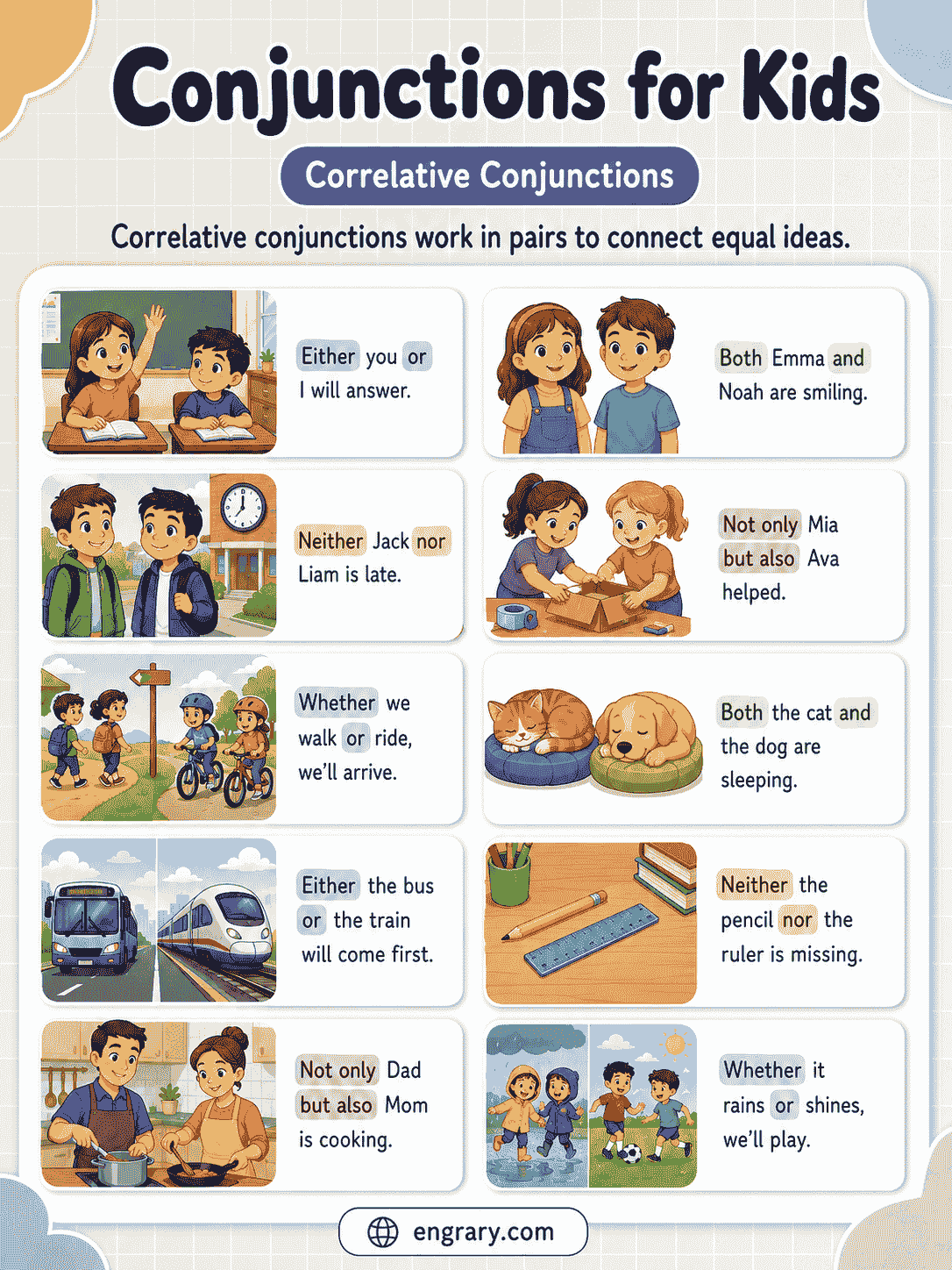
Correlative conjunctions work in pairs. They connect matching words, phrases, or clauses.
Both Ava and Mia volunteered.
We can choose either blue or green.
Neither Noah nor Liam was late.
Both parts of the pair must appear in the sentence.
Common Correlative Conjunction Pairs
| Pair | Main use | Example |
|---|---|---|
| both…and | adds two elements | Both Ava and Mia volunteered. |
| either…or | presents choices | Choose either blue or green. |
| neither…nor | rejects both choices | Neither Noah nor Liam was late. |
| not only…but also | adds emphasis | She is not only kind but also patient. |
| whether…or | presents alternatives or uncertainty | I do not know whether we will walk or drive. |
| rather…than | shows preference | I would rather read than watch television. |
The parts of each pair work together.
Incorrect:
Either Ava and Mia will lead.
Correct:
Either Ava or Mia will lead.
Keeping Correlative Conjunctions Balanced
Correlative conjunctions should connect matching grammatical structures.
Balanced:
Mia likes both reading and drawing.
Both joined elements use -ing forms.
Unbalanced:
Mia likes both reading and to draw.
The forms do not match.
Balanced:
We will either walk to school or ride the bus.
Both choices are verb phrases.
Unbalanced:
We will either walk to school or the bus.
One choice is a verb phrase, while the other is only a noun phrase.
Another balanced example:
Noah is not only helpful but also patient.
Both joined words are adjectives.
With either…or and neither…nor, the verb often agrees with the closer subject.
Either the teacher or the students are presenting.
Either the students or the teacher is presenting.
This is a more advanced rule. Younger children should first focus on using the complete pair and keeping the joined parts balanced.
Choosing Conjunctions by Meaning
A conjunction should match the relationship between the ideas.
| Intended meaning | Good choices |
|---|---|
| Add information | and, both…and |
| Show contrast | but, yet, although |
| Give a choice | or, either…or |
| Explain a reason | because, since, for |
| Show a result | so |
| State a condition | if, unless |
| Show time | when, before, after, while |
| Reject two choices | neither…nor |
Consider these sentences:
I wore boots because it was raining.
The rain is the reason for wearing boots.
It was raining, so I wore boots.
Wearing boots is the result.
Changing the conjunction changes the relationship.
Another example:
I was tired, but I finished my work.
The conjunction but shows contrast.
I was tired, so I rested.
The conjunction so shows a result.
Writers should ask:
Am I adding, contrasting, choosing, explaining, or showing a result?
That question makes conjunction choice easier.
Commonly Confused Conjunctions
Some conjunctions express related ideas but build sentences differently.
Because and So
Because introduces a reason. So introduces a result.
| Conjunction | What it introduces | Example |
|---|---|---|
| because | reason | We stayed inside because it rained. |
| so | result | It rained, so we stayed inside. |
Incorrect:
Because it rained, so we stayed inside.
Correct:
Because it rained, we stayed inside.
Or:
It rained, so we stayed inside.
Use one conjunction to show the connection clearly.
Although and But
Both conjunctions show contrast, but their sentence structures differ.
| Conjunction | Pattern | Example |
|---|---|---|
| although | dependent clause plus independent clause | Although it was cold, we played outside. |
| but | two independent clauses | It was cold, but we played outside. |
Incorrect:
Although it was cold, but we played outside.
Correct:
Although it was cold, we played outside.
Or:
It was cold, but we played outside.
If and Unless
If introduces a condition. Unless usually means if not.
| Conjunction | Meaning | Example |
|---|---|---|
| if | on the condition that | We will go if it stops raining. |
| unless | if not | We will go unless it keeps raining. |
Compare:
You can play outside if you finish your homework.
Finishing the homework makes outdoor play possible.
You cannot play outside unless you finish your homework.
Outdoor play is not possible if the homework remains unfinished.
When and While
Both conjunctions can show time.
| Conjunction | Common use | Example |
|---|---|---|
| when | one event happens at a particular time or triggers another | Call me when you arrive. |
| while | two actions happen during the same period | Read quietly while the baby sleeps. |
The lights turned on when the show began.
Ava read a book while Noah drew a picture.
These are useful patterns, although context can sometimes change the best choice.
Common Conjunction Mistakes
Conjunction mistakes often involve punctuation, incomplete clauses, broken pairs, or a connector that does not match the intended meaning.
Adding a Comma Between Joined Words
Incorrect:
We packed sandwiches, and juice.
Correct:
We packed sandwiches and juice.
The conjunction joins two nouns, so no comma is usually needed.
Missing a Comma in a Compound Sentence
Incorrect:
I wanted to play but it was raining.
Correct in formal writing:
I wanted to play, but it was raining.
Both sides are independent clauses, so place a comma before but.
Joining Complete Sentences with Only a Comma
Incorrect:
The rain stopped, we went outside.
This error is called a comma splice.
Correct:
The rain stopped, so we went outside.
Another correction is:
The rain stopped. We went outside.
Using Two Conjunctions for the Same Relationship
Incorrect:
Although I was tired, but I finished the project.
Correct:
Although I was tired, I finished the project.
Or:
I was tired, but I finished the project.
Incorrect:
Because the bus was late, so we missed the show.
Correct:
Because the bus was late, we missed the show.
Breaking a Correlative Pair
Incorrect:
Either Ava and Mia will lead.
Correct:
Either Ava or Mia will lead.
Incorrect:
Neither the teacher or the students were ready.
Correct:
Neither the teacher nor the students were ready.
Choosing the Wrong Conjunction
A grammatically possible conjunction may still create the wrong meaning.
Less logical:
I was hungry, but I made a sandwich.
More logical:
I was hungry, so I made a sandwich.
The first sentence could work only if making a sandwich was unexpected. In most situations, so expresses the intended result more clearly.
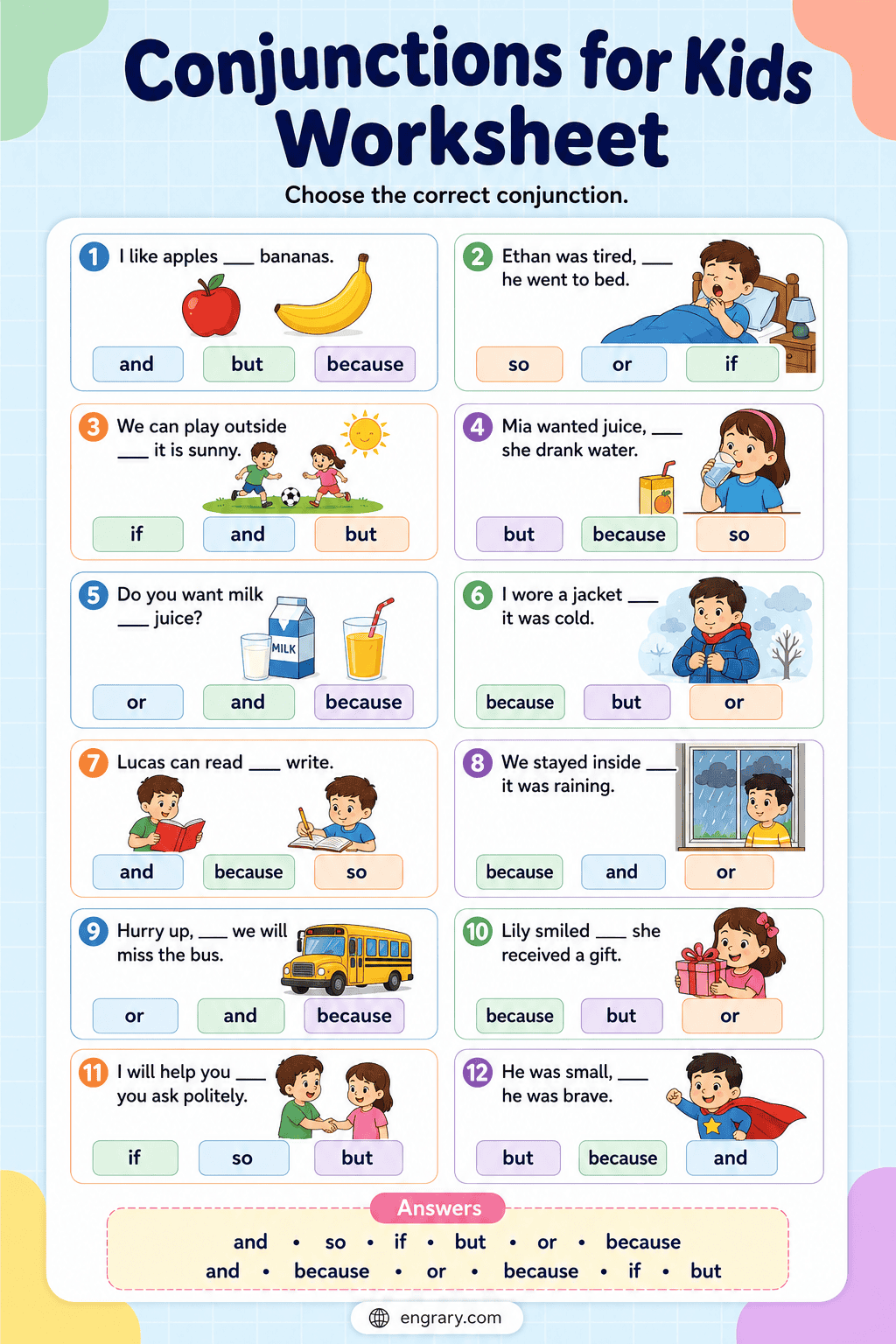
Conjunction Practice with Answers
These activities help children identify conjunctions, classify their types, combine ideas, and apply punctuation rules.
Identify the Conjunction
Find the conjunction in each sentence.
- Ava packed pencils and markers.
- We stayed inside because it was raining.
- Either Mia or Noah will lead the group.
- I wanted to play, but the field was wet.
- Call me when you arrive.
Name the Conjunction Type
Choose from:
coordinating · subordinating · correlative
- We packed lunch and water.
- Although the road was wet, the bus arrived safely.
- Both Ava and Mia volunteered.
- We stayed home because it snowed.
- You may choose tea or juice.
- Neither Noah nor Liam was absent.
Identify What Is Joined
Choose from:
words · phrases · clauses
- We bought apples and oranges.
- We can meet before school or after lunch.
- I was tired, but I finished my homework.
- The puppy was small but energetic.
- Noah enjoys reading books and drawing cartoons.
Choose a Conjunction by Meaning
Choose the best conjunction.
- I was thirsty, ___ I drank some water.
(but / so) - We stayed inside ___ it was snowing.
(because / or) - Would you like milk ___ juice?
(or / because) - ___ the test was difficult, Mia stayed calm.
(Although / So) - We will walk to school ___ the rain stops.
(if / but) - Wash your hands ___ you eat.
(before / yet)
Complete the FANBOYS Sentence
Choose from:
and · but · or · so · yet
- Ava packed a notebook ___ a pencil.
- I wanted to swim, ___ the pool was closed.
- We can walk, ___ we can ride the bus.
- It began raining, ___ we went inside.
- The puzzle was difficult, ___ Noah continued.
Complete the Subordinating Conjunction
Choose from:
because · although · if · when · before · while
- We stayed home ___ the road was icy.
- ___ the bell rang, the students entered the room.
- Wash your hands ___ you eat.
- ___ the game was difficult, the team kept trying.
- We can go outside ___ the rain stops.
- Mia read a book ___ Noah drew a picture.
Complete the Correlative Pair
- Both Ava ___ Mia volunteered.
- Either walk ___ ride the bus.
- Neither Noah ___ Liam was late.
- She is not only kind ___ also patient.
- I do not know whether we will stay ___ leave.
Combine the Sentences
Join each pair with a suitable conjunction.
- The sky was dark. We went inside.
- Ava wanted to play. She had to finish her homework.
- The bell rang. The students entered the classroom.
- We can eat now. We can wait for Noah.
- The road was icy. The bus moved slowly.
Add the Correct Comma
Add a comma only where needed.
- I finished my homework and I packed my bag.
- We bought apples and oranges.
- Because the rain was heavy the game was canceled.
- We stayed inside because it was raining.
- Mia wanted to swim but the pool was closed.
Fix the Sentence Fragment
Rewrite each fragment as a complete sentence.
- Because the bus was late.
- Although the game was difficult.
- When the bell rang.
- If the weather improves.
- While the baby slept.
Correct the Conjunction Mistake
- Although I was tired, but I finished my work.
- Because it rained, so we stayed inside.
- Either Ava and Mia will lead.
- We packed sandwiches, and juice.
- The rain stopped, we went outside.
- Noah likes both swimming and to hike.
- I was hungry, but I made a sandwich.
Write Your Own Sentences
- Write a compound sentence using but.
- Write a complex sentence using because.
- Write a sentence using either…or.
- Write a sentence using when.
- Write a sentence using both…and.
Answer Key
Identify the conjunction
- and
- because
- either…or
- but
- when
Name the conjunction type
- coordinating
- subordinating
- correlative
- subordinating
- coordinating
- correlative
Identify what is joined
- words
- phrases
- clauses
- words
- phrases
Choose a conjunction by meaning
- so
- because
- or
- Although
- if
- before
Complete the FANBOYS sentence
- and
- but
- or
- so
- yet
Complete the subordinating conjunction
- because
- when
- before
- although
- if
- while
Complete the correlative pair
- and
- or
- nor
- but
- or
Combine the sentences: possible answers
- The sky was dark, so we went inside.
- Ava wanted to play, but she had to finish her homework.
- When the bell rang, the students entered the classroom.
- We can eat now, or we can wait for Noah.
- Because the road was icy, the bus moved slowly.
Add the correct comma
- I finished my homework, and I packed my bag.
- We bought apples and oranges.
- Because the rain was heavy, the game was canceled.
- We stayed inside because it was raining.
- Mia wanted to swim, but the pool was closed.
Fix the sentence fragment: possible answers
- Because the bus was late, we missed the opening song.
- Although the game was difficult, the team kept playing.
- When the bell rang, the students entered the room.
- If the weather improves, we will go outside.
- While the baby slept, Ava read a book.
Correct the conjunction mistake
- Although I was tired, I finished my work.
Or: I was tired, but I finished my work. - Because it rained, we stayed inside.
Or: It rained, so we stayed inside. - Either Ava or Mia will lead.
- We packed sandwiches and juice.
- The rain stopped, so we went outside.
Or: The rain stopped. We went outside. - Noah likes both swimming and hiking.
- I was hungry, so I made a sandwich.
Write your own sentences: possible answers
- I wanted to go outside, but it was raining.
- We stayed home because the road was icy.
- We can either walk or ride the bus.
- Call me when you arrive.
- Both Ava and Mia finished the project.
FAQs
A conjunction is a word or group of words that connects words, phrases, or clauses. Common examples include and, but, or, because, if, and when.
The three main types are coordinating, subordinating, and correlative conjunctions.
FANBOYS stands for for, and, nor, but, or, yet, and so, the seven coordinating conjunctions.
Use a comma before a coordinating conjunction when it joins two independent clauses, as in “I was tired, but I finished my homework.”
Because introduces a reason, while so introduces a result. For example, “We stayed inside because it rained” and “It rained, so we stayed inside.”
You May Also Like