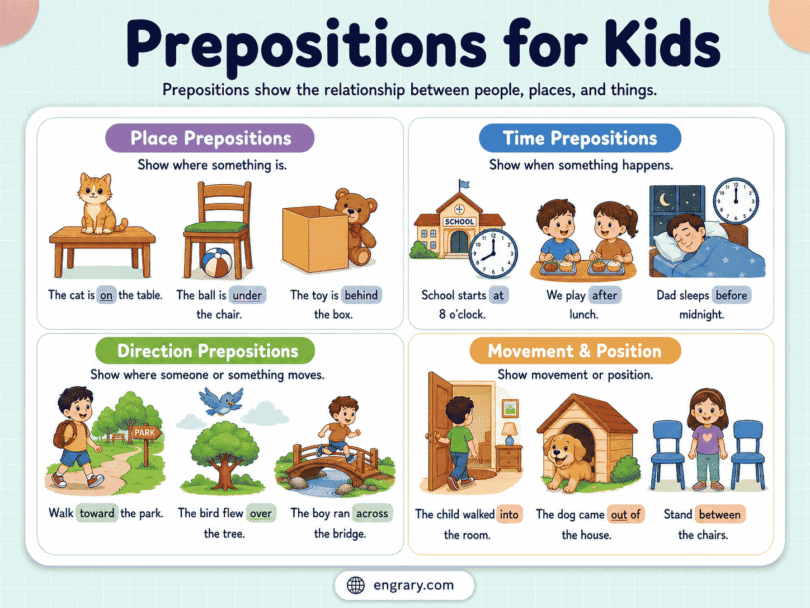
Prepositions help us explain where something is, when something happens, where someone is going, and how ideas connect. Words such as in, on, under, after, toward, with, and for are common prepositions.
This guide explains how prepositions work, how to find them in sentences, and how they form prepositional phrases. It also covers place, time, direction, movement, commonly confused forms, frequent mistakes, and practice activities with answers.
What Is a Preposition?
A preposition is a word that connects a noun or pronoun to another part of a sentence and shows a relationship.
That relationship may involve:
- place;
- time;
- direction;
- movement;
- source;
- purpose;
- means;
- connection.
Read this sentence:
The ball is under the chair.
The word under shows the relationship between the ball and the chair.
- Preposition: under
- Object of the preposition: chair
- Complete prepositional phrase: under the chair
- Relationship shown: place
A preposition usually works with another word rather than standing alone.
We waited after lunch.
Here, after connects the action waited to the time word lunch.
Relationships Shown by Prepositions
Prepositions do more than show where objects are located. They can express several kinds of relationships.
| Relationship | Example |
|---|---|
| Place | The shoes are under the bed. |
| Time | We will leave after lunch. |
| Direction | Walk toward the gate. |
| Movement | The dog ran through the tunnel. |
| Source | The letter is from Maya. |
| Purpose | The gift is for Noah. |
| Means | She drew the picture with crayons. |
| Connection | The cover of the book is blue. |
The same preposition can sometimes show different relationships.
We met at the library.
In this sentence, at shows place.
We met at noon.
Here, at shows time.
Context helps readers understand the relationship.
Prepositions and Their Objects
A preposition usually comes before a noun, pronoun, or noun phrase called its object.
We waited near the entrance.
- Preposition: near
- Object: entrance
- Prepositional phrase: near the entrance
The object can be a noun:
The cat slept under the table.
It can also be a pronoun:
The gift is for her.
Sometimes the object includes describing words.
The puppy rested beside the warm fireplace.
The main object is fireplace, while the warm fireplace is the complete noun phrase that follows the preposition.
A preposition and its object work together to form a complete idea. For example, under alone does not tell us enough. However, under the table gives a clear relationship.
Finding Prepositions in Sentences
Children can find prepositions more easily by looking for relationships rather than memorizing a long list.
Use these steps:
- Look for a word that connects ideas.
- Find the noun or pronoun that follows it.
- Read from the preposition through its object.
- Decide what relationship the phrase shows.
Example:
The puppy slept beside the fireplace.
- Relationship word: beside
- Object: fireplace
- Complete phrase: beside the fireplace
- Detail added: where the puppy slept
Another example:
We practiced before dinner.
- Preposition: before
- Object: dinner
- Complete phrase: before dinner
- Detail added: when we practiced
Some words can perform different jobs depending on the sentence. Therefore, a memorized word list is not always enough.
We walked around the lake.
Here, around is a preposition because it has the object lake.
Please turn around.
In this sentence, around does not have an object, so it is not functioning as a preposition.
Prepositions of Place
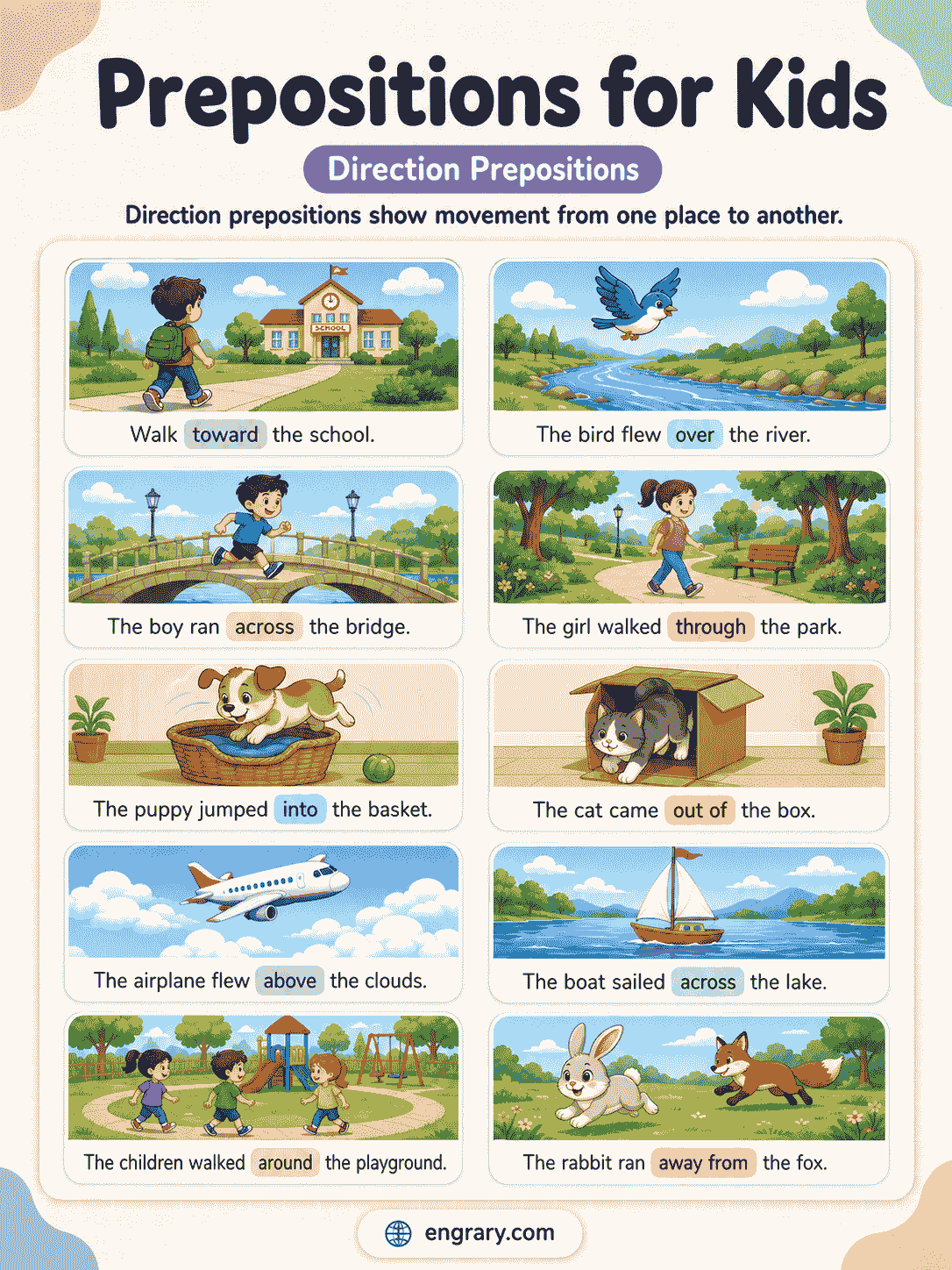
Prepositions of place tell where a person, animal, or object is located.
Common place prepositions include:
- above;
- behind;
- below;
- beside;
- between;
- in;
- inside;
- near;
- next to;
- on;
- opposite;
- outside;
- over;
- under;
- underneath.
Examples:
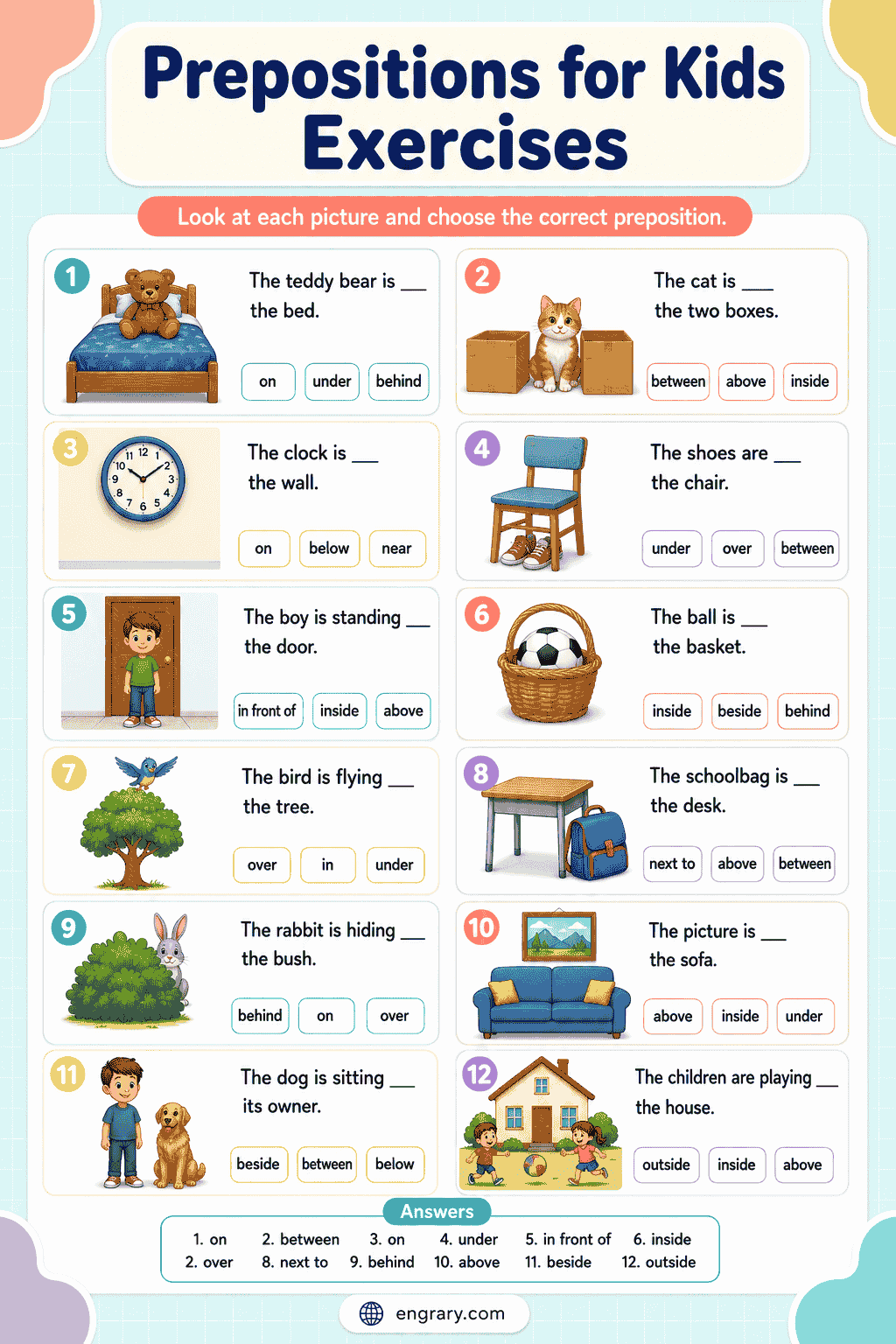
The lamp is above the desk.
The backpack is beside the chair.
The dog is hiding under the table.
The school is opposite the park.
The keys are inside the drawer.
Place prepositions often work best with visual examples because the relationship can be seen directly.
In, On, and At for Place
The prepositions in, on, and at all show place, but they are used differently.
| Preposition | Main use | Example |
|---|---|---|
| in | inside an area, room, container, city, or country | in the classroom |
| on | touching a surface | on the desk |
| at | a point or specific location | at the entrance |
Use in when something is inside a space.
The pencils are in the box.
We live in Chicago.
Use on when something touches a surface.
The notebook is on the desk.
A picture hangs on the wall.
Use at for a specific point or location.
We met at the bus stop.
Dad is waiting at the door.
These rules are useful starting points, although some expressions must be learned through practice.
Prepositions of Time
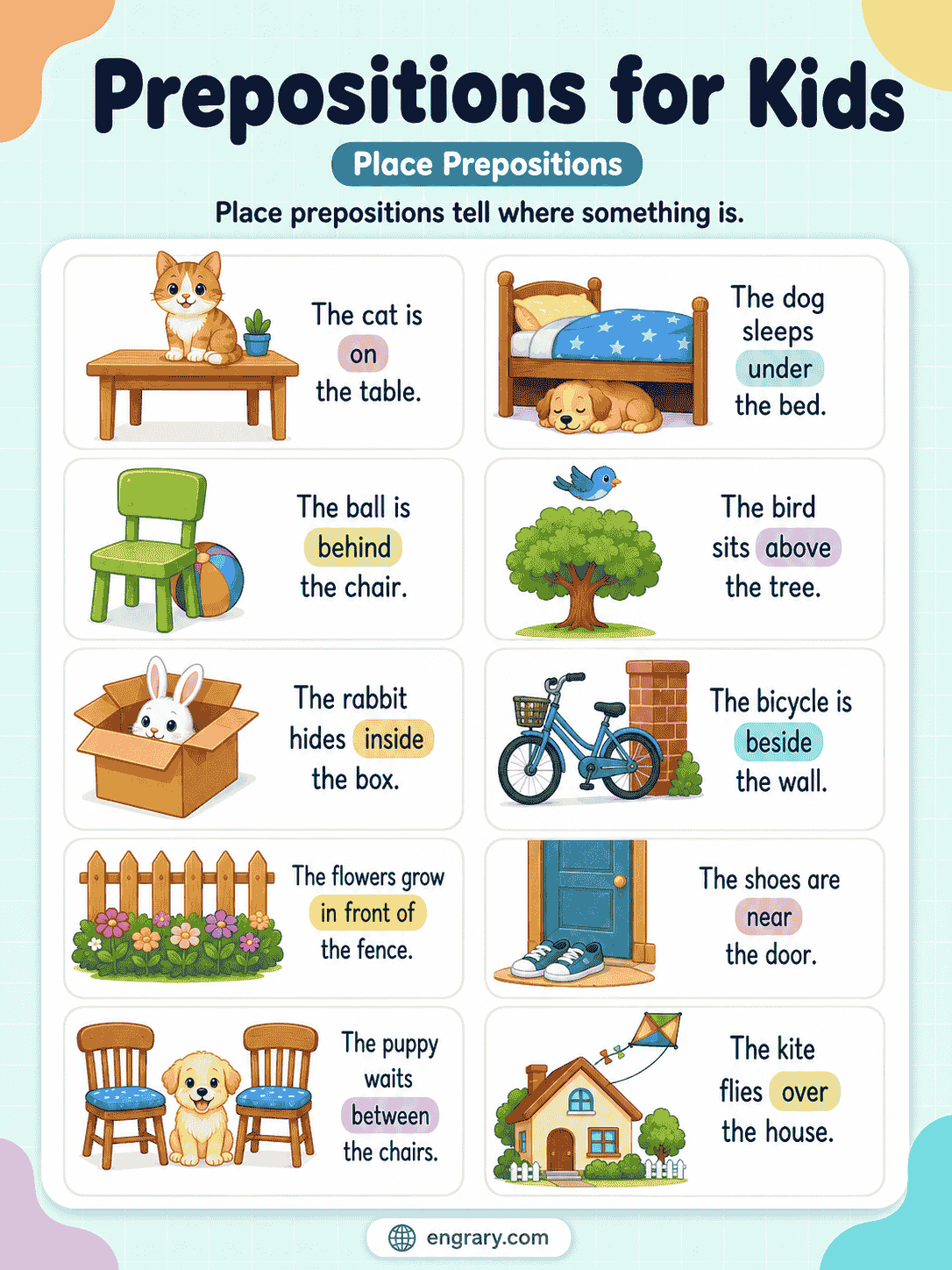
Prepositions of time explain when something happens, how long it lasts, or when a period begins or ends.
Common time prepositions include:
- after;
- at;
- before;
- by;
- during;
- for;
- from;
- in;
- on;
- since;
- throughout;
- until;
- within.
Examples:
The lesson begins at 9:00.
We will visit Grandma on Sunday.
School starts in August.
The children stayed inside during the storm.
Finish the assignment by Friday.
In, On, and At for Time
| Preposition | Main use | Example |
|---|---|---|
| in | months, years, seasons, and broad periods | in July |
| on | days and dates | on Monday |
| at | exact times and precise points | at 3:00 |
Use in for longer periods.
We travel in summer.
She was born in 2016.
Use on for days and dates.
The class meets on Tuesday.
The party is on July 10.
Use at for exact times.
Lunch begins at noon.
The bus arrives at 8:15.
Common Time Prepositions Compared
Several time prepositions express similar ideas, so comparisons help children choose correctly.
Since and For
| Preposition | Use | Example |
|---|---|---|
| since | starting point | since Monday |
| for | length of time | for three days |
We have lived here since 2022.
We have lived here for four years.
By and Until
| Preposition | Use | Example |
|---|---|---|
| by | no later than a deadline | Finish by Friday. |
| until | continuing up to a time | Stay until Friday. |
Please return the book by Monday.
The book may be returned earlier, but Monday is the deadline.
The library stays open until 6:00.
It remains open up to that time.
During and For
| Preposition | Use | Example |
|---|---|---|
| during | within an event or named period | during the movie |
| for | length of time | for two hours |
We were quiet during the movie.
The movie lasted for two hours.
Prepositions of Direction and Movement
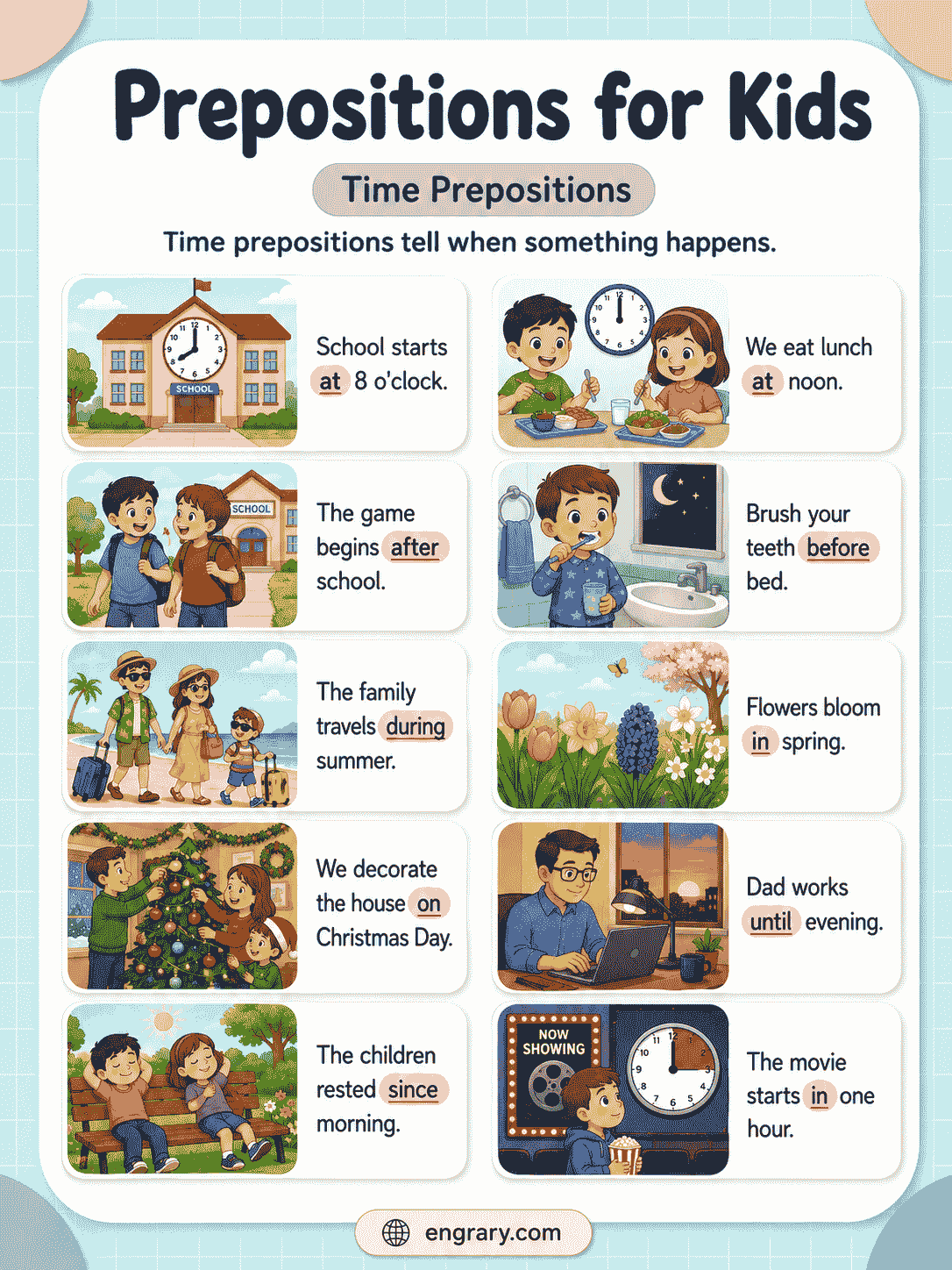
Direction prepositions show where someone or something is headed. Movement prepositions show the path or route followed.
Common direction prepositions include:
- to;
- toward;
- from;
- away from.
We walked toward the playground.
The bus traveled from Boston to New York.
Common movement prepositions include:
- across;
- along;
- around;
- down;
- into;
- off;
- onto;
- out of;
- over;
- past;
- through;
- up.
The dog ran through the tunnel.
The children walked across the field.
The cyclist rode past the library.
In and Into
| Word | Meaning | Example |
|---|---|---|
| in | location inside | The toys are in the box. |
| into | movement from outside to inside | Put the toys into the box. |
Use in when something is already inside.
The rabbit is in the cage.
Use into when movement ends inside.
The rabbit jumped into the cage.
On and Onto
| Word | Meaning | Example |
|---|---|---|
| on | location touching a surface | The cat is on the chair. |
| onto | movement to a surface | The cat jumped onto the chair. |
The first sentence shows position, while the second shows movement.
Through and Across
| Word | Meaning | Example |
|---|---|---|
| through | movement within an enclosed or surrounding space | through the tunnel |
| across | movement from one side to another | across the field |
The train moved through the tunnel.
The hikers walked across the bridge.
These are common patterns rather than rules for every possible situation.
Other Relationships Shown by Prepositions
Prepositions can also show source, purpose, method, cause, connection, or absence.
| Preposition | Common relationship | Example |
|---|---|---|
| for | purpose or intended receiver | a gift for Ava |
| from | source or starting point | a message from Noah |
| by | agent, method, or nearby place | written by Mia |
| with | tool, company, or feature | cut with scissors |
| without | absence | tea without sugar |
| of | connection, possession, or part | the top of the hill |
| about | topic | a book about space |
| because of | cause | canceled because of rain |
| according to | source of information | according to the report |
Examples:
This card is for my teacher.
The painting was created by Elena.
We opened the package with scissors.
The game was delayed because of rain.
Multiword expressions such as because of and according to can also function as prepositions.
Prepositional Phrases
A prepositional phrase begins with a preposition and includes its object and any words describing that object.
Examples include:
- under the table;
- after the long game;
- toward the open gate;
- with a blue marker.
Read this sentence:
We walked through the park after lunch.
It contains two prepositional phrases.
- through the park shows the route.
- after lunch shows time.
A sentence may contain several prepositional phrases.
The puppy slept under the chair near the window during the storm.
However, too many phrases can make a sentence hard to follow. Clear writing uses only the details readers need.
How Prepositional Phrases Add Details
A prepositional phrase can describe a noun.
The puppy under the chair is sleeping.
The phrase tells readers which puppy.
A prepositional phrase can also describe a verb.
The puppy slept under the chair.
Here, the phrase tells where the puppy slept.
Compare the two uses:
| Sentence | What the phrase describes |
|---|---|
| The puppy under the chair is sleeping. | the noun puppy |
| The puppy slept under the chair. | the verb slept |
Children do not need to memorize advanced labels to understand the difference. They can simply ask what information the phrase adds.
Commonly Confused Prepositions
Some prepositions look or sound similar but express different relationships.
Between and Among
| Word | Main use | Example |
|---|---|---|
| between | separate or clearly distinct people or things | between the two houses |
| among | within a group | among the flowers |
The bench stood between two trees.
The rabbit hid among the bushes.
The word between is not limited to two things. It may also connect several distinct items.
The teacher divided the tasks between Ava, Mia, and Noah.
Beside and Besides
| Word | Meaning | Example |
|---|---|---|
| beside | next to | Sit beside me. |
| besides | in addition to | Besides art, she enjoys music. |
The backpack is beside the desk.
Besides math, he studies science.
Above and Over
| Word | Common use | Example |
|---|---|---|
| above | higher than | above the shelf |
| over | higher, covering, or crossing | over the bridge |
The clock hangs above the door.
The plane flew over the city.
She placed a blanket over the child.
Both words may show a higher position, but over can also suggest covering or crossing.
Below and Under
| Word | Common use | Example |
|---|---|---|
| below | lower level or measurement | below freezing |
| under | directly lower, beneath, or covered by | under the table |
The temperature fell below freezing.
The shoes are under the bed.
The difference depends on context, so children should focus on the most natural meaning in each sentence.
Pronouns After Prepositions
Object pronouns normally follow prepositions.
Correct:
between you and me
for him
with them
Incorrect:
between you and I
for he
with they
After a preposition, use an object pronoun such as:
- me;
- you;
- him;
- her;
- it;
- us;
- them.
The teacher spoke to us.
This gift is from her.
The secret is between you and me.
Common Words That Use Specific Prepositions
Some verbs and adjectives naturally pair with particular prepositions.
Common examples include:
- interested in;
- afraid of;
- proud of;
- listen to;
- depend on;
- belong to;
- good at;
- ready for.
Examples:
Ava is interested in science.
Noah is afraid of spiders.
Please listen to the instructions.
The answer depends on the question.
These combinations do not always follow one simple rule. Therefore, children often learn them through reading, listening, and repeated practice.
Common Preposition Mistakes
Many preposition errors happen because two forms seem similar or because a word requires a specific partner.
Using In, On, and At Incorrectly
Incorrect:
The lesson starts in 9:00.
Correct:
The lesson starts at 9:00.
Incorrect:
The meeting is at Monday.
Correct:
The meeting is on Monday.
Use at for exact times and on for days or dates.
Confusing Location with Movement
Incorrect when movement is intended:
She walked in the room.
Correct:
She walked into the room.
The first sentence may mean that she walked while already inside the room. The second clearly shows movement from outside to inside.
Compare:
The book is on the desk.
Put the book onto the desk.
Using the Wrong Pronoun After a Preposition
Incorrect:
Keep this between you and I.
Correct:
Keep this between you and me.
Incorrect:
The package is for she.
Correct:
The package is for her.
Use object pronouns after prepositions.
Adding an Unnecessary Preposition
Incorrect:
We discussed about the project.
Correct:
We discussed the project.
The verb discuss does not need about in this sentence.
Another example:
Incorrect:
Where did you enter into?
Correct:
Where did you enter?
However, enter into may be correct in expressions such as enter into an agreement, so context matters.
Leaving Out a Needed Preposition
Incorrect:
She listened the teacher.
Correct:
She listened to the teacher.
Incorrect:
This backpack belongs Maya.
Correct:
This backpack belongs to Maya.
Some verbs require a preposition before their object.
Using the Wrong Preposition with a Word
Incorrect:
He is interested on science.
Correct:
He is interested in science.
Incorrect:
She is good in chess.
Correct:
She is good at chess.
Incorrect:
We depend of our teammates.
Correct:
We depend on our teammates.
These word combinations become easier with regular reading and practice.
Preposition Practice with Answers
The following activities help children identify prepositions, objects, relationships, and complete phrases.
Identify the Preposition
Find the preposition in each sentence.
- The shoes are under the bed.
- We arrived after lunch.
- The children walked toward the playground.
- Ava opened the box with a key.
- The letter came from Noah.
Identify the Object
Find the object of the preposition.
- The puppy slept beside the fireplace.
- We waited near the entrance.
- The class begins after lunch.
- The gift is for her.
- The children ran across the field.
Find the Complete Prepositional Phrase
- The cat hid behind the blue curtain.
- We practiced before the important game.
- The bus stopped at the corner.
- Mia wrote with a red pencil.
- The bird flew over the quiet lake.
Name the Relationship
Choose from:
place · time · direction · movement · purpose · means
- The ball rolled under the chair.
- We will meet after school.
- The children walked toward the gate.
- The dog ran through the tunnel.
- This card is for my teacher.
- She cut the paper with scissors.
Choose In, On, or At
- The books are ___ the shelf.
- We live ___ Boston.
- The bus stops ___ the corner.
- School begins ___ August.
- The game is ___ Friday.
- Lunch starts ___ noon.
Choose the Correct Preposition
- The rabbit jumped in / into the box.
- The picture is on / onto the wall.
- The dog ran through / across the tunnel.
- We walked through / across the field.
- The bench stood between / among two trees.
- The butterfly rested between / among the flowers.
Complete the Time Comparison
- We have lived here since / for three years.
- She has studied here since / for 2023.
- Please finish the work by / until Friday.
- The store remains open by / until 8:00.
- We stayed quiet during / for the movie.
- The lesson lasted during / for one hour.
Choose the Correct Pronoun
- The gift is for she / her.
- The teacher spoke to we / us.
- Keep this between you and I / me.
- The message came from he / him.
- Mia sat beside they / them.
Correct the Preposition Mistake
- The class starts in 10:00.
- We discussed about the book.
- She listened the instructions.
- He is interested on science.
- The cat jumped in the chair.
- This notebook belongs Ava.
- The package is for he.
Expand the Sentence
Add a suitable prepositional phrase to each sentence.
- The bird flew.
- The puppy slept.
- We waited.
- The children walked.
- Ava wrote.
Possible phrases include:
- over the lake;
- under the table;
- after lunch;
- toward the park;
- with a blue marker.
Answer Key
Identify the preposition
- under
- after
- toward
- with
- from
Identify the object
- fireplace
- entrance
- lunch
- her
- field
Find the complete prepositional phrase
- behind the blue curtain
- before the important game
- at the corner
- with a red pencil
- over the quiet lake
Name the relationship
- place
- time
- direction
- movement
- purpose
- means
Choose in, on, or at
- on
- in
- at
- in
- on
- at
Choose the correct preposition
- into
- on
- through
- across
- between
- among
Complete the time comparison
- for
- since
- by
- until
- during
- for
Choose the correct pronoun
- her
- us
- me
- him
- them
Correct the preposition mistake
- The class starts at 10:00.
- We discussed the book.
- She listened to the instructions.
- He is interested in science.
- The cat jumped onto the chair.
- This notebook belongs to Ava.
- The package is for him.
Expand the sentence: possible answers
- The bird flew over the lake.
- The puppy slept under the table.
- We waited after lunch.
- The children walked toward the park.
- Ava wrote with a blue marker.
FAQs
A preposition is a word that connects a noun or pronoun to another part of a sentence and shows a relationship such as place, time, direction, movement, source, or purpose.
Common prepositions include in, on, at, under, above, beside, between, after, before, toward, through, with, for, and from.
The object is the noun, pronoun, or noun phrase that follows the preposition. In under the table, the object is table.
A prepositional phrase begins with a preposition and includes its object and any describing words, such as under the old wooden table.
Yes. A sentence may end with a preposition when the wording sounds natural and the meaning is clear, as in “What are you looking at?”
You May Also Like