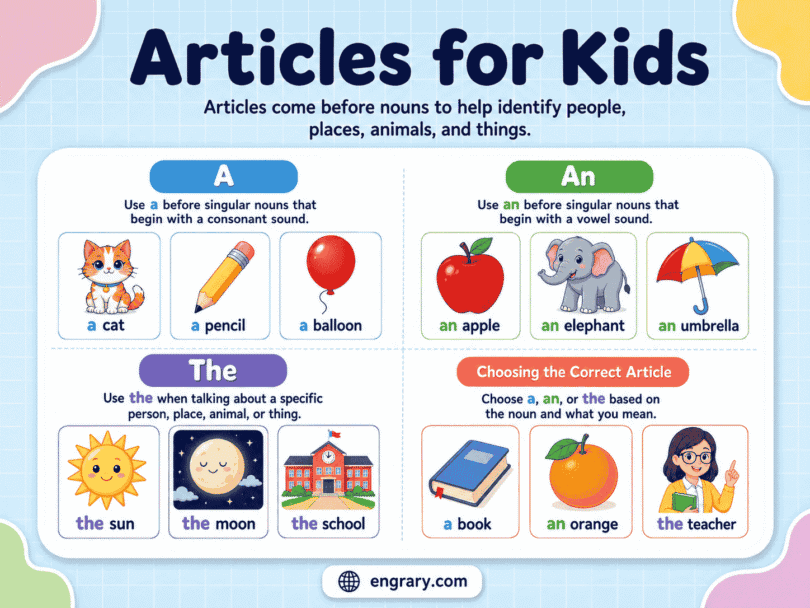
Articles are small words that do an important job in English sentences. The words a, an, and the come before nouns and help readers understand whether someone means any person or thing, or one particular person or thing.
Children can learn the basic article rules quickly, but correct choices often depend on pronunciation, countability, and context. By understanding these ideas together, students can choose a, an, the, or no article more accurately in speaking and writing.
What Are Articles in English Grammar?
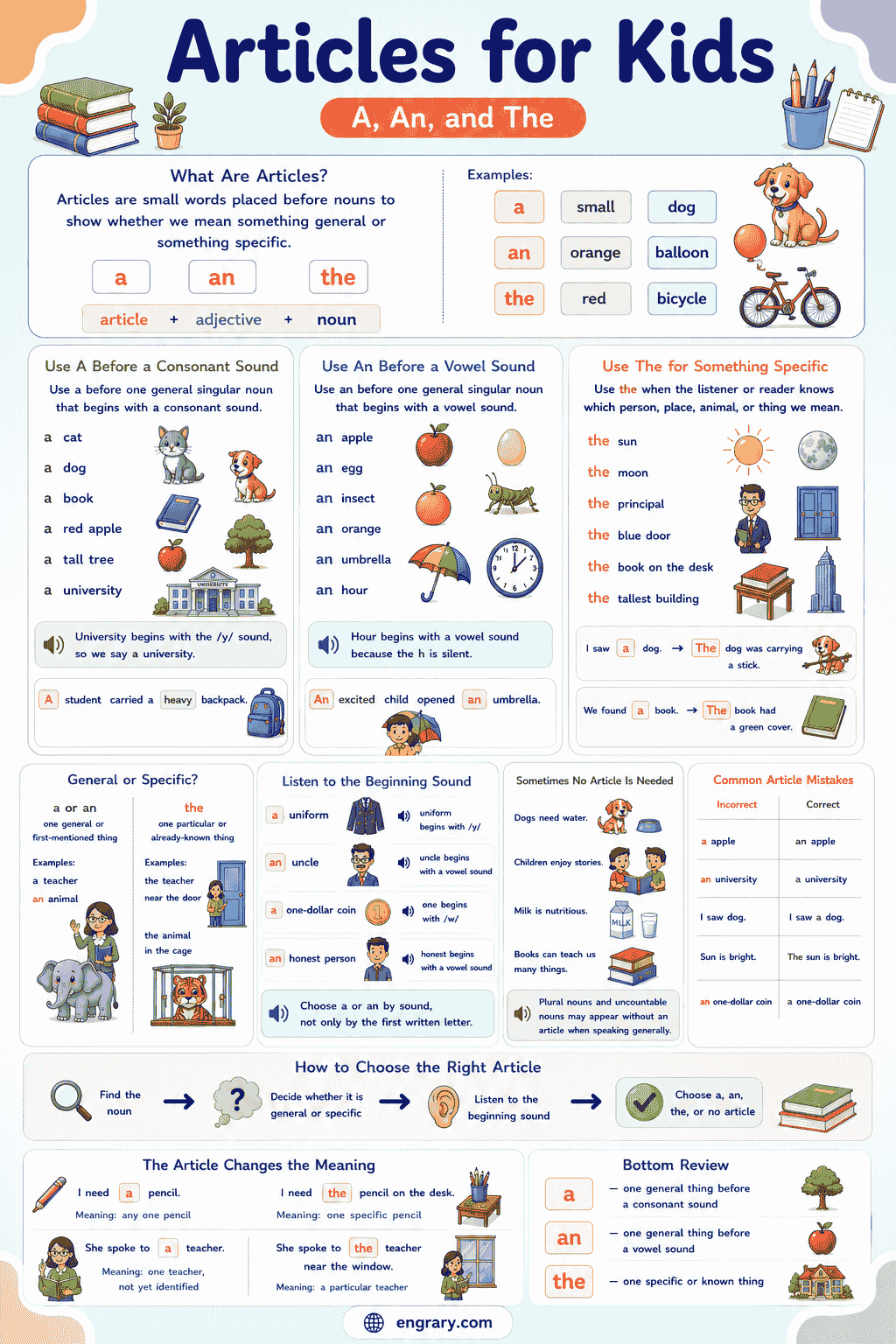
An article is a word placed before a noun or a group of words built around a noun. English has three articles:
- a
- an
- the
Examples include:
- a rabbit
- an orange
- the classroom
- a noisy bird
- an old house
- the new teacher
Articles belong to a larger group called determiners. Determiners introduce or identify nouns. However, children can understand article use without learning every type of determiner at once.
Definite and Indefinite Articles
English articles belong to two main groups.
| Article Type | Articles | Basic Meaning |
|---|---|---|
| Indefinite articles | a, an | one general or not-yet-identified person or thing |
| Definite article | the | a particular or clearly identified person or thing |
Use a or an when the reader or listener does not yet know exactly which person or thing is meant.
- I saw a dog.
- Mia opened an envelope.
- Noah wants a pencil.
In contrast, use the when the exact noun can be identified.
- The dog followed me home.
- Please open the envelope on the desk.
- Noah wants the blue pencil.
The word indefinite means that the noun is not clearly identified. Meanwhile, definite means that a particular noun is known or understood.
Where Articles Go in a Sentence
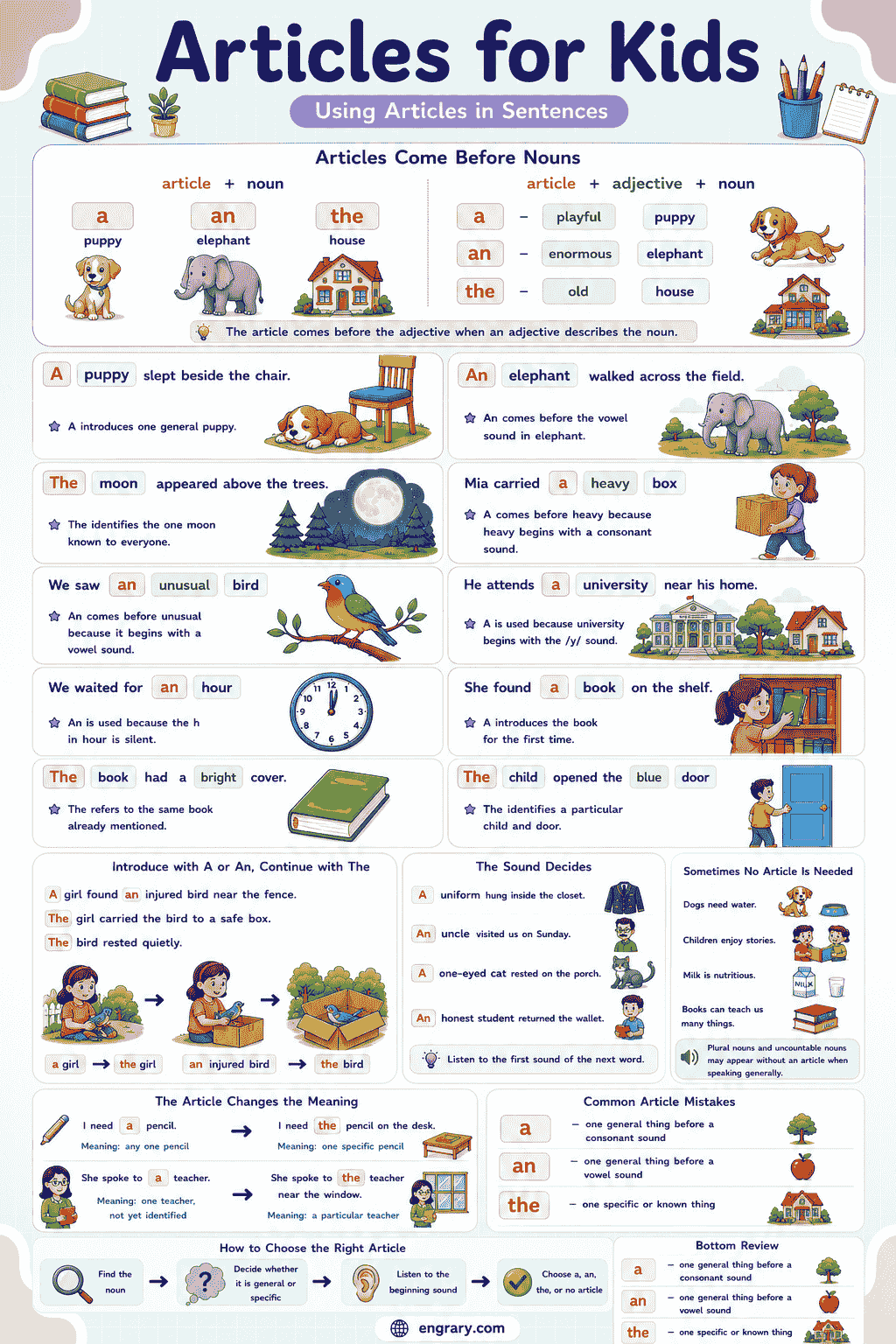
Articles usually come before nouns.
- a chair
- an animal
- the teacher
- a sandwich
- the playground
Sometimes an adjective appears between the article and noun.
- a large chair
- an excited animal
- the helpful teacher
- a fresh sandwich
- the new playground
The usual pattern is:
article + adjective + noun
For example:
- a bright light
- an empty box
- the tall building
When a or an comes before an adjective, the adjective’s first sound controls the article choice.
Compare:
- a red apple
- an old apple
Both phrases contain the noun apple. However, red begins with a consonant sound, while old begins with a vowel sound.
How to Choose A or An
Both a and an usually mean one general person, animal, place, object, or idea. They normally appear before singular countable nouns.
- a book
- an egg
- a child
- an idea
To choose between them, listen to the first sound of the next word.
Use A Before a Consonant Sound
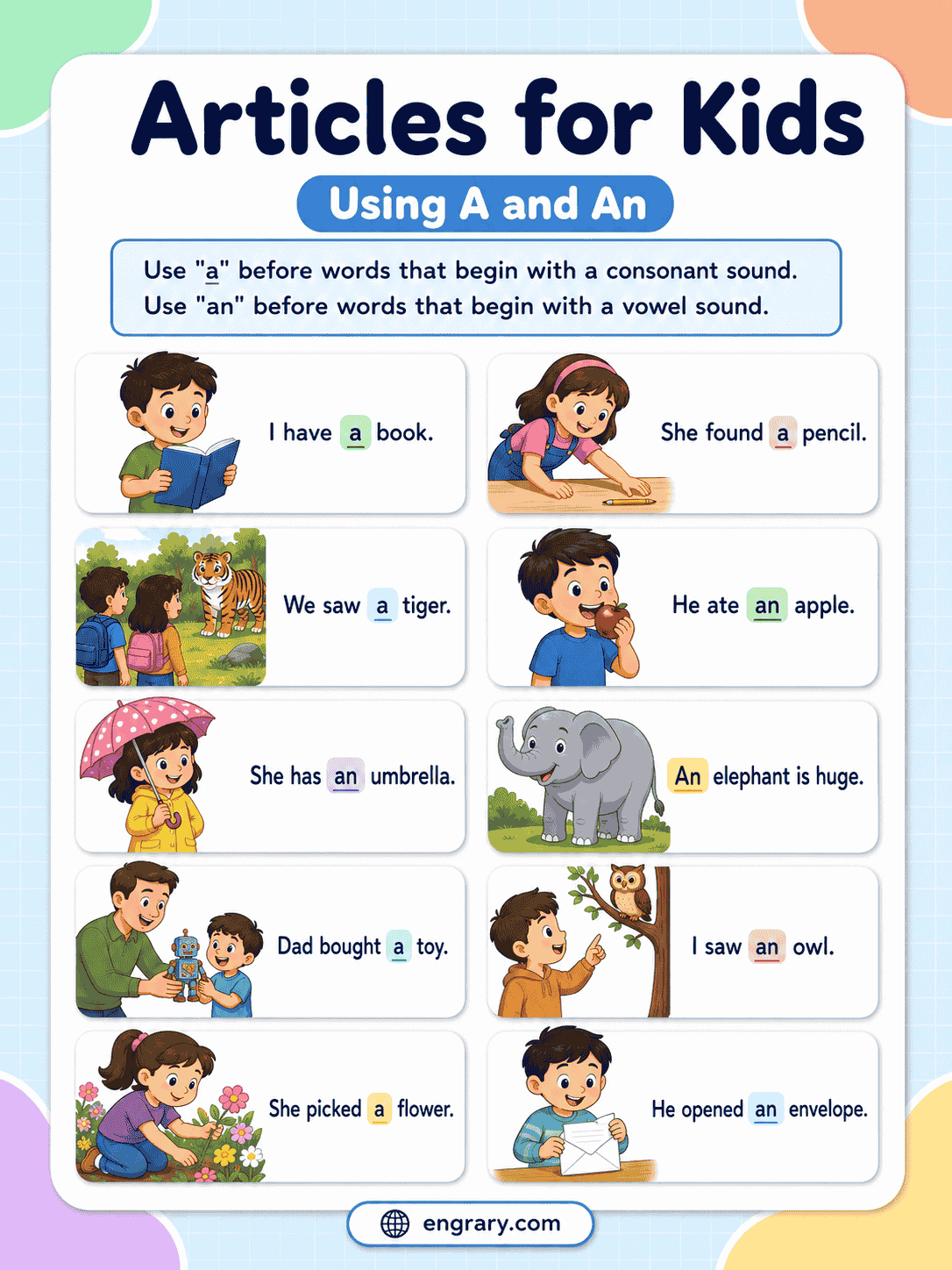
Use a before a word that begins with a consonant sound.
Examples:
- a ball
- a dog
- a flower
- a house
- a pencil
- a teacher
- a yellow kite
- a red apple
The next word may be an adjective rather than a noun.
- a small elephant
- a beautiful orange
- a noisy owl
- a large umbrella
Although elephant, orange, owl, and umbrella begin with vowel sounds, the adjectives before them begin with consonant sounds. Therefore, a is correct.
Use An Before a Vowel Sound
Use an before a word that begins with a vowel sound.
Examples:
- an apple
- an egg
- an insect
- an orange
- an umbrella
- an artist
- an idea
- an open window
The vowel letters are a, e, i, o, and u. Still, the spoken sound matters more than the written letter.
Adjectives may also determine the choice.
- an enormous elephant
- an orange balloon
- an interesting story
- an unusual animal
In each phrase, the word immediately after an begins with a vowel sound.
The First Sound Matters Most
Children sometimes choose a or an by looking only at the first written letter. However, English articles follow pronunciation.
| Correct Phrase | Reason |
|---|---|
| an hour | The h is silent, so the word begins with an “ow” sound. |
| a university | The word begins with a “yoo” consonant sound. |
| an honest person | The h is silent. |
| a one-way street | One begins with a “w” sound. |
| a uniform | Uniform begins with a “yoo” sound. |
| an umbrella | Umbrella begins with a vowel sound. |
A useful question is:
What sound do I hear first?
This method is more reliable than checking only the first letter.
Choosing A or An Before Adjectives
When an adjective appears before a noun, choose the article according to the adjective’s first sound.
| Phrase | Correct Choice |
|---|---|
| ___ red apple | a red apple |
| ___ old apple | an old apple |
| ___ useful tool | a useful tool |
| ___ unusual tool | an unusual tool |
| ___ happy child | a happy child |
| ___ honest child | an honest child |
The noun does not control the article when an adjective comes between them.
Incorrect:
- an red apple
- a old house
- an useful book
Correct:
- a red apple
- an old house
- a useful book
A and An With Tricky Beginning Sounds
Most words follow the basic sound rule. Nevertheless, several common groups deserve closer attention.
Silent H Words
Some words begin with the letter h, but speakers do not pronounce it. Because the first spoken sound is a vowel sound, these words take an.
- an hour
- an honest person
- an honor
- an heir
Examples:
- We waited for an hour.
- Ava gave an honest answer.
- Winning the award was an honor.
In ordinary words such as house, hat, horse, and happy, the h is pronounced. Therefore, they take a.
- a house
- a hat
- a horse
- a happy child
U and Eu Words With Different Sounds
Some words beginning with u or eu start with a “yoo” sound. Since “yoo” begins with a consonant sound, use a.
- a university
- a uniform
- a useful book
- a unique idea
- a European country
- a eucalyptus tree
Other words beginning with u start with a true vowel sound. As a result, they take an.
- an umbrella
- an uncle
- an unusual event
- an urgent message
- an upset child
Compare:
- a useful tool
- an unusual tool
Both words begin with the letter u, but their first sounds differ.
A similar sound rule applies to spoken abbreviations. For example, F begins with an “ef” sound, so we say an FBI agent. Meanwhile, UFO begins with a “yoo” sound, so we say a UFO.
Words Beginning With One
The word one begins with a “w” sound. Therefore, it normally takes a.
- a one-way street
- a one-dollar bill
- a one-eyed cat
- a one-time event
- a one-page report
Examples:
- We drove down a one-way street.
- Mia found a one-dollar bill.
- The class completed a one-page assignment.
How to Use The
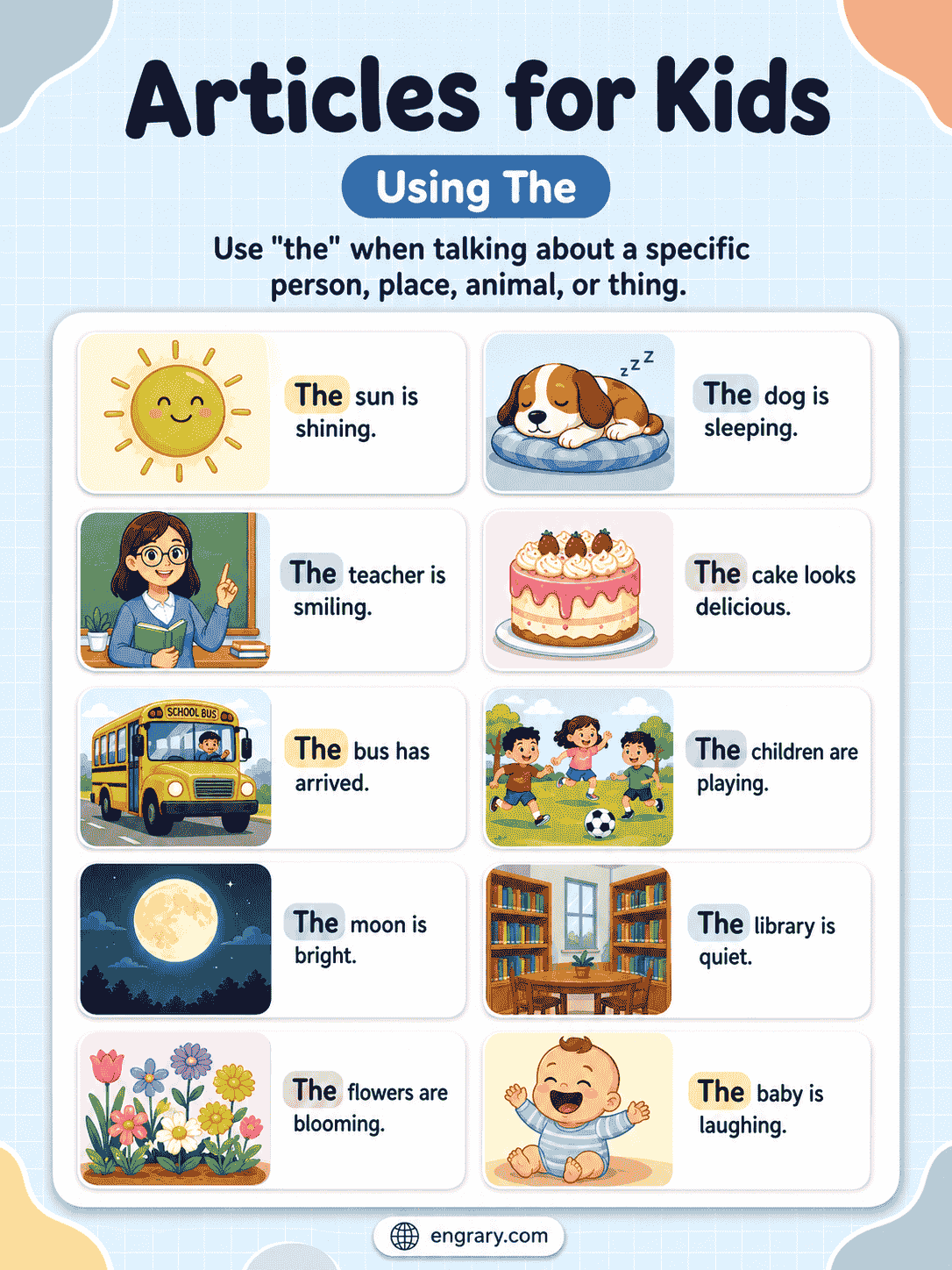
Use the when the reader or listener can identify the exact person, place, animal, object, or idea being discussed.
General and Specific Nouns
Compare these examples:
| General or Unidentified | Specific or Identified |
|---|---|
| I need a pencil. | I need the pencil on the desk. |
| We saw an owl. | The owl had a white face. |
| Noah wants a book. | Noah wants the book you borrowed. |
| She found a key. | She found the key to the cabinet. |
Use a/an when any suitable member of a group will work.
- Please give me a marker.
Here, any marker is acceptable.
Use the when one particular item is meant.
- Please give me the red marker.
The adjective red identifies the exact marker.
First Mention and Later Mention
Writers often introduce a noun with a or an. Afterward, they use the because the reader already knows which noun is meant.
Lily found a kitten near the fence. The kitten looked hungry.
Another example shows the same pattern:
We saw an old house beside the road. The house had broken windows.
The first sentence introduces the noun. Then, the next sentence refers to that same noun with the.
This pattern appears frequently in stories, reports, and descriptive paragraphs.
Things Both People Can Identify
Use the when both the speaker and listener understand which noun is meant, even if it has not been mentioned earlier.
- Please close the door.
- Turn off the light.
- Meet me in the library.
- Put the dishes in the kitchen.
- Ask the teacher for help.
The situation makes the meaning clear. For instance, when someone says, “Close the door,” both people usually know which nearby door matters.
Unique People, Places, and Things
Use the when something is understood as unique in the situation or context.
- the sun
- the moon
- the sky
- the principal
- the school office
- the main entrance
Examples:
- The sun is bright today.
- We spoke to the principal.
- Please wait near the main entrance.
The phrase the principal does not mean that only one principal exists in the world. Instead, it means the particular principal connected to that school or conversation.
Some geographical names also take the because of established English patterns.
- the United States
- the Netherlands
- the Pacific Ocean
- the Rocky Mountains
- the Mississippi River
These place-name patterns are best learned through regular reading and use.
Nouns Identified by Extra Information
Use the when an added phrase or clause clearly identifies the noun.
- the boy in the red shirt
- the book on the table
- the dog that barked last night
- the teacher who helped us
- the park near our school
Sentence examples include:
- The girl with the blue backpack is my cousin.
- Please return the book on the shelf.
- We visited the museum near the river.
Even though these nouns may appear for the first time, the extra information makes them specific.
The With Superlatives and Ordinal Numbers
Superlative adjectives usually take the.
- the tallest building
- the fastest runner
- the most interesting story
- the best answer
- the smallest puppy
Examples:
- Mia is the fastest runner in the class.
- This is the most exciting chapter.
- Noah chose the smallest cookie.
Ordinal numbers also commonly take the when they show order or position.
- the first page
- the second question
- the third floor
- the last chapter
Classroom examples include:
- Turn to the first page.
- Answer the second question.
- Our room is on the third floor.
Articles With Different Nouns
Article choice often depends on whether a noun is singular, plural, countable, or uncountable.
Singular Countable Nouns
A singular countable noun names one person, animal, place, object, or idea that can be counted.
- one book, two books
- one chair, three chairs
- one student, four students
Use a/an when a singular countable noun is general or newly introduced.
- a book
- an idea
- a chair
- an animal
Use the when the noun is specific.
- the book on my desk
- the idea we discussed
- the chair by the window
- the animal in the cage
A singular countable noun usually needs a determiner such as a, an, the, my, or this.
| Incorrect | Correct |
|---|---|
| I bought book. | I bought a book. |
| She is teacher. | She is a teacher. |
| He found coin. | He found a coin. |
Plural Nouns: General and Specific
Do not use a or an before plural nouns.
| Incorrect | Correct |
|---|---|
| a dogs | dogs, some dogs, or the dogs |
| an apples | apples, some apples, or the apples |
| a books | books, some books, or the books |
Use no article when discussing plural nouns generally.
- Dogs need exercise.
- Birds have feathers.
- Teachers help students.
- Books can teach new ideas.
In contrast, use the when referring to a particular group.
- The dogs in our yard are barking.
- The birds in that tree are noisy.
- The teachers at our school are helpful.
- The books on the shelf belong to Ava.
The added information identifies the exact group.
Uncountable Nouns: General and Specific
Uncountable nouns name substances, materials, ideas, or groups that English does not usually count as separate units.
Common examples include:
- water
- rice
- information
- homework
- furniture
- music
Do not normally place a/an directly before an uncountable noun.
| Incorrect | Better Choice |
|---|---|
| a water | some water or a glass of water |
| an information | some information or a piece of information |
| a homework | some homework or an assignment |
| a furniture | some furniture or a piece of furniture |
Use no article when the meaning is general.
- Water is important.
- Music can affect emotions.
- Homework takes time.
- Furniture can be expensive.
However, use the when the uncountable noun is specific.
- The water in this bottle is cold.
- The music from the next room is loud.
- The homework from Monday was difficult.
- The furniture in our classroom is new.
Articles With Occupations
Use a or an when stating one person’s occupation.
- She is a teacher.
- He is an engineer.
- Ava wants to become a doctor.
- Noah is an artist.
- My aunt is a nurse.
Choose the article by sound.
| Use A | Use An |
|---|---|
| a teacher | an engineer |
| a doctor | an artist |
| a nurse | an architect |
Do not omit the article before a singular occupation.
Incorrect:
- She is teacher.
- He is engineer.
Correct:
- She is a teacher.
- He is an engineer.
When No Article Is Needed
English sometimes uses no article before a noun. This pattern is often called the zero article.
Names and Most Place Names
Most personal names do not take an article.
- Emma is my friend.
- Mr. Davis teaches science.
- We invited Jordan.
- Maya lives nearby.
Most cities and countries also take no article.
- Chicago
- Canada
- Japan
- Brazil
- Mexico
Examples:
- Ava visited Chicago.
- Canada is north of the United States.
- Mia wants to travel to Japan.
However, some country and geographical names take the, including the United States, the United Kingdom, the Netherlands, and the Philippines.
Languages and School Subjects
Languages usually take no article when discussed generally.
- She speaks English.
- Noah is learning Spanish.
- French is spoken in several countries.
School subjects also normally appear without articles.
- We study math.
- Science is interesting.
- Mia enjoys history.
Use the when referring to a particular lesson, example, or version.
- The math lesson today was difficult.
- The English in this book is simple.
- The science project on the table is ours.
Sports and Meals
Sports normally take no article.
- We play soccer.
- Ava enjoys tennis.
- Baseball is popular.
- They practice basketball.
A particular event or object may take the.
- The soccer game starts at noon.
- The basketball is in the garage.
- The tennis match lasted two hours.
Meals usually take no article when referring to the regular daily activity.
- We eat breakfast at seven.
- Lunch begins at noon.
- They cooked dinner together.
An article appears when a meal is described as a particular event or type.
- We had a delicious breakfast.
- The dinner at the hotel was excellent.
- Ava prepared a large lunch.
Articles and Other Determiners
Articles are not the only words that introduce nouns. Possessive and demonstrative words can also identify them.
Articles and Possessive Words
Possessive words include:
- my
- your
- his
- her
- its
- our
- their
These words already identify the noun. Therefore, an article does not normally appear with them.
| Incorrect | Correct |
|---|---|
| the my book | my book |
| a her pencil | her pencil |
| the our classroom | our classroom |
Compare:
- I found a backpack.
- I found my backpack.
- I found the backpack near the door.
Each sentence introduces or identifies the noun differently.
Articles and Demonstrative Words
Demonstrative words include:
- this
- that
- these
- those
Do not normally combine an article with a demonstrative before the same noun.
| Incorrect | Correct |
|---|---|
| the this chair | this chair |
| a that dog | that dog |
| the those books | those books |
A demonstrative already points to the noun, so another central determiner is unnecessary.
How Article Choice Changes Meaning
Articles can change the meaning of a sentence.
| Sentence | Meaning |
|---|---|
| I need a marker. | Any marker will work. |
| I need the marker. | A particular marker is meant. |
| Dogs are friendly. | Dogs generally are being discussed. |
| The dogs are friendly. | A specific group of dogs is meant. |
| We ate breakfast. | The regular meal is meant. |
| We ate a large breakfast. | One particular breakfast is described. |
Consider another pair:
- Noah wants a book.
- Noah wants the book.
The first sentence allows any suitable book. By contrast, the second refers to one exact book that the speaker and listener can identify.
Common Article Mistakes
Children often make article errors because they focus only on spelling, forget whether a noun is specific, or overlook countability.
| Mistake | Correct Form | Reason |
|---|---|---|
| an university | a university | University begins with a “yoo” sound. |
| a hour | an hour | The h is silent. |
| an red apple | a red apple | The article follows the sound in red. |
| a books | some books or the books | A cannot come before a plural noun. |
| an homework | some homework | Homework is uncountable. |
| She is teacher. | She is a teacher. | A singular occupation needs an article. |
| the my backpack | my backpack | Do not combine an article with a possessive word. |
| We visited the Canada. | We visited Canada. | Most country names take no article. |
| Dogs in our yard are barking. | The dogs in our yard are barking. | A specific group is identified. |
| The dogs need exercise. | Dogs need exercise. | No article is needed for dogs generally. |
A simple editing method can solve many article problems:
- Decide whether the noun is singular and countable.
- Ask whether the meaning is general or specific.
- Listen to the first sound after a/an.
Articles Practice for Kids
Complete each activity before checking the answer key.
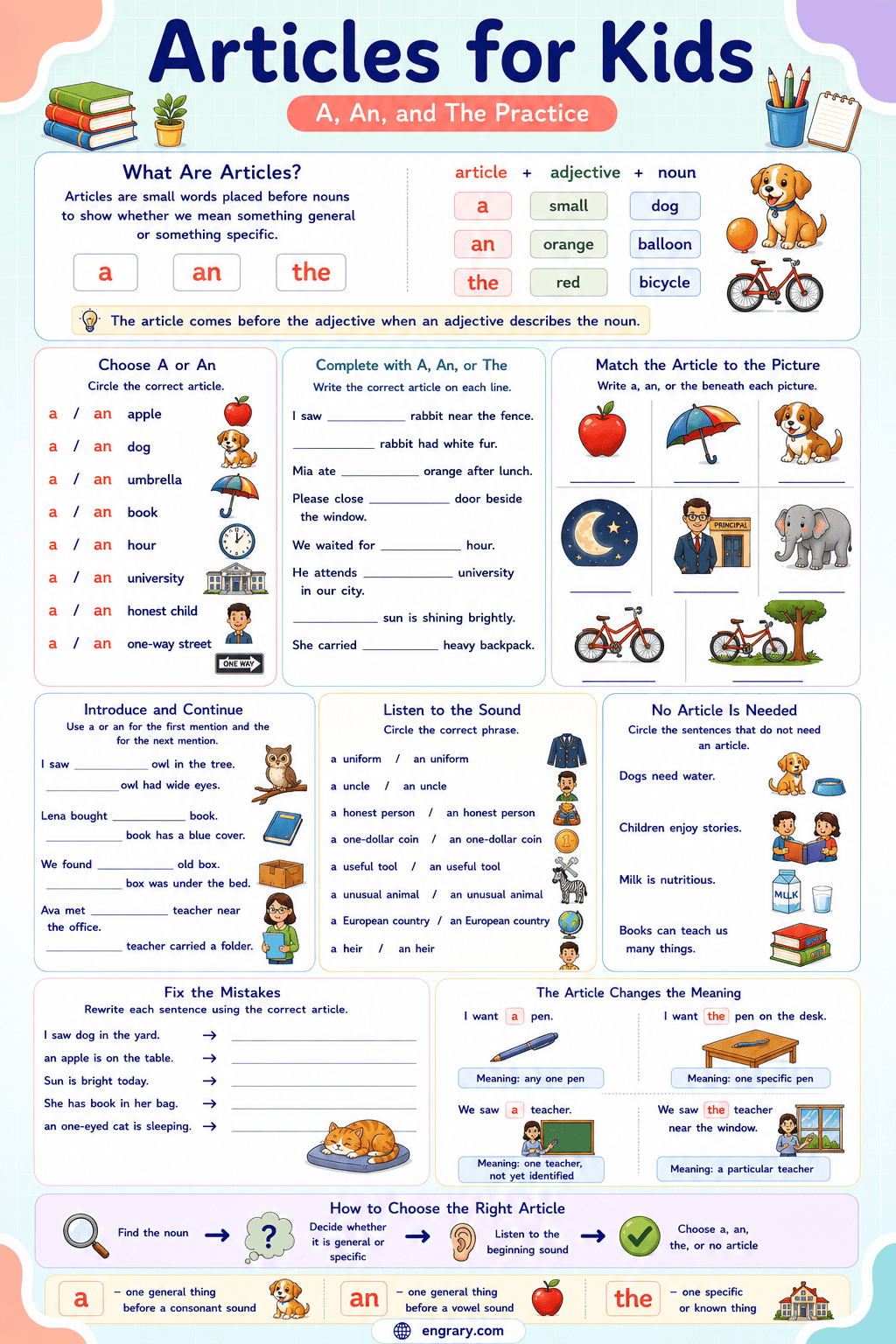
Choose A or An
Write a or an in each blank.
- ___ apple
- ___ bicycle
- ___ elephant
- ___ teacher
- ___ hour
- ___ uniform
- ___ honest child
- ___ one-way street
- ___ unusual story
- ___ useful lesson
- ___ old house
- ___ red umbrella
Choose A, An, The, or No Article
Write a, an, the, or — for no article.
- Mia found ___ kitten near the fence.
- ___ kitten had a white tail.
- ___ water is important for health.
- Please drink ___ water in this glass.
- Noah wants to become ___ engineer.
- ___ dogs need regular exercise.
- ___ dogs next door are barking.
- We study ___ science at school.
- Please open ___ door beside the window.
- Ava ate ___ orange after lunch.
- We had ___ delicious breakfast at the hotel.
- Jordan plays ___ soccer every Saturday.
- ___ United States has fifty states.
- She carried ___ heavy box.
- He waited for ___ hour.
Correct the Article Mistakes
Rewrite each sentence correctly.
- We visited the Canada last summer.
- Mia wore an uniform to school.
- I need an red marker.
- Ava gave me an useful idea.
- He is teacher.
- Please bring a book from shelf.
- The my backpack is under the desk.
- We need an information about the trip.
- A dogs in the yard are noisy.
- Noah waited a hour for the bus.
Complete a Short Passage
Fill each blank with a, an, the, or no article.
Yesterday, Ava saw ___ injured bird near ___ tree. She carried ___ bird to ___ quiet place beside her house. Then she brought ___ small box and placed ___ soft towel inside it. Ava called ___ animal rescue center. ___ rescue worker arrived after ___ hour and carefully examined ___ bird.
Write Sentences With Articles
Write:
- one sentence using a;
- one sentence using an;
- one sentence using the for something specific;
- one sentence with no article before a general plural noun;
- one sentence with no article before a general uncountable noun;
- two connected sentences that introduce a noun with a/an and mention it again with the.
Articles Practice Answer Key
Choose A or An
- an apple
- a bicycle
- an elephant
- a teacher
- an hour
- a uniform
- an honest child
- a one-way street
- an unusual story
- a useful lesson
- an old house
- a red umbrella
Choose A, An, The, or No Article
- Mia found a kitten near the fence.
- The kitten had a white tail.
- — Water is important for health.
- Please drink the water in this glass.
- Noah wants to become an engineer.
- — Dogs need regular exercise.
- The dogs next door are barking.
- We study — science at school.
- Please open the door beside the window.
- Ava ate an orange after lunch.
- We had a delicious breakfast at the hotel.
- Jordan plays — soccer every Saturday.
- The United States has fifty states.
- She carried a heavy box.
- He waited for an hour.
Correct the Article Mistakes
- We visited Canada last summer.
- Mia wore a uniform to school.
- I need a red marker.
- Ava gave me a useful idea.
- He is a teacher.
- Please bring a book from the shelf.
- My backpack is under the desk.
- We need some information about the trip.
- The dogs in the yard are noisy.
- Noah waited an hour for the bus.
Complete a Short Passage
Yesterday, Ava saw an injured bird near a tree. She carried the bird to a quiet place beside her house. Then she brought a small box and placed a soft towel inside it. Ava called an animal rescue center. A rescue worker arrived after an hour and carefully examined the bird.
Write Sentences With Articles
Sample answers:
- I saw a rabbit in the garden.
- Mia ate an apple after school.
- Please close the window beside the door.
- Birds build nests.
- Water is important for life.
- We found a puppy near the park. The puppy looked hungry.
Other answers are acceptable when the article matches the noun, sound, and intended meaning.
FAQs
Articles are the words a, an, and the. They come before nouns and help show whether a person or thing is general or specific.
Use a before a consonant sound and an before a vowel sound. For example, write a uniform but an umbrella.
The h in hour is silent, so the word begins with a vowel sound. The h in house is pronounced, so the word begins with a consonant sound.
Use the when the listener or reader can identify the exact noun. It may have been mentioned earlier, be clear from the situation, or be identified by extra information.
Plural nouns cannot use a or an. They may use the when a specific group is meant, or no article when the noun refers to a group generally.
You May Also Like