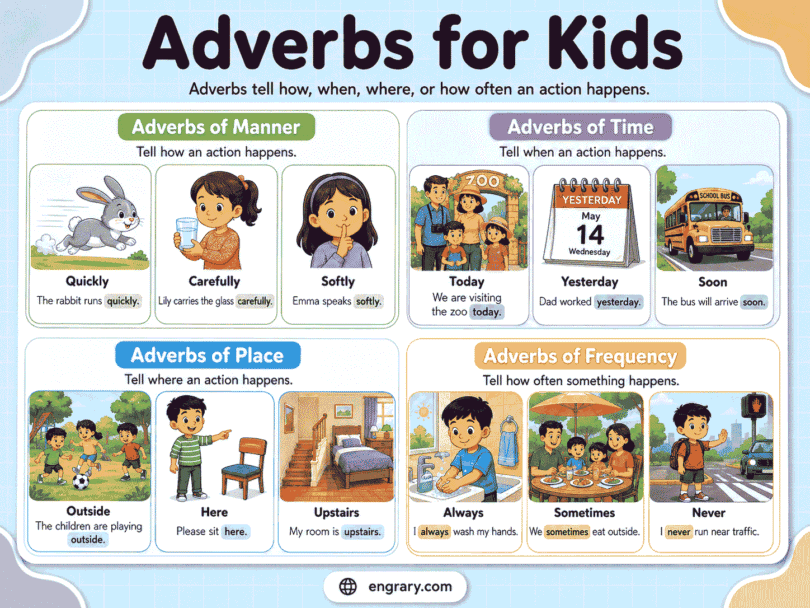
Adverbs make sentences more exact by showing how, when, where, how often, or to what extent something happens. Without them, many sentences sound plain or incomplete; with the right adverb, readers can understand an action or description much more clearly.
This guide explains the main types of adverbs in simple language and introduces 100 useful examples for children. It also shows how adverbs differ from adjectives, where they belong in sentences, how common forms are created, and how to avoid frequent grammar mistakes through clear examples and practice.
What Is an Adverb?
Adverbs help readers understand an action or description more precisely.
An adverb is a word that modifies a verb, an adjective, another adverb, or sometimes a complete sentence.
The dog barked loudly.
The word loudly tells how the dog barked, so it modifies the verb barked.
The water was very cold.
Here, very strengthens the adjective cold.
Maya walked extremely slowly.
In this sentence, extremely modifies the adverb slowly.
Fortunately, the rain stopped before the game.
The adverb fortunately comments on the whole sentence.
What Questions Do Adverbs Answer?
The easiest way to recognize an adverb is to notice the extra information it provides.
Most adverbs answer one of five questions.
| Question | Adverb type | Example |
|---|---|---|
| How? | Manner | She spoke politely. |
| When? | Time | We will leave tomorrow. |
| Where? | Place | The children waited outside. |
| How often? | Frequency | I usually walk to school. |
| How much or to what extent? | Degree | The bag was too heavy. |
These questions help children identify the role of an adverb without relying only on spelling.
How to Find an Adverb in a Sentence
Finding an adverb becomes easier when students focus on what each word is doing.
Use this simple process:
- Find the verb, adjective, or adverb being described.
- Look for a word that adds more information.
- Ask how, when, where, how often, or how much.
- Check the word’s function instead of looking only at its ending.
Example:
The students worked quietly.
- Verb: worked
- Adverb: quietly
- Question answered: How did they work?
Another example:
The puzzle was extremely difficult.
- Adjective: difficult
- Adverb: extremely
- Question answered: How difficult was it?
Not every adverb ends in -ly, and not every -ly word is an adverb. Therefore, a word’s job in the sentence matters more than its appearance.
Adverbs of Manner
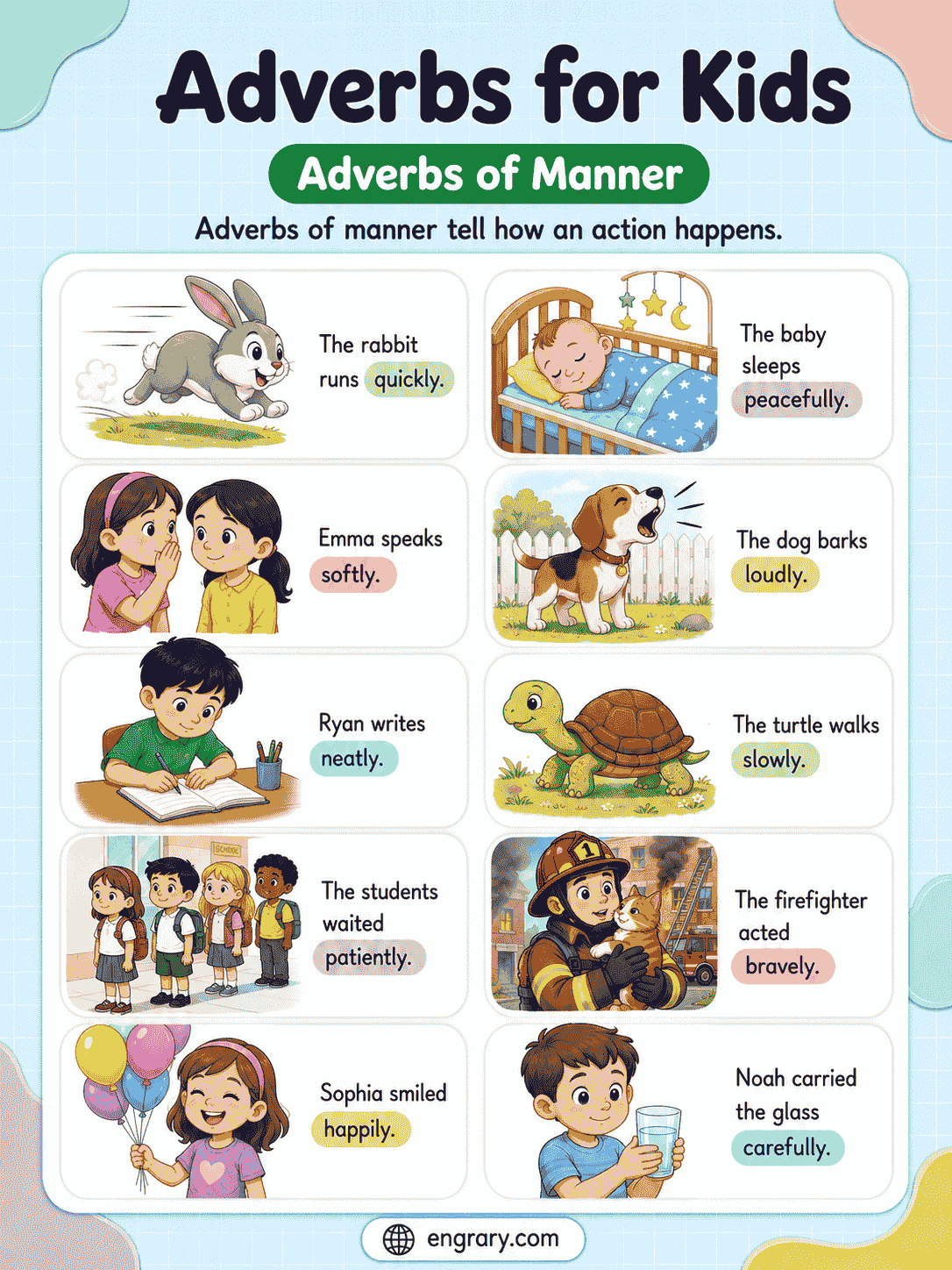
Adverbs of manner explain how someone performs an action or how an event happens.
The nurse spoke gently.
The adverb gently tells how the nurse spoke.
| Adverb | Example sentence |
|---|---|
| accidentally | Mia accidentally dropped the cup. |
| angrily | The customer spoke angrily. |
| bravely | The firefighter entered the building bravely. |
| carefully | Leo carried the bowl carefully. |
| cheerfully | The children greeted us cheerfully. |
| clearly | The teacher explained the rule clearly. |
| correctly | Ava answered correctly. |
| eagerly | The students eagerly opened their books. |
| easily | Sam solved the puzzle easily. |
| gently | She placed the bird gently in the box. |
| gracefully | The dancer moved gracefully. |
| happily | The child smiled happily. |
| honestly | He answered honestly. |
| kindly | The neighbor kindly offered help. |
| loudly | The crowd cheered loudly. |
| neatly | Emma wrote neatly. |
| patiently | We waited patiently. |
| politely | The student asked politely. |
| quickly | The rabbit ran quickly. |
| quietly | The class worked quietly. |
| safely | The driver brought everyone home safely. |
| slowly | The turtle moved slowly. |
| softly | The baby cried softly. |
| suddenly | The lights suddenly went out. |
| thoughtfully | Maya responded thoughtfully. |
| well | Jordan plays the piano well. |
| badly | The team played badly. |
| fast | The train moved fast. |
| hard | The students worked hard. |
| together | The friends completed the task together. |
Many manner adverbs end in -ly. However, common words such as well, fast, hard, and together do not.
Adverbs of Time
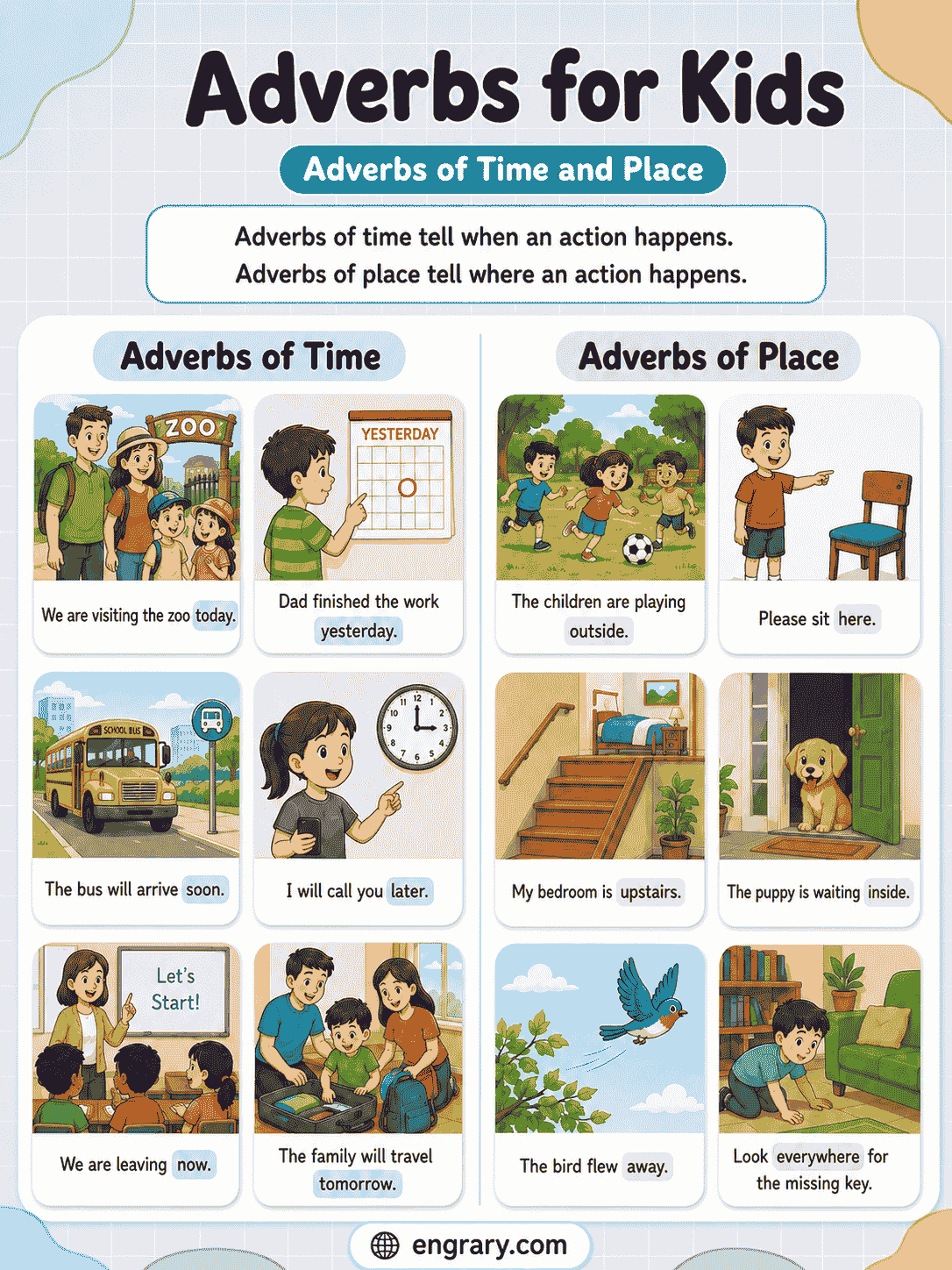
Adverbs of time show when an action happens or how long a situation continues.
We will finish the project tomorrow.
The word tomorrow tells when the project will be completed.
| Adverb | Example sentence |
|---|---|
| already | We have already finished the first page. |
| early | The bus arrived early. |
| eventually | The lost dog eventually returned home. |
| immediately | Please come inside immediately. |
| later | We will discuss the problem later. |
| lately | I have been reading more lately. |
| now | The lesson begins now. |
| recently | We recently visited the museum. |
| soon | Dinner will be ready soon. |
| still | The baby is still sleeping. |
| then | Finish your work, and then call me. |
| today | We are studying adverbs today. |
| tomorrow | The class will take a quiz tomorrow. |
| tonight | We will watch the stars tonight. |
| yesterday | It rained yesterday. |
| yet | She has not arrived yet. |
| before | I had seen the painting before. |
| afterward | We ate lunch and afterward visited the park. |
Some time adverbs look similar but have different meanings:
- Late means after the expected time.
- Lately means recently.
- Still shows that an action or condition continues.
- Yet often appears in questions and negative sentences.
- Already shows that something happened before now.
- Eventually means after some time or difficulty.
Adverbs of Place
Adverbs of place tell where an action happens or in which direction something moves.
The children played outside.
The word outside explains where they played.
| Adverb | Example sentence |
|---|---|
| above | A hawk circled above. |
| abroad | Her family traveled abroad. |
| anywhere | You may sit anywhere. |
| away | The dog ran away. |
| downstairs | Dad is waiting downstairs. |
| everywhere | We searched everywhere. |
| here | Please stand here. |
| indoors | The children stayed indoors. |
| nearby | A small store is located nearby. |
| nowhere | The missing key was nowhere to be found. |
| outdoors | We ate outdoors. |
| outside | The students played outside. |
| somewhere | I left my notebook somewhere. |
| there | Place the bag there. |
| underground | The cable runs underground. |
| upstairs | Your coat is upstairs. |
Some place adverbs show direction as well as location.
The dog ran away.
Please move upstairs.
Adverbs of Frequency
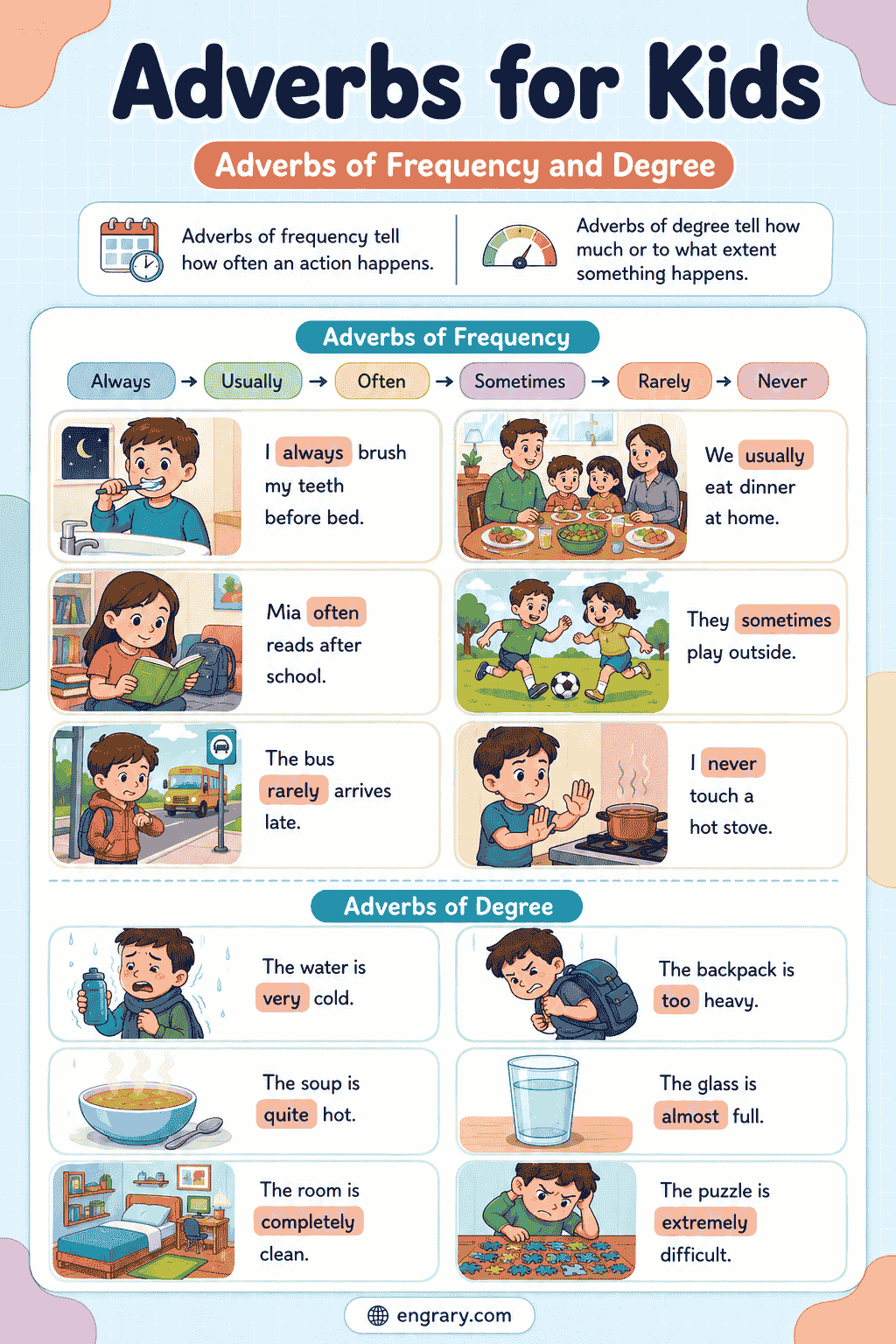
Adverbs of frequency explain how often an action occurs.
We often visit the library.
The word often shows how frequently the action happens.
| Adverb | Example sentence |
|---|---|
| always | Mia always completes her homework. |
| constantly | The puppy constantly follows its owner. |
| daily | We practice reading daily. |
| frequently | The teacher frequently checks our work. |
| generally | Birds generally build nests in safe places. |
| never | I never leave the door unlocked. |
| normally | The store normally closes at eight. |
| occasionally | We occasionally eat outside. |
| often | Ben often rides his bicycle. |
| rarely | It rarely snows here. |
| regularly | The machines are regularly inspected. |
| sometimes | I sometimes read before bed. |
| usually | The bus usually arrives on time. |
| weekly | The team meets weekly. |
| monthly | The club publishes a newsletter monthly. |
| yearly | The school holds the event yearly. |
A frequency scale can help children compare these words.
| Frequency | Common adverbs |
|---|---|
| All the time | always |
| Very often | constantly, frequently |
| Commonly | generally, normally, usually |
| At times | often, regularly, sometimes |
| Not often | occasionally, rarely |
| Not at all | never |
These levels are approximate because meaning may change with context.
Adverbs of Degree
Adverbs of degree show how much or to what extent something is true.
The water was very cold.
The adverb very strengthens the adjective cold.
| Adverb | Example sentence |
|---|---|
| almost | The glass was almost empty. |
| completely | The room was completely silent. |
| deeply | She was deeply concerned. |
| enough | The soup was warm enough. |
| entirely | The answer was entirely correct. |
| extremely | The path was extremely narrow. |
| fairly | The test was fairly easy. |
| hardly | We could hardly hear the speaker. |
| highly | The scientist is highly respected. |
| just | The box is just large enough. |
| nearly | We nearly missed the bus. |
| partly | The road was partly blocked. |
| quite | The book was quite interesting. |
| rather | The water felt rather cold. |
| really | The movie was really exciting. |
| slightly | The door was slightly open. |
| so | The puppy was so tired. |
| too | The bag was too heavy. |
| totally | The students were totally surprised. |
| very | The room was very quiet. |
Several degree adverbs have special meanings:
- Too means more than needed or wanted.
- Enough means as much as necessary.
- Hardly means almost not.
- Nearly and almost have similar meanings.
- Highly often means greatly, as in highly respected.
How Adjectives and Adverbs Differ
Adjectives and adverbs both add detail, but they describe different kinds of words.
Adjectives describe nouns or pronouns. Adverbs usually describe verbs, adjectives, or other adverbs.
| Adjective | Adverb |
|---|---|
| a quiet child | spoke quietly |
| a careful driver | drove carefully |
| a happy student | smiled happily |
| a slow turtle | moved slowly |
| a fast car | traveled fast |
Compare these sentences:
The turtle is slow.
The adjective slow describes the turtle.
The turtle moves slowly.
The adverb slowly describes the action moves.
Some words can work as either adjectives or adverbs.
It is a fast car.
Here, fast describes the noun car.
The car moves fast.
In this sentence, fast describes the verb moves.
Adjective and Adverb Forms
Understanding how adverbs are formed helps children spell and use them correctly.
The following patterns cover the most common forms, exceptions, and easily confused words.
How Adjectives Become Adverbs
Many adverbs are formed by adding -ly to an adjective.
| Adjective | Adverb |
|---|---|
| quick | quickly |
| careful | carefully |
| quiet | quietly |
| honest | honestly |
| happy | happily |
| angry | angrily |
| gentle | gently |
| simple | simply |
| true | truly |
| good | well |
Common spelling patterns include:
- Add -ly: quick → quickly
- Change y to i: happy → happily
- Change -le to -ly: gentle → gently
- Learn irregular forms: good → well
These rules do not work with every adjective. For example, friendly is usually an adjective, so children can write:
She spoke in a friendly way.
Adverbs Without -ly
An adverb does not need an -ly ending to perform its job.
Common examples include:
- fast;
- hard;
- well;
- soon;
- now;
- here;
- there;
- often;
- never;
- always;
- outside;
- upstairs.
The athlete ran fast.
The students worked hard.
Ella sings well.
Each word functions as an adverb because it adds information about an action.
-ly Words That Are Adjectives
Some words ending in -ly describe nouns rather than actions.
Common examples include:
- friendly;
- lovely;
- lonely;
- lively;
- elderly;
- costly.
Our friendly neighbor waved.
The word friendly describes the neighbor.
The garden looked lovely.
The word lovely describes the garden.
Therefore, children should never identify a word as an adverb based only on its ending.
Irregular Adverbs and Confusing Pairs
Several common adverbs have irregular forms or meanings that differ from similar-looking words.
Good and well
She is a good singer.
She sings well.
Good describes the singer, while well describes the action.
Hard and hardly
He worked hard.
This means he used great effort.
He hardly worked.
This means he did almost no work.
Late and lately
We arrived late.
We have lately practiced more often.
Late means after the expected time, while lately means recently.
Near and nearly
The dog stood near.
We nearly finished.
Near shows place, while nearly means almost.
High and highly
The kite flew high.
She is highly respected.
High describes physical height, while highly means greatly.
Adjectives After Linking and Sense Verbs
Some verbs connect the subject to a description rather than showing a clear action.
Common linking and sense verbs include:
- be;
- seem;
- become;
- look;
- feel;
- smell;
- sound;
- taste.
These verbs often take adjectives because the describing word refers to the subject.
The soup smells delicious.
The blanket feels soft.
The music sounds beautiful.
The adjectives describe the soup, blanket, and music.
An adverb is appropriate when the verb represents a real action.
She sang beautifully.
The dog smelled the bag carefully.
In the second sentence, smelled is an action, and carefully explains how the dog performed it.
Where Adverbs Go in a Sentence
Adverb placement depends on the kind of detail being added.
Keeping an adverb near the word it modifies usually makes the meaning easier to understand.
Where Manner Adverbs Go
Manner adverbs often appear after the verb or its object.
The child answered politely.
She closed the door quietly.
However, a manner adverb may appear before the verb when the writer wants to emphasize it.
She quietly closed the door.
Where Frequency Adverbs Go
Frequency adverbs usually appear before the main verb.
We often visit the library.
They usually eat lunch at noon.
With the verb be, the frequency adverb normally comes afterward.
She is always prepared.
They are sometimes noisy.
Where Degree Adverbs Go
Degree adverbs usually appear before the adjective or adverb they modify.
The water was extremely cold.
He moved very slowly.
The word enough usually comes after the adjective or adverb.
The room was warm enough.
She spoke clearly enough.
Where Time and Place Adverbs Go
Time and place adverbs often appear near the end of a sentence.
We will leave tomorrow.
The children are playing outside.
A time adverb can also begin a sentence when the writer wants to emphasize when something happened.
Yesterday, we visited the museum.
Comparative and Superlative Adverbs
Adverbs can also compare the way two or more actions happen.
Comparative adverbs compare two actions, while superlative adverbs compare three or more.
| Basic form | Comparative | Superlative |
|---|---|---|
| fast | faster | fastest |
| hard | harder | hardest |
| early | earlier | earliest |
| carefully | more carefully | most carefully |
| quietly | more quietly | most quietly |
| well | better | best |
| badly | worse | worst |
Short adverbs often use -er and -est.
Maya ran faster than Noah.
Of the three runners, Liam ran fastest.
Many adverbs ending in -ly use more and most.
Ava answered more carefully than Ben.
Rosa completed the experiment most carefully.
Some forms are irregular.
Jordan played better today.
Of all the singers, Elena performed best.
Using Adverbs Effectively
Adverbs work best when they add information that the verb does not already provide.
Compare:
She whispered quietly.
The adverb quietly repeats an idea already contained in whispered.
A more concise version is:
She whispered.
However, this sentence adds a useful new detail:
She whispered urgently.
The adverb urgently changes how readers understand the action.
A strong verb may also replace a weak verb and adverb.
Basic:
The boy walked slowly.
Stronger:
The boy crept.
Children should keep an adverb when it adds an important detail and remove it when it merely repeats the verb’s meaning.
Common Adverb Mistakes
Most adverb mistakes happen when students choose the wrong word form or place the adverb awkwardly.
The following examples show how to correct the most common problems.
Using an Adjective Instead of an Adverb
Incorrect:
The turtle moved slow.
Correct:
The turtle moved slowly.
The adverb slowly modifies the verb moved.
Using an Adverb Instead of an Adjective
Incorrect:
The soup tastes deliciously.
Correct:
The soup tastes delicious.
The adjective delicious describes the soup.
Confusing Hard and Hardly
Incorrect when strong effort is intended:
She hardly studied for the test.
Correct:
She studied hard for the test.
Hardly means almost not, while hard means with effort.
Adding a Double Negative
Incorrect:
I never saw nothing.
Correct:
I never saw anything.
The word never already makes the sentence negative.
Misplacing a Frequency Adverb
Awkward:
We visit often the library.
Natural:
We often visit the library.
The frequency adverb usually comes before the main verb.
Using Too Many Adverbs
Overloaded:
He quickly, quietly, and carefully opened the box.
Clearer:
He carefully opened the box.
The improved version keeps the most useful detail and removes unnecessary clutter.
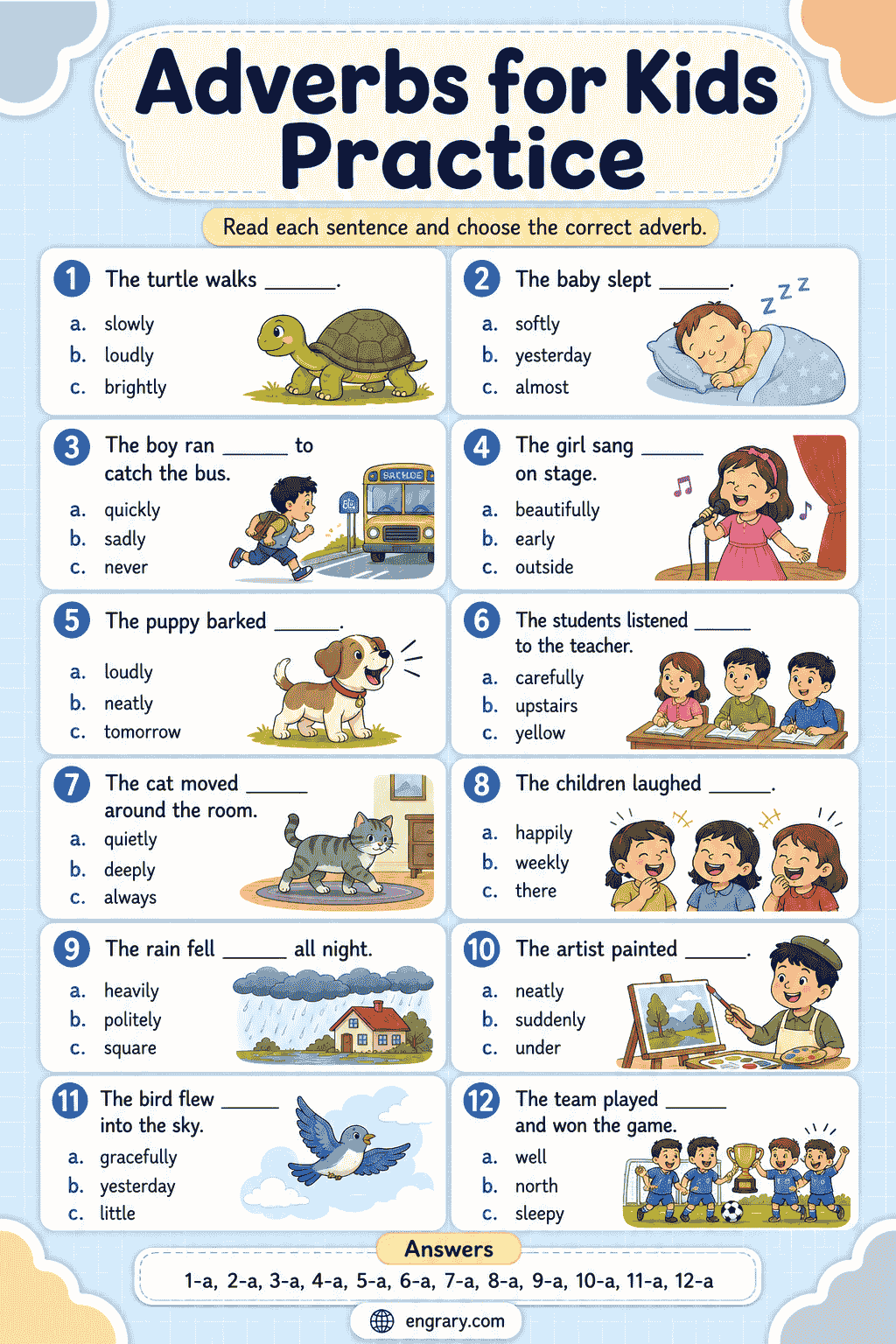
Adverb Practice with Answers
Practice helps children recognize adverbs and use them naturally in sentences.
Complete the activities before checking the answer key.
Find the Adverb
Identify the adverb in each sentence.
- The baby slept peacefully.
- We will leave tomorrow.
- The children played outside.
- Mia often reads before bed.
- The water was extremely cold.
Name the Adverb Type
Choose from manner, time, place, frequency, and degree.
- gently
- yesterday
- upstairs
- rarely
- completely
Choose the Correct Word
- The turtle moved slow / slowly.
- The soup smells delicious / deliciously.
- The singer performed good / well.
- The children were quiet / quietly.
- The driver turned careful / carefully.
Form the Adverb
Change each adjective into an adverb.
- quick
- happy
- gentle
- true
- good
Place the Adverb Correctly
Rewrite each sentence by placing the adverb naturally.
- We visit the library. (often)
- She is prepared. (always)
- The children played. (outside)
- I will finish the assignment. (tomorrow)
- The dog barked. (loudly)
Correct the Mistake
Rewrite each sentence correctly.
- The baby slept peaceful.
- The cake smells wonderfully.
- He hardly worked and completed every task.
- I never saw nobody there.
- We go usually to the park on Saturday.
Answer Key
Find the adverb
- peacefully
- tomorrow
- outside
- often
- extremely
Name the adverb type
- manner
- time
- place
- frequency
- degree
Choose the correct word
- slowly
- delicious
- well
- quiet
- carefully
Form the adverb
- quickly
- happily
- gently
- truly
- well
Place the adverb correctly
- We often visit the library.
- She is always prepared.
- The children played outside.
- I will finish the assignment tomorrow.
- The dog barked loudly.
Correct the mistake
- The baby slept peacefully.
- The cake smells wonderful.
- He worked hard and completed every task.
- I never saw anybody there.
- We usually go to the park on Saturday.
FAQs
An adverb is a word that adds information about a verb, adjective, another adverb, or sometimes a complete sentence.
Adverbs commonly answer how, when, where, how often, and how much or to what extent.
No. Words such as fast, hard, well, often, here, and never can also function as adverbs.
Yes. Words such as friendly, lovely, lonely, and lively are usually adjectives.
They should find the word being described, ask what detail is being added, and decide whether the word answers how, when, where, how often, or how much.
You May Also Like