A child walks into a classroom and sees many things at once: a desk, a chair, a board, a clock, a bag, a book, and a pencil. These everyday objects are easy to learn because children can see, touch, use, and point to them during class.
Learning classroom objects names helps children talk about the things around them at school. It also supports reading, writing, speaking, picture labeling, classroom games, and simple sentences such as “The book is on the desk” or “The clock is on the wall.”
What Kids Notice First in a Classroom
Children usually notice the biggest and most useful classroom objects first. They may see a board at the front, desks and chairs in rows, a clock on the wall, or a bag under a desk.
Common things kids notice in a classroom include:
- desk
- chair
- board
- book
- bag
- pencil
- eraser
- notebook
- clock
- door
- window
- shelf
- bin
- map
- chart
A simple explanation for children:
Classroom objects are the things we see, touch, and use inside a classroom.
Useful speaking examples:
- This is a desk.
- That is a chair.
- The board is at the front.
- The clock is on the wall.
- My bag is under the desk.
Common Classroom Object Names to Learn First
Children should start with classroom object names they see and use every day. These words are useful for beginners, ESL learners, and young students.
Good first classroom object names include:
- desk 🔊 /desk/
- chair 🔊 /chair/
- board 🔊 /bord/
- book 🔊 /book/
- notebook 🔊 /NOHT-book/
- bag 🔊 /bag/
- pencil 🔊 /PEN-suhl/
- pen 🔊 /pen/
- eraser 🔊 /ih-RAY-ser/
- ruler 🔊 /ROO-ler/
- sharpener 🔊 /SHAR-puh-ner/
- marker 🔊 /MAR-ker/
- clock 🔊 /klok/
- door 🔊 /dor/
- window 🔊 /WIN-doh/
Easy meanings:
- Desk is where a student writes or keeps books.
- Chair is where a student sits.
- Board is where the teacher writes.
- Book is for reading.
- Notebook is for writing.
- Bag carries books and supplies.
- Pencil is used for writing or drawing.
- Eraser removes pencil marks.
- Ruler helps draw straight lines.
- Clock shows the time.
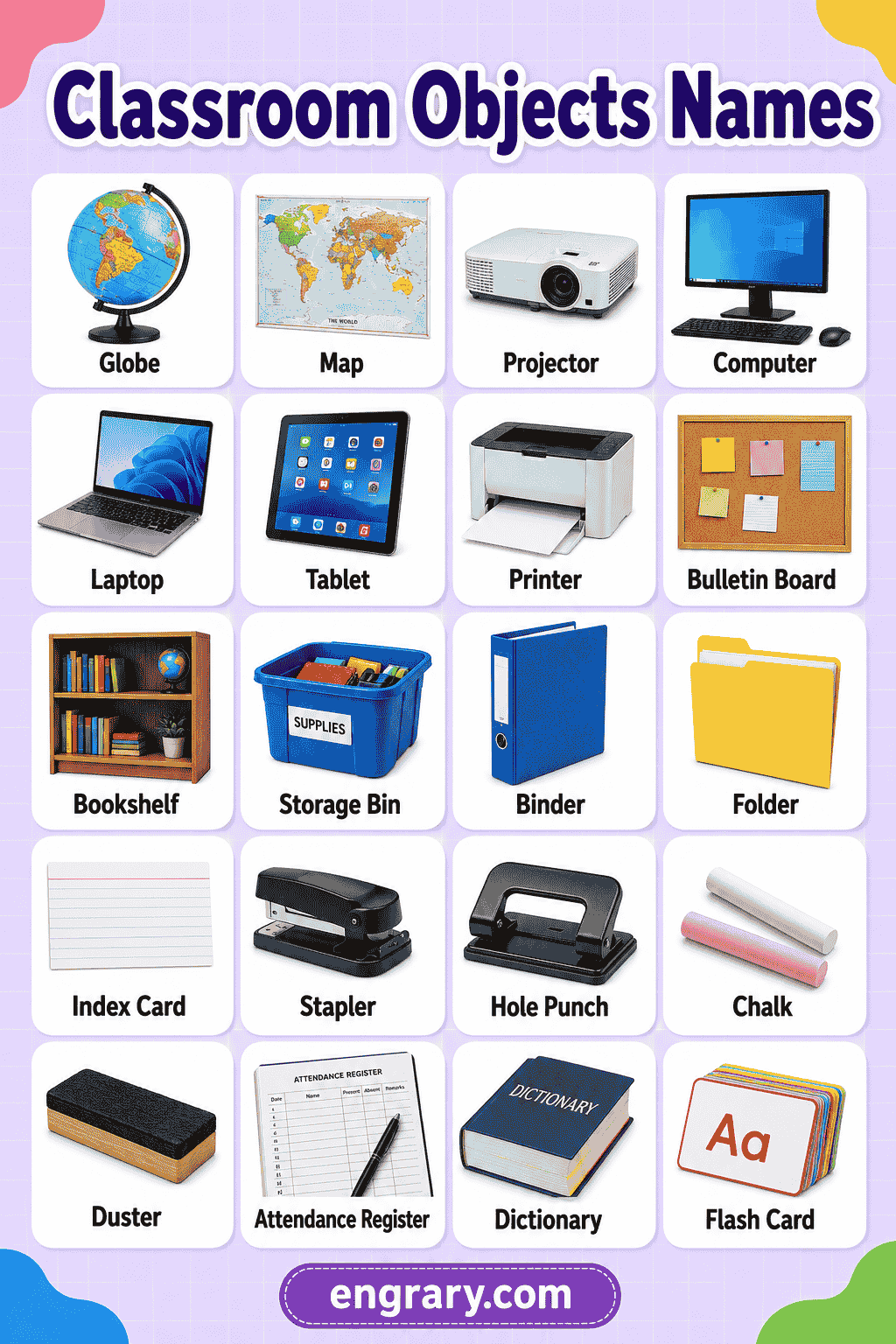
Things Children Keep on Their Desks
A student’s desk usually has small classroom objects used for reading, writing, drawing, and learning. These are often the easiest words for children to practice because they can look at their own desks.
Common desk items:
- book
- notebook
- pencil
- pen
- eraser
- ruler
- sharpener
- pencil case
- crayons
- paper
Simple examples:
- The book is on the desk.
- My pencil is in the pencil case.
- The eraser is beside the notebook.
- I write with a pencil.
- I draw with crayons.
- The ruler is long.
Children can use this pattern:
I have a ________ on my desk.
Examples:
- I have a book on my desk.
- I have a pencil on my desk.
- I have an eraser on my desk.
Desks, Chairs, Tables, and Classroom Furniture
Classroom furniture means the large objects students and teachers use for sitting, writing, reading, and storing things. These objects are bigger than school supplies.
Common classroom furniture:
- desk
- chair
- table
- teacher’s desk
- shelf
- cupboard
- bench
- bookcase
Easy meanings:
- Desk is used for writing and schoolwork.
- Chair is used for sitting.
- Table can be used for group work or activities.
- Teacher’s desk is where the teacher keeps books or papers.
- Shelf holds books, boxes, or classroom items.
- Cupboard stores supplies.
- Bench is a long seat.
- Bookcase holds books.
Furniture sentences:
- I sit on a chair.
- I write at my desk.
- The books are on the shelf.
- The cupboard is near the wall.
- The teacher’s desk is at the front.
Board and Wall Items Kids See Every Day
Classroom walls and board areas have many useful object names. Children see these words often during lessons, routines, and classroom activities.
Common board and wall items:
- whiteboard
- blackboard
- chalkboard
- marker
- chalk
- duster
- clock
- chart
- map
- calendar
- poster
- notice board
Simple examples:
- The teacher writes on the board.
- A marker is used on a whiteboard.
- Chalk is used on a blackboard.
- The duster cleans the board.
- The clock is on the wall.
- The map is near the board.
- The calendar shows the date.
- The poster is colorful.
A helpful classroom question:
What can you see on the wall?

Supplies for Reading, Writing, and Art
Some classroom objects are small supplies children use during lessons. They help students read, write, draw, cut, paste, color, and complete activities.
Useful classroom supplies:
- book
- notebook
- paper
- pencil
- pen
- crayon
- colored pencil
- marker
- glue
- scissors
- paintbrush
- pencil case
Simple supply sentences:
- I read a book.
- I write in my notebook.
- I draw with a pencil.
- I color with crayons.
- I cut paper with scissors.
- I paste with glue.
- I keep my pencil in a pencil case.
Use scissors and glue with adult or teacher guidance when needed.
Shelves, Bins, Bags, and Storage Items
Classrooms also have objects for keeping things neat. These words help children talk about where books, supplies, papers, toys, and waste belong.
Common storage and cleaning items:
- shelf
- cupboard
- tray
- basket
- box
- bag
- bin
- dustbin
- duster
- tissue box
Easy meanings:
- Shelf holds books or classroom items.
- Cupboard stores supplies.
- Tray can hold papers or materials.
- Basket can hold small classroom things.
- Box can store toys, crayons, or cards.
- Bag carries books and supplies.
- Bin or dustbin holds waste.
- Duster cleans the board.
- Tissue box holds tissues.
Simple examples:
- The books are on the shelf.
- The crayons are in the box.
- The papers are in the tray.
- The bin is near the door.
- My bag is under the desk.
Where Objects Are in the Classroom
Classroom object names become more useful when children can say where each object is. Position words help children make clear sentences.
Useful position words:
- on
- in
- under
- near
- beside
- behind
- between
- next to
- above
- below
Classroom examples:
- The book is on the desk.
- The pencil is in the pencil case.
- The bag is under the chair.
- The clock is on the wall.
- The bin is near the door.
- The shelf is beside the board.
- The ruler is next to the notebook.
- The chart is above the shelf.
Children can use this sentence pattern:
The ________ is ________ the ________.
Examples:
- The bag is under the desk.
- The clock is on the wall.
- The book is on the shelf.
Simple Sentences with Classroom Object Names
Children learn classroom object names better when they use them in sentences. These examples are useful for speaking, reading, writing, and classroom practice.
Useful classroom object sentences:
- This is my desk.
- That is a chair.
- The board is white.
- The teacher writes on the board.
- I write with a pencil.
- I erase with an eraser.
- The book is on the desk.
- The notebook is in my bag.
- The ruler is long.
- The clock is on the wall.
- The map is near the board.
- The bin is near the door.
- The crayons are in the box.
- The glue is on the table.
- The shelf has many books.
Question practice:
- What is on your desk?
- Where is your bag?
- What does the teacher write on?
- What do you use to erase pencil marks?
- Where is the clock?
Short answers:
- A book is on my desk.
- My bag is under the chair.
- The teacher writes on the board.
- I use an eraser.
- The clock is on the wall.
Classroom Object Mix-Ups Kids Often Make
Some classroom object names are easy to confuse. This table keeps the differences short and clear.
| Mix-up | Easy difference |
|---|---|
| Book vs notebook | A book is for reading. A notebook is for writing. |
| Pen vs pencil | A pen uses ink. A pencil can be erased. |
| Eraser vs sharpener | An eraser removes pencil marks. A sharpener makes a pencil point sharp. |
| Desk vs chair | A desk is for writing. A chair is for sitting. |
| Board vs paper | A board is used at the front of the class. Paper is used by students for writing or drawing. |
| Marker vs chalk | A marker is used on a whiteboard. Chalk is used on a blackboard or chalkboard. |
| Shelf vs cupboard | A shelf is open storage. A cupboard usually has doors. |
| Bin vs bag | A bin holds waste. A bag carries books and supplies. |
Picture Cards, Classroom Hunt, and Labeling Games
Classroom object names are easy to practice because the objects are already around the child. These activities work well at home, in class, or with printable picture cards.
Classroom picture cards
Use picture cards for desk, chair, board, book, pencil, eraser, ruler, clock, bag, and shelf. Children say the word and match it to the picture.
Classroom object hunt
Ask children to find one object in the room: Find a pencil. Find a chair. Find the clock. Find the board.
Label the classroom
Place small labels on classroom objects, such as door, window, board, shelf, desk, and chair.
What is on your desk?
Children look at their desks and answer with simple sentences: “A pencil is on my desk.”
Object sorting game
Sort words into groups: furniture, supplies, wall items, and storage items.
Missing object game
Show three classroom objects, hide one, and ask: “What is missing?”

Classroom Objects Names Practice Worksheet
Use this practice block for classwork, homework, or quick revision.
A. Circle the classroom object
- desk / apple / shoe
- pencil / spoon / pillow
- board / banana / sock
- clock / carrot / cup
- eraser / ball / plate
B. Match the word
- Desk — ________
- Chair — ________
- Board — ________
- Eraser — ________
- Clock — ________
Word bank: shows time, used for sitting, used for writing work, used at the front of class, removes pencil marks
C. Complete the sentences
- I sit on a ________.
- I write with a ________.
- The teacher writes on the ________.
- The clock is on the ________.
- My bag is under the ________.
D. Write furniture, supply, wall item, or storage item
- Desk — ________
- Pencil — ________
- Clock — ________
- Shelf — ________
- Eraser — ________
Answer key:
- A1: desk
- A2: pencil
- A3: board
- A4: clock
- A5: eraser
- B1: used for writing work
- B2: used for sitting
- B3: used at the front of class
- B4: removes pencil marks
- B5: shows time
- C1: chair
- C2: pencil / pen
- C3: board
- C4: wall
- C5: desk / chair
- D1: furniture
- D2: supply
- D3: wall item
- D4: storage item
- D5: supply
Classroom Objects Names Quiz for Kids
Try the questions first, then check the answers below.
- What do students sit on in class?
- What do students write on at a desk?
- What does the teacher write on at the front?
- What removes pencil marks?
- What shows the time?
- What carries books and supplies?
- What is used to draw a straight line?
- Is a desk furniture or a school supply?
- Is a pencil a supply or a wall item?
- Name one object you can see in a classroom.
Answers:
- Chair
- Notebook / paper
- Board
- Eraser
- Clock
- Bag
- Ruler
- Furniture
- Supply
- Desk, chair, board, book, bag, pencil, clock, shelf, door, window, or another classroom object
FAQs
Classroom objects names are the words for things found in a classroom, such as desk, chair, board, book, pencil, eraser, clock, bag, shelf, and bin.
Children can start with common classroom objects like desk, chair, board, book, notebook, bag, pencil, eraser, ruler, clock, door, and window.
Not exactly. School supplies are small items students use, such as pencils, erasers, rulers, and glue. Classroom objects include supplies but also furniture, wall items, storage items, doors, windows, and boards.
Kids can learn classroom object names by using picture cards, labeling classroom items, playing object hunt games, sorting supplies and furniture, and making sentences like “The book is on the desk.”
Common classroom furniture names include desk, chair, table, teacher’s desk, shelf, cupboard, bench, and bookcase.
You May Also Like