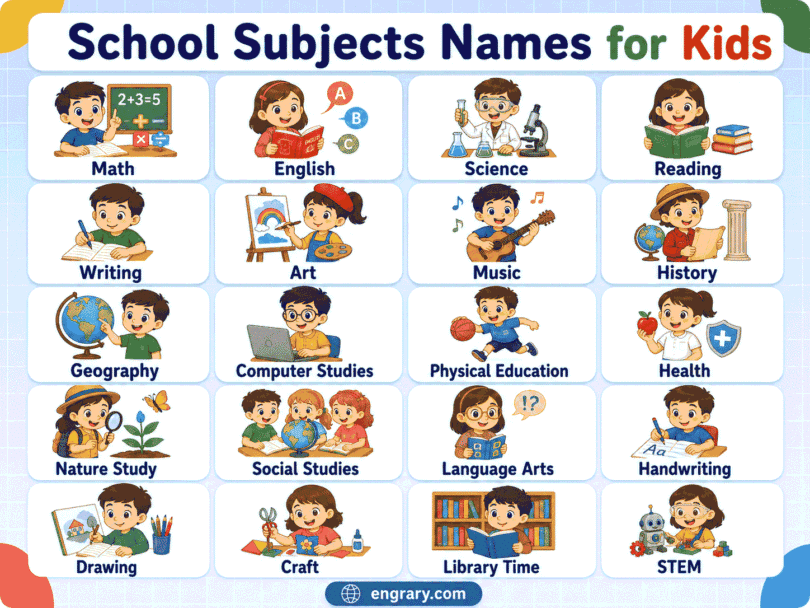
The school bell rings, books open, and a new lesson begins. One class may be filled with numbers, while the next brings stories, maps, music, experiments, or movement.
Learning school subjects names for kids helps children understand their timetable and talk about what they study. It also gives young learners useful language for saying which subjects they enjoy, what they do in each lesson, and when a class takes place.
What Is a School Subject?
A school subject is an area of learning taught at school. Each subject helps children build different knowledge and skills.
The word subject is pronounced /ˈsʌb.dʒɪkt/ 🔊.
For example:
- English helps children read, write, speak, and listen.
- Math teaches numbers, shapes, measurement, and problem-solving.
- Science helps children explore living things, materials, weather, and how the world works.
- Art develops creativity through drawing, painting, and design.
- Physical education develops movement, balance, fitness, and teamwork.
A child may study several subjects in one day:
- English is our first lesson.
- Math comes before break.
- We have science after lunch.
- Art is the final subject today.
Schools may use different subject names depending on the country, curriculum, and age group.
School Subjects on a Timetable
A timetable shows which subjects students have and when each lesson begins.
| School subject | What children learn or do |
|---|---|
| English | Read, write, speak, listen, and learn new words |
| Math | Count, calculate, measure, work with shapes, and solve problems |
| Science | Explore plants, animals, weather, materials, and simple experiments |
| Reading | Read stories, poems, instructions, and information |
| Writing | Form letters and write words, sentences, and short texts |
| Phonics | Connect letters and letter groups with spoken sounds |
| Art | Draw, paint, color, design, and make visual work |
| Music | Sing, listen, clap rhythms, and play instruments |
| PE | Exercise, move, balance, and play physical games |
| History | Learn about people and events from the past |
| Geography | Study maps, countries, land, weather, and places |
| Computer studies | Use computers and digital tools safely |
| Social studies | Learn about communities, cultures, history, and society |
| Foreign language | Learn another language used outside the main classroom language |
Some schools also teach:
- handwriting
- spelling
- general knowledge
- environmental studies
- drama
- dance
- coding
- design and technology
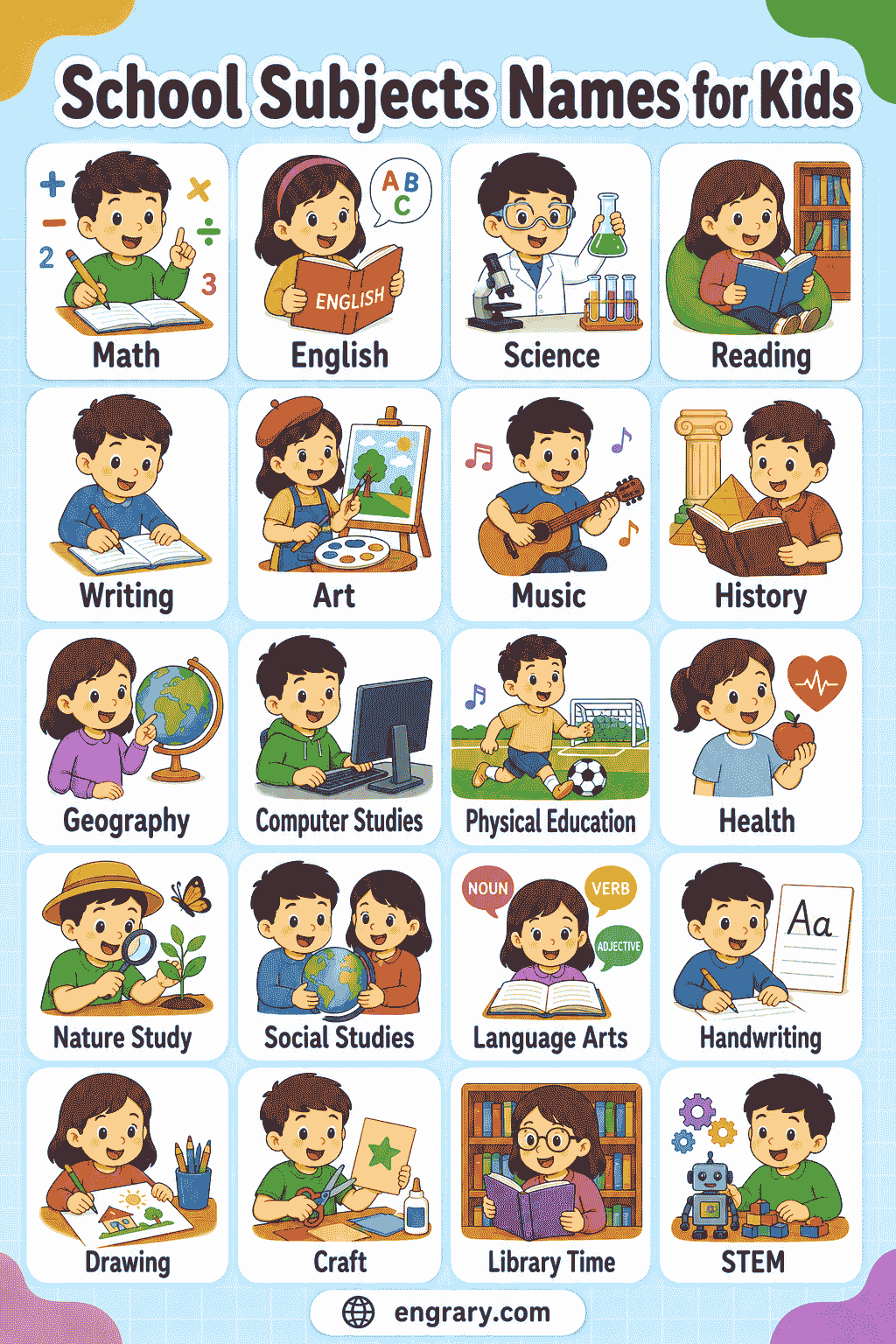
What Kids Do During Each Lesson
Children remember subject names more easily when they connect them with familiar classroom activities.
English
In English, children may:
- read stories
- learn vocabulary
- practise spelling
- write sentences
- answer questions
- speak with classmates
Examples:
- We read a story in English.
- The class learns five new words.
- I write a sentence about my family.
Math
In math, children may:
- count objects
- add and subtract
- compare numbers
- measure length
- identify shapes
- solve problems
Examples:
- We add two numbers.
- The teacher draws a triangle.
- Our class measures the desk.
Science
In science, children may:
- observe plants
- learn about animals
- study weather
- compare materials
- make predictions
- carry out simple experiments
Examples:
- We observe how a seed grows.
- The class learns why ice melts.
- Our experiment uses water.
Art
In art, children may:
- draw pictures
- paint
- mix colors
- create patterns
- cut and paste
- make models
Examples:
- I paint a picture of a tree.
- We mix blue and yellow.
- The class makes paper masks.
Music
In music, children may:
- sing songs
- clap rhythms
- listen to sounds
- learn simple notes
- play instruments
Examples:
- The class sings together.
- Children clap the rhythm.
- The teacher plays a drum.
Physical Education
Physical education, usually shortened to PE, includes exercise, movement, games, coordination, and fitness.
Children may:
- run
- jump
- stretch
- balance
- throw
- catch
- play team games
Examples:
- We warm up before the game.
- The class practises throwing a ball.
- Everyone stretches carefully.
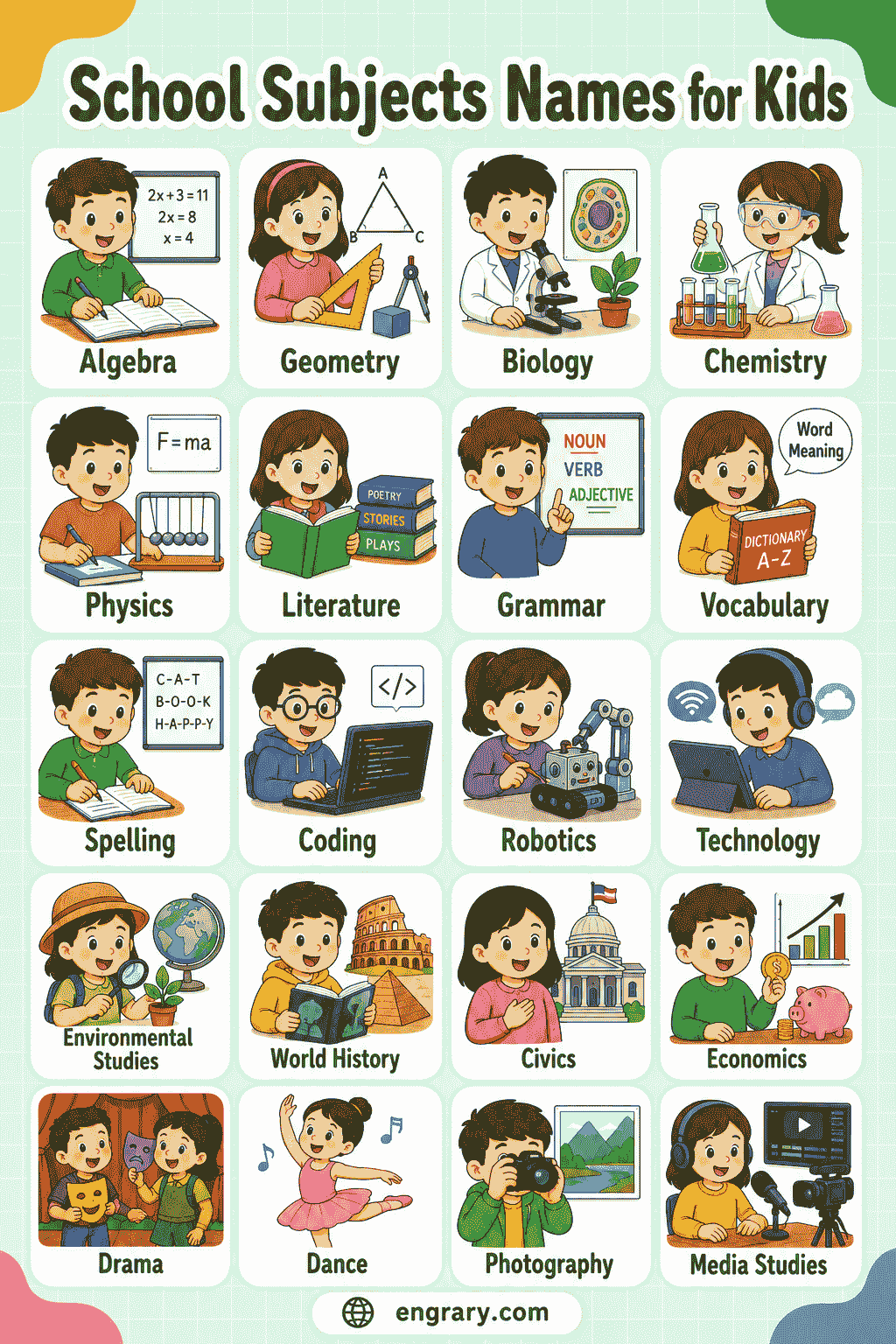
Subjects Taught in the Early Grades
Young children usually begin with broad subjects that build language, number, creative, digital, and physical skills.
Common early-grade subjects include:
- English
- math
- reading
- writing
- phonics
- science
- art
- music
- PE
- computer studies
Some early-grade activities may appear as separate lessons:
- story time
- circle time
- handwriting
- spelling
- library time
- activity period
Phonics is pronounced /ˈfɒn.ɪks/ 🔊. It teaches the connection between written letters and spoken sounds.
Examples:
- b represents the first sound in bat.
- sh appears at the beginning of ship.
- ai can represent the long vowel sound in rain.
Subjects Kids Study in Later Grades
As students grow older, broad subjects may divide into more specific areas.
| Broad subject | Later subjects | Main focus |
|---|---|---|
| Science | Biology, chemistry, physics | Living things, materials, forces, energy, and motion |
| Social studies | History, geography, civics, economics | The past, places, communities, government, and resources |
| Computer studies | ICT, computing, coding | Technology use, digital skills, and programming |
| English | Language and literature | Communication, grammar, reading, stories, poems, and plays |
Schools organize these lessons differently. A digital subject may be called computer studies, ICT, or computing, depending on the school.
Talking About a Favorite Subject
Children often begin with this sentence:
My favorite subject is _____.
A stronger answer also gives a reason.
Examples:
- My favorite subject is science because I enjoy experiments.
- I like English because I love stories.
- Art is my favorite subject because drawing makes me happy.
- I enjoy math because I like solving problems.
- Music is fun because we sing and play instruments.
- PE is exciting because we move and play games.
- Geography interests me because I like maps.
- History is useful because it teaches us about the past.
Useful question patterns:
What is your favorite subject?
My favorite subject is art.
Why do you like it?
I like it because I enjoy painting.
Which lesson do you enjoy most?
I enjoy science most.
What do you do in that lesson?
We observe, compare, and experiment.
Children can also mention more than one subject:
- I like both math and science.
- English and art are my favorite subjects.
- I enjoy music, but I also like PE.
How to Describe School Subjects
Children need descriptive words to explain how a lesson feels to them.
| Word | Simple meaning | Example |
|---|---|---|
| Fun | enjoyable | Music is fun. |
| Interesting | makes you want to learn more | Science is interesting. |
| Easy | does not feel difficult | Reading feels easy today. |
| Difficult | needs more effort | This math lesson is difficult. |
| Exciting | makes you feel eager | The experiment is exciting. |
| Creative | uses ideas and imagination | Art is creative. |
| Useful | helps in real life | Computer studies is useful. |
| Active | involves movement | PE is active. |
| Challenging | difficult in a helpful way | The problem is challenging. |
| Relaxing | makes you feel calm | Drawing is relaxing. |
A subject that feels easy to one child may feel difficult to another.
Useful examples:
- I find math easy.
- Spelling is difficult for me.
- Science is interesting because we ask questions.
- Art feels relaxing.
- History is challenging, but I am improving.
Talking About Subjects by Day and Time
Subject names often appear with weekdays, times, and lesson order.
Using Days
- We have English on Monday.
- Art is on Tuesday afternoon.
- Science is on Wednesday.
- We study geography on Thursday.
- PE is on Friday morning.
Use on before a day:
- on Monday
- on Wednesday
- on Friday afternoon
Using Lesson Order
- Math is the first lesson.
- Science is our second subject.
- English comes before break.
- Art is after lunch.
- Our next lesson is music.
- PE is the final subject today.
Useful timetable words include:
- first
- second
- next
- before
- after
- morning
- afternoon
- period
- lesson
- timetable
Sample School Timetable
| Time | Monday | Tuesday | Wednesday |
|---|---|---|---|
| 8:30 | English | Math | Science |
| 9:30 | Math | English | English |
| 10:30 | Break | Break | Break |
| 11:00 | Science | Art | Math |
| 12:00 | Music | Computer studies | PE |
Questions:
- Which subject comes first on Monday?
- When do students have art?
- What comes after break on Wednesday?
- Which day includes computer studies?
Answers:
- English comes first on Monday.
- Art is on Tuesday at 11:00.
- Math comes after break on Wednesday.
- Computer studies is on Tuesday.
Other Names for School Subjects
English-speaking schools do not always use the same subject names.
| Name | Common alternative | Helpful note |
|---|---|---|
| Math | Maths | Math is common in American English; maths is common in British English. |
| Physical education | PE, gym | PE includes movement, fitness, games, and physical skills. |
| Computer studies | ICT, computing | The lesson content may differ between schools. |
| Art | Visual arts | Visual arts may include drawing, painting, sculpture, and design. |
| Social studies | Humanities | These areas may include history, geography, culture, and civics. |
| Foreign language | World language, modern languages | Schools may teach French, Spanish, Arabic, German, or another language. |
| Design and technology | Technology, DT | Students design, build, and test objects or products. |
These names are related, but they are not always exact equivalents.

School Subjects Kids Often Confuse
| Subject mix-up | Easy difference |
|---|---|
| English vs reading | English includes several language skills. Reading focuses mainly on understanding texts. |
| Math vs science | Math focuses on numbers and patterns. Science explores the natural and physical world. |
| Art vs craft | Art focuses on visual expression. Craft often involves making objects by hand. |
| Music vs dance | Music focuses on sound and rhythm. Dance focuses on body movement. |
| PE vs sports | PE is a school subject. Sports are physical games that may be part of PE. |
| History vs social studies | History focuses on the past. Social studies may also include geography, civics, and culture. |
| Geography vs science | Geography studies places and environments. Science studies living things, matter, energy, and forces. |
| Computer studies vs coding | Computer studies covers broad digital skills. Coding focuses on writing instructions for computers. |
| Biology vs science | Science is broad. Biology is the branch that studies living things. |
Guess the Subject from the Activity
Read each clue and name the subject.
- We count, measure, and solve number problems.
Answer: Math - We draw, paint, and create designs.
Answer: Art - We learn about animals, plants, and materials.
Answer: Science - We sing songs and clap rhythms.
Answer: Music - We run, stretch, and play physical games.
Answer: PE - We read stories and write sentences.
Answer: English - We use maps and learn about countries.
Answer: Geography - We study people and events from the past.
Answer: History - We learn to use computers and digital tools.
Answer: Computer studies - We connect letters with sounds.
Answer: Phonics
Create Your Own Weekly Timetable
Children can practise subject names by building a simple timetable.
Choose Your Subjects
For example:
- English
- math
- science
- art
- PE
Place Them on Different Days
| Day | Morning subject | Afternoon subject |
|---|---|---|
| Monday | English | Art |
| Tuesday | Math | PE |
| Wednesday | Science | Music |
| Thursday | English | Computer studies |
| Friday | Geography | Art |
Talk About the Timetable
- English is on Monday morning.
- We have PE on Tuesday afternoon.
- Science is the first lesson on Wednesday.
- Computer studies is on Thursday afternoon.
- Friday begins with geography.
Children can also answer:
- Which subject would you place first?
- Which lesson would you have twice?
- Would you choose art or music?
- Which subject would come after break?
- What would your final Friday lesson be?
Talking About Subjects in a School Day
Read the short school-day description:
On Monday, English is the first lesson. The class reads a story and learns new words. Math comes next, and the children solve number problems. After break, they study science and observe different leaves. Art is the final lesson, so everyone draws and colors a plant.
Answer the questions:
- Which subject comes first?
English comes first. - What do the children do in math?
They solve number problems. - Which lesson comes after break?
Science comes after break. - What do students observe?
They observe different leaves. - What is the final subject?
Art is the final subject.
Speaking prompts:
- Which subjects do you have today?
- What is your first lesson?
- Which subject comes after break?
- What do you do in science?
- Which lesson do you enjoy most?
- Which subject would you like to improve?
FAQs
Common subjects include English, math, science, reading, writing, art, music, PE, and computer studies. Older children may also study history, geography, biology, chemistry, and physics.
They are two names for the same subject. Math is more common in American English, while maths is more common in British English.
PE stands for physical education. It includes exercise, movement skills, fitness, games, and sometimes sports.
Names depend on the country, school system, age group, and curriculum. For example, a digital lesson may be called computer studies, ICT, or computing.
Children can connect each subject with an activity, read a timetable, discuss favorite lessons, guess subjects from clues, and use sentences such as We have science on Tuesday.
You May Also Like