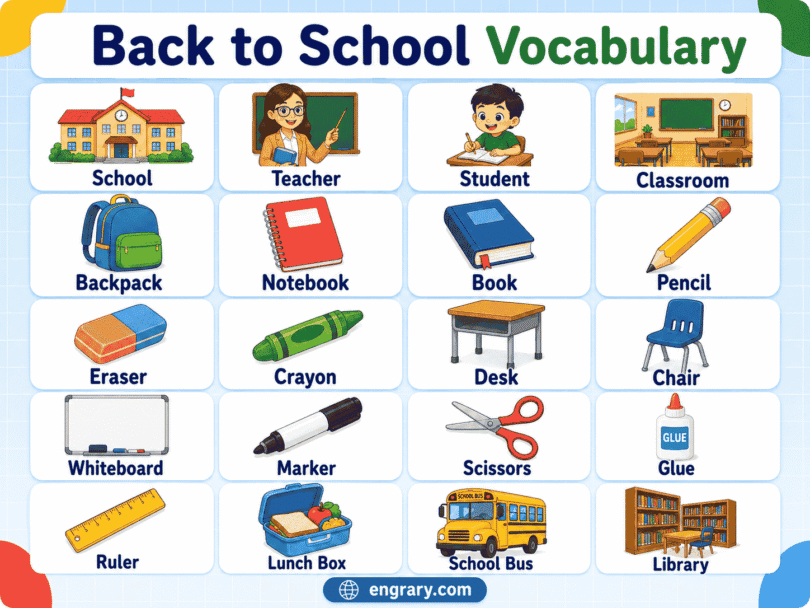
The zipper on the school bag closes, the uniform feels fresh, and the school bell is ready to ring again. After a long break, children return to classrooms, meet teachers and classmates, follow a new routine, and learn the words they need for the first day and first week.
Learning back to school vocabulary helps children talk about getting ready, packing a bag, meeting people, finding places, following routines, sharing feelings, and using polite classroom phrases. These are not just general school words. They are the words children need when school starts again and everything feels new.
What “Back to School” Words Help Kids Say
Back-to-school words help children describe the return to school after a holiday, weekend, or long break. They are useful when kids prepare at home, enter school again, meet a new teacher, follow a timetable, and begin classwork and homework routines.
Useful back-to-school words include:
- school
- first day
- first week
- teacher
- classmate
- school bag
- uniform
- timetable
- routine
- homework
- classwork
- attendance
- excited
- nervous
- ready
A simple explanation for kids:
Back to school vocabulary means the words children use when they return to school and start a new school year, term, or class routine.
Useful examples:
- Today is my first day back at school.
- My school bag is ready.
- Our new teacher welcomes the class.
- The timetable shows today’s lessons.
- The first week helps us learn the routine.
Getting Ready Before the First Day
Back-to-school vocabulary begins before children reach the classroom. The school morning may include waking up early, getting dressed, eating breakfast, checking the bag, and leaving home on time.
Useful getting-ready words:
- wake up
- get dressed
- uniform
- breakfast
- pack
- ready
- leave home
- arrive
- on time
- school morning
Simple meanings:
- Wake up means stop sleeping.
- Get dressed means put on clothes.
- Uniform is special clothing worn for school.
- Breakfast is the morning meal.
- Pack means put things into a bag.
- Ready means prepared to start.
- Arrive means reach a place.
- On time means not late.
Simple examples:
- The alarm rings early.
- I get dressed in my uniform.
- Breakfast gives me energy for school.
- My bag is packed before I leave home.
- We arrive at school on time.
A child can say:
I am ready to go back to school.

Packing the School Bag Again
After a break, children may need to remember what belongs in the school bag. This section focuses only on back-to-school preparation, so it stays different from a full school supplies list.
Useful school-start bag words:
- school bag
- backpack
- pencil case
- notebook
- homework folder
- lunch box
- water bottle
- timetable
- name tag
Simple meanings:
- School bag carries school items.
- Backpack is a bag worn on the back.
- Pencil case holds pencils, pens, and erasers.
- Notebook is used for writing notes or classwork.
- Homework folder keeps homework papers together.
- Lunch box holds food.
- Water bottle holds water.
- Timetable shows lessons and times.
- Name tag shows a child’s name.
Simple examples:
- The pencil case goes inside the school bag.
- A homework folder keeps papers safe.
- My lunch box is ready for break time.
- A full water bottle helps during the day.
- The timetable tells me which lesson comes next.
Seeing Familiar Faces and New People
Back-to-school time often means seeing old friends again and meeting new people. Children may have a new teacher, new classmates, or a new student in the class.
Useful people words:
- teacher
- student
- classmate
- friend
- new student
- old friend
- principal
- helper
Simple meanings:
- Teacher teaches the class.
- Student learns in school.
- Classmate is someone in the same class.
- Friend is someone a child likes and spends time with.
- New student is a student who has just joined.
- Old friend is a friend a child already knows.
- Principal leads the school.
- Helper helps the teacher or students.
Simple examples:
- Our teacher welcomes everyone back.
- A new student joins the class.
- My old friend waves at the gate.
- Classmates sit together during the lesson.
- The helper gives out worksheets.
Useful phrase:
Nice to meet you.
Finding Your Way Around School
During the first week, children may need to find classrooms, offices, lunch areas, or the washroom again. Keep these words tied to first-week navigation rather than turning this section into a full school-places lesson.
Useful place words for going back to school:
- school gate
- classroom
- office
- library
- playground
- canteen
- washroom
- bus stop
Simple examples:
- The school gate is open in the morning.
- My classroom is near the office.
- The library is quiet after lunch.
- Children meet friends on the playground.
- The washroom is down the corridor.
- The bus stop is near the gate.
Helpful first-week question:
Where is my classroom?
Short answers:
- It is near the office.
- It is next to the library.
- It is down the corridor.
Learning the New Routine
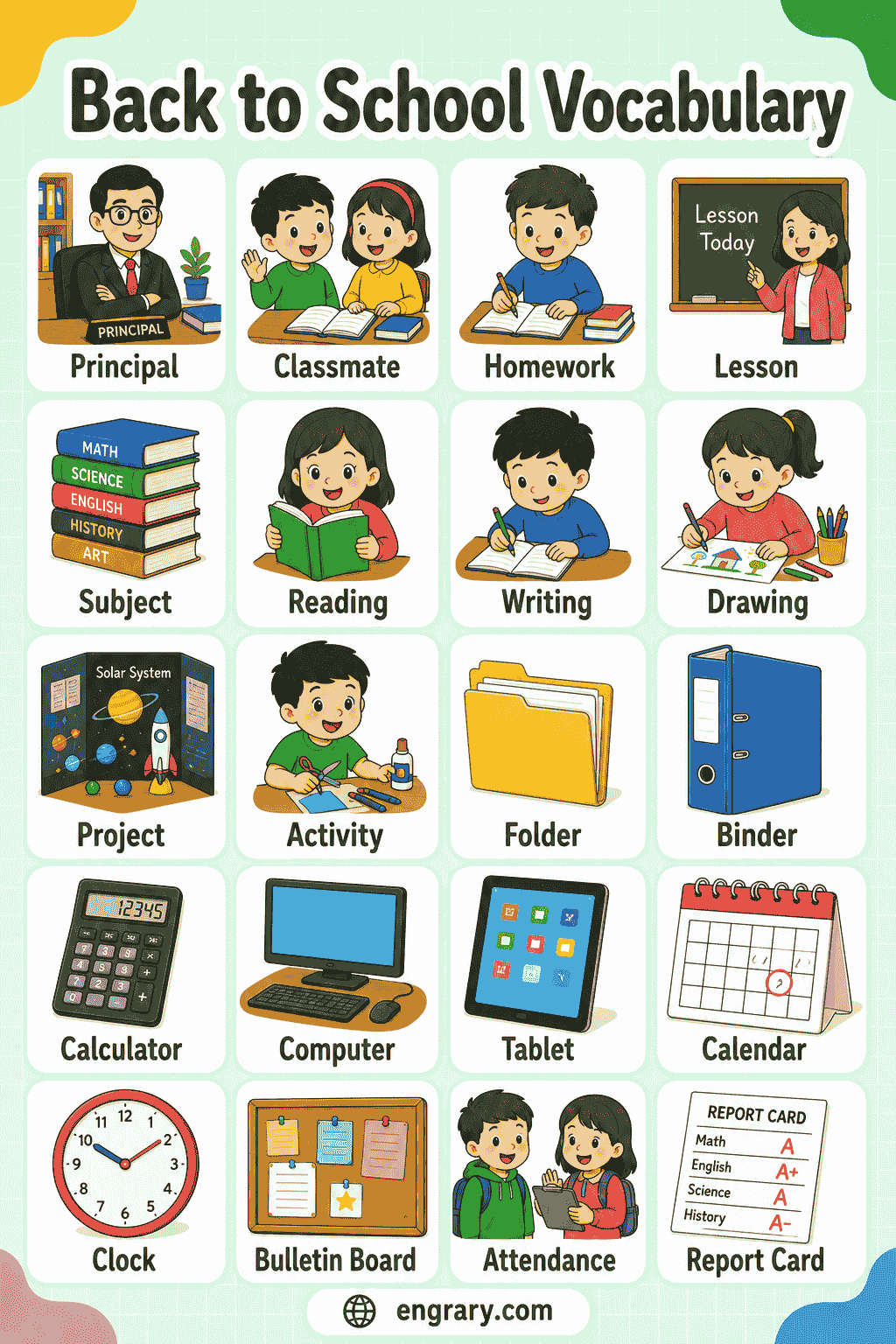
A new school term often brings a new daily rhythm. Children need words for lesson times, attendance, breaks, homework, and class rules.
Useful routine words:
- school year
- first day
- first week
- morning routine
- attendance
- timetable
- lesson
- break time
- lunch time
- homework
- class rules
- after school
Simple meanings:
- School year is the full year of school.
- First day is the first school day after a break.
- First week is the first week back at school.
- Attendance shows who is present.
- Timetable shows lesson times.
- Lesson is what students learn in class.
- Break time is a short rest time.
- Lunch time is when students eat lunch.
- Class rules help students learn safely and kindly.
Simple examples:
- The teacher takes attendance in the morning.
- Our timetable shows English after math.
- Break time comes after the first lesson.
- Class rules help everyone learn.
- Homework starts again after school.
First-Day Feelings
Going back to school is not only about books, bags, and timetables. Children also need words for feelings because the first day can feel exciting, strange, happy, or a little scary.
Useful feeling words:
- happy
- excited
- nervous
- shy
- worried
- ready
- confident
- curious
- comfortable
Easy meanings:
- Excited means happy and eager.
- Nervous means a little worried about something new.
- Shy means quiet around new people.
- Worried means thinking something may go wrong.
- Ready means prepared.
- Confident means feeling sure and brave.
- Curious means wanting to know more.
- Comfortable means feeling okay and safe.
Simple examples:
- The first day makes me excited.
- A new classroom can make a child feel nervous.
- Some children feel shy with new classmates.
- A kind teacher helps students feel comfortable.
- By the end of the week, many children feel more confident.
Helpful Phrases for the First Week
Children need simple phrases during the first week of school. These lines help them introduce themselves, ask for help, ask where something is, and speak politely.
Useful first-week phrases:
- Good morning, teacher.
- My name is ____.
- I am in this class.
- I am new here.
- Can you help me, please?
- Where is my classroom?
- Can I sit here?
- I don’t understand.
- May I come in?
- Thank you.
Simple examples:
- My name is Sara.
- I am new here.
- Can you help me, please?
- Where is my classroom?
- Can I sit here?
- I don’t understand this word.
Short dialogue:
Teacher: Good morning. What is your name?
Student: My name is Ali.
Teacher: Welcome to class, Ali.
Student: Thank you, teacher.
Words for Schoolwork and Daily Plans
Once children settle into class, schoolwork begins again. These words help them understand tasks, deadlines, lesson plans, homework, and practice.
Useful schoolwork words:
- classwork
- homework
- worksheet
- assignment
- project
- test
- revision
- practice
- due date
- finished
Simple meanings:
- Classwork is work done in class.
- Homework is schoolwork done at home.
- Worksheet is a practice paper.
- Assignment is a task given by the teacher.
- Project is a bigger task that may take more time.
- Test checks what students know.
- Revision means studying again.
- Practice means doing something again to improve.
- Due date is the day work must be finished.
- Finished means done.
Simple examples:
- Classwork begins after the lesson.
- Homework goes in the homework folder.
- The worksheet has five questions.
- Our project is due on Friday.
- Revision helps before a test.
Back-to-School Words Kids Often Mix Up
Some back-to-school words are easy to confuse. This table explains the differences in simple language.
| Mix-up | Easy difference |
|---|---|
| School bag vs backpack | A backpack is worn on the back. A school bag can be any bag used for school. |
| Classmate vs friend | A classmate is in your class. A friend is someone you like and spend time with. |
| Classwork vs homework | Classwork is done in class. Homework is done at home. |
| Timetable vs schedule | Both show times and plans, but timetable is common for school lessons. |
| Uniform vs clothes | A uniform is special clothing worn for school. Clothes is a general word. |
| Nervous vs excited | Nervous means worried. Excited means happy and eager. |
| Break time vs lunch time | Break time is a short rest. Lunch time is for eating lunch. |
First-Week Speaking and Writing Lines
These short lines help children use back to school vocabulary in a first-week context. They work well for speaking practice, writing practice, morning warm-ups, and classroom discussion.
Useful first-week lines:
- I am ready for school.
- Today is my first day back.
- My school bag is packed.
- My uniform is clean.
- Our teacher welcomes the class.
- A new student sits near me.
- My old friend smiles at me.
- The first day feels exciting.
- I feel nervous but ready.
- The timetable is on the wall.
- Our routine is new.
- Classwork starts after the lesson.
- Homework goes in my folder.
- I ask for help when I need it.
- The first week is going well.
Question practice:
- How do you feel on the first day?
- What do you pack in your school bag?
- Who do you meet at school?
- Where is your classroom?
- What do you do after school?
Short answers:
- I feel excited.
- My notebook and pencil case are in my bag.
- I meet my teacher and classmates.
- My classroom is near the office.
- Homework is done after school.

School-Start Vocabulary Activities
Back-to-school vocabulary becomes easier when children connect words with routines, feelings, places, and classroom situations.
Pack-the-bag word sort
Children sort words into bag items, clothes, food, and school papers. For example, lunch box goes with food, and homework folder goes with school papers.
First-day feelings match
Match feeling words with simple meanings: excited — happy and eager, nervous — a little worried, ready — prepared, shy — quiet around new people.
School morning order cards
Put cards in order: wake up, get dressed, eat breakfast, pack bag, leave home, arrive at school.
Meet-the-teacher dialogue practice
Children practice short lines such as Good morning, teacher, My name is ____, and Can you help me, please?
Routine word matching
Match routine words to actions: attendance — teacher checks names, timetable — shows lessons, homework — work done at home.
Back-to-School Word Review Tasks
Use these tasks for classwork, homework, or first-week revision.
A. Circle the back-to-school word
- uniform / apple / spoon
- timetable / pillow / shoe
- classmate / mango / chair
- homework / cup / banana
- school bag / blanket / plate
B. Match the word
- Timetable — ________
- Uniform — ________
- Classmate — ________
- Homework — ________
- Nervous — ________
Word bank: school clothing, someone in your class, a little worried, work done at home, shows lesson times
C. Complete the lines
- My ________ is packed.
- The teacher ________ the class.
- I feel ________ on the first day.
- The ________ shows my lessons.
- Homework goes in my ________.
D. Write people, feelings, routine, or school bag
- Teacher — ________
- Excited — ________
- Timetable — ________
- Lunch box — ________
- Classmate — ________
Answer key:
- A1: uniform
- A2: timetable
- A3: classmate
- A4: homework
- A5: school bag
- B1: shows lesson times
- B2: school clothing
- B3: someone in your class
- B4: work done at home
- B5: a little worried
- C1: school bag
- C2: welcomes
- C3: excited / nervous / ready
- C4: timetable
- C5: folder
- D1: people
- D2: feelings
- D3: routine
- D4: school bag
- D5: people
Quick Check for Back-to-School Words
Try these questions after learning the vocabulary.
- What do children wear if their school has special clothing?
- What shows lesson times?
- What do you call someone in your class?
- What word means happy and eager?
- What word means a little worried?
- What work is done at home?
- What do children carry school items in?
- What can a child say when meeting a teacher in the morning?
- What do you call the first school day after a break?
- What can a child say when they need help?
Answers:
- Uniform
- Timetable
- Classmate
- Excited
- Nervous
- Homework
- School bag / backpack
- Good morning, teacher
- First day back / first day of school
- Can you help me, please?
FAQs
Back to school vocabulary means words children use when they return to school after a break. Examples include school bag, uniform, teacher, classmate, timetable, homework, first day, excited, and nervous.
School vocabulary can include many general school words. Back-to-school vocabulary focuses on the first day or first week back, including preparation, routines, feelings, classroom phrases, and school-start words.
Useful early words include school bag, uniform, teacher, classmate, classroom, timetable, homework, first day, ready, excited, and nervous.
Feelings words help children talk honestly about the first day. A child may feel excited, nervous, shy, worried, ready, or confident when going back to school.
Children can practice with pack-the-bag sorting, school morning order cards, first-day dialogue practice, feelings matching, routine word games, review tasks, and quick-check questions.
You May Also Like