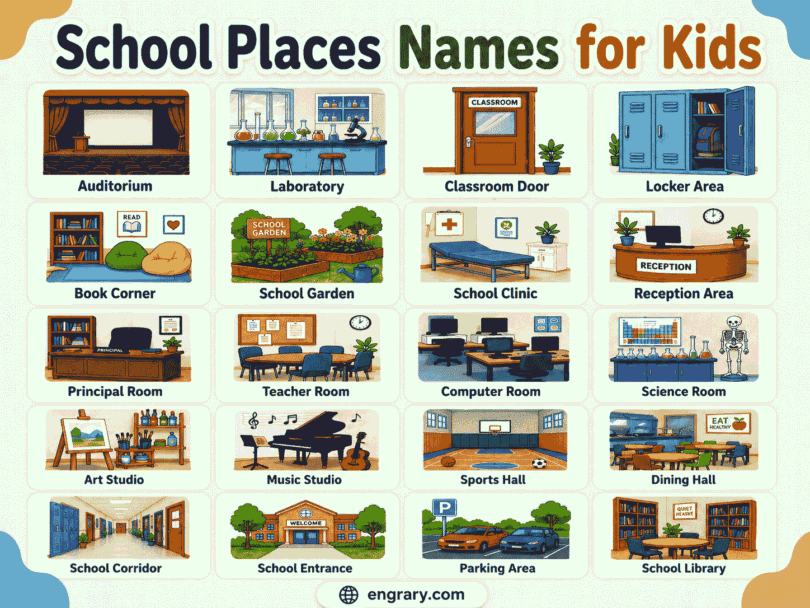
The school gate opens, the bell rings, and children walk toward different places for learning, reading, playing, eating, and getting help. A child may start the day at the school gate, learn in a classroom, read in the library, play on the playground, eat in the canteen, and walk through the corridor before going home.
Learning school places names for kids helps children talk about where they go during the school day. Instead of memorizing a flat list of rooms, kids can learn each place by connecting it with a real action: where they enter, where they learn, where they read, where they play, where they eat, where they ask for help, and where they move safely.
What School Places Mean
School places are the rooms, areas, and spaces children use in and around a school. Some places are for lessons, some are for books, some are for games, and others are for food, water, help, or safe movement.
Common school places include:
- school
- classroom
- library
- playground
- office
- canteen
- hall
- corridor
- school gate
- washroom
- bus stop
A simple explanation for children:
School places are the rooms and areas where children learn, read, play, eat, walk, wait, and get help at school.
Useful examples:
- I learn in the classroom.
- Children read in the library.
- The playground is for play.
- Lunch is in the canteen.
- Students enter through the school gate.
First School Places Children Should Know
Young learners should begin with school places they see, visit, or hear about often. These words are easy to teach with pictures, a simple school map, real school visits, and question-answer practice.
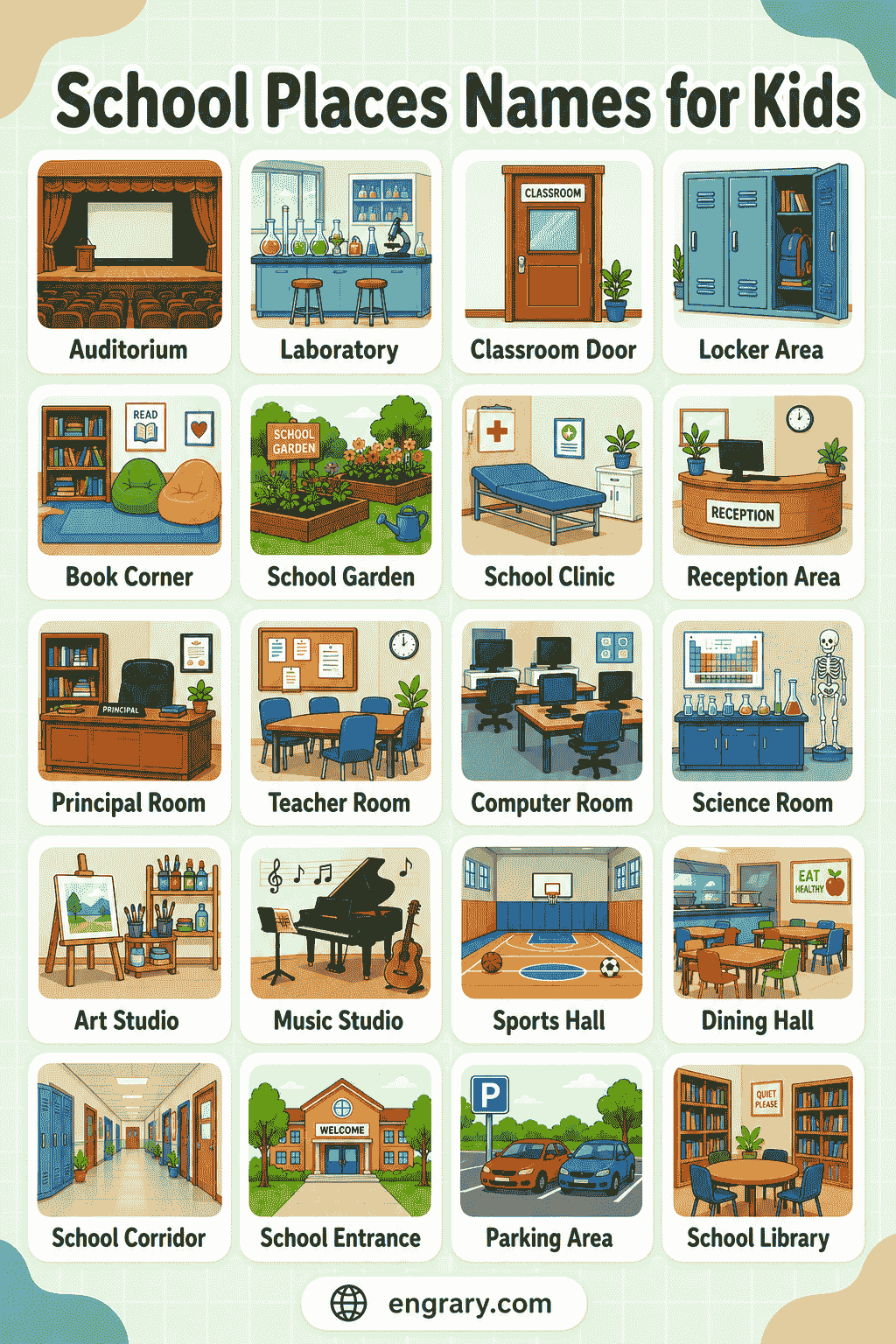
Important school places names include:
- school 🔊 /skool/
- classroom 🔊 /KLAS-room/
- library 🔊 /LY-brair-ee/
- playground 🔊 /PLAY-ground/
- office 🔊 /AW-fis/
- canteen 🔊 /kan-TEEN/
- cafeteria 🔊 /ka-fuh-TEER-ee-uh/
- hall 🔊 /hawl/
- corridor 🔊 /KOR-ih-dor/
- washroom 🔊 /WOSH-room/
- gate 🔊 /gayt/
- bus stop 🔊 /bus stop/
Easy meanings:
- School is the whole place where children learn.
- Classroom is a room where students have lessons.
- Library is a place with books for reading.
- Playground is a place where children play.
- Office is a place where school staff work.
- Canteen is a place where students eat or buy food.
- Cafeteria is another word for a school eating area.
- Hall is a large school area or passage.
- Corridor is a passage between rooms.
- Washroom is a place to wash hands or use the toilet.
- Gate is the entrance to the school.
- Bus stop is where the school bus may stop.
Starting at the School Gate
The school day often begins near the school gate. Children arrive, meet friends, walk inside, and move toward their classrooms. After school, many children leave through the same gate or wait near a bus stop.
Useful gate and arrival words:
- school gate
- entrance
- exit
- waiting area
- bus stop
- parking area
Simple examples:
- I enter through the school gate.
- My parents wait near the gate.
- The school bus stops near the bus stop.
- The entrance is at the front of the school.
- Children leave through the exit after school.
A child can say:
I come to school through the gate.
Rooms Where Kids Learn Lessons
The classroom is the main place where children learn lessons every day. This is where students listen to the teacher, read, write, ask questions, answer, and complete classwork.
Useful learning-place words:
- classroom
- activity room
- language room
- study room
Simple meanings:
- Classroom is where students learn daily lessons.
- Activity room is used for group tasks, learning games, or special practice.
- Language room is used for language lessons in some schools.
- Study room is a quiet place for study or extra learning.
Simple examples:
- The classroom is where we learn.
- Students answer questions in the classroom.
- A group activity may happen in the activity room.
- Some schools use a language room for speaking practice.
For younger children, classroom is the most important word in this group.
Quiet Places for Reading
A school often has a quiet place where children read books, borrow books, or listen to stories. In many schools, this place is called the library.
Useful reading-place words:
- library
- reading room
- reading corner
- bookshelf area
Simple meanings:
- Library is a place with books for reading or borrowing.
- Reading room is a quiet room for reading.
- Reading corner is a small area for reading.
- Bookshelf area is where books are kept.
Simple examples:
- We read books in the library.
- A librarian may help children find books.
- The reading corner is quiet.
- Books are kept in the bookshelf area.
Useful question:
Where do we read books?
Answer:
We read books in the library.
Outdoor Places for Play
Children need places to run, play, exercise, and enjoy break time. These places are usually outside the classroom and help children move their bodies.
Useful outdoor school-place words:
- playground
- sports ground
- field
- gym
- court
- assembly ground
Simple meanings:
- Playground is a place where children play.
- Sports ground is used for games and sports.
- Field is an open area for running or outdoor activities.
- Gym is an indoor place for exercise.
- Court is used for games such as basketball or badminton.
- Assembly ground is where students may stand together for assembly.
Simple examples:
- Children play on the playground.
- Students run on the field.
- The gym is used for exercise.
- Older students may play games on the court.
- Morning assembly can happen on the assembly ground.
Lunch and Water Areas
During the school day, children need places to eat, drink water, and rest during break time. Schools use different words for eating areas, so children may hear canteen, cafeteria, lunch room, or dining hall depending on the school.
Useful lunch and water place words:
- canteen
- cafeteria
- lunch room
- dining hall
- water area
Simple meanings:
- Canteen is a place where students eat or buy food.
- Cafeteria is another common word for a school eating area.
- Lunch room is a room for eating lunch.
- Dining hall is a larger room for meals.
- Water area is where students may drink water or refill bottles.
Simple examples:
- I eat lunch in the canteen.
- Some students buy food in the cafeteria.
- The lunch room is busy at break time.
- Children drink water near the water area.
- A dining hall is used for meals in some schools.
Places Where Kids Get Help
Some school places are used when children need information, care, support, or help with a problem. These places are important because children may visit them during the school day.
Useful help-place words:
- school office
- principal’s office
- reception
- nurse’s room
- staff room
- lost and found
- first-aid room
Simple meanings:
- School office is where school staff work.
- Principal’s office is where the principal works.
- Reception is where visitors may ask for help.
- Nurse’s room is where a sick child may go in some schools.
- Staff room is where teachers may meet or rest.
- Lost and found is where lost items may be kept.
- First-aid room is used for small injuries or care.
Simple examples:
- The principal works in the principal’s office.
- A visitor may ask for help at reception.
- A sick child may go to the nurse’s room.
- Lost items can go to lost and found.
- Teachers may meet in the staff room.
Not every school has all of these places, so children can learn the words that match their own school first.
Special Learning Rooms
Some schools have special rooms for creative lessons, computer practice, science activities, or music. These rooms are not always used every day, but children may visit them for certain lessons.
Useful special-room words:
- art room
- music room
- computer room
- science lab
- activity room
Simple meanings:
- Art room is where children draw, paint, or make art.
- Music room is where children sing or learn music.
- Computer room is where children use computers.
- Science lab is where students do science activities.
- Activity room is used for projects, games, or group learning.
Simple examples:
- Children paint in the art room.
- Music lessons can happen in the music room.
- Students use computers in the computer room.
- Older students may work in the science lab.
- Group projects can happen in the activity room.
Safe Ways to Move Around School
Children also need words for the places they use while moving from one room to another. These words help them talk about walking safely, lining up, entering, leaving, and finding rooms.
Useful movement-place words:
- hall
- corridor
- stairs
- entrance
- exit
- line area
- assembly area
Simple meanings:
- Hall can be a large area or passage in a school.
- Corridor is a passage between rooms.
- Stairs help people move between floors.
- Entrance is where people go in.
- Exit is where people go out.
- Line area is where students stand in a line.
- Assembly area is where students gather together.
Simple examples:
- Students walk in the corridor.
- Children use the stairs carefully.
- The entrance is near the gate.
- The exit leads outside.
- Students stand in the line area.
- The assembly area is used when students gather.
Useful safety sentences:
- Walk slowly in the corridor.
- Hold the railing on the stairs.
- Wait in the line area.
- Use the exit safely.
Where Do We Go at School?
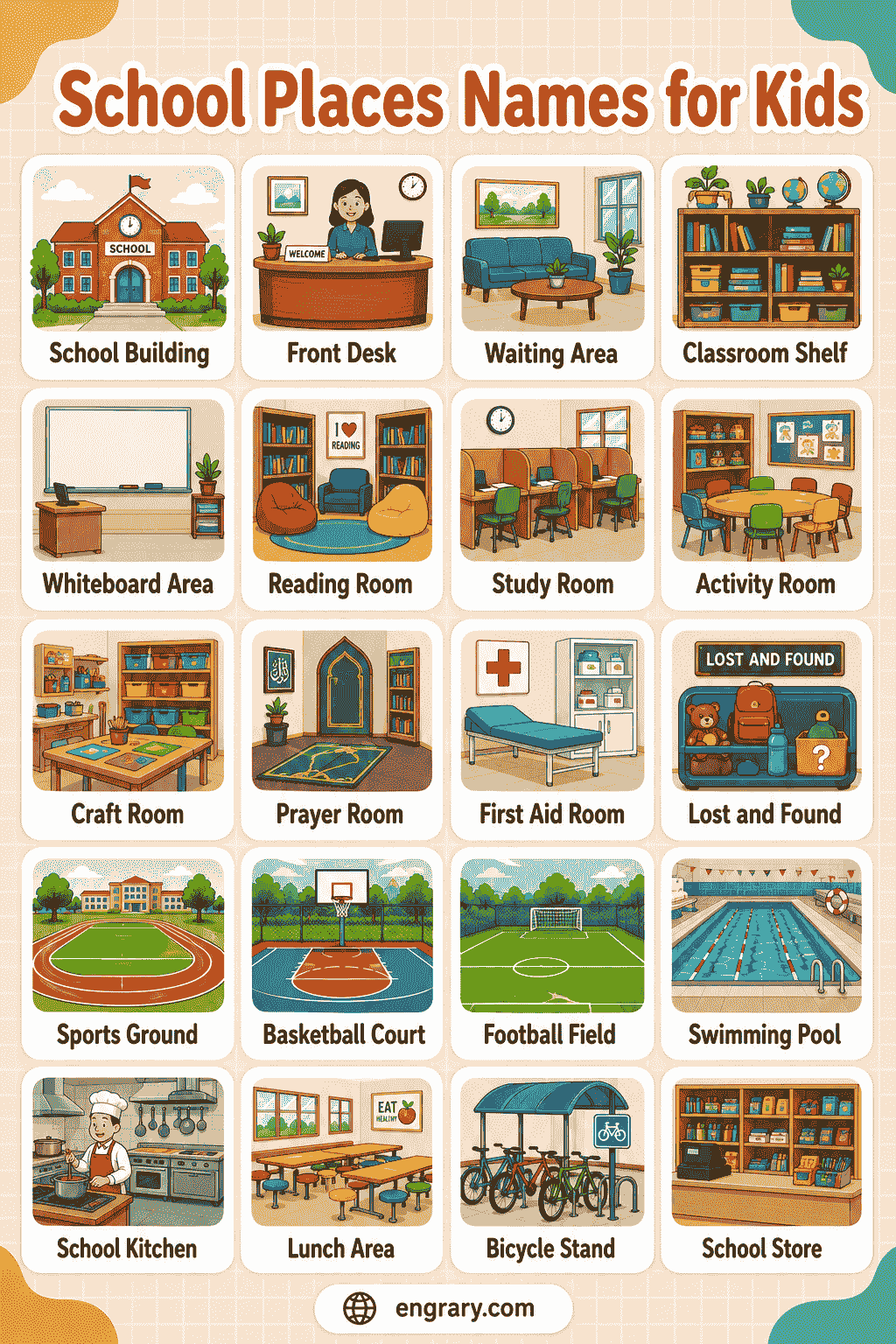
Children remember school places names better when they connect each place with a real action. This question-answer practice is useful for speaking, reading, writing, and classroom review.
| Question | Answer |
|---|---|
| Where do we learn lessons? | In the classroom. |
| Where do we read books? | In the library. |
| Where do we play? | On the playground. |
| Where do we eat lunch? | In the canteen or cafeteria. |
| Where do we use computers? | In the computer room. |
| Where do we go when we feel sick? | To the nurse’s room. |
| Where do we enter school? | Through the school gate. |
| Where do we walk between rooms? | In the hall or corridor. |
| Where do we wash our hands? | In the washroom. |
| Where do we wait for the bus? | At the bus stop. |
School Place Words Kids Often Confuse
Some school place words are easy to mix up because they sound similar, look related, or vary from school to school. This table explains the differences in simple language.
| Mix-up | Easy difference |
|---|---|
| School vs classroom | A school is the whole place. A classroom is one room for learning. |
| Canteen vs cafeteria | Both are places to eat; different schools use different words. |
| Hall vs corridor | A hall can be a large open area. A corridor is a passage between rooms. |
| Office vs principal’s office | A school office is for staff work. A principal’s office is where the principal works. |
| Library vs reading corner | A library is a room or place with many books. A reading corner is a small reading area. |
| Playground vs sports ground | A playground is for play. A sports ground is for games and sports. |
| Washroom vs toilet | Washroom is a polite word. Toilet is more direct. |
| Computer room vs classroom | A computer room has computers. A classroom is a general learning room. |
Simple Sentences with School Places Names
Children learn school place vocabulary better when they use the words in complete sentences. These examples are useful for speaking, writing, ESL practice, and picture labeling.
Useful school-place sentences:
- Every morning, I go to school.
- The school gate opens early.
- My classroom is near the library.
- A quiet library is good for reading.
- Children play on the playground.
- Lunch is served in the canteen.
- The office is near the entrance.
- Students walk through the corridor.
- The washroom is clean.
- Computer lessons happen in the computer room.
- The assembly area is outside.
- My bus stops near the school gate.
- Music class is in the music room.
- Paintings are made in the art room.
- Books are kept in the library.
Question practice:
- Where do you learn?
- Where do you read books?
- Where do you play?
- Where do you eat lunch?
- Where do you wash your hands?
Short answers:
- I learn in the classroom.
- I read books in the library.
- I play on the playground.
- I eat lunch in the canteen.
- I wash my hands in the washroom.
Picture Sorting and School Tour Games
School places are easy to practice with pictures, maps, and pretend school tours. These activities help children connect each place with a real action.
Label a school map
Show a simple school map. Ask children to label places such as classroom, library, playground, office, canteen, washroom, and school gate.
Match places to actions
Match each place with what happens there: library — read, playground — play, canteen — eat, classroom — learn, washroom — wash hands.
School tour order cards
Put cards in school-day order: school gate, classroom, library, playground, canteen, washroom, bus stop.
Where do we go? game
Ask a question such as “Where do we read books?” Children answer: “In the library.”
Place sorting activity
Sort place cards into groups: learn, read, play, eat, get help, and move safely.
Draw your school activity
Children draw their school and label simple places such as classroom, gate, library, playground, and office.
School Places Names Practice Worksheet
Use this practice block for classwork, homework, or quick revision.
A. Circle the school place
- classroom / pencil / spoon
- library / pillow / mango
- playground / shoe / carrot
- canteen / eraser / cup
- office / notebook / ball
B. Match the place
- Classroom — ________
- Library — ________
- Playground — ________
- Canteen — ________
- Washroom — ________
Word bank: place to eat, place to learn, place to wash hands, place to play, place to read books
C. Complete the sentences
- I learn in the ________.
- We read books in the ________.
- Children play on the ________.
- I eat lunch in the ________.
- I wash my hands in the ________.
D. Write learn, read, play, eat, or wash
- Classroom — ________
- Library — ________
- Playground — ________
- Canteen — ________
- Washroom — ________
Answer key:
- A1: classroom
- A2: library
- A3: playground
- A4: canteen
- A5: office
- B1: place to learn
- B2: place to read books
- B3: place to play
- B4: place to eat
- B5: place to wash hands
- C1: classroom
- C2: library
- C3: playground
- C4: canteen
- C5: washroom
- D1: learn
- D2: read
- D3: play
- D4: eat
- D5: wash
School Places Names Quiz for Kids
Try the questions first, then check the answers below.
- Where do students learn lessons?
- Where do children read books?
- Where do children play at school?
- Where can students eat lunch?
- Where do school staff work?
- Where do children wash their hands?
- Where do students use computers?
- What is the entrance to a school called?
- Where do students walk between rooms?
- Where might students wait for the school bus?
Answers:
- Classroom
- Library
- Playground
- Canteen / cafeteria / lunch room
- Office
- Washroom
- Computer room
- School gate / entrance
- Hall / corridor
- Bus stop
FAQs
School places names for kids are words for rooms and areas in or around a school. Examples include classroom, library, playground, office, canteen, washroom, school gate, and bus stop.
Children can start with common places like school, classroom, library, playground, office, canteen, hall, corridor, washroom, school gate, and bus stop.
A school is the whole place where children learn. A classroom is one room inside the school where students have lessons.
Kids can learn school places names with picture cards, school maps, school-tour games, matching activities, simple sentences, worksheets, quizzes, and real school visits.
Children may eat in a canteen, cafeteria, lunch room, or dining hall. They may play on a playground, field, sports ground, or in a gym.
You May Also Like