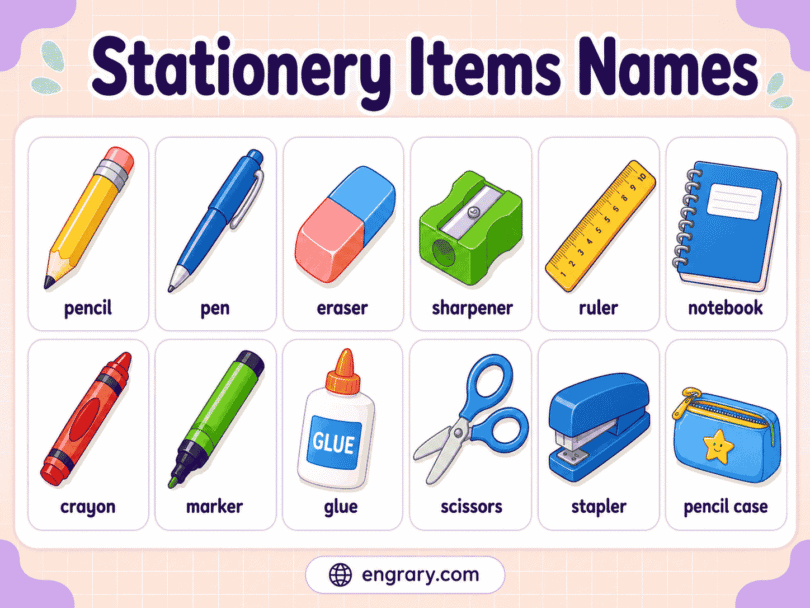
A pencil on a desk, a notebook in a bag, a sticky note on a page, and a folder full of papers all belong to the world of stationery. These are the small tools children, students, teachers, and office workers use for writing, drawing, cutting, sticking, measuring, organizing, and learning.
Learning stationery items names helps kids and English learners name the things they use every day. Instead of memorizing a plain list, children can understand stationery by what each item does: some help us write, some fix mistakes, some hold papers, some make drawings colorful, and some keep a study table neat.
What Stationery Means in Everyday Use
Stationery items are tools and materials used for writing, drawing, paper work, school tasks, office work, and simple creative activities. Many stationery items are used at school, but stationery is not only school supplies. It can also include paper items, desk tools, office items, and things used for organizing documents.
Common stationery items include:
- pen
- pencil
- eraser
- sharpener
- ruler
- notebook
- paper
- folder
- glue
- scissors
- stapler
- paper clip
- marker
- highlighter
- sticky note
A simple explanation for kids:
Stationery items are things we use for writing, drawing, cutting, sticking, measuring, and keeping papers neat.
Useful examples:
- I write with a pen.
- I draw with a pencil.
- I keep papers in a folder.
- I use a ruler to draw a straight line.
- I write a note on a sticky note.
First Stationery Words Kids Should Know
Young learners should start with stationery words they see and use often. These items are easy to teach with real objects, picture cards, classroom activities, and simple sentences.
Important stationery items names include:
- pen 🔊 /pen/
- pencil 🔊 /PEN-suhl/
- eraser 🔊 /ih-RAY-ser/
- sharpener 🔊 /SHAR-puh-ner/
- ruler 🔊 /ROO-ler/
- notebook 🔊 /NOHT-book/
- paper 🔊 /PAY-per/
- folder 🔊 /FOHL-der/
- glue 🔊 /gloo/
- scissors 🔊 /SIZ-erz/
- crayons 🔊 /KRAY-onz/
- marker 🔊 /MAR-ker/
- highlighter 🔊 /HY-ly-ter/
- stapler 🔊 /STAY-pler/
- paper clip 🔊 /PAY-per klip/
Easy meanings:
- Pen is used for writing with ink.
- Pencil is used for writing or drawing and can be erased.
- Eraser removes pencil marks.
- Sharpener makes a pencil point sharp.
- Ruler helps draw straight lines and measure length.
- Notebook is used for writing notes or schoolwork.
- Paper is used for writing, drawing, or printing.
- Folder keeps papers together.
- Glue sticks paper together.
- Scissors cut paper.
- Stapler joins papers with staples.
- Paper clip holds papers together without staples.

Things We Use to Write
Writing tools are some of the most common stationery items. Children use them in school, adults use them at work, and many people use them at home for notes, lists, letters, and reminders.
Useful writing tools include:
- pen
- pencil
- marker
- highlighter
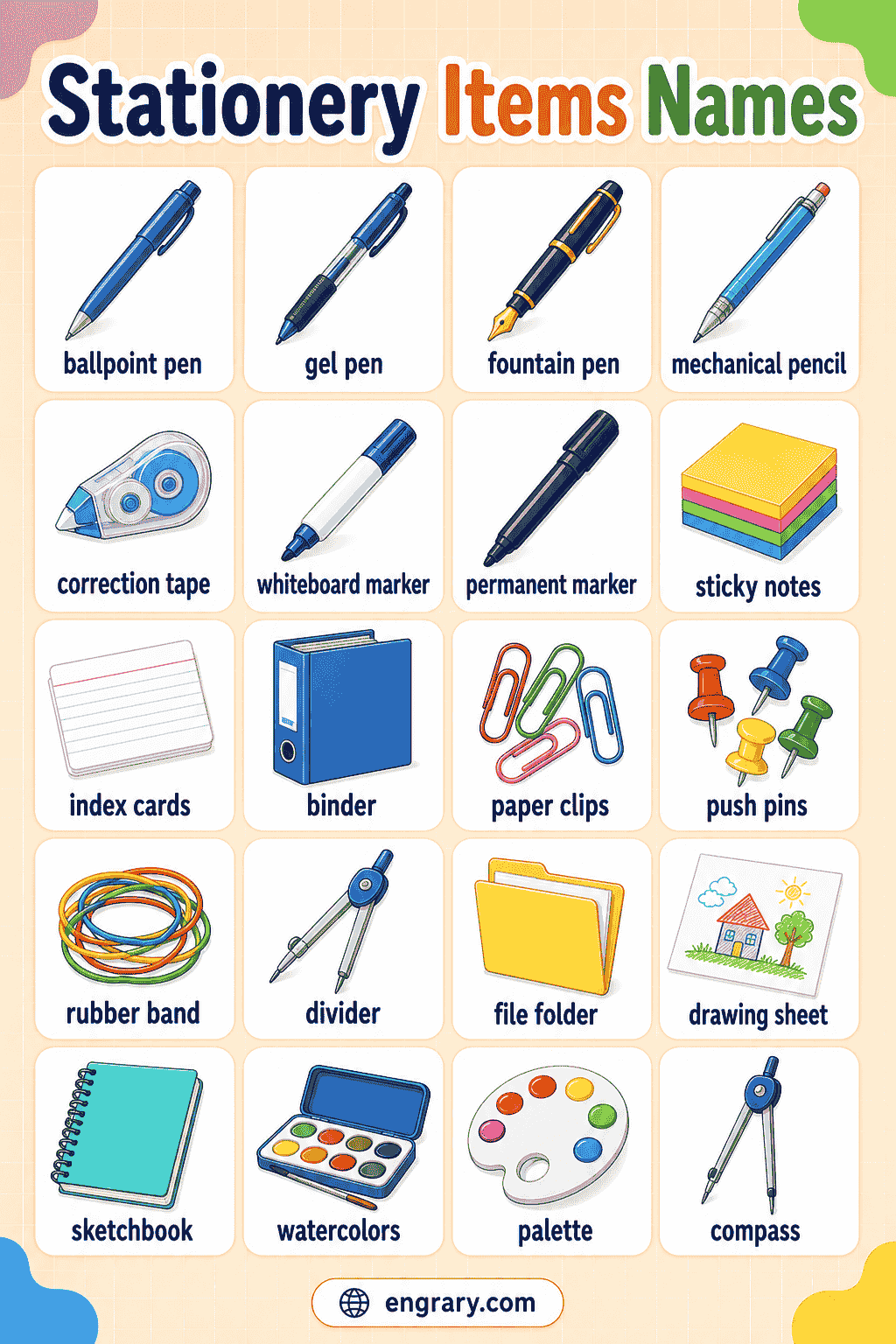
- ballpoint pen
- gel pen
- colored pen
Simple examples:
- I write with a pen.
- I draw with a pencil.
- I write my name with a marker.
- I mark important words with a highlighter.
- I use a colored pen for headings.
A pen writes with ink, so it is usually harder to erase. A pencil is better for young learners because they can erase mistakes and try again.
Tools That Fix Writing Mistakes
Mistakes happen when children write, draw, or copy words. Some stationery items help fix those mistakes neatly.
Useful mistake-fixing tools include:
- eraser
- sharpener
- correction tape
- correction pen
Simple meanings:
- Eraser removes pencil marks.
- Sharpener makes a pencil point sharp again.
- Correction tape covers a writing mistake.
- Correction pen covers an ink mistake with white liquid.
Simple examples:
- I erase the wrong word with an eraser.
- I sharpen my pencil with a sharpener.
- Correction tape covers the mistake.
- A correction pen helps fix ink writing.
For younger children, eraser and sharpener are the most useful first words. Correction tape and correction pen are better for older students.
Paper Items for Notes, Letters, and Practice
Paper stationery includes the things people write on, draw on, fold, send, or use for practice. These items are useful at school, at home, and in offices.
Common paper items include:
- paper
- notebook
- notepad
- diary
- journal
- sticky note
- envelope
- index card
- drawing sheet
Simple meanings:
- Paper is used for writing or drawing.
- Notebook is used for classwork, notes, and practice.
- Notepad is a small pad of paper for quick notes.
- Diary is often used for personal writing.
- Journal is used for thoughts, records, or daily writing.
- Sticky note is a small paper that can stick to a surface.
- Envelope holds a letter or paper.
- Index card is a small card used for notes or study.
- Drawing sheet is used for drawing or coloring.
Useful examples:
- I write notes in my notebook.
- I put the letter in an envelope.
- I write a reminder on a sticky note.
- I draw a picture on a drawing sheet.
Things Used for Drawing and Coloring
Some stationery items help children draw, color, shade, and make creative work. These words are useful for art class, classroom activities, and home practice.
Common drawing and coloring items include:
- crayons
- colored pencils
- markers
- sketchbook
- drawing sheet
- paintbrush
- watercolors
Simple examples:
- I color with crayons.
- I draw with colored pencils.
- I use markers for bright colors.
- I draw in my sketchbook.
- I paint with a paintbrush.
- I use watercolors for painting.
This section should stay simple because deep art tools belong better in an art supplies names article. For stationery vocabulary, children mostly need familiar drawing and coloring words.

Supplies for Cutting, Pasting, and Joining Paper
Some stationery items help children cut paper, paste pictures, attach worksheets, or join pages together. These items are common in classrooms, offices, and craft activities.
Useful cutting, pasting, and joining supplies include:
- scissors
- glue
- glue stick
- tape
- stapler
- staples
- paper clip
- binder clip
Simple meanings:
- Scissors cut paper.
- Glue sticks paper together.
- Glue stick is a solid glue used on paper.
- Tape sticks things with a sticky strip.
- Stapler joins papers with staples.
- Staples are small metal pieces used in a stapler.
- Paper clip holds papers without making holes.
- Binder clip holds thicker groups of papers.
Simple examples:
- I cut paper with scissors.
- I paste the picture with glue.
- I use tape to fix the paper.
- I join the pages with a stapler.
- I hold the papers with a paper clip.
Children should use scissors, staplers, and paper cutters carefully.
Measuring Tools Used in Schoolwork
Some stationery items help students measure, draw lines, make shapes, and complete geometry work. Younger children usually start with a ruler, while older students may use more geometry tools.
Useful measuring and geometry tools include:
- ruler
- scale
- protractor
- compass
- set square
- measuring tape
Simple meanings:
- Ruler helps measure length and draw straight lines.
- Scale is another word for ruler in some places.
- Protractor measures angles.
- Compass draws circles.
- Set square helps draw straight lines and angles.
- Measuring tape measures longer or curved things.
Simple examples:
- I draw a line with a ruler.
- The ruler is fifteen centimeters long.
- I measure an angle with a protractor.
- I draw a circle with a compass.
- I use a set square in geometry.
For beginners, ruler is the most important measuring word.
Things That Keep Papers Neat
Stationery is not only for writing and drawing. Some items help keep papers clean, safe, sorted, and easy to find.
Useful paper-organizing items include:
- folder
- file
- binder
- clipboard
- paper clip
- binder clip
- rubber band
- label
- file divider
Simple meanings:
- Folder keeps loose papers together.
- File stores or organizes documents.
- Binder holds papers, often with rings.
- Clipboard holds paper while someone writes.
- Paper clip holds a few papers together.
- Binder clip holds thicker papers together.
- Rubber band holds things in a bundle.
- Label shows a name, title, or category.
- File divider separates papers into sections.
Simple examples:
- I keep my papers in a folder.
- The file stores important documents.
- The label shows my name.
- A clipboard holds my worksheet.
- A paper clip keeps the pages together.
Stationery Used on a Study Table or Office Desk
Some stationery items are common on a study table, teacher’s desk, or office desk. These items help people write, mark, stamp, organize, and manage papers.
Common desk and office stationery includes:
- stapler
- staples
- hole punch
- stamp
- stamp pad
- sticky notes
- clipboard
- calculator
- desk organizer
Simple meanings:
- Stapler joins papers with staples.
- Hole punch makes holes in paper.
- Stamp prints a small mark.
- Stamp pad holds ink for a stamp.
- Sticky notes are small papers used for reminders.
- Clipboard holds paper while writing.
- Calculator helps with numbers.
- Desk organizer keeps stationery neat.
Useful examples:
- The stapler is on the desk.
- I write a reminder on a sticky note.
- The hole punch makes holes in the paper.
- The stamp pad has ink.
- A desk organizer keeps pens and pencils together.
This section should stay vocabulary-focused, not shopping-focused.
Stationery Items with Simple Uses
Children learn stationery names better when they know what each item does. This table gives quick, easy uses.
| Stationery item | Simple use |
|---|---|
| Pen | writes with ink |
| Pencil | writes or draws and can be erased |
| Eraser | removes pencil marks |
| Sharpener | sharpens a pencil |
| Ruler | measures length or draws straight lines |
| Notebook | holds notes or schoolwork |
| Paper | is used for writing, drawing, or printing |
| Glue | sticks paper together |
| Scissors | cut paper |
| Folder | keeps papers together |
| Stapler | joins papers with staples |
| Paper clip | holds papers without staples |
| Highlighter | marks important words |
| Sticky note | holds a short reminder |
Stationery Words Kids Often Confuse
Some stationery words are easy to mix up because the items look similar or have related uses. This table explains the difference in simple language.
| Mix-up | Easy difference |
|---|---|
| Pen vs pencil | A pen uses ink. A pencil can be erased. |
| Marker vs highlighter | A marker writes or draws. A highlighter marks important words. |
| Eraser vs sharpener | An eraser removes marks. A sharpener makes a pencil point sharp. |
| Notebook vs diary | A notebook is for notes or schoolwork. A diary is often for personal writing. |
| Folder vs file | A folder holds loose papers. A file stores or organizes documents. |
| Glue vs tape | Glue sticks with paste. Tape sticks with a strip. |
| Stapler vs paper clip | A stapler joins papers with staples. A paper clip holds papers without staples. |
| Ruler vs protractor | A ruler measures length. A protractor measures angles. |
| Crayons vs colored pencils | Crayons are waxy. Colored pencils are pencil-shaped. |
Simple Sentences with Stationery Items Names
Children understand stationery items names better when they use the words in complete sentences. These examples are useful for speaking, reading, writing, and classroom practice.
Useful stationery sentences:
- I write with a pen.
- I draw with a pencil.
- I erase with an eraser.
- I sharpen my pencil.
- I draw a straight line with a ruler.
- I write notes in my notebook.
- I color with crayons.
- I mark important words with a highlighter.
- I cut paper with scissors.
- I paste the paper with glue.
- I keep my papers in a folder.
- I join the papers with a stapler.
- I hold the papers with a paper clip.
- I write a reminder on a sticky note.
- My stationery is on the desk.
Question practice:
- What do you write with?
- What removes pencil marks?
- What makes a pencil sharp?
- What keeps papers together?
- What do you use to cut paper?
Short answers:
- I write with a pen.
- An eraser removes pencil marks.
- A sharpener makes a pencil sharp.
- A folder keeps papers together.
- Scissors cut paper.
Picture Sorting and Stationery Practice Games
Stationery vocabulary is easy to practice with real items, pictures, and simple sorting games.
Label the stationery picture
Show a picture with common stationery items. Children label words such as pen, pencil, eraser, ruler, notebook, glue, and scissors.
Sort by use
Sort items into groups: write, draw, cut, stick, measure, and organize.
What is missing? game
Place five stationery items on a table. Hide one item and ask, “What is missing?”
Stationery action match
Match each item to an action: pen — write, scissors — cut, glue — paste, ruler — measure, eraser — erase.
School or office sorting
Sort items into school stationery, office stationery, or both. For example, pencil can be both, while stamp pad is more common in an office.
Safe-use sorting
Sort items into safe for daily use and use carefully. Items like scissors, stapler, compass, and paper cutter need careful hands.
Stationery Items Names Practice Worksheet
Use this practice block for classwork, homework, or quick revision.
A. Circle the stationery item
- pencil / apple / spoon
- eraser / pillow / shoe
- ruler / banana / sock
- folder / cup / plate
- stapler / mango / chair
B. Match the item
- Pen — ________
- Eraser — ________
- Sharpener — ________
- Glue — ________
- Folder — ________
Word bank: sticks paper, writes with ink, keeps papers together, removes pencil marks, sharpens a pencil
C. Complete the sentences
- I write with a ________.
- I erase with an ________.
- I cut paper with ________.
- I draw a line with a ________.
- I keep papers in a ________.
D. Write write, cut, stick, measure, or organize
- Pencil — ________
- Scissors — ________
- Glue — ________
- Ruler — ________
- Folder — ________
Answer key:
- A1: pencil
- A2: eraser
- A3: ruler
- A4: folder
- A5: stapler
- B1: writes with ink
- B2: removes pencil marks
- B3: sharpens a pencil
- B4: sticks paper
- B5: keeps papers together
- C1: pen / pencil
- C2: eraser
- C3: scissors
- C4: ruler
- C5: folder
- D1: write
- D2: cut
- D3: stick
- D4: measure
- D5: organize
Stationery Items Names Quiz for Kids
Try the questions first, then check the answers below.
- What do you use to write with ink?
- What do you use to write or draw and then erase?
- What removes pencil marks?
- What makes a pencil point sharp?
- What helps draw straight lines?
- What do you use to cut paper?
- What sticks paper together?
- What keeps loose papers together?
- What joins papers with staples?
- What marks important words?
Answers:
- Pen
- Pencil
- Eraser
- Sharpener
- Ruler
- Scissors
- Glue
- Folder / paper clip
- Stapler
- Highlighter
FAQs
Stationery items names are words for tools and materials used for writing, drawing, cutting, sticking, measuring, organizing, and paper work. Examples include pen, pencil, eraser, ruler, notebook, glue, scissors, folder, and stapler.
Kids can start with common stationery items such as pen, pencil, eraser, sharpener, ruler, notebook, paper, folder, glue, scissors, crayons, and stapler.
Not exactly. Some stationery items are school supplies, such as pencils, erasers, notebooks, and rulers. However, stationery also includes office and desk items like sticky notes, staplers, files, paper clips, and stamp pads.
Common office stationery items include pen, paper, file, folder, stapler, staples, paper clip, sticky notes, hole punch, clipboard, and desk organizer.
Kids can learn stationery items names by using real items, labeling pictures, sorting items by use, matching items to actions, making simple sentences, completing worksheets, and playing stationery word games.
You May Also Like