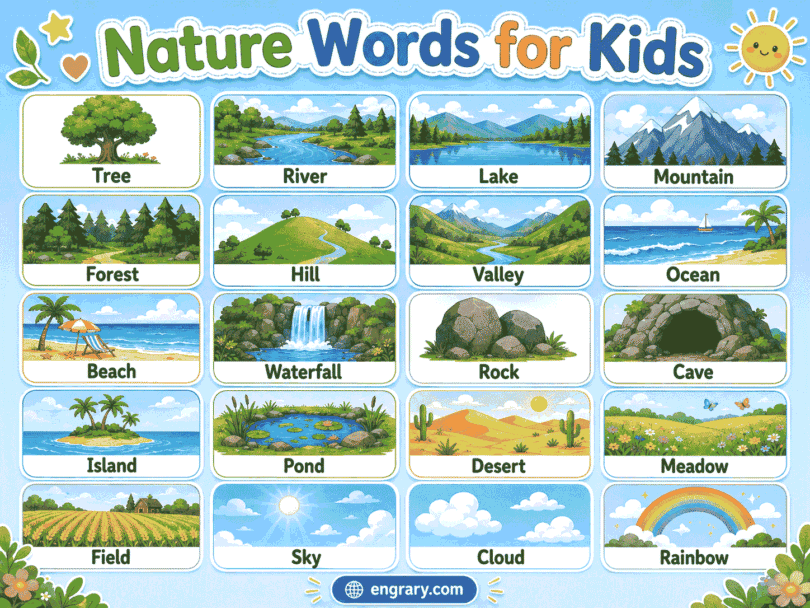
Children learn many nature words before they can explain what nature means. They may point to a tree, pick up a leaf, watch a bird, feel soft grass, or look at the moon in the night sky.
Learning nature words for kids helps children name the natural things they see outside. Once they know words like tree, flower, river, cloud, rock, and bird, they can talk about walks, parks, gardens, weather, animals, and the world around them in simple English.
What Is Nature in Simple Words?
Nature means the world around us that is not made by people. It includes plants, animals, land, water, sky, and weather.
A tree is part of nature. A river is part of nature. A bird, flower, mountain, cloud, and rock are also part of nature. A toy, chair, road, phone, or building is made by people, so it is not nature.
A simple way to explain nature is:
Nature is the outside world with plants, animals, land, water, sky, and weather.
Common nature examples include:
- tree
- flower
- leaf
- grass
- river
- mountain
- sun
- cloud
- bird
- butterfly
- rock
- rain
What Children Notice Outside
Children usually learn nature words by looking, listening, feeling, and asking questions. A walk in a garden, park, field, beach, or backyard can become a simple vocabulary lesson.
They may notice:
- something green, like grass or leaves
- something bright, like the sun or a flower
- something moving, like a bird or butterfly
- something wet, like rain or mud
- something hard, like a rock
- something soft, like grass
- something high, like a mountain or tree
- something in the sky, like clouds or stars
Safe observation is important. Children can look closely, draw what they see, and name things aloud, but they should touch plants, insects, water, rocks, or soil only with adult permission.
Try this simple outdoor question:
What nature word can you see right now?
First Nature Words Kids Should Learn
Children should begin with common nature words they can see in pictures, books, parks, gardens, and everyday life. These words are easy to understand because they connect to real things.
Good first nature words include:
- tree — a tall plant with a trunk, branches, and leaves
- flower — the colorful part of a plant
- leaf — a flat green part of a plant
- grass — small green plants that cover the ground
- sun — the bright light we see in the sky during the day
- moon — the round object we often see in the night sky
- cloud — a soft-looking shape in the sky
- rain — water that falls from clouds
- river — moving water that flows across land
- rock — a hard natural piece of earth
- bird — an animal with wings and feathers
- butterfly — an insect with colorful wings
These words give children a strong base before they learn harder nature vocabulary such as valley, forest, wave, soil, or root.
Green Things in Nature
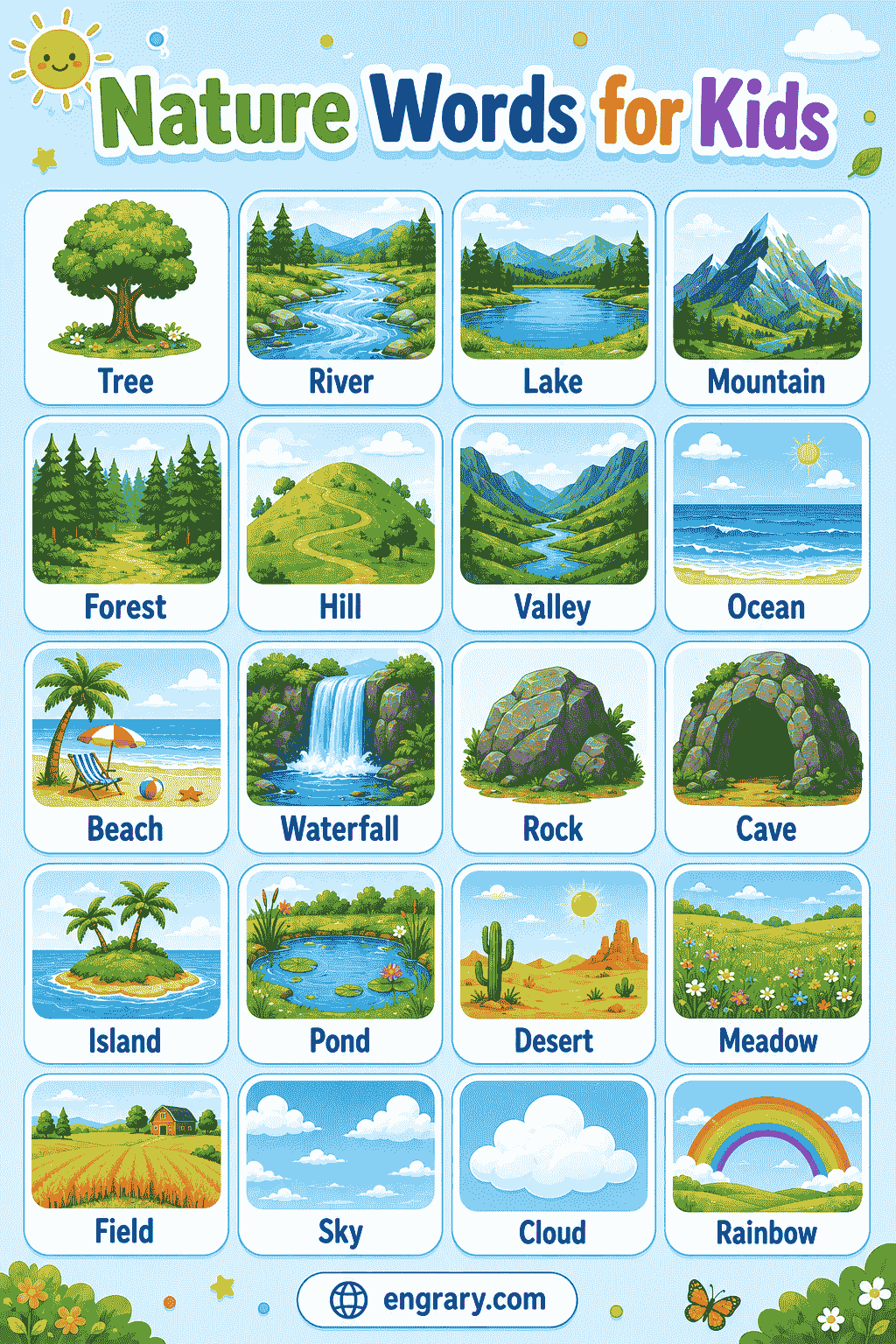
Many nature words are connected to green things outside. Children often notice green plants first because they are easy to see in gardens, parks, fields, and forests.
Common green nature words:
- tree
- leaf
- grass
- plant
- bush
- stem
- vine
- moss
A tree is a large plant with a trunk, branches, and leaves. A leaf grows on a tree or plant. Grass covers the ground in many parks and gardens. A bush is smaller than many trees and often has many branches close to the ground.
Simple examples:
- I see a tree.
- The leaf is green.
- The grass is soft.
- A plant can grow in soil.
- The bush has small leaves.
Children can also sort green nature pictures into groups:
- trees
- leaves
- grass
- plants
- bushes
Small Things Children Find Outdoors
Nature is not only made of big things. Many small things outside are also part of nature. Children may see seeds, ants, bees, worms, pebbles, and tiny flowers.
Small nature words include:
- seed
- ant
- bee
- worm
- pebble
- bud
- twig
- shell
A seed can grow into a new plant. An ant is a tiny insect that often walks on the ground. A bee visits flowers. A worm lives in soil. A pebble is a small rock.
Simple examples:
- A seed can grow.
- An ant is small.
- A bee visits a flower.
- A worm lives in soil.
- I found a pebble.
Children should learn to observe tiny living things gently. They can look, count, draw, and describe, but they should not hurt insects or pick up unknown objects without permission.
Big Things in the Natural World
Some nature words name large things children may see in pictures, books, trips, or outdoor places. These words help children talk about wide open spaces and big parts of the natural world.
Big nature words include:
- mountain
- forest
- river
- lake
- sea
- hill
- valley
- field
A mountain is a very high part of land. A hill is raised land that is usually smaller than a mountain. A forest has many trees. A river is water that flows. A lake is water with land around it.
Simple examples:
- The mountain is high.
- The forest has many trees.
- The river is long.
- The lake is calm.
- The hill is green.
Picture books, posters, and outdoor photos work well for these words because children may not see mountains, forests, or seas every day.
Nature Words in the Sky
The sky gives children many easy nature words to learn. They can look up during the day or night and name what they see.
Sky nature words include:
- sky
- sun
- moon
- star
- cloud
- rainbow
- rain
- snow
The sun gives light during the day. The moon is often seen at night. Stars shine in the night sky. A cloud floats in the sky. A rainbow may appear when sunlight and rain happen together.
Simple examples:
- The sun is bright.
- The moon shines at night.
- Stars are in the sky.
- Clouds can bring rain.
- A rainbow has many colors.
A quick sky activity:
Look up and complete the sentence:
I can see ________ in the sky.
Nature Words on the Ground
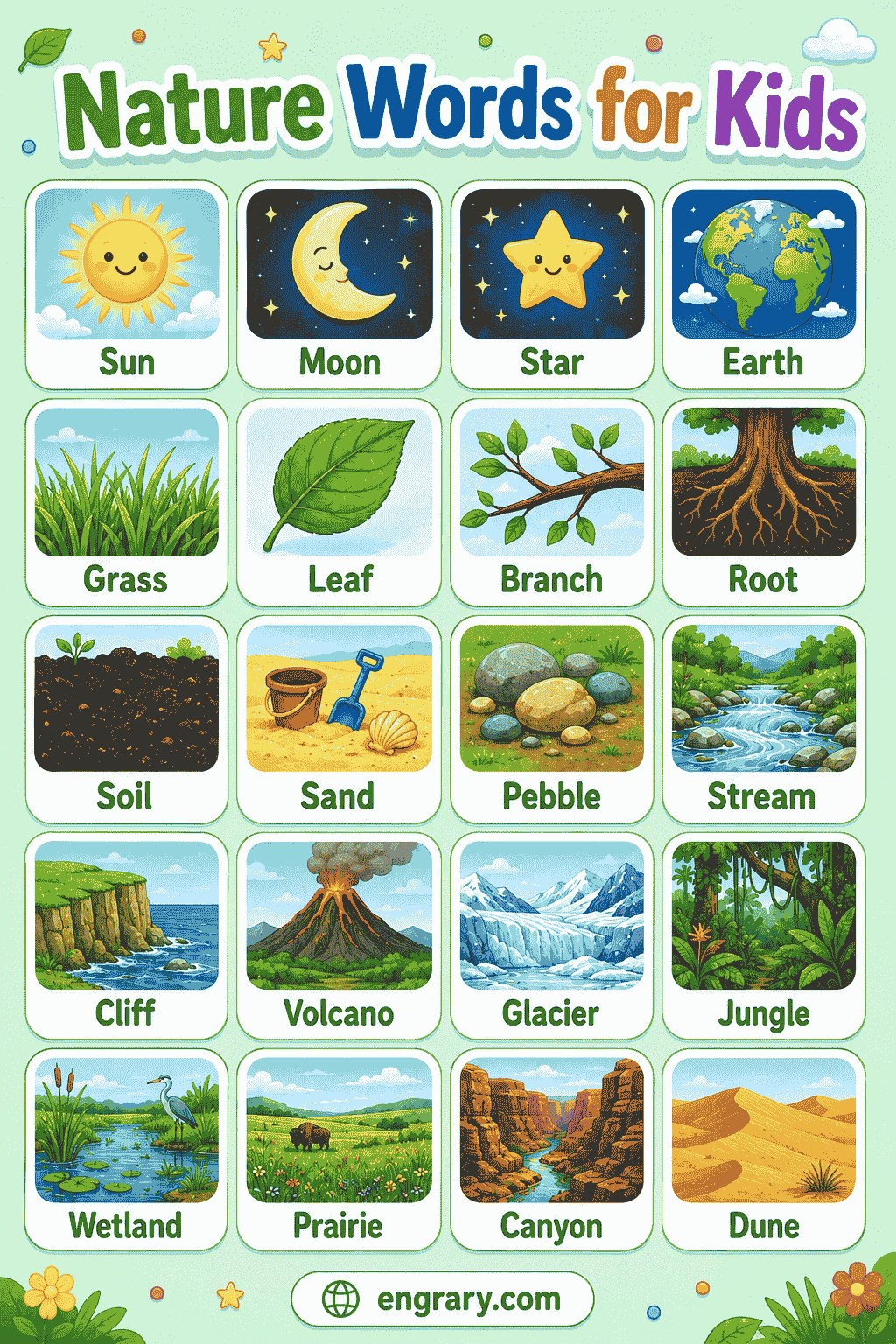
Children also notice many nature words under their feet. Ground words help them describe earth, sand, mud, rocks, and other natural things they may see while walking.
Ground nature words include:
- soil
- sand
- mud
- rock
- stone
- pebble
- path
- root
Soil is earth where plants can grow. Mud is wet soil. Sand is made of tiny grains, often found near beaches, deserts, or playground areas. A rock is hard. A root is the part of a plant that grows under the ground.
Simple examples:
- Plants grow in soil.
- Mud is wet soil.
- The rock is hard.
- Sand feels soft.
- Roots grow under the ground.
Children can compare safe objects:
- hard rock
- soft sand
- wet mud
- dry soil
- small pebble
Water Words in Nature
Water is an important part of nature. Children may see water in rain, rivers, ponds, lakes, seas, puddles, or waves.
Water nature words include:
- rain
- river
- lake
- pond
- sea
- wave
- puddle
- stream
A river is moving water that flows across land. A lake is a large area of water with land around it. A pond is usually smaller than a lake. The sea is a very large area of salty water. A wave is moving water on the sea or lake.
Simple examples:
- Rain falls from clouds.
- The river flows.
- A pond is small.
- The lake is quiet.
- Waves move in the sea.
Water safety matters. Children should look at rivers, ponds, lakes, and seas with an adult and should not go near deep water alone.
Living and Nonliving Things in Nature
Nature has both living and nonliving things. This is a useful idea for children because it helps them sort nature words more clearly.
Living things grow, need food or water, and can change over time. Nonliving things do not grow or need food.
| Living Things in Nature | Nonliving Things in Nature |
|---|---|
| tree | rock |
| flower | mountain |
| bird | river |
| fish | sand |
| butterfly | cloud |
| frog | rain |
Simple examples:
- A tree is living.
- A bird is living.
- A rock is nonliving.
- Sand is nonliving.
- Rain is nonliving.
This section should stay simple. Children do not need a deep science lesson here; they only need a clear way to understand nature words.
Natural Things and Things People Make
Children often see natural and man-made things together. A park may have trees and flowers, but it may also have benches, roads, fences, and swings. This can confuse young learners.
| Natural Things | Things People Make |
|---|---|
| tree | chair |
| river | road |
| flower | toy |
| mountain | building |
| rock | car |
| bird | bus |
A simple teaching line is:
Natural things are part of nature. Man-made things are made by people.
Examples:
- A tree is natural.
- A road is made by people.
- A flower is natural.
- A toy is made by people.
- A bird is natural.
A good sorting activity is to show picture cards and ask:
Is it natural or made by people?
Nature Words Children Use on a Walk
A nature walk is one of the best ways to practice nature vocabulary. Children can name real things instead of only looking at pictures.
During a walk, children can look for:
- one plant
- one animal or insect
- one thing in the sky
- one thing on the ground
- one water word, if water is nearby
- one color in nature
- one sound in nature
Useful walk sentences:
- I see a tree.
- I hear a bird.
- I found a leaf.
- The grass is green.
- The sky is blue.
- The flower is yellow.
- The rock is hard.
- The wind moves the leaves.
Nature walk question prompts:
- What can you see?
- What can you hear?
- What color is it?
- Is it living or nonliving?
- Is it natural or made by people?
Children can draw one thing after the walk and say one sentence about it.
Easy Nature Words with Meanings
This list gives children simple meanings for common nature words. Keep the focus on words they can understand through pictures or real-life observation.
| Nature Word | Simple Meaning |
|---|---|
| Tree | A tall plant with a trunk, branches, and leaves |
| Flower | A colorful part of a plant |
| Leaf | A flat part of a plant or tree |
| Grass | Small green plants that cover the ground |
| Seed | A small thing that can grow into a plant |
| Root | The part of a plant under the ground |
| Soil | Earth where plants grow |
| Rock | A hard natural piece of earth |
| River | Water that flows across land |
| Lake | A large area of water with land around it |
| Mountain | A very high part of land |
| Cloud | A soft-looking shape in the sky |
| Rainbow | Colorful bands seen in the sky after rain and sunlight |
| Bird | An animal with wings and feathers |
| Butterfly | An insect with colorful wings |
These words are enough for a strong beginner lesson. Harder terms like ecosystem, habitat, erosion, or pollution belong in separate science topics.
Nature Sentences for Kids
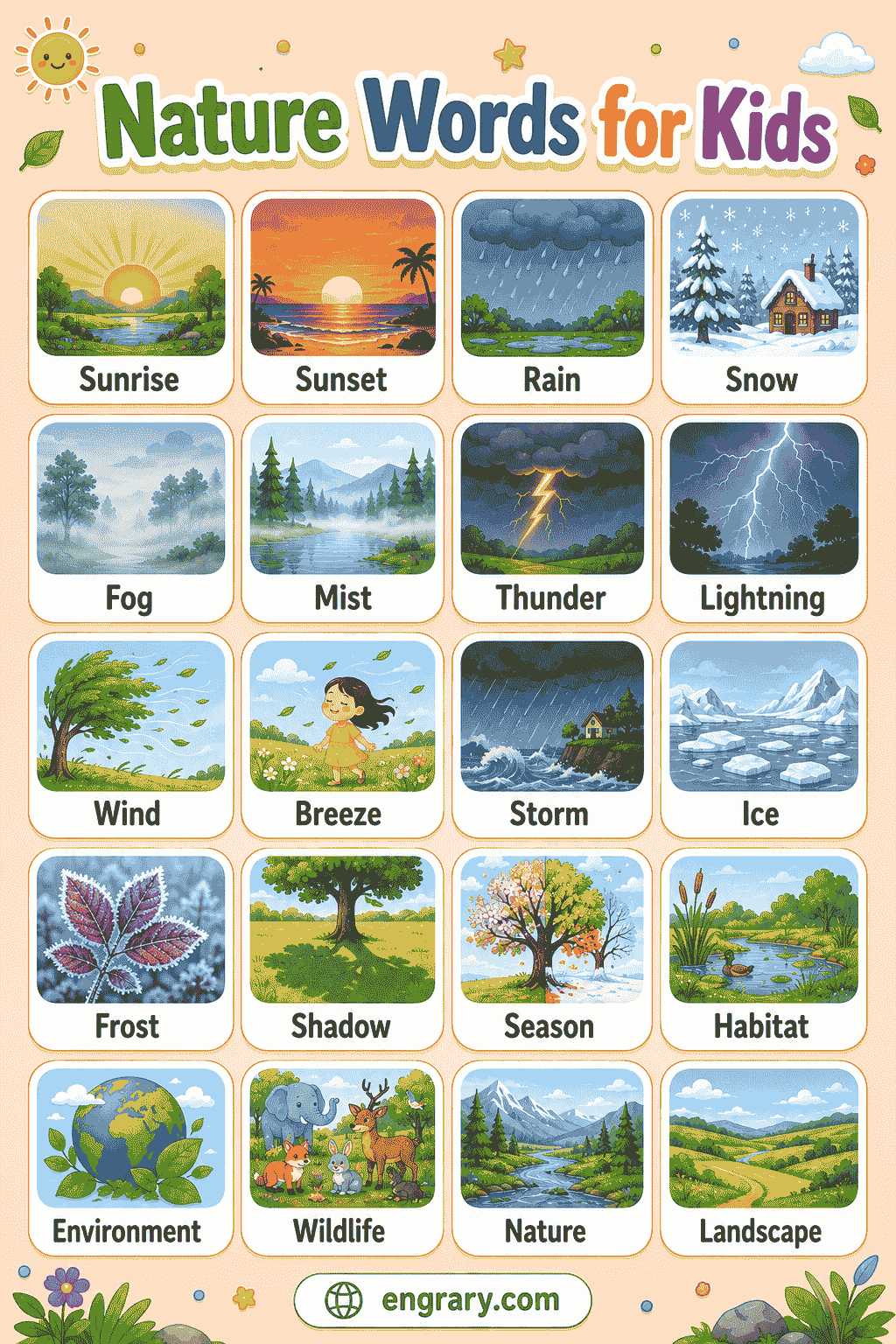
Children learn vocabulary better when they use words in real sentences. Nature sentences can be short, clear, and connected to things children can see.
Useful nature sentences:
- I see a tree.
- The flower is red.
- A leaf is green.
- The grass is soft.
- The sun is bright.
- The moon is in the sky.
- Rain falls from clouds.
- The river is long.
- The mountain is high.
- A bird is flying.
- A butterfly has colorful wings.
- A worm lives in soil.
Question practice:
- What do you see outside?
- Can you name one plant?
- Can you name one animal?
- What is in the sky?
- Is a rock living or nonliving?
- Is a chair natural or made by people?
Short answers children can use:
- I see grass.
- A tree is a plant.
- A bird is an animal.
- The sun is in the sky.
- A rock is nonliving.
- A chair is made by people.
Nature Picture Sorting and Outdoor Games
Nature words become easier when children sort, match, draw, and observe. These activities work well at home, in class, or during outdoor learning.
- Nature vs man-made sorting
Use picture cards. Ask children to sort natural things and things made by people. - Living and nonliving sort
Sort words like tree, bird, rock, rain, flower, and sand into living and nonliving groups. - Nature color hunt
Ask children to find something green, brown, blue, yellow, or white in nature. - Plant picture match
Match words like tree, leaf, flower, grass, and seed to pictures. - Sky drawing
Children draw the sun, moon, stars, clouds, or rainbow and label the picture. - Ground texture talk
Use safe examples like sand, soil, grass, or a smooth stone. Ask children to describe how each one feels. - Nature sentence cards
Use the sentence pattern “I see a ____.” Children pick a word card and complete the sentence. - Outdoor sound check
Ask children to listen for birds, wind, rain, leaves, or water, then name the sound they hear.
Common Nature Word Mix-Ups Kids Need Help With
Some nature words are close in meaning. A compact comparison helps children understand the difference.
| Mix-Up | Simple Difference |
|---|---|
| Tree vs Plant | A tree is one kind of plant. A plant can be small or large. |
| River vs Lake | A river flows. A lake stays in one place. |
| Hill vs Mountain | A mountain is usually much higher than a hill. |
| Pond vs Lake | A pond is usually smaller than a lake. |
| Soil vs Mud | Soil is earth. Mud is wet soil. |
| Rock vs Pebble | A pebble is a small rock. |
| Natural vs Man-Made | Natural things are part of nature. Man-made things are made by people. |
Quick examples:
- A river moves, but a lake stays in one place.
- Mud is wet soil.
- A pebble is a small rock.
- A tree is a plant, but not every plant is a tree.
Nature Words Practice Worksheet
Use this practice block for classwork, homework, or review.
A. Match the nature word
- Tree — ________
- River — ________
- Mountain — ________
- Sun — ________
- Bird — ________
Word bank: sky, animal, plant, water, land
B. Circle the nature word
- tree / chair / car
- river / road / bus
- flower / toy / desk
- cloud / phone / pencil
- bird / shoe / cup
C. Write living or nonliving
- Flower — ________
- Rock — ________
- Bird — ________
- Rain — ________
- Tree — ________
D. Complete the sentences
- I see a ________.
- The flower is ________.
- A bird can ________.
- The sun is ________.
- Rain falls from ________.
Answer key:
- A1: plant
- A2: water
- A3: land
- A4: sky
- A5: animal
- B1: tree
- B2: river
- B3: flower
- B4: cloud
- B5: bird
- C1: living
- C2: nonliving
- C3: living
- C4: nonliving
- C5: living
Nature Words Quiz for Kids
Try the questions first, then check the answers below.
- What is nature?
- Is a tree natural or made by people?
- What word means water that flows across land?
- What word means a very high part of land?
- What word means wet soil?
- What can grow from a seed?
- What nature word gives light during the day?
- What insect visits flowers?
- Is a toy part of nature or made by people?
- What is the difference between a river and a lake?
Answers:
- Nature means plants, animals, land, water, sky, and weather around us.
- Natural
- River
- Mountain
- Mud
- A plant
- Sun
- Bee
- Made by people
- A river flows, but a lake stays in one place.
FAQs
Nature words are words that name things in the natural world, such as tree, flower, river, mountain, sun, cloud, bird, and rain.
Easy nature words include tree, leaf, grass, flower, sun, moon, cloud, rain, rock, bird, and fish.
You can teach nature words by going outside, naming what children see, using picture cards, sorting natural and man-made things, drawing nature, and practicing sentences like “I see a tree.”
Nature includes things not made by people, such as trees, rivers, birds, rocks, and clouds. Man-made things are made by people, such as roads, toys, chairs, and buildings.
Yes. A plant is part of nature. Trees, flowers, grass, leaves, seeds, and roots are all connected to plants.
You May Also Like