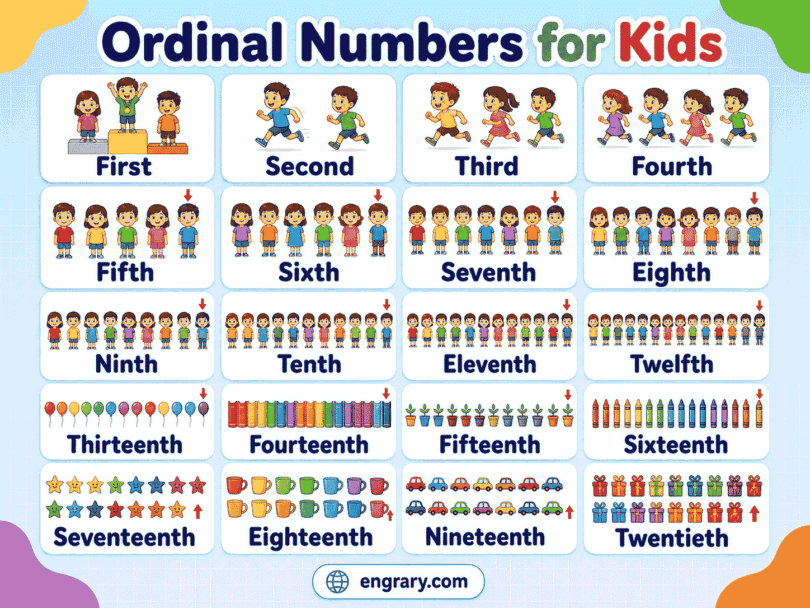
A child at the front of a line is first. The child behind them is second. The next child is third. These words do not tell how many children are in the line. They tell each child’s position.
Ordinal numbers help kids talk about order, place, and rank. Children use them when they line up toys, play a race game, read calendar dates, follow steps, or explain what happens first and last in a story.
Ordinal Numbers Show Position, Not Amount
Ordinal numbers tell the position or order of something. They answer “which one?” instead of “how many?”
For example, if four toy cars are in a row, the car at the front is the first car. The car behind it is the second car. The next car is the third car. The car at the end is the last car.
A simple way to explain this to kids is: counting numbers tell amount, but ordinal numbers tell position.
Simple examples:
- The first child is at the front.
- The second child stands after the first.
- The third runner is in third place.
- The last toy is at the end.
- The fourth step comes after the third step.
First, Second, Third, and Last in a Line
Ordinal numbers are easiest to teach with things in a row. Use toy cars, crayons, blocks, picture cards, or children standing in line.
Imagine four cars in a line:
- The red car is first.
- The blue car is second.
- The yellow car is third.
- The green car is last.
Position words also help children understand the line:
- First means at the front.
- Second means after the first.
- Third means after the second.
- Last means at the end.
For young children, start with only three or four objects. Too many objects can make the idea harder at first. After they understand first, second, third, and last, add more positions slowly.
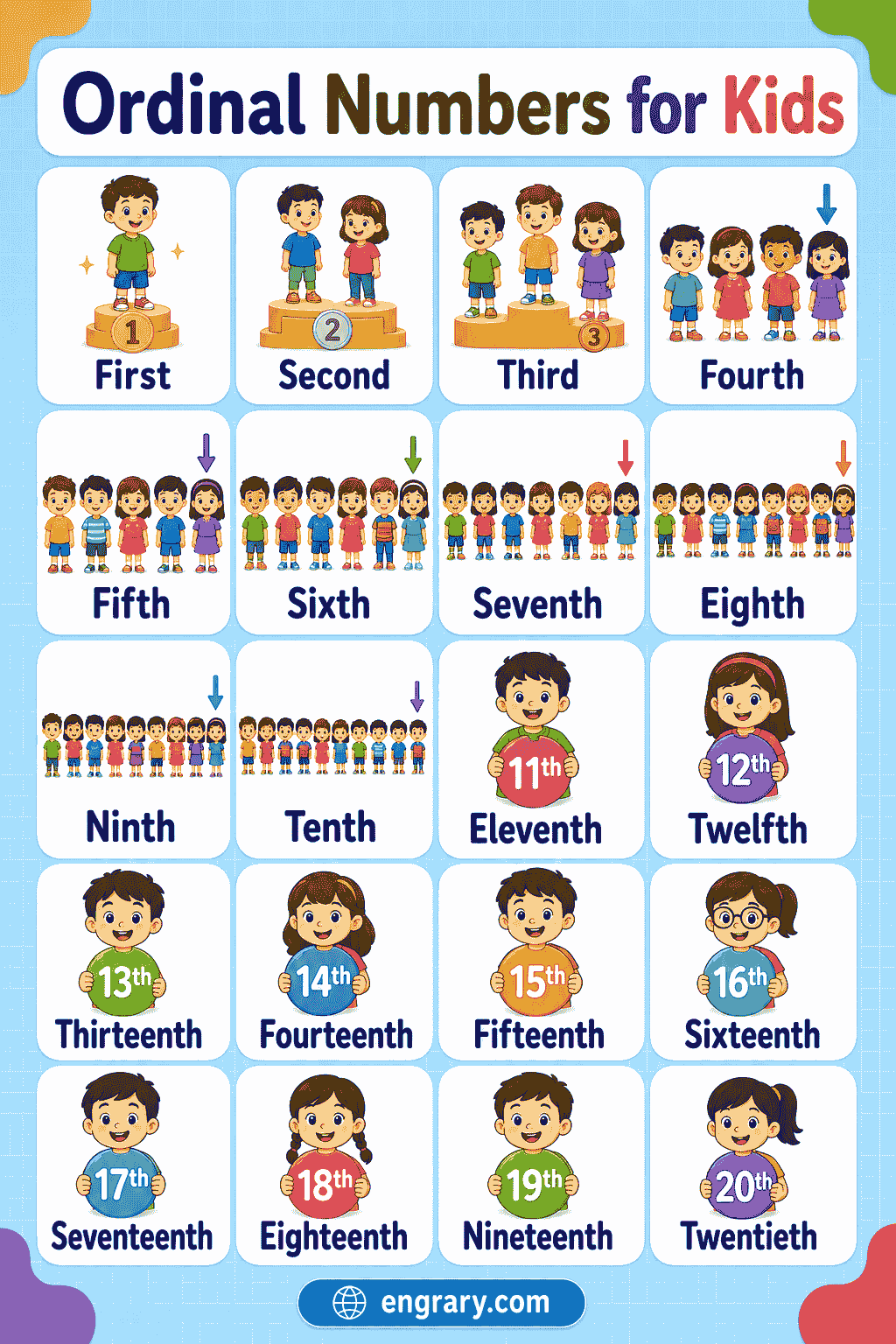
Ordinal Numbers in Races, Games, and Rankings
Kids often hear ordinal numbers during races, games, and competitions. These words tell who finished in each place, not only who won.
Common race and game words include:
- first place
- second place
- third place
- fourth place
- rank
- winner
- place
Examples:
- She came first in the race.
- He finished in second place.
- The blue team is in third place.
- The player ranked fourth.
- The winner came in first place.
In a classroom, children can use toy animals, cars, or runners on a track picture. Ask questions like:
- Who is first?
- Who is in second place?
- Which runner is third?
- Who came last?
Cardinal Numbers vs Ordinal Numbers
Kids often mix up cardinal and ordinal numbers because the words look related. A cardinal number tells how many. An ordinal number tells which position.
| Type | Tells | Example |
|---|---|---|
| Cardinal | how many | three cars |
| Ordinal | which position | third car |
In three cars, the word three tells the amount. In third car, the word third tells which car in a line or group.
More examples:
- five candles tells how many candles there are.
- fifth birthday tells which birthday it is.
- two runners tells how many runners there are.
- second runner tells the runner’s position.
This difference is important because three and third do not mean the same thing. One tells an amount, and the other tells a place.
Ordinal Numbers 1st to 10th
Ordinal numbers from 1st to 10th are the best starting point for kids. These forms appear in lines, turns, birthdays, steps, games, pages, and classroom activities.
Watch tricky spellings like fifth, eighth, and ninth as kids practice the chart.
| Number | Word | Example |
|---|---|---|
| 1st | first | first in line |
| 2nd | second | second turn |
| 3rd | third | third place |
| 4th | fourth | fourth step |
| 5th | fifth | fifth birthday |
| 6th | sixth | sixth card |
| 7th | seventh | seventh block |
| 8th | eighth | eighth crayon |
| 9th | ninth | ninth page |
| 10th | tenth | tenth toy |
Ordinal Numbers from 11th to 20th
After children understand 1st to 10th, they can practice ordinal numbers from 11th to 20th. These forms are common in dates, page numbers, class lists, contest places, and longer rows of objects.
- 11th = eleventh
- 12th = twelfth
- 13th = thirteenth
- 14th = fourteenth
- 15th = fifteenth
- 16th = sixteenth
- 17th = seventeenth
- 18th = eighteenth
- 19th = nineteenth
- 20th = twentieth
The words eleventh, twelfth, and twentieth often need more practice. Children may also need help seeing the difference between twelve and twelfth, or twenty and twentieth.

Writing Ordinal Numbers with st, nd, rd, and th
Ordinal numbers can be written as words or as number forms with small ending letters. These ending letters are called suffixes.
- 1st uses st.
- 2nd uses nd.
- 3rd uses rd.
- Most other ordinal numbers use th.
Examples:
- 1st = first
- 2nd = second
- 3rd = third
- 4th = fourth
- 5th = fifth
- 10th = tenth
Children see these forms often in dates, rankings, and worksheets. For example, May 1st, 2nd place, and 3rd prize all use ordinal number suffixes.
A simple teaching tip is to say the word first, then write the number form. For example, say third, then write 3rd.
Why 11th, 12th, and 13th Use th
Many children want to write 11st, 12nd, or 13rd because the numbers end in 1, 2, and 3. However, 11th, 12th, and 13th are special. They all use th.
| Wrong | Correct | Reminder |
|---|---|---|
| 11st | 11th | Eleven uses th. |
| 12nd | 12th | Twelve uses th. |
| 13rd | 13th | Thirteen uses th. |
After 20, the last part of the number usually helps:
- 21st uses st.
- 22nd uses nd.
- 23rd uses rd.
- 24th uses th.
- 31st uses st.
This rule is especially helpful for calendar dates because kids often see 21st, 22nd, 23rd, and 31st on calendars and worksheets.
Ordinal Numbers on Calendar Dates
Calendar dates are one of the most common places kids see ordinal numbers. Dates use forms like 1st, 2nd, 3rd, 4th, 11th, 21st, and 31st.
Examples:
- January 1st
- March 2nd
- April 3rd
- May 4th
- June 11th
- July 12th
- August 13th
- September 21st
- October 22nd
- November 23rd
- December 31st
Calendar practice helps children understand ordinal numbers in a real-life way. Instead of only memorizing a list, they can see how ordinal numbers show the position of a day in a month.
Helpful date questions:
- What date is the 1st?
- Which day is the 3rd?
- What comes after the 20th?
- Which date is written as 21st?
- Which month has a 31st day?
Position Words That Help Kids Understand Ordinals
Ordinal numbers work with position words. These words help children describe where something is in a line, row, list, story, or sequence.
If the red car moves from the front to the end, it is no longer first. It becomes last. This shows children that ordinal numbers depend on order.
Useful position words include:
- front
- behind
- before
- after
- between
- next
- last
- place
- position
- order
Examples:
- The first child is at the front.
- The second child is behind the first child.
- The third card comes after the second card.
- The fifth block is between the fourth and sixth blocks.
- The last toy is at the end of the row.
- The next player comes after the first player.
Ordinal Numbers in Steps and Story Order
Ordinal numbers are useful when children follow steps, explain routines, or retell a story. They help kids describe what happens at the beginning, what comes next, and what happens at the end.
Routine examples
- The first step is wash your hands.
- The second step is dry them.
- The third step is sit down.
- The fourth step is open your book.
- The last step is clean up.
Story examples
- The first event happens at the beginning.
- The second event comes after that.
- The third event happens next.
- The fourth event may show a problem.
- The last event happens at the end.
Direction examples
- Put the first card on the table.
- Place the second card beside it.
- Move the third card after the blue card.
- Put the last card at the end.
Ordinal Number Mix-Ups Kids Should Practice
Some ordinal words look or sound close to counting words. Children may know the amount word but still need practice with the position word.
| Mix-Up | Difference | Example |
|---|---|---|
| one / first | amount vs position | one toy / first toy |
| two / second | amount vs position | two cars / second car |
| three / third | amount vs position | three runners / third runner |
| five / fifth | count vs place | five candles / fifth birthday |
| eight / eighth | count vs place | eight blocks / eighth block |
| twelve / twelfth | count vs place | twelve months / twelfth month |
The pair three / third is one of the most important. Three means an amount, but third means a position.
The pair twelve / twelfth also needs practice because the spelling changes. Children may write “twelveth,” but the correct word is twelfth.

Line-Up Activity for Ordinal Numbers
This activity helps children see ordinal numbers instead of only memorizing them. Use toy cars, crayons, blocks, picture cards, animal toys, or classroom objects.
For beginners, use 5 objects. For advanced practice, use 10 objects. For extra practice, let the child move one object to a new place, then ask how its position changed.
Activity flow:
- Place 5 toy cars in a row.
- Ask which car is first.
- Ask which car is second.
- Ask which car is third.
- Ask which car is last.
- Move one car and ask again.
- Repeat with crayons, blocks, or picture cards.
Helpful teacher questions:
- Which object is at the front?
- Which object is behind the first one?
- Which object comes after the second one?
- Which object is between the second and fourth objects?
- Which object is last?
FAQs
Ordinal numbers tell the position or order of something. Examples include first, second, third, fourth, and fifth. Kids use ordinal numbers to talk about lines, races, dates, turns, steps, and story order.
Cardinal numbers tell how many, such as three apples. Ordinal numbers tell position, such as third apple. A simple way to remember it is: cardinal numbers count, while ordinal numbers show order.
Kids should learn first, second, third, and last first. After that, they can practice fourth, fifth, sixth, seventh, eighth, ninth, and tenth.
Ordinal numbers can be written as words or with number suffixes. For example, first = 1st, second = 2nd, third = 3rd, and fourth = 4th. Most ordinal numbers use th, but 1st, 2nd, and 3rd are special.
Teach ordinal numbers with real objects in a row. Line up toys, cars, crayons, or picture cards, then ask which object is first, second, third, and last.
You May Also Like