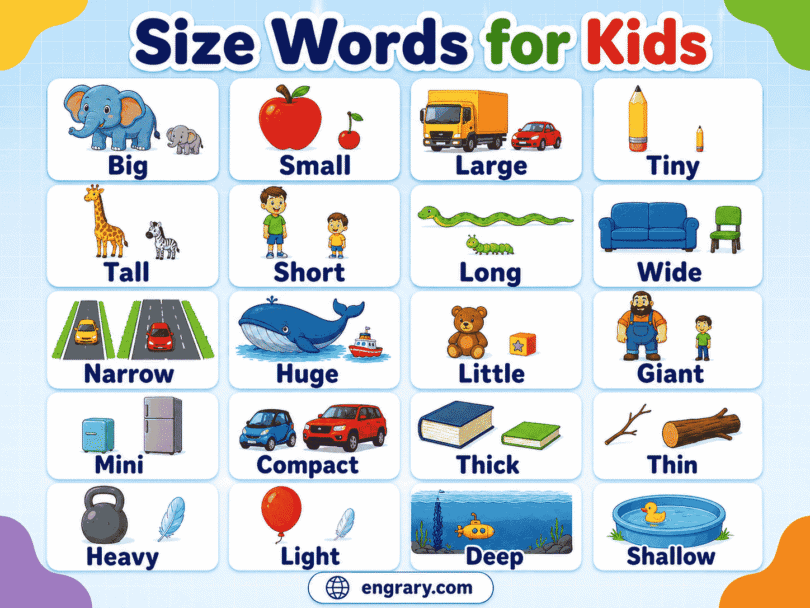
Two balls sit side by side on the table: one looks big, and the other looks small. A child can point to a tree and call it tall, hold a pencil and call it short, or lift a bag and say it feels heavy.
Size words help kids describe what they see, touch, compare, and carry. Children use these words while playing with toys, sorting classroom objects, looking at pictures, reading books, and talking about the world around them.
Size Words Tell How Something Looks or Feels in Size
Size words describe how something looks or feels in size. They help children answer questions like How big is it?, How tall is it?, How long is it?, How wide is it?, or Is it heavy or light?
A child may say big for a tall tree, a long rope, and a heavy bag at first. Later, they learn that each object needs a more exact word. A tree may be tall, a rope may be long, a road may be wide, and a backpack may be heavy.
Size words are different from color, shape, and number words. Big, small, tall, and long describe size, while red, round, and three describe other things.
Simple examples:
- A ball can be big or small.
- A tree can be tall.
- A rope can be long.
- A road can be wide.
- A book can be thick.
- A backpack can be heavy.
- A feather can be light.
Big, Small, Large, and Little
The first size words many children learn are big and small. These words are easy to show because kids can compare two objects side by side.
Big means something has a large size. Small means something has a little size. Large is close to big, while little is close to small.
Common examples:
- big elephant
- small mouse
- large box
- little toy
- big ball
- small cup
- large bag
- little spoon
- medium-sized basket
The word medium-sized is useful when something is not very big and not very small. For example, a child may see three boxes and say: small box, medium-sized box, and large box.
Short practice sentences:
- I have a big ball.
- She has a small cup.
- The large box is on the floor.
- He found a little toy.
- This basket is medium-sized.
Tiny, Huge, and Other Strong Size Words
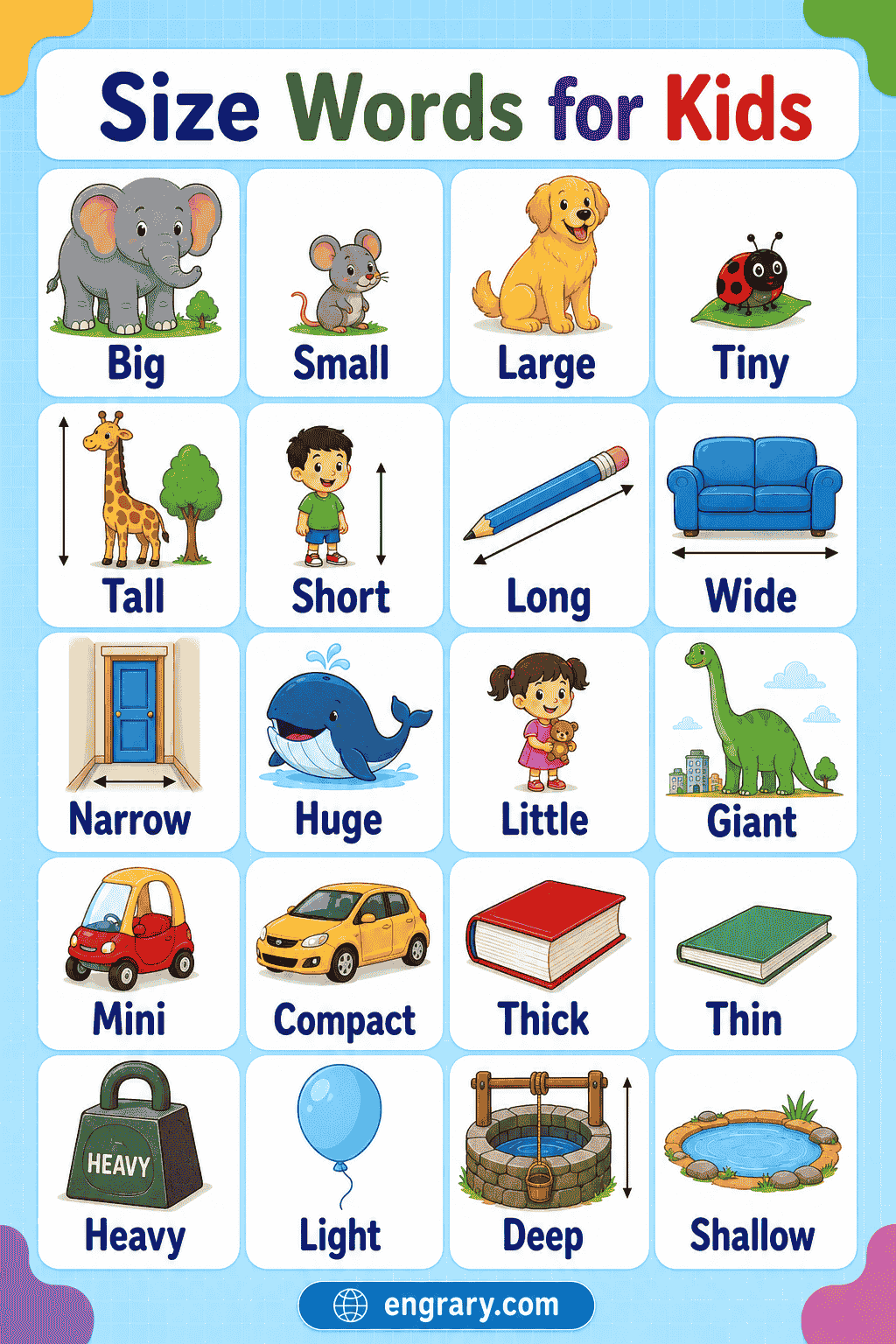
After kids understand big and small, they can learn stronger size words. These words help children describe size more clearly when big or small is not exact enough.
Tiny means very small. Huge, giant, enormous, and massive mean very big.
Useful strong size words:
- tiny
- huge
- giant
- enormous
- massive
- mini
- miniature
Examples:
- tiny ant
- huge whale
- giant pumpkin
- enormous dinosaur
- massive truck
- mini cupcake
- miniature car
Practice with familiar objects:
- A seed can be tiny.
- A whale can be huge.
- A pumpkin can be giant.
- A toy car can be miniature.
- A truck can be massive.
Tall and Short for Height
Tall and short describe height. Height means how high something goes from bottom to top.
Use tall for things that go up high, such as trees, buildings, giraffes, towers, or people. Use short for things that do not go up very high.
For children, height is easiest to understand with standing objects. Put a tall bottle next to a short cup, or place a tall block tower beside a short block tower.
Examples:
- tall tree
- short flower
- tall building
- short chair
- tall giraffe
- short stool
- tall tower
- short plant
Try these short sentences:
- The tree is tall.
- The flower is short.
- A giraffe has a tall neck.
- The stool is short.
- That building is very tall.
Long and Short for Length
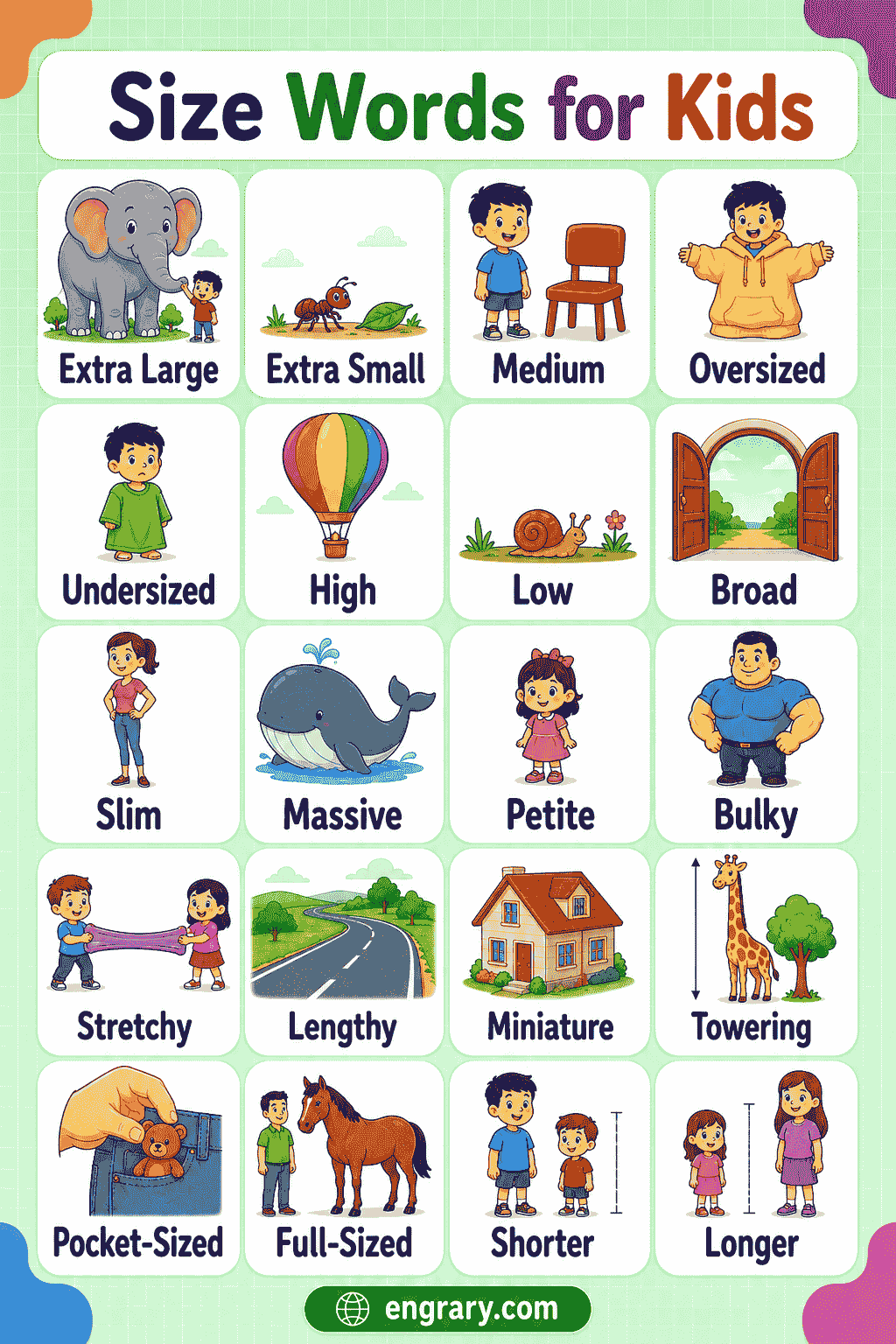
Long and short can describe length. Length means how far something stretches from one end to the other.
The word short can describe both height and length. A short flower is low in height, while a short pencil is small from one end to the other.
Use long for objects like ropes, roads, pencils, snakes, ribbons, and lines. Use short when the object does not stretch far from end to end.
Examples:
- long rope
- short pencil
- long snake
- short crayon
- long road
- short line
- long ribbon
- short stick
Practice sentences:
- The rope is long.
- My pencil is short.
- The snake is long.
- This crayon is short.
- We walked on a long road.
When to Use Tall Instead of Long
Kids often mix up tall and long. Both words describe size, but they are used in different ways.
| Word | Use For | Example |
|---|---|---|
| tall | height going up | tall tree |
| long | length from end to end | long rope |
Use tall when something goes up. Use long when something stretches across, forward, or from one end to another.
Examples:
- A building is tall.
- A pencil can be long.
- A giraffe is tall.
- A road is long.
- A tower is tall.
- A ribbon can be long.
Wide and Narrow for Side-to-Side Size
Wide and narrow describe side-to-side space.
When something is wide, it has more space from one side to the other. Something narrow has less side-to-side space. Children can see the difference by comparing a wide road with a narrow path, or a wide table with a narrow shelf.
Examples:
- wide road
- narrow path
- wide door
- narrow bridge
- wide table
- narrow shelf
- wide box
- narrow hallway
Use the words in context:
- The road is wide.
- The path is narrow.
- This door is wide.
- The bridge is narrow.
- We used a wide table.
- The shelf is narrow.
Thick and Thin for Depth and Layers
Thick and thin describe how much depth, layer, or body something has.
A thick object is not thin. A thin object is not thick. Children can feel this difference with objects like books, paper, blankets, ribbons, ropes, and strings.
Examples:
- thick book
- thin paper
- thick blanket
- thin ribbon
- thick rope
- thin string
- thick notebook
- thin slice
Useful sentences:
- This book is thick.
- The paper is thin.
- The blanket feels thick.
- The ribbon is thin.
- The rope is thick.
- The string is thin.
Heavy and Light for Weight
Heavy and light describe weight. Weight means how hard or easy something is to lift.
A heavy object is hard to lift. A light object is easy to lift. These words are important because size and weight are not always the same.
Important teaching point:
- A small rock can be heavy.
- A big balloon can be light.
Examples:
- heavy backpack
- light feather
- heavy rock
- light balloon
- heavy suitcase
- light paper bag
- heavy box
- light leaf
Practice sentences:
- My backpack is heavy.
- The feather is light.
- This rock feels heavy.
- The balloon is light.
- The suitcase is too heavy to carry.
Size Words Kids Often Mix Up
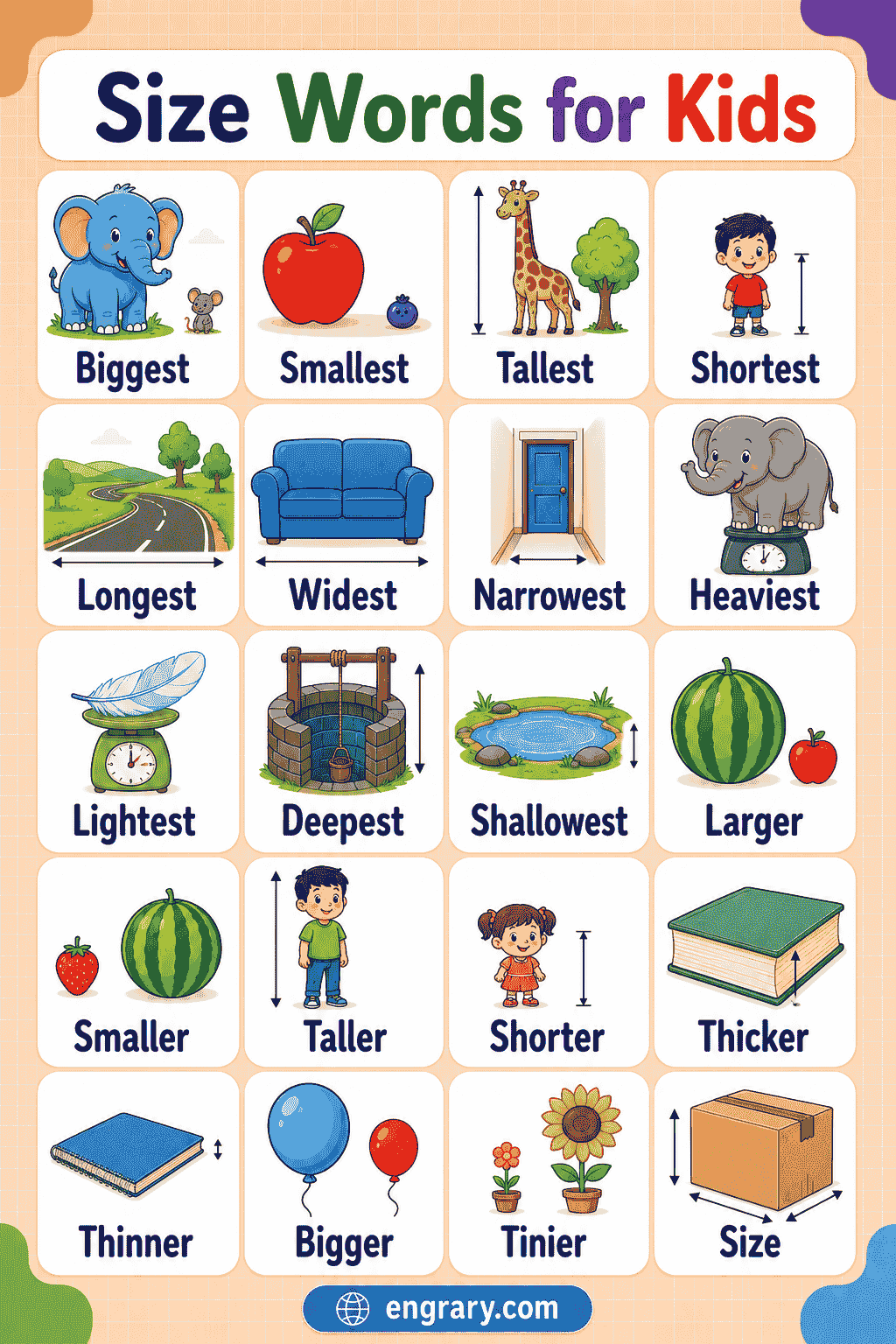
Some size words are close in meaning, so children may use one word when another word is more exact. These mix-ups are normal, especially when kids are still learning how to describe objects.
| Mix-Up | Difference | Example |
|---|---|---|
| big / heavy | size vs weight | big balloon / heavy rock |
| tall / long | height vs length | tall tree / long rope |
| small / short | general size vs height or length | small cup / short pencil |
| wide / thick | side-to-side vs depth | wide road / thick book |
| tiny / small | very small vs small | tiny ant / small toy |
Helpful reminders:
- Use big for size you can see.
- Choose heavy for something hard to lift.
- Use tall when something goes up.
- Choose long when something stretches from end to end.
- Use tiny when something is very small.
Everyday Objects Kids Can Describe by Size
Use examples children can see, touch, lift, or compare. Toys, classroom objects, animals, books, bags, and home items all work well for size-word practice.
Toys and classroom objects
- big ball
- small cup
- long pencil
- short crayon
Animals and nature
- tiny ant
- huge whale
- tall tree
- short flower
Home and school items
- thick book
- thin notebook
- heavy backpack
- light feather
Outdoor objects
- wide road
- narrow path
- tall tower
- long bridge
How to Teach Size Words with Real Objects
Real objects are better than only memorizing a word list. Children understand size words more easily when they can see, touch, compare, or lift the objects.
Use this simple activity:
- Show two objects.
- Ask what the child notices.
- Say the size word clearly.
- Ask the child to repeat it.
- Make a short sentence.
- Switch objects and compare again.
Example practice:
- Hold a big ball and a small ball.
- Compare a long pencil and a short pencil.
- Show a thick book and a thin notebook.
- Lift a heavy bag and a light feather.
- Place a wide box beside a narrow box.
- Compare a tall bottle with a short cup.
Helpful teacher questions:
- Which one is big?
- Which one is small?
- Is this object tall or short?
- Which pencil is longer?
- Which book is thicker?
- Which bag feels heavier?
- Which object is lighter?
FAQs
Size words are words children use to describe how big, small, tall, short, long, wide, thick, heavy, or light something is. Examples include big, small, tall, short, long, wide, narrow, thick, thin, heavy, and light.
Kids should start with simple size words like big, small, tall, short, long, heavy, and light. After that, they can learn more exact words like tiny, huge, wide, narrow, thick, and thin.
Tall describes height going up, such as a tall tree or tall building. Long describes length from one end to the other, such as a long rope, long pencil, or long road.
Heavy and light describe weight, so they are often taught with size words. A heavy object is hard to lift, while a light object is easy to lift. A big balloon can still be light, and a small rock can still be heavy.
Teach size words with real objects. Show a big ball and a small ball, compare a long pencil and a short pencil, or let the child lift a heavy bag and a light feather. Ask the child to say the size word and use it in a short sentence.
You May Also Like